English

Giuseppe Piazzi
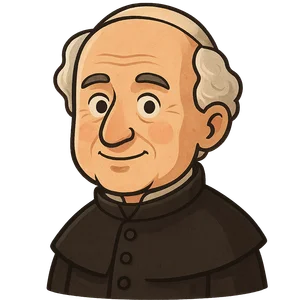
Giuseppe Piazzi was an Italian Catholic priest, mathematician…
Reads at Grades 3–5 Listens at Grades 1–5
Print & create
Answer keys·No prep·Free with an account
28 worksheets · answer keys · full story · quiz · Ages 8-10 · CEFR B1
Plus adds 244,000+ more stories in 27 languages, audio for every one, and printables for all of them.
Just want Giuseppe Piazzi?
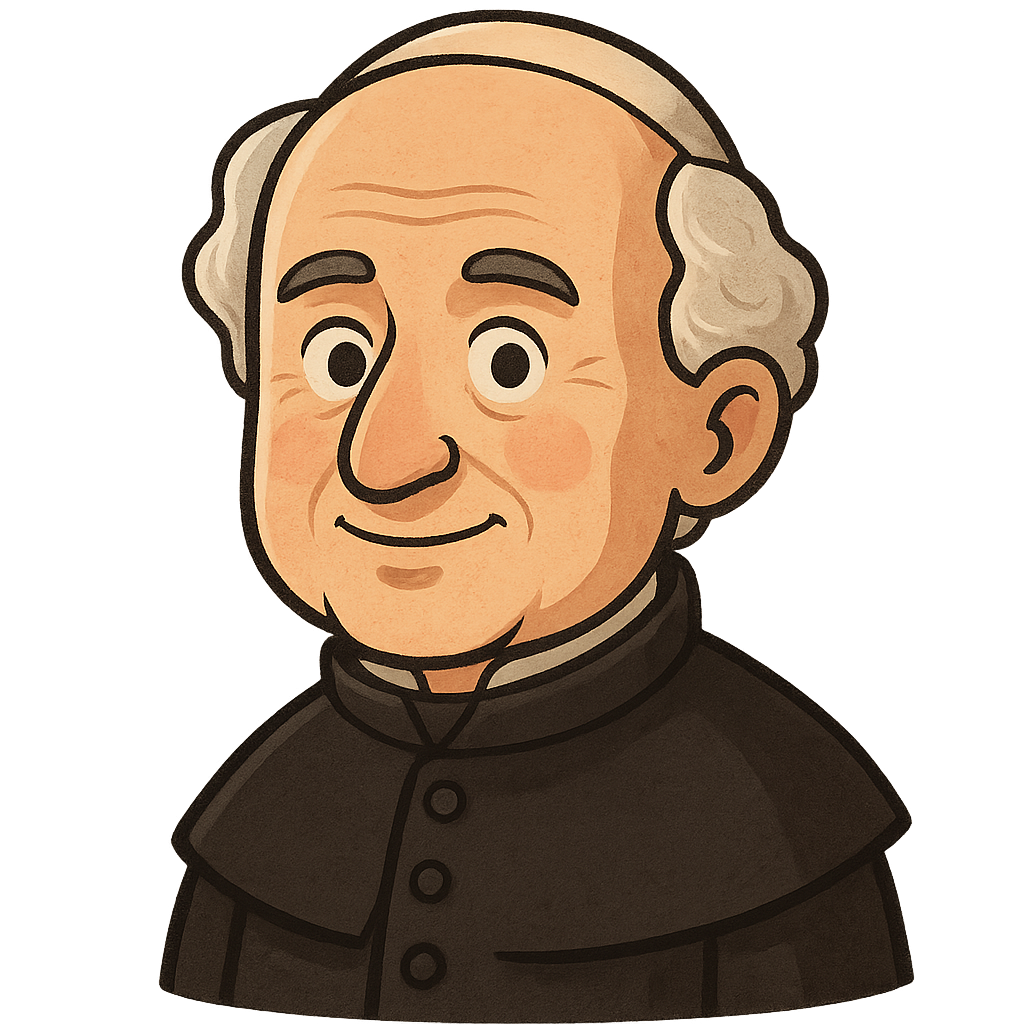
Hello, my name is Giuseppe Piazzi, and I am an astronomer who found a new world hidden in our night sky. I was born on July 16th, 1746, in a small town in the beautiful mountains of Italy. From a young age, I was filled with curiosity. I absolutely loved learning, especially mathematics, because numbers helped explain how the world worked. I wanted to spend my life studying and teaching. When I was a young man, I joined a religious group called the Theatines. This was a wonderful choice for me because it gave me the chance to study at the best schools and dedicate my life to science and education. It was the perfect path for a boy who was always looking up at the stars and wondering what was out there.
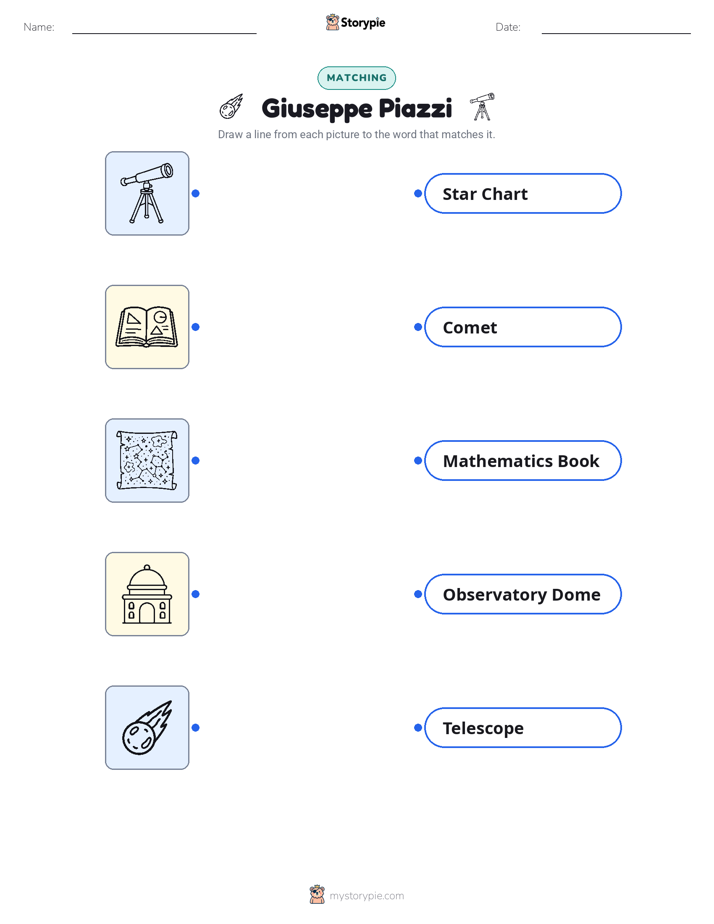
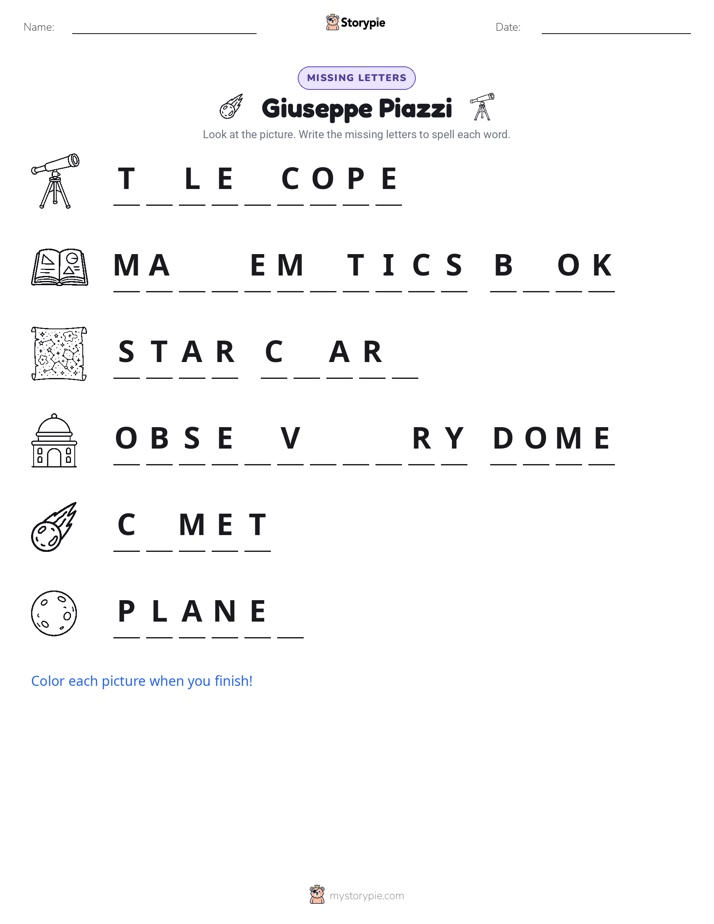
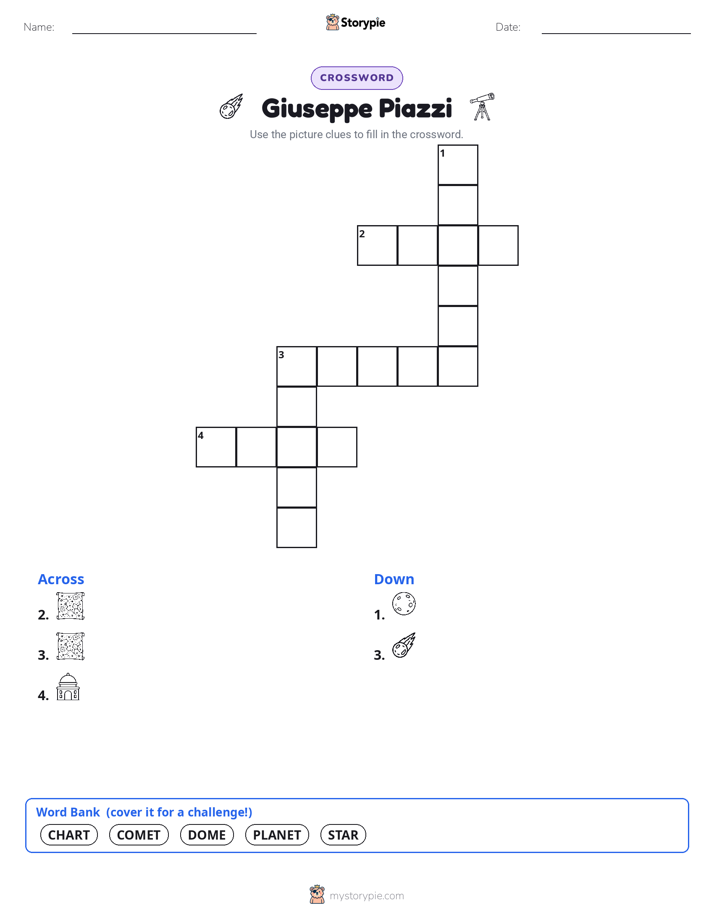
My love for the stars led me to become a professor of astronomy. In 1787, I was offered a fantastic job at the University of Palermo, a city on the island of Sicily. It was there that my biggest dream began to take shape. I was given the incredible opportunity to build a brand-new observatory. An observatory is a special building with powerful telescopes designed for looking deep into space. I was able to get a powerful new telescope that let me see the stars more clearly than anyone had ever seen them from that part of the world. My most important job was to begin a huge project: creating a very precise map of the stars. I spent many years carefully measuring the exact position of every star I could see, creating a giant, accurate guide to the heavens for all the astronomers who would come after me.
Giuseppe Piazzi: The Star Mapper
Hello, my name is Giuseppe Piazzi, and I am an astronomer who found a new world hidden in our night sky. I was born on July 16th, 1746, in a small town in the beautiful mountains of Italy. From a young age, I was filled with curiosity. I absolutely loved learning, especially mathematics, because numbers helped explain how the world worked. I wanted to spend my life studying and teaching. When I was a young man, I joined a religious group called the Theatines. This was a wonderful choice for me because it gave me the chance to study at the best schools and dedicate my life to science and education. It was the perfect path for a boy who was always looking up at the stars and wondering what was out there.
My love for the stars led me to become a professor of astronomy. In 1787, I was offered a fantastic job at the University of Palermo, a city on the island of Sicily. It was there that my biggest dream began to take shape. I was given the incredible opportunity to build a brand-new observatory. An observatory is a special building with powerful telescopes designed for looking deep into space. I was able to get a powerful new telescope that let me see the stars more clearly than anyone had ever seen them from that part of the world. My most important job was to begin a huge project: creating a very precise map of the stars. I spent many years carefully measuring the exact position of every star I could see, creating a giant, accurate guide to the heavens for all the astronomers who would come after me.
My greatest discovery happened on a very special night, the first night of a new century. On January 1st, 1801, I was in my observatory, working on my star map. I was focused on a part of the sky called the constellation Taurus, which looks like a bull. As I looked through my telescope, I saw a tiny point of light that I had never seen before. I checked all of my old charts and maps, but it wasn't on any of them. This was very strange. I knew I had to watch it closely. For the next several nights, I pointed my telescope to that same spot. To my amazement, the tiny light had moved. Real stars are so far away that they don't seem to move from our point of view, but this little light was slowly traveling across the sky. I knew right away that I had not found a star. I had found something new and special within our own solar system.
I was filled with questions about what this new object could be. At first, I thought it might be a comet. Comets are balls of ice and dust that travel through space, and they often have a fuzzy tail of gas behind them. But when I looked closely at my discovery, it was a sharp point of light with no tail at all. The more I studied its path across the sky, the more I became convinced it was not a comet. I believed I had found a new planet orbiting the sun in the large space between Mars and Jupiter. I was so excited by this idea that I gave it a name: Ceres. I announced my discovery to other astronomers, but soon I had a problem. As Ceres continued its orbit, it moved too close to the sun, and the bright glare made it impossible for me to see it anymore. I had lost it. But I had kept very careful notes of all my observations. I shared my notes, and a brilliant mathematician named Carl Friedrich Gauss used them to calculate exactly where Ceres would appear again. Thanks to my data, other astronomers were able to find it once more.
My discovery, Ceres, turned out to be something amazing. It was the very first object of its kind ever seen. We now call these objects asteroids, and Ceres was the first one ever found. Today, scientists have a special name for it; they call Ceres a 'dwarf planet' because it is round like a planet but much smaller. It is the biggest object in the asteroid belt between Mars and Jupiter. My work creating detailed star maps also became very important and helped many other astronomers with their own discoveries. I lived to be 80 years old, passing away in 1826. I was happy knowing that my curiosity and careful work helped people see our solar system in a whole new way, reminding us that there are always new wonders to discover.
Wow facts
About
Giuseppe Piazzi was an Italian Catholic priest, mathematician, and astronomer who discovered the dwarf planet Ceres on January 1st, 1801.
Take a Quiz
Question 1 of 5
In the story, I said I was carefully 'mapping' the stars. What does 'mapping' mean in this sentence?
Explore next





Want to do even more?
Go beyond exploring. Unlock tools that turn every story into real learning.

Storypie Plus for families
Full stories, quizzes, and printables. Nights and car rides, sorted.
- Unlimited audio stories
- Create Mode: your child stars in the story
- Offline downloads
- Printable worksheets & coloring pages

Why Storypie for Schools
Students engaged. Prep in seconds. Evenings back to you.
- Worksheets & Quizzes
- Classroom Management
- Formative Assessment
- Custom Curriculum & Lesson Plans
- 27 Languages

Why Storypie for Homeschool
Curriculum done. They'll ask for more. Hours back in your day.
- Worksheet Generator
- First-Person Audio Stories
- Built-in Comprehension Quizzes
- Custom Curriculum & Lesson Plans
- Print & Go Activities