English

Guglielmo Marconi
Guglielmo Marconi was an Italian inventor and electrical engineer…
Reads at Grades 6–8 Listens at Grades 4–8
Print & create
Answer keys·No prep·Free with an account
28 worksheets · answer keys · full story · quiz · Ages 10-12 · CEFR B2
Plus adds 279,000+ more stories in 27 languages, audio for every one, and printables for all of them.
Just want Guglielmo Marconi?
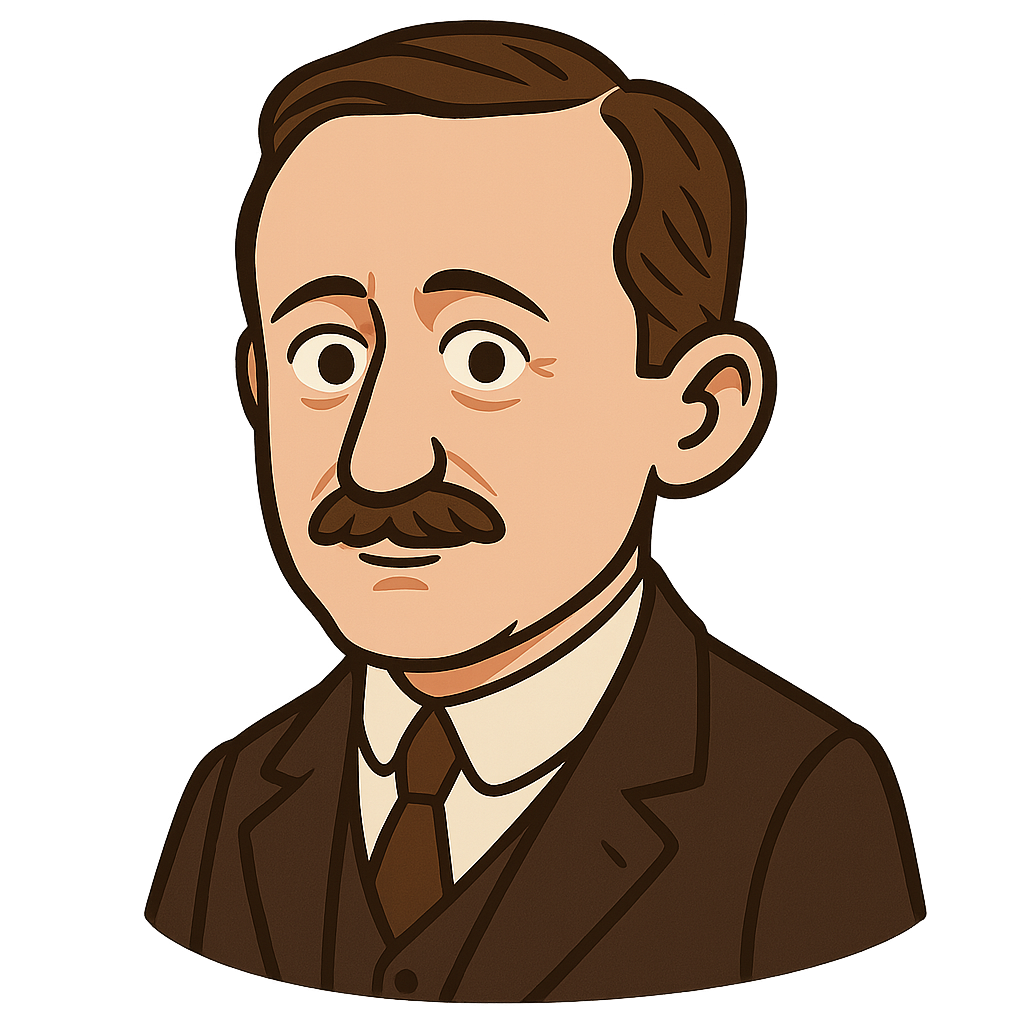
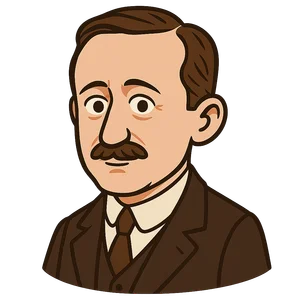
Hello, my name is Guglielmo Marconi, and I am known for developing a way to send messages through the air using invisible waves. I was born in Bologna, Italy, on April 25th, 1874. Growing up, I wasn't a typical student who excelled in school, but I had an immense curiosity about the world, particularly the science of electricity. My life's direction changed around 1894, when I was twenty years old. I was reading about the work of a German physicist, Heinrich Hertz, who had successfully proven the existence of invisible electromagnetic waves. As I learned about his discoveries, a powerful idea formed in my mind: what if these waves could be used to send signals over great distances without any wires? I imagined a 'wireless telegraph,' and this idea would soon become my life's passion.
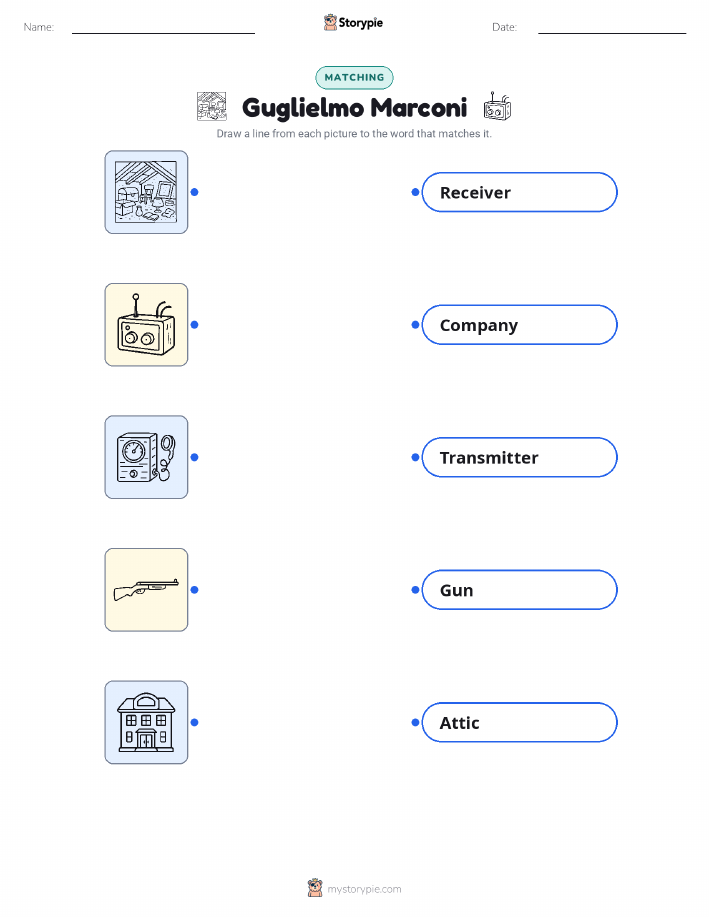
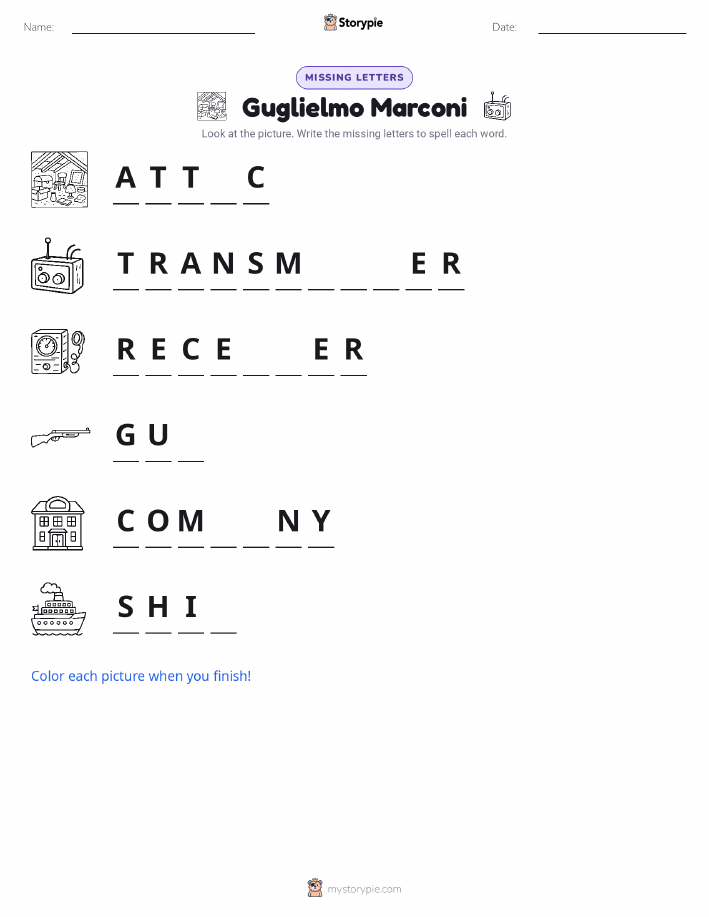
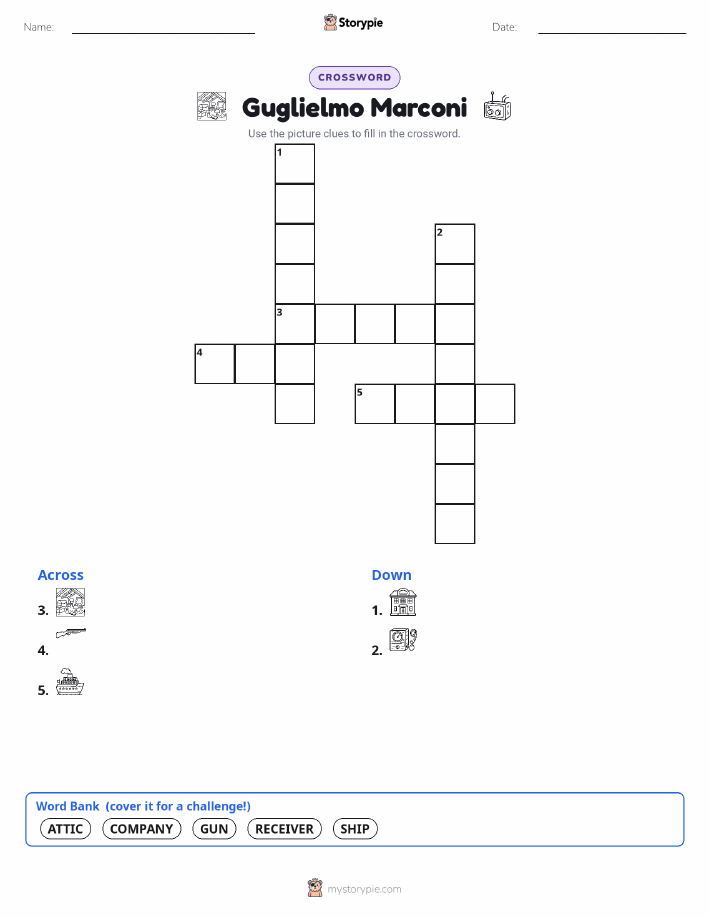
I immediately set to work, converting the attic of my family home, Villa Griffone, into my own personal laboratory. My mother was my greatest supporter, always encouraging my scientific pursuits even when others thought my ideas were strange or impossible. I spent countless hours, often working day and night, building my own transmitters to create the waves and receivers to detect them. In 1895, all my hard work led to my first significant breakthrough. I set up a transmitter in the attic and asked my brother, Alfonso, to take a receiver to the far side of a hill on our property, about a mile and a half away. He carried a rifle with him for our experiment. The instructions were simple: if he received the signal I sent, he was to fire the gun. I carefully tapped out the Morse code for the letter 'S.' After a few tense moments of waiting, the sound of a gunshot echoed across the fields. It was a moment of pure triumph; I had proven that my wireless telegraph could work.
Guglielmo Marconi
Hello, my name is Guglielmo Marconi, and I am known for developing a way to send messages through the air using invisible waves. I was born in Bologna, Italy, on April 25th, 1874. Growing up, I wasn't a typical student who excelled in school, but I had an immense curiosity about the world, particularly the science of electricity. My life's direction changed around 1894, when I was twenty years old. I was reading about the work of a German physicist, Heinrich Hertz, who had successfully proven the existence of invisible electromagnetic waves. As I learned about his discoveries, a powerful idea formed in my mind: what if these waves could be used to send signals over great distances without any wires? I imagined a 'wireless telegraph,' and this idea would soon become my life's passion.
I immediately set to work, converting the attic of my family home, Villa Griffone, into my own personal laboratory. My mother was my greatest supporter, always encouraging my scientific pursuits even when others thought my ideas were strange or impossible. I spent countless hours, often working day and night, building my own transmitters to create the waves and receivers to detect them. In 1895, all my hard work led to my first significant breakthrough. I set up a transmitter in the attic and asked my brother, Alfonso, to take a receiver to the far side of a hill on our property, about a mile and a half away. He carried a rifle with him for our experiment. The instructions were simple: if he received the signal I sent, he was to fire the gun. I carefully tapped out the Morse code for the letter 'S.' After a few tense moments of waiting, the sound of a gunshot echoed across the fields. It was a moment of pure triumph; I had proven that my wireless telegraph could work.
After my success at home, I tried to present my invention to the Italian government, but they were not interested. Believing in my work, my mother and I traveled to England in 1896, where I found a more receptive audience for my ideas. I applied for the world's first patent for a system of wireless telegraphy, which was granted on June 2nd, 1896. The following year, in 1897, I established my own company to continue developing the technology. We constantly pushed the boundaries of what was possible, first by sending signals across the Bristol Channel, and then in 1899, sending a message all the way across the English Channel to France. My ultimate goal, however, was to bridge the vast Atlantic Ocean. Many leading scientists declared this impossible, believing the curve of the Earth would block the signals. But I was determined to try. On December 12th, 1901, I stood on Signal Hill in Newfoundland, Canada, with a receiver pressed to my ear. All the way from Cornwall, England, over 2,000 miles away, a signal was sent. I listened intently and heard three faint clicks—the letter 'S' in Morse code. I had proven them all wrong.
My invention began to change the world very quickly. It was especially important for ships at sea, which were often completely cut off from the rest of the world once they sailed out of sight of land. The true life-saving power of wireless communication was demonstrated to the entire world during a terrible disaster. On April 15th, 1912, the magnificent passenger ship RMS Titanic struck an iceberg and began to sink in the icy Atlantic. The ship's wireless operators used my equipment to frantically send out distress signals. A nearby ship, the Carpathia, received the call for help and immediately sailed to the rescue. Because of that wireless message, over 700 people were saved who would have otherwise been lost. In the aftermath of this tragedy, new laws were passed requiring wireless sets on all passenger ships. For my contributions to this new field of communication, I was deeply honored to share the Nobel Prize in Physics in 1909 with Karl Ferdinand Braun, another scientist who made crucial advancements in radio technology.
I spent the rest of my life continuing my work, exploring how even shorter radio waves could be used for more advanced forms of communication. I lived to be 63 years old. Today, people often call me the 'Father of Radio,' and it fills me with pride to know my work had such an impact. My dream was to harness the invisible forces of nature to connect people, no matter the distance between them. Every time you listen to a radio broadcast, make a call on a cell phone, or connect a device to Wi-Fi, you are experiencing the legacy of those first experiments I conducted in my family's attic. I helped give the world a voice that could travel across oceans and continents, and that voice continues to connect us all.
Wow facts
About
Guglielmo Marconi was an Italian inventor and electrical engineer, known for his pioneering work on long-distance radio transmission and for his development of Marconi's law and a radio telegraph system.
Take a Quiz
Question 1 of 5
In your own words, describe the key experiment Marconi conducted in 1895 at his family home.
Explore next




Want to do even more?
Go beyond exploring. Unlock tools that turn every story into real learning.

Storypie Plus for families
Full stories, quizzes, and printables. Nights and car rides, sorted.
- Unlimited audio stories
- Create Mode: your child stars in the story
- Offline downloads
- Printable worksheets & coloring pages

Why Storypie for Schools
Students engaged. Prep in seconds. Evenings back to you.
- Worksheets & Quizzes
- Classroom Management
- Formative Assessment
- Custom Curriculum & Lesson Plans
- 27 Languages

Why Storypie for Homeschool
Curriculum done. They'll ask for more. Hours back in your day.
- Worksheet Generator
- First-Person Audio Stories
- Built-in Comprehension Quizzes
- Custom Curriculum & Lesson Plans
- Print & Go Activities