English

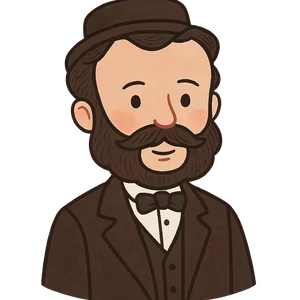
Henry Dunant
A Swiss businessman, social activist, and humanitarian who witnessed the Battle of Solferino in 1859.
Reads at Grades 6–8 Listens at Grades 4–8
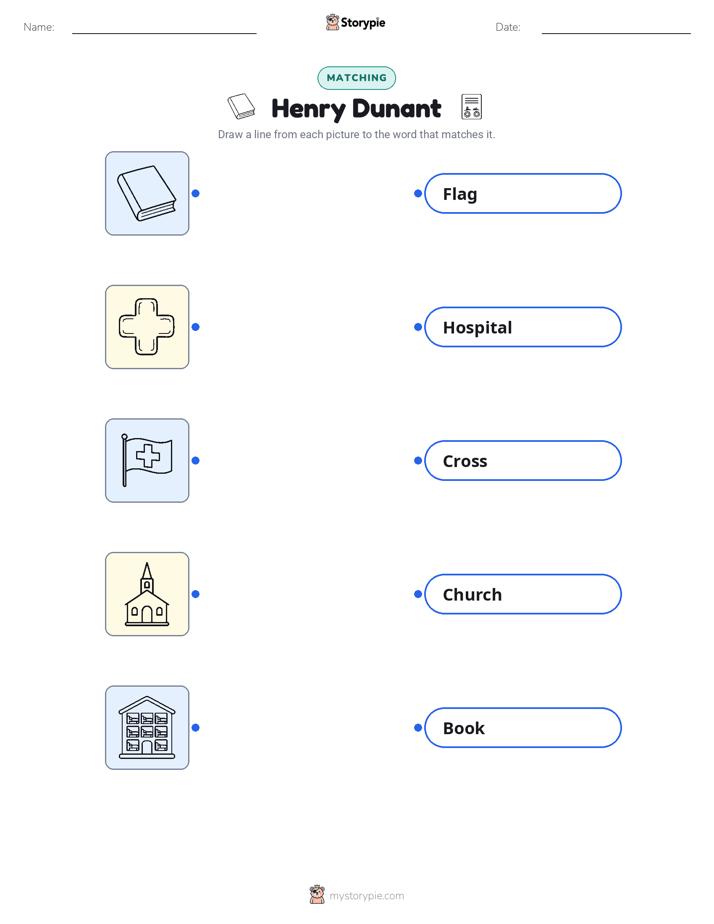
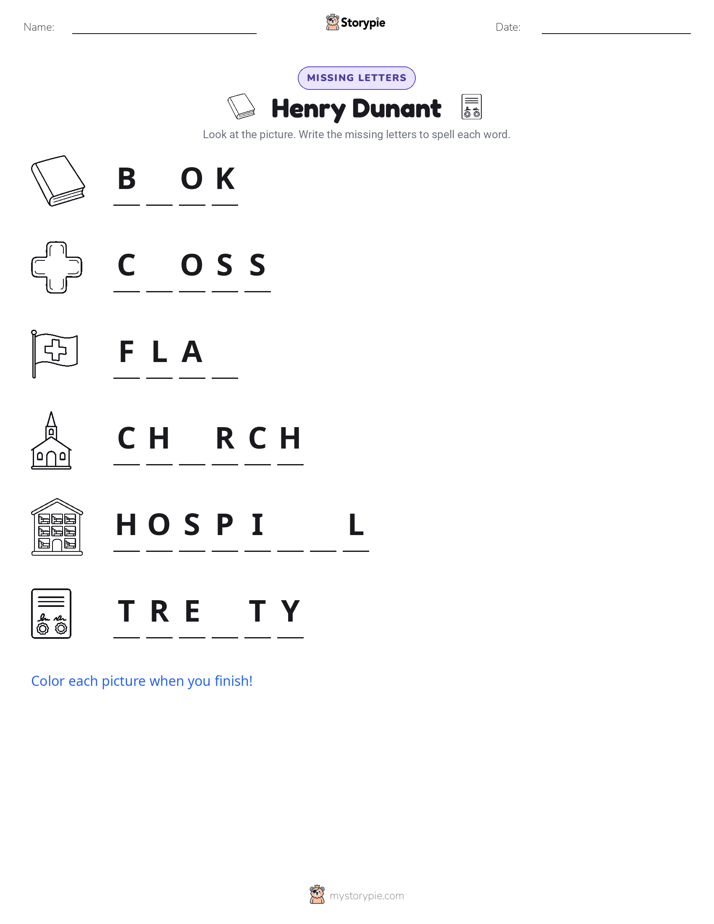
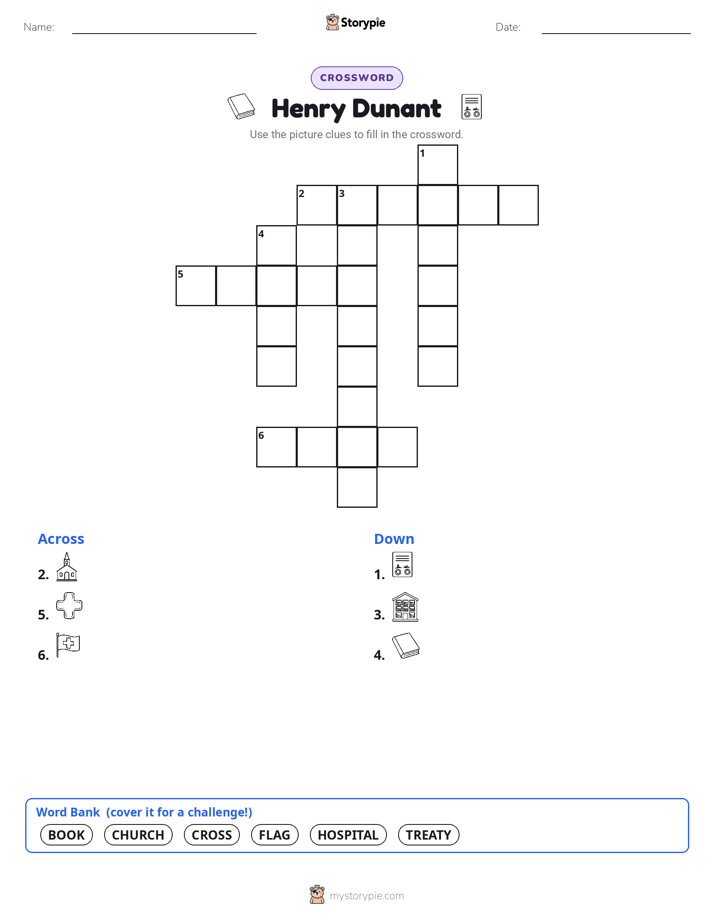
Print & create
Answer keys·No prep·Free with an account
28 worksheets · answer keys · full story · quiz · Ages 10-12 · CEFR B2
Plus adds 279,000+ more stories in 27 languages, audio for every one, and printables for all of them.
Just want Henry Dunant?
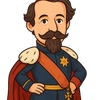
Hello! My name is Jean-Henri Dunant, though many people know me as Henry. My story begins on May 8th, 1828, in a beautiful city called Geneva, in Switzerland. I grew up in a family that believed deeply in helping others. My parents taught me that it was our duty to care for those who were sick or in need. From a young age, I would go with them to visit people in prison and help families who didn't have much money. These early experiences planted a seed in my heart—a powerful wish to make the world a kinder place. As I grew up, I became a businessman, and my work took me on adventures all across Europe.
In the summer of 1859, I was traveling through Italy on a business trip, hoping to meet with the French Emperor, Napoleon III. But on June 24th, 1859, my journey led me to a small town called Solferino, and what I saw there changed my life forever. A huge, terrible battle had just been fought. The fields were filled with nearly 40,000 wounded or dying soldiers from the French, Austrian, and Sardinian armies. There were hardly any doctors or nurses to help them. I couldn't just walk away. I knew I had to do something. I asked the local villagers, mostly women, to help me. We gathered the wounded, taking them to nearby churches and houses that we turned into makeshift hospitals. We treated everyone, no matter which side they fought for. Our motto became 'Tutti fratelli,' which means 'We are all brothers.' That day, I was no longer just a businessman; I was a witness to great suffering and a helper in a time of desperate need.
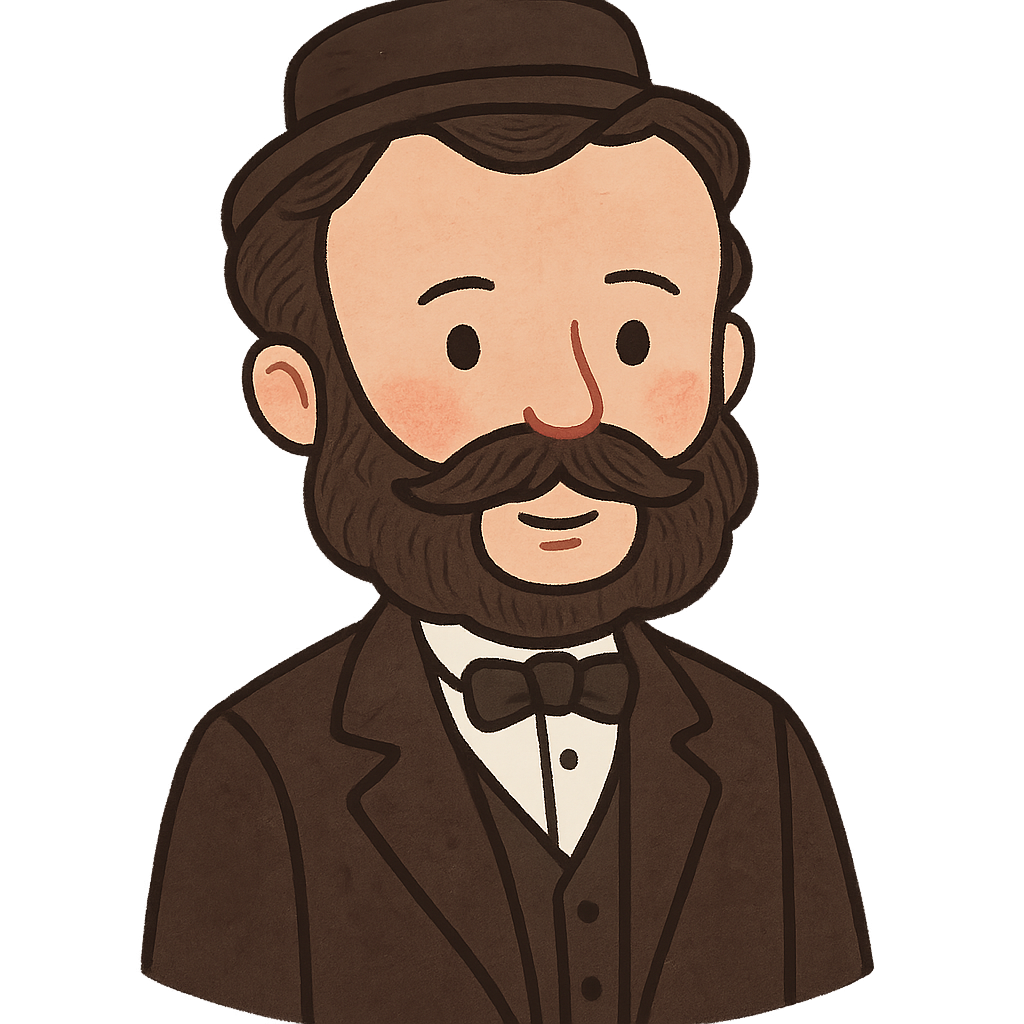
Henry Dunant
Hello! My name is Jean-Henri Dunant, though many people know me as Henry. My story begins on May 8th, 1828, in a beautiful city called Geneva, in Switzerland. I grew up in a family that believed deeply in helping others. My parents taught me that it was our duty to care for those who were sick or in need. From a young age, I would go with them to visit people in prison and help families who didn't have much money. These early experiences planted a seed in my heart—a powerful wish to make the world a kinder place. As I grew up, I became a businessman, and my work took me on adventures all across Europe.
In the summer of 1859, I was traveling through Italy on a business trip, hoping to meet with the French Emperor, Napoleon III. But on June 24th, 1859, my journey led me to a small town called Solferino, and what I saw there changed my life forever. A huge, terrible battle had just been fought. The fields were filled with nearly 40,000 wounded or dying soldiers from the French, Austrian, and Sardinian armies. There were hardly any doctors or nurses to help them. I couldn't just walk away. I knew I had to do something. I asked the local villagers, mostly women, to help me. We gathered the wounded, taking them to nearby churches and houses that we turned into makeshift hospitals. We treated everyone, no matter which side they fought for. Our motto became 'Tutti fratelli,' which means 'We are all brothers.' That day, I was no longer just a businessman; I was a witness to great suffering and a helper in a time of desperate need.
When I returned to Geneva, the images of Solferino haunted me. I couldn't stop thinking about the soldiers who were left to suffer. I decided to write a book, which I published in 1862, called 'A Memory of Solferino.' In it, I described the horrors I had witnessed, but I also shared two very important ideas. My first idea was that every country should create groups of trained volunteers who would be ready to help the wounded during wartime, regardless of their nationality. My second idea was that the nations of the world should agree to an international treaty—a set of official rules—to protect wounded soldiers and the medical workers caring for them on the battlefield. I sent my book to leaders all across Europe, hoping my ideas would inspire them to act.
My ideas began to spread! In 1863, I joined with four other men in Geneva, including a lawyer named Gustave Moynier, to form the 'International Committee for Relief to the Wounded.' This was the beginning of what would become the International Committee of the Red Cross. We needed a symbol so that our volunteers would be safe on the battlefield, so we chose a red cross on a white background—the reverse of the Swiss flag—to show that we were neutral and there only to help. The next year, in 1864, was even more amazing. The Swiss government invited leaders from across Europe to a conference in Geneva. On August 22nd, 1864, twelve countries signed the very first Geneva Convention, officially agreeing to protect the wounded and those who cared for them. My dream was becoming a reality.
Even though these ideas were successful, my own life became very difficult. I had spent so much time and money on my humanitarian work that my businesses failed, and for many years, I lived in poverty and was largely forgotten. But the world eventually remembered. In 1895, a journalist found me and wrote about my life's work. In 1901, I was given one of the greatest honors imaginable: I was a co-recipient of the very first Nobel Peace Prize. I lived to be 82 years old, passing away on October 30th, 1910. Today, the seeds I planted at Solferino have grown into the worldwide Red Cross and Red Crescent Movement, which helps millions of people every year. The Geneva Conventions continue to provide essential protections for people caught in conflicts, reminding the world that even in war, there must be humanity.
Wow facts
About
A Swiss businessman, social activist, and humanitarian who witnessed the Battle of Solferino in 1859. His experience led him to write "A Memory of Solferino" and co-found the International Committee of the Red Cross, for which he received the first Nobel Peace Prize in 1901.
Take a Quiz
Question 1 of 5
What motivated Henry Dunant to organize help for the soldiers at the Battle of Solferino?
Explore next


Want to do even more?
Go beyond exploring. Unlock tools that turn every story into real learning.
Storypie Plus for families
Full stories, quizzes, and printables. Nights and car rides, sorted.
- Unlimited audio stories
- Create Mode: your child stars in the story
- Offline downloads
- Printable worksheets & coloring pages

Why Storypie for Schools
Students engaged. Prep in seconds. Evenings back to you.
- Worksheets & Quizzes
- Classroom Management
- Formative Assessment
- Custom Curriculum & Lesson Plans
- 27 Languages

Why Storypie for Homeschool
Curriculum done. They'll ask for more. Hours back in your day.
- Worksheet Generator
- First-Person Audio Stories
- Built-in Comprehension Quizzes
- Custom Curriculum & Lesson Plans
- Print & Go Activities