

 English


Herodotus
A Greek historian from the 5th century BCE…
Reads at Grades 6–8 Listens at Grades 4–8
Herodotus: The Father of History
Hello! My name is Herodotus. I was born in a bustling port city called Halicarnassus around the year 484 BCE. My home was a fascinating place, part of the great Persian Empire but filled with people who spoke Greek and followed Greek customs. Growing up in a crossroads of the world meant I saw sailors, merchants, and travelers from distant lands every day. I would listen to their languages and hear snippets of their stories, which sparked a deep curiosity inside me. I wanted to understand everything about them: where they came from, what gods they worshipped, and what made their lives so different from my own. This desire to know more, to inquire and to understand, became the guiding star of my entire life, setting me on a path no one had ever walked before.
As a young man, my curiosity could no longer be contained within the walls of my city. I knew I had to see the world for myself to find the answers to my questions. Sometime during the 460s and 450s BCE, I began a series of incredible journeys that took me across the known world. I sailed to the ancient land of Egypt, where I stood in awe of the great pyramids and learned from the priests who kept records stretching back thousands of years. I traveled through the heart of the vast Persian Empire, visiting incredible cities like Babylon with its legendary towering walls. My adventures also took me to the wild lands of Scythia and along the coasts of the Black Sea. During these travels, I did more than just observe the sights. I made it my mission to talk to everyone I could find—priests, soldiers, merchants, and local guides. I asked them endless questions about their history, their customs, and their beliefs, carefully recording their answers.
As I gathered countless stories and facts from my travels, I began to see a larger picture forming. All these different cultures and histories were connected. I realized I wanted to do something that no one had attempted before. I decided to write a complete account, an 'inquiry'—which in my Greek language is called a 'historia'—of the most significant event of the generation before I was born: the massive war between the mighty Persian Empire and the small, independent city-states of Greece. These conflicts, which took place between 499 and 479 BCE, are now known as the Greco-Persian Wars. My goal was not just to list the battles and the heroes. I wanted to investigate the deeper reasons why the war happened in the first place. It was important to me to preserve the memory of the great and marvelous deeds of both the Greeks and the Persians, so that future generations would never forget their achievements.
Before I began my work, most stories about the past were epic poems about gods and mythical heroes, like those told by the great poet Homer. They were exciting tales, but they were not based on evidence. I wanted to create a new way of understanding the past. My method was to gather as much evidence as I could from different sources and to listen to various viewpoints. I wrote down everything people told me, even the stories that seemed unbelievable or contradicted each other. I often reminded my readers of my approach by saying, 'I am obliged to report what I am told, but I am not obliged to believe it.' I wanted to present the information and allow people to think for themselves and draw their own conclusions. This new system of investigation, of asking questions and analyzing evidence to tell a factual story about the past, was the beginning of the subject you now call 'history.' Around 430 BCE, my great work, which I called The Histories, was largely complete.
Later in my life, around 443 BCE, I embarked on a new adventure. I joined a group of Greeks to help establish a new colony called Thurii in what is now southern Italy. I spent many of my remaining years in this new city, continuing to write and refine my life's work. I lived to be about 59 years old. Though my life came to an end, my 'historia' had just begun its own long journey through time. Because I created this new way of systematically investigating and recording the past, people have given me the title 'The Father of History.' My book, The Histories, is still read thousands of years later, not just for the events it describes, but for the spirit of endless curiosity that drove me to see the world and always ask the simple but powerful question, 'Why?'
Wow facts
About
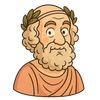
A Greek historian from the 5th century BCE, widely known as the 'Father of History' for his work 'The Histories', which documents the Greco-Persian Wars and the cultures of the ancient world.
Take a Quiz
Question 1 of 5
In your own words, describe Herodotus's method for writing about the past and how it was different from what came before.
Explore next




Want to do even more?
Go beyond exploring. Unlock tools that turn every story into real learning.

Storypie Plus for families
Full stories, quizzes, and printables. Nights and car rides, sorted.
- Unlimited audio stories
- Create Mode: your child stars in the story
- Offline downloads
- Printable worksheets & coloring pages

Why Storypie for Schools
Students engaged. Prep in seconds. Evenings back to you.
- Worksheets & Quizzes
- Classroom Management
- Formative Assessment
- Custom Curriculum & Lesson Plans
- 27 Languages

Why Storypie for Homeschool
Curriculum done. They'll ask for more. Hours back in your day.
- Worksheet Generator
- First-Person Audio Stories
- Built-in Comprehension Quizzes
- Custom Curriculum & Lesson Plans
- Print & Go Activities

