English


Ibn al-Nafis
Ibn al-Nafis was a 13th-century Arab physician and scholar…
Reads at Grades 3–5 Listens at Grades 1–5
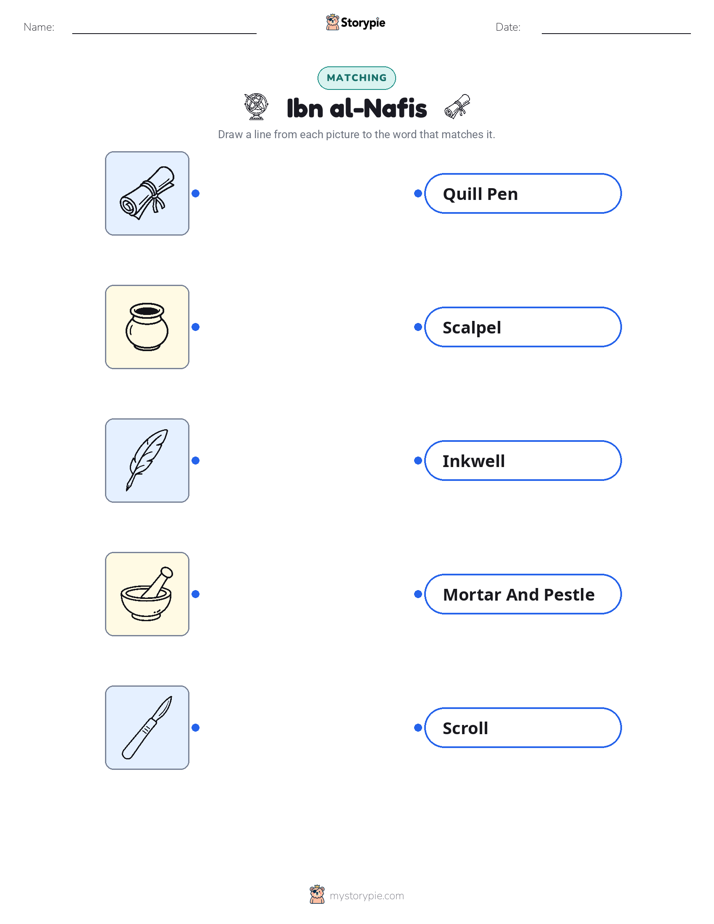
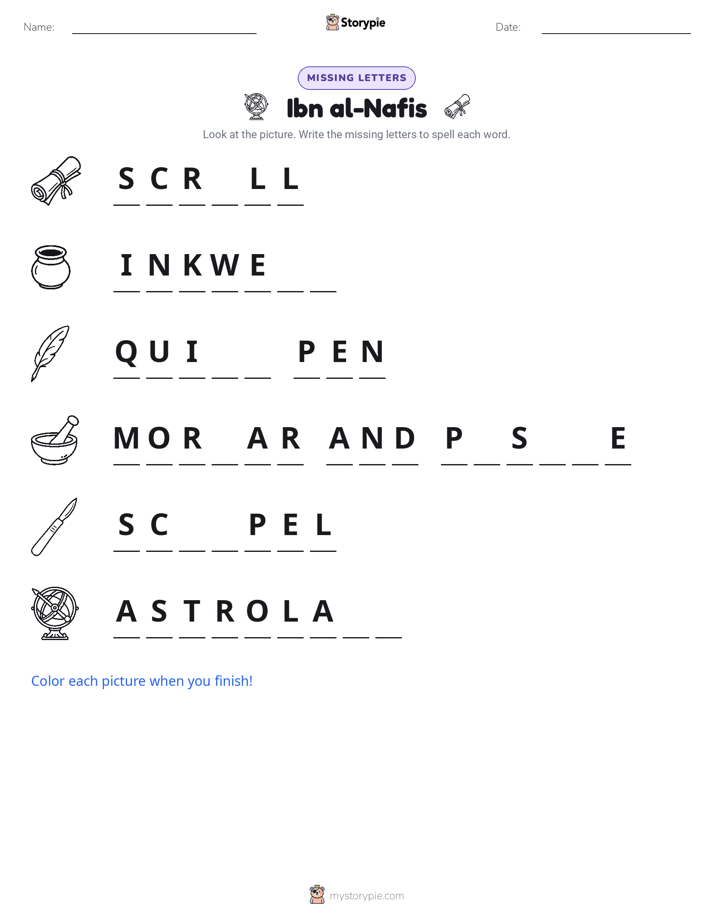
Print & create
Answer keys·No prep·Free with an account
28 worksheets · answer keys · full story · quiz · Ages 8-10 · CEFR B1
Plus adds 244,000+ more stories in 27 languages, audio for every one, and printables for all of them.
Just want Ibn al-Nafis?

Hello, my name is Ibn al-Nafis. My story begins a long time ago, around the year 1213, when I was born near the beautiful and busy city of Damascus. Even as a young boy, I was filled with curiosity. While other children played games, I wondered about the world inside of us. How did our bodies work? What made our hearts beat? I asked questions all the time, eager to understand the mysteries of human life. This passion led me to a very special place, the Bimaristan al-Noori. It was more than just a hospital; it was also a famous school for medicine. It was there, surrounded by doctors and books, that my real journey to understand the human body began. I knew I wanted to spend my life healing people and discovering the secrets held within.
Around the year 1236, I decided to move to a new city, one of the biggest and most exciting in the world at that time: Cairo, in Egypt. The city was a whirlwind of sights and sounds, full of markets, scholars, and grand buildings. In Cairo, I began working as a doctor at important hospitals, helping people who were sick or injured. But my work didn't stop when I left the hospital. My passion was not just for healing people, but also for learning everything I could. I spent countless hours reading old medical books and thinking about the ideas within them. I also loved sharing what I learned. I became a teacher, gathering students around me to explain the complexities of the human body. I felt a strong desire to look past what was already known. I wanted to understand the body better than anyone had before me, and I was determined to use my own observations to find the truth.
Ibn al-Nafis: The Doctor Who Solved a Heart Mystery
Hello, my name is Ibn al-Nafis. My story begins a long time ago, around the year 1213, when I was born near the beautiful and busy city of Damascus. Even as a young boy, I was filled with curiosity. While other children played games, I wondered about the world inside of us. How did our bodies work? What made our hearts beat? I asked questions all the time, eager to understand the mysteries of human life. This passion led me to a very special place, the Bimaristan al-Noori. It was more than just a hospital; it was also a famous school for medicine. It was there, surrounded by doctors and books, that my real journey to understand the human body began. I knew I wanted to spend my life healing people and discovering the secrets held within.
Around the year 1236, I decided to move to a new city, one of the biggest and most exciting in the world at that time: Cairo, in Egypt. The city was a whirlwind of sights and sounds, full of markets, scholars, and grand buildings. In Cairo, I began working as a doctor at important hospitals, helping people who were sick or injured. But my work didn't stop when I left the hospital. My passion was not just for healing people, but also for learning everything I could. I spent countless hours reading old medical books and thinking about the ideas within them. I also loved sharing what I learned. I became a teacher, gathering students around me to explain the complexities of the human body. I felt a strong desire to look past what was already known. I wanted to understand the body better than anyone had before me, and I was determined to use my own observations to find the truth.
For hundreds of years, doctors followed the ideas of a very famous physician from ancient times named Galen. He had a theory about how blood moved inside the body. Galen believed that blood passed from the right side of the heart to the left side through tiny, invisible holes in the wall between them. Everyone accepted this as fact. But as I studied the human heart more closely, something didn't seem right. I examined the wall, called the septum, and I could not find any holes, no matter how small. I realized that Galen's idea, which had been trusted for centuries, had to be wrong. Through careful study, I made a breakthrough discovery. I figured out that blood doesn't go through the heart's wall at all. Instead, blood travels from the right side of the heart into the lungs. In the lungs, it mixes with fresh air, and then it flows back to the left side of the heart, ready to be pumped out to the entire body. I described this new path for the blood in my book, 'Commentary on Anatomy in Avicenna's Canon,' which I wrote around the year 1242. It was a completely new way of understanding our own bodies.
My work in Cairo continued for many years, and I was honored to become the chief physician at the great Al-Mansuri Hospital. This was a very important job, and it allowed me to care for many people and guide other doctors. But I was always a writer and a scholar at heart. I knew that knowledge needed to be collected and shared so that future generations could learn from it. I took on a massive project: writing a huge medical encyclopedia I called 'The Comprehensive Book on Medicine.' It was an enormous collection of everything I had learned and observed throughout my life as a doctor. My goal was to create a resource that other physicians could use for many years to come. Throughout my life, I remained dedicated to these three things: healing patients, teaching students, and sharing knowledge through my writing.
I lived a long and full life, always dedicated to the study of medicine and the care of others. I lived to be about 75 years old. For a very long time after I was gone, my discovery about how blood flows through the lungs was not widely known, and other scientists had to rediscover it centuries later. But today, I am remembered as a pioneer. People now know that I was one of the first to correctly describe a part of how our bodies work, helping to change our understanding of the human body forever.
Wow facts
About
Ibn al-Nafis was a 13th-century Arab physician and scholar, best known for being the first person to accurately describe the pulmonary circulation of blood.
Take a Quiz
Question 1 of 5
In the story, the narrator says Cairo was a 'whirlwind of sights and sounds.' What does the word 'whirlwind' mean here?
Explore next






Want to do even more?
Go beyond exploring. Unlock tools that turn every story into real learning.

Storypie Plus for families
Full stories, quizzes, and printables. Nights and car rides, sorted.
- Unlimited audio stories
- Create Mode: your child stars in the story
- Offline downloads
- Printable worksheets & coloring pages

Why Storypie for Schools
Students engaged. Prep in seconds. Evenings back to you.
- Worksheets & Quizzes
- Classroom Management
- Formative Assessment
- Custom Curriculum & Lesson Plans
- 27 Languages

Why Storypie for Homeschool
Curriculum done. They'll ask for more. Hours back in your day.
- Worksheet Generator
- First-Person Audio Stories
- Built-in Comprehension Quizzes
- Custom Curriculum & Lesson Plans
- Print & Go Activities