English

James Chadwick
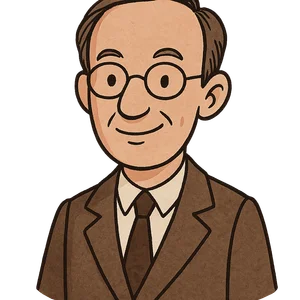
Sir James Chadwick was a British physicist who was awarded the 1935 Nobel Prize in Physics for his discovery…
Reads at Grades 3–5 Listens at Grades 1–5
Print & create
Answer keys·No prep·Free with an account
28 worksheets · answer keys · full story · quiz · Ages 8-10 · CEFR B1
Plus adds 208,000+ more stories in 27 languages, audio for every one, and printables for all of them.
Just want James Chadwick?
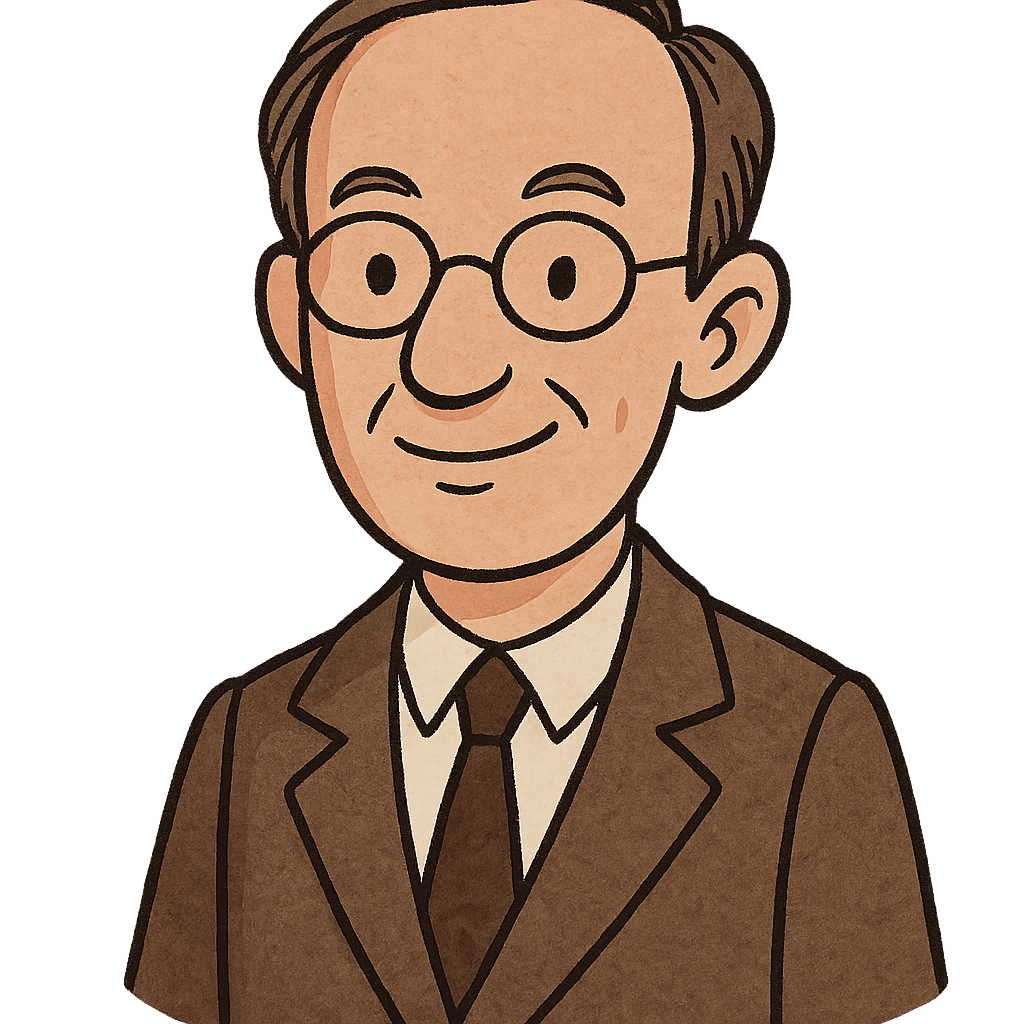
Hello! My name is James Chadwick, and I was a scientist who loved solving puzzles. I was born in a small town in England on October 20th, 1891. Even as a boy, I was fascinated by how the world worked, always asking questions and wanting to know the 'why' behind everything. When I was old enough, in 1908, I went to the Victoria University of Manchester to study physics. I chose physics because I wanted to understand the tiniest, most secret parts of everything around us. It felt like being a detective, but instead of solving crimes, I was trying to solve the mysteries of the universe itself.
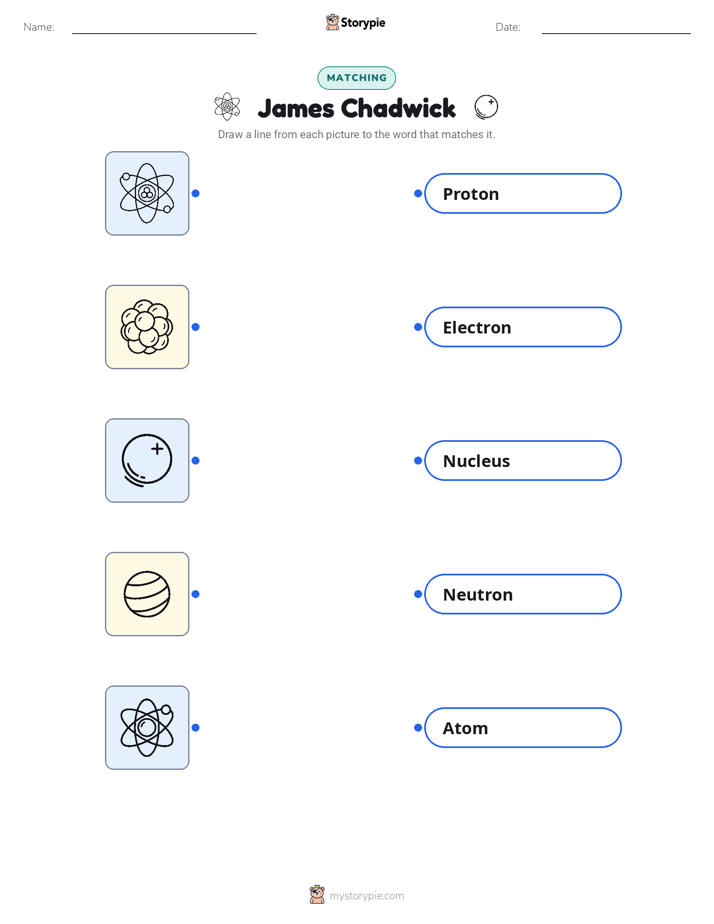
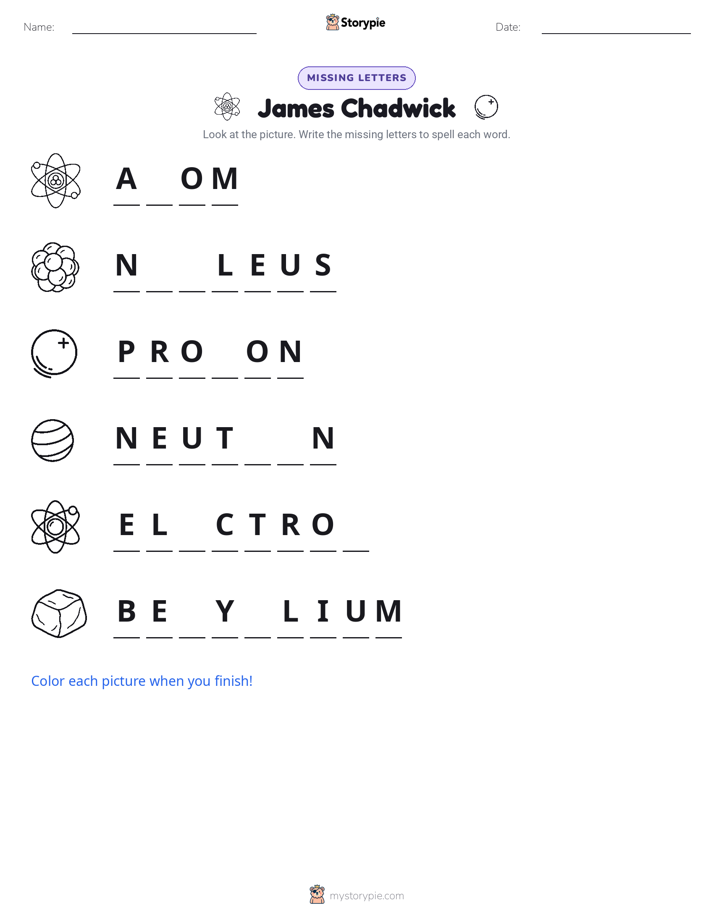
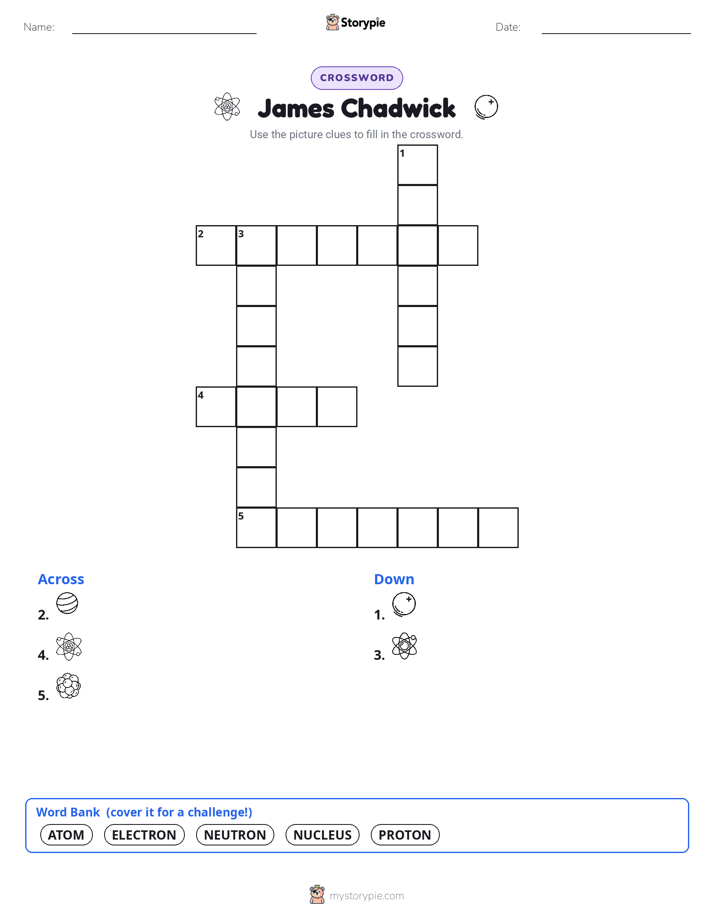
After I graduated in 1911, I was very lucky to get the chance to work with a famous scientist named Ernest Rutherford. He was an expert on the atom, which is the teeny-tiny building block of all matter. He had already discovered the center of the atom, which he called the nucleus. But there was a big mystery we couldn't solve. We knew the nucleus had positively charged particles called protons, but when we measured the atom's weight, it didn't add up correctly. It was always heavier than it should be! It was a puzzle I couldn't stop thinking about, even when I was stuck in Germany during World War I, which lasted from 1914 to 1918.
When the war was over, I returned to England and joined Mr. Rutherford again, this time at the University of Cambridge. I just couldn't let go of the mystery of the atom's missing weight. For years, scientists all over the world were stumped by this same problem. Then, in 1932, I decided to try a new series of experiments. I aimed special, powerful particles at a very thin piece of a material called beryllium. When the particles hit the beryllium, something new and invisible came out the other side! It wasn't a proton, and it wasn't a negatively charged electron. This new particle had no electrical charge at all—it was neutral. I knew right away that I had found the missing piece! I decided to call this new particle the 'neutron.'
James Chadwick
Hello! My name is James Chadwick, and I was a scientist who loved solving puzzles. I was born in a small town in England on October 20th, 1891. Even as a boy, I was fascinated by how the world worked, always asking questions and wanting to know the 'why' behind everything. When I was old enough, in 1908, I went to the Victoria University of Manchester to study physics. I chose physics because I wanted to understand the tiniest, most secret parts of everything around us. It felt like being a detective, but instead of solving crimes, I was trying to solve the mysteries of the universe itself.
After I graduated in 1911, I was very lucky to get the chance to work with a famous scientist named Ernest Rutherford. He was an expert on the atom, which is the teeny-tiny building block of all matter. He had already discovered the center of the atom, which he called the nucleus. But there was a big mystery we couldn't solve. We knew the nucleus had positively charged particles called protons, but when we measured the atom's weight, it didn't add up correctly. It was always heavier than it should be! It was a puzzle I couldn't stop thinking about, even when I was stuck in Germany during World War I, which lasted from 1914 to 1918.
When the war was over, I returned to England and joined Mr. Rutherford again, this time at the University of Cambridge. I just couldn't let go of the mystery of the atom's missing weight. For years, scientists all over the world were stumped by this same problem. Then, in 1932, I decided to try a new series of experiments. I aimed special, powerful particles at a very thin piece of a material called beryllium. When the particles hit the beryllium, something new and invisible came out the other side! It wasn't a proton, and it wasn't a negatively charged electron. This new particle had no electrical charge at all—it was neutral. I knew right away that I had found the missing piece! I decided to call this new particle the 'neutron.'
Discovering the neutron was a huge breakthrough for science! It perfectly explained the atom's missing weight and completely changed how we understood the building blocks of the world. It was a very exciting time. In 1935, I was honored to receive the Nobel Prize in Physics for my discovery, which is one of the biggest awards a scientist can get. A few years later, the world entered a very difficult and sad period called World War II. Because of my scientific knowledge, I was asked to help. Starting in 1943, I worked with a team of scientists in the United States on a top-secret program called the Manhattan Project. It was a serious time, and we all hoped our work would help end the war and bring peace.
After the war ended, I returned home to England and went back to teaching and exploring science at universities. My discovery of the neutron did more than just solve a puzzle; it helped other scientists unlock the power of the atom. This led to many new technologies, including nuclear energy, which can power entire cities. I lived a full and curious life and was 82 years old when I passed away in 1974. I am remembered as the scientist who found a key piece of the atomic puzzle, and my work continues to help us understand the amazing, invisible world all around us.
Wow facts
About
Sir James Chadwick was a British physicist who was awarded the 1935 Nobel Prize in Physics for his discovery of the neutron in 1932, a fundamental discovery for the development of nuclear physics.
Take a Quiz
Question 1 of 5
In the story, I said the atom's weight 'didn't add up correctly.' What did this mean?
Explore next






Want to do even more?
Go beyond exploring. Unlock tools that turn every story into real learning.

Storypie Plus for families
Full stories, quizzes, and printables. Nights and car rides, sorted.
- Unlimited audio stories
- Create Mode: your child stars in the story
- Offline downloads
- Printable worksheets & coloring pages

Why Storypie for Schools
Students engaged. Prep in seconds. Evenings back to you.
- Worksheets & Quizzes
- Classroom Management
- Formative Assessment
- Custom Curriculum & Lesson Plans
- 27 Languages

Why Storypie for Homeschool
Curriculum done. They'll ask for more. Hours back in your day.
- Worksheet Generator
- First-Person Audio Stories
- Built-in Comprehension Quizzes
- Custom Curriculum & Lesson Plans
- Print & Go Activities