English

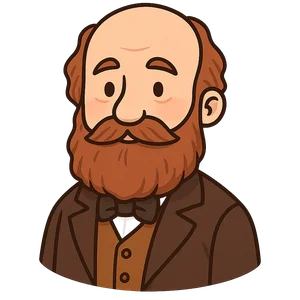
James Prescott Joule
James Prescott Joule was an English physicist and brewer whose work on the relationship between heat…
Reads at Grades 6–8 Listens at Grades 4–8
Print & create
Answer keys·No prep·Free with an account
28 worksheets · answer keys · full story · quiz · Ages 10-12 · CEFR B2
Plus adds 164,000+ more stories in 27 languages, audio for every one, and printables for all of them.
Just want James Prescott Joule?
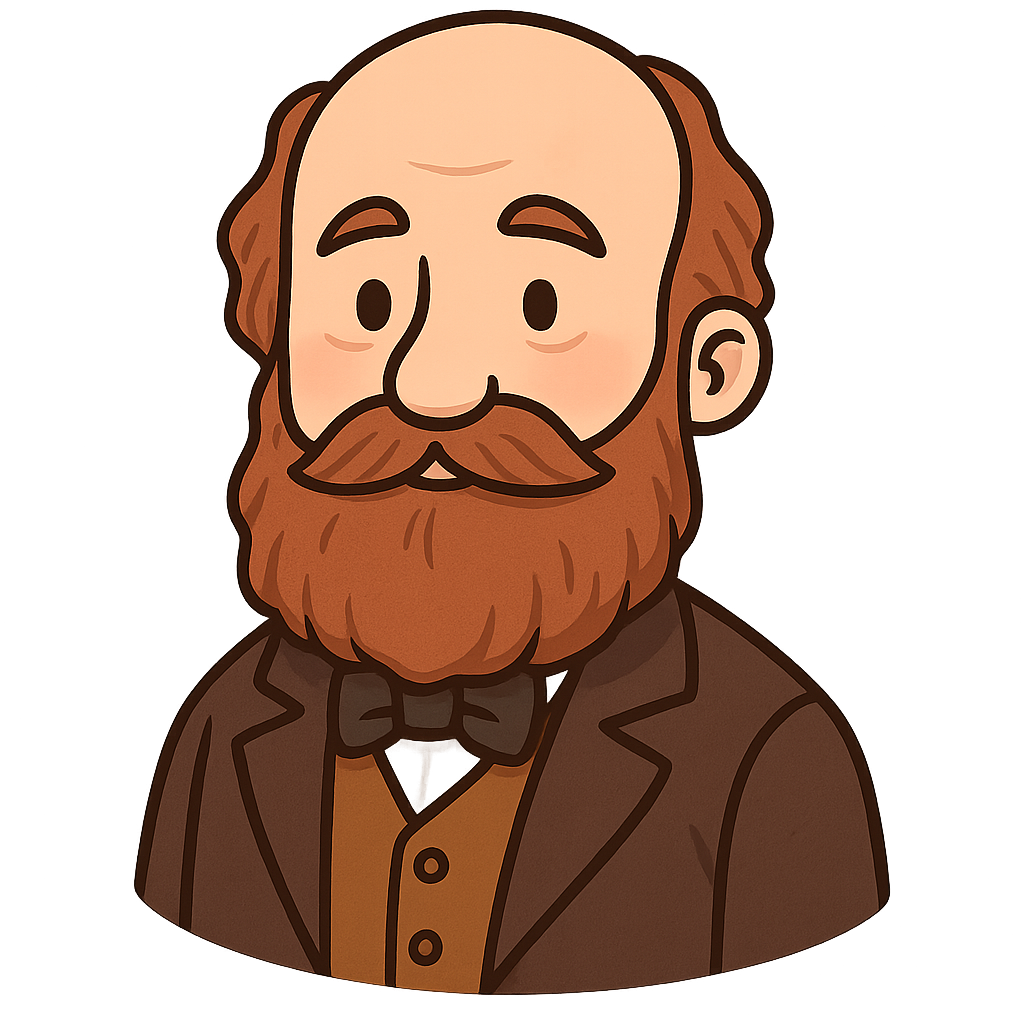
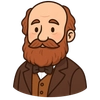
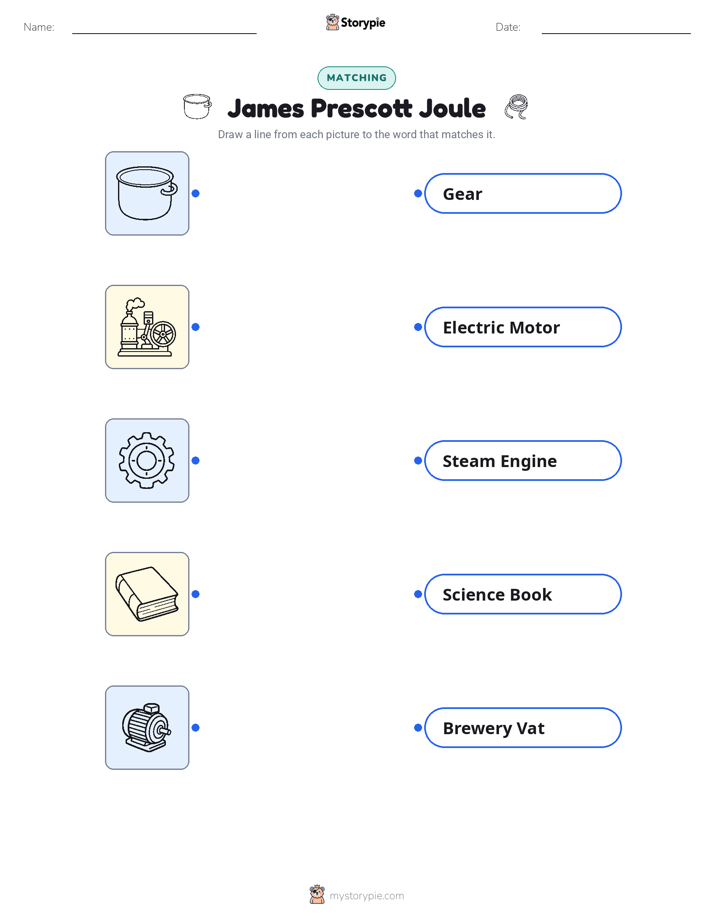
Hello, my name is James Prescott Joule, and I am a physicist who spent my life trying to understand the nature of energy. I was born on December 24th, 1818, in Salford, England, into a world buzzing with new ideas and inventions. My family owned a large brewery, and for a curious boy like me, it was the most wonderful playground imaginable. There were steam engines puffing, gears turning, and liquids bubbling in giant vats. Due to some health issues when I was young, I didn't go to a regular school. Instead, I was educated at home. This gave me a unique opportunity to spend countless hours in my own company, reading every science book I could find and tinkering with experiments. The brewery wasn't just a place of business; it was my first laboratory, where the seeds of my scientific curiosity were planted and began to grow.
My formal scientific training truly began around 1834 when my brother and I had the great fortune of being tutored by the famous scientist John Dalton. He was a brilliant man who taught us mathematics and chemistry, but the most important lesson he passed on was the necessity of precise and careful measurement. Mr. Dalton was known for his atomic theory, which proposed that all matter was made of tiny atoms. I was fascinated by this idea and by the orderly, predictable way the world seemed to work. His mentorship was a turning point for me. Inspired by his methods, I set up a laboratory at home and began my own investigations. My first major project was an attempt to improve the brewery by replacing the old steam engines with the newly invented electric motors, a task that required me to understand exactly how electricity, motion, and power were all connected.
James Prescott Joule: The Energy Detective
Hello, my name is James Prescott Joule, and I am a physicist who spent my life trying to understand the nature of energy. I was born on December 24th, 1818, in Salford, England, into a world buzzing with new ideas and inventions. My family owned a large brewery, and for a curious boy like me, it was the most wonderful playground imaginable. There were steam engines puffing, gears turning, and liquids bubbling in giant vats. Due to some health issues when I was young, I didn't go to a regular school. Instead, I was educated at home. This gave me a unique opportunity to spend countless hours in my own company, reading every science book I could find and tinkering with experiments. The brewery wasn't just a place of business; it was my first laboratory, where the seeds of my scientific curiosity were planted and began to grow.
My formal scientific training truly began around 1834 when my brother and I had the great fortune of being tutored by the famous scientist John Dalton. He was a brilliant man who taught us mathematics and chemistry, but the most important lesson he passed on was the necessity of precise and careful measurement. Mr. Dalton was known for his atomic theory, which proposed that all matter was made of tiny atoms. I was fascinated by this idea and by the orderly, predictable way the world seemed to work. His mentorship was a turning point for me. Inspired by his methods, I set up a laboratory at home and began my own investigations. My first major project was an attempt to improve the brewery by replacing the old steam engines with the newly invented electric motors, a task that required me to understand exactly how electricity, motion, and power were all connected.
My work with electric motors led me to a series of important discoveries. Around the year 1840, I was studying how electricity moved through wires. Through careful measurement, I established a clear mathematical relationship between the amount of electric current and the amount of heat it produced. This principle is now known as Joule's first law. This finding made me question the accepted scientific theory of the time. Most scientists believed that heat was an invisible fluid called 'caloric' that flowed from hot objects to cold ones. But my experiments suggested something different. I began to believe that heat wasn't a substance at all, but a form of energy. I formed a hypothesis that all forms of energy—like the motion of a motor, the flow of electricity, or the warmth of a fire—were fundamentally the same and could be converted from one form to another. I was convinced that in these transformations, no energy was ever truly lost, and I dedicated the next several years of my life to proving it.
To prove my theory, I knew I needed an experiment that was so precise it could not be disputed. This led me to the most famous work of my career, a series of experiments I conducted between 1843 and 1847. The setup was quite clever, if I do say so myself. I used a falling weight, attached to a string and a pulley, to turn a paddlewheel that was submerged in an insulated container of water. As the weight fell, its mechanical energy made the paddles churn the water. I used a highly sensitive thermometer to measure the temperature of the water before and after the paddles turned. I repeated the experiment over and over, meticulously recording my data. I proved, without a doubt, that a specific amount of mechanical work always produced the exact same amount of heat. This discovery established what is called the 'mechanical equivalent of heat' and provided powerful evidence for the law of conservation of energy—the idea that energy can change form but cannot be created or destroyed.
At first, the scientific community was hesitant to accept my conclusions. I was a brewer, not a professor at a prestigious university, and my ideas challenged long-held beliefs. It was difficult to get my papers published or taken seriously by the established scientific societies. However, my work eventually caught the attention of a brilliant physicist named William Thomson, who would later be known as Lord Kelvin. Around 1852, we began to collaborate, and his support was invaluable. Together, we studied how the temperature of a gas changes as it expands, a phenomenon now called the Joule-Thomson effect. His mathematical genius combined with my experimental precision helped solidify our ideas. With his backing, my work finally gained the widespread acceptance it deserved, laying the foundation for the first law of thermodynamics, one of the most fundamental principles in all of science.
My dedication to careful experimentation was recognized in 1850 when I was elected a Fellow of the Royal Society, one of the highest honors a scientist could receive. I lived to be 70 years old, and my life was filled with the joy of discovery. My work helped to transform our understanding of the universe by showing that energy is a constant force that connects everything, merely changing its appearance but never disappearing. I am very proud that today, the standard unit used to measure energy is called the 'joule' in my honor. It is a wonderful reminder that a curious mind, combined with patience and precision, can help illuminate the world.
Wow facts
About
James Prescott Joule was an English physicist and brewer whose work on the relationship between heat, electricity, and mechanical work led to the first law of thermodynamics and the law of conservation of energy.
Take a Quiz
Question 1 of 5
In your own words, summarize the main events of James Prescott Joule's scientific journey.
Explore next





Want to do even more?
Go beyond exploring. Unlock tools that turn every story into real learning.

Storypie Plus for families
Full stories, quizzes, and printables. Nights and car rides, sorted.
- Unlimited audio stories
- Create Mode: your child stars in the story
- Offline downloads
- Printable worksheets & coloring pages

Why Storypie for Schools
Students engaged. Prep in seconds. Evenings back to you.
- Worksheets & Quizzes
- Classroom Management
- Formative Assessment
- Custom Curriculum & Lesson Plans
- 27 Languages

Why Storypie for Homeschool
Curriculum done. They'll ask for more. Hours back in your day.
- Worksheet Generator
- First-Person Audio Stories
- Built-in Comprehension Quizzes
- Custom Curriculum & Lesson Plans
- Print & Go Activities