English

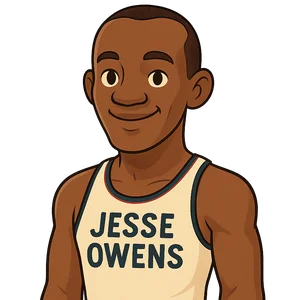
Jesse Owens
Jesse Owens was an American track and field athlete who won four gold medals at the 1936 Olympic Games in…
Reads at Grades 6–8 Listens at Grades 4–8
Print & create
Answer keys·No prep·Free with an account
28 worksheets · answer keys · full story · quiz · Ages 10-12 · CEFR B2
Plus adds 244,000+ more stories in 27 languages, audio for every one, and printables for all of them.
Just want Jesse Owens?
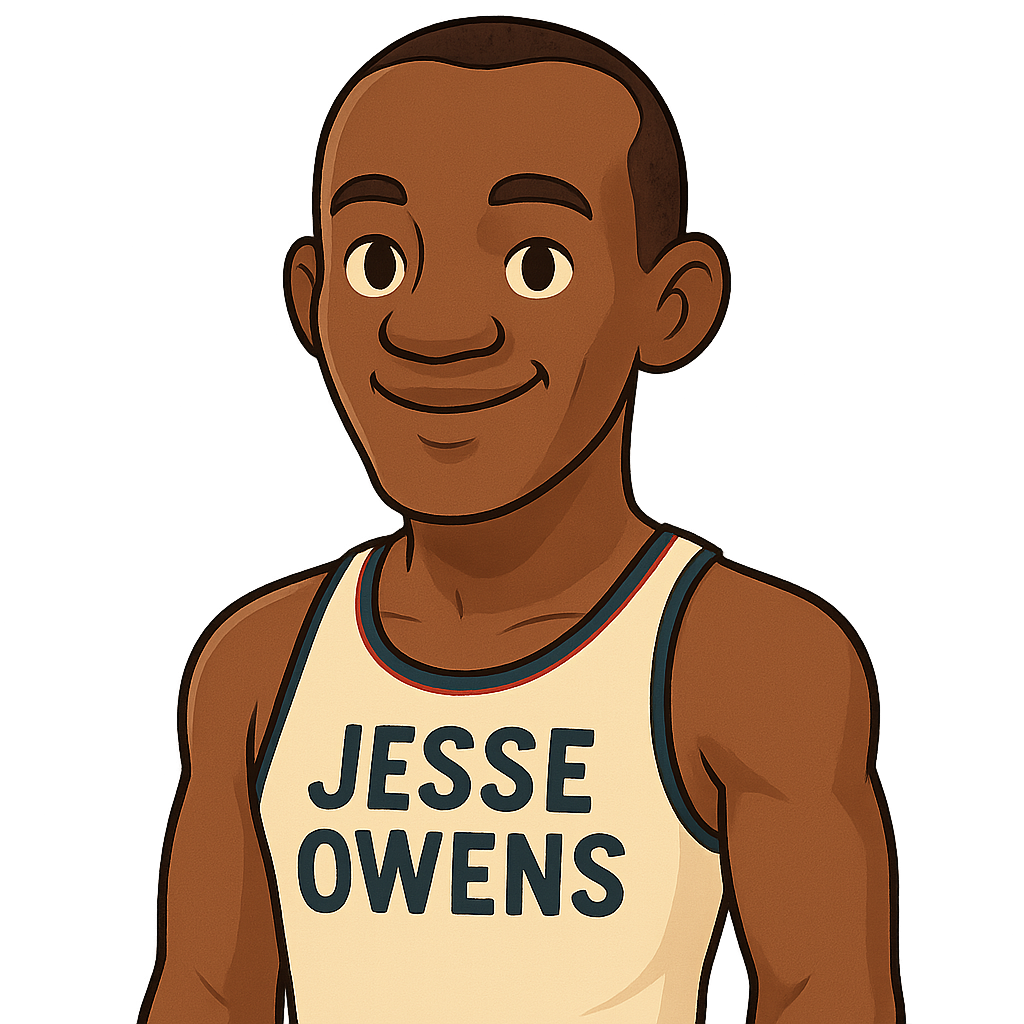
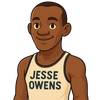
You probably know me as Jesse Owens, the Olympic champion, but that wasn't the name I was born with. My story begins on September 12th, 1913, in Oakville, Alabama, where my parents named me James Cleveland Owens. Everyone called me 'J.C.' for short. I was the youngest of ten children, and my family worked as sharecroppers, which was a very difficult life. We worked long hours in the fields, and there was never much to spare. Seeking better opportunities, my family decided to move north. Around 1922, we packed up our lives and moved to Cleveland, Ohio, becoming part of what history calls the Great Migration. It was in a new school in Cleveland that my name changed forever. When my new teacher asked for my name, I quietly said, 'J.C.' She must have misheard my southern accent, because she thought I said 'Jesse.' The name stuck, and from that day on, I was Jesse Owens.
It was in Ohio that I first discovered how much I loved to run. In junior high, a coach named Charles Riley saw potential in me that I didn't even see in myself. I had to work after school to help my family, so I couldn't attend regular practices. But Coach Riley didn't let that stop me. He offered to train me in the mornings before school started, and his belief in me made all the difference. I continued to work hard, and my speed on the track eventually led me to Ohio State University in 1933. It was there, during the Big Ten Championships on May 25th, 1935, that I had one of the greatest days of my athletic career. In the span of just 45 minutes, I did something incredible: I set three new world records and tied a fourth. That day proved to me that with hard work, the impossible could become possible.
Jesse Owens: A Story of Speed and Courage
You probably know me as Jesse Owens, the Olympic champion, but that wasn't the name I was born with. My story begins on September 12th, 1913, in Oakville, Alabama, where my parents named me James Cleveland Owens. Everyone called me 'J.C.' for short. I was the youngest of ten children, and my family worked as sharecroppers, which was a very difficult life. We worked long hours in the fields, and there was never much to spare. Seeking better opportunities, my family decided to move north. Around 1922, we packed up our lives and moved to Cleveland, Ohio, becoming part of what history calls the Great Migration. It was in a new school in Cleveland that my name changed forever. When my new teacher asked for my name, I quietly said, 'J.C.' She must have misheard my southern accent, because she thought I said 'Jesse.' The name stuck, and from that day on, I was Jesse Owens.
It was in Ohio that I first discovered how much I loved to run. In junior high, a coach named Charles Riley saw potential in me that I didn't even see in myself. I had to work after school to help my family, so I couldn't attend regular practices. But Coach Riley didn't let that stop me. He offered to train me in the mornings before school started, and his belief in me made all the difference. I continued to work hard, and my speed on the track eventually led me to Ohio State University in 1933. It was there, during the Big Ten Championships on May 25th, 1935, that I had one of the greatest days of my athletic career. In the span of just 45 minutes, I did something incredible: I set three new world records and tied a fourth. That day proved to me that with hard work, the impossible could become possible.
The biggest test of my life came the following year, at the 1936 Olympic Games held in Berlin, Germany. The atmosphere was tense and unsettling. The games were hosted by Adolf Hitler and his Nazi party, who promoted hateful and false ideas that some groups of people were superior to others. As an African American man, I knew that my presence there was a challenge to everything they stood for. I focused on what I came to do: compete to the best of my ability. In front of the entire world, I won four gold medals. I won the 100-meter dash, the 200-meter dash, the 4x100-meter relay, and the long jump. But one of my most important moments wasn't a victory, but a friendship. During the long jump competition, a German athlete named Luz Long gave me helpful advice after I had faulted. His act of sportsmanship and kindness showed everyone that friendship and respect could rise above the hatred being promoted around us.
After the triumph of the Olympics, I returned home to America. I was a world-famous champion, but that fame didn't protect me from the realities of racism and segregation in my own country. It was a strange and difficult time. While I was celebrated abroad, at home I was often denied the same rights and opportunities as white citizens. Finding a job that honored my achievements was a struggle, and for many years, I took on various jobs to support my family. I never gave up, though. Eventually, I found a new purpose as a public speaker. I began traveling across the country and around the world as a goodwill ambassador, sharing my story with young people. I encouraged them to pursue their dreams with determination and to overcome any obstacles they might face.
My journey took me from a childhood spent in the cotton fields of Alabama to a podium at an Olympic stadium in Berlin. I lived to be 66 years old. Today, I hope when people hear my name, they remember more than just the four gold medals I won in 1936. I hope they remember that dedication, character, and courage are the true measures of a person. My story stands as proof that we can challenge prejudice and that friendship can be found in the most unlikely of places, reminding us all of what is truly important.
Wow facts
About
Jesse Owens was an American track and field athlete who won four gold medals at the 1936 Olympic Games in Berlin, Germany, challenging Adolf Hitler's racist ideology.
Take a Quiz
Question 1 of 5
What was the setting of the 1936 Olympic Games, and why was it a challenging environment?
Explore next




Want to do even more?
Go beyond exploring. Unlock tools that turn every story into real learning.

Storypie Plus for families
Full stories, quizzes, and printables. Nights and car rides, sorted.
- Unlimited audio stories
- Create Mode: your child stars in the story
- Offline downloads
- Printable worksheets & coloring pages

Why Storypie for Schools
Students engaged. Prep in seconds. Evenings back to you.
- Worksheets & Quizzes
- Classroom Management
- Formative Assessment
- Custom Curriculum & Lesson Plans
- 27 Languages

Why Storypie for Homeschool
Curriculum done. They'll ask for more. Hours back in your day.
- Worksheet Generator
- First-Person Audio Stories
- Built-in Comprehension Quizzes
- Custom Curriculum & Lesson Plans
- Print & Go Activities