English

Joan of Arc
A French peasant girl who, believing she was acting under divine guidance…
Reads at Grades 6–8 Listens at Grades 4–8
Print & create
Answer keys·No prep·Free with an account
28 worksheets · answer keys · full story · quiz · Ages 10-12 · CEFR B2
Plus adds 280,000+ more stories in 27 languages, audio for every one, and printables for all of them.
Just want Joan of Arc?
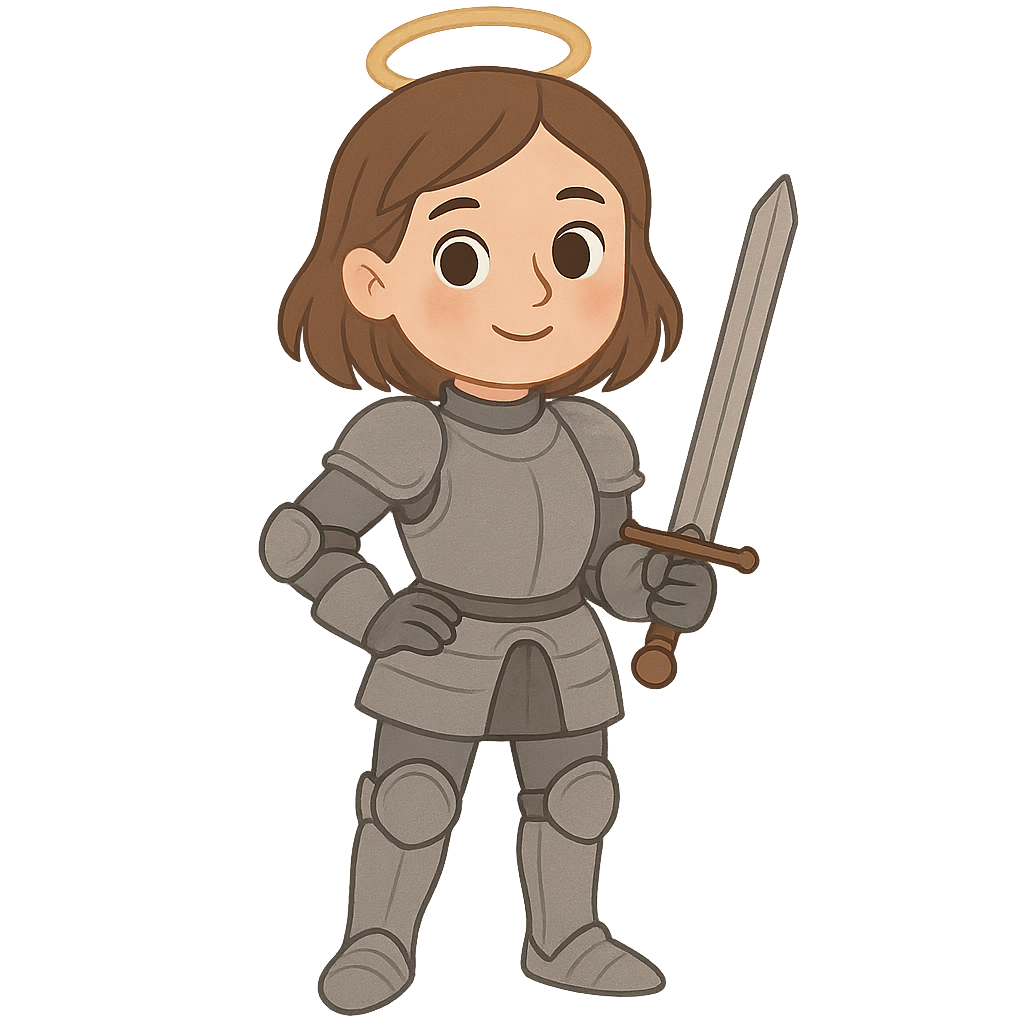
Hello, my name is Joan. You may know me as Joan of Arc, a young girl who followed her faith to lead an army. I was born into a humble family of farmers around the year 1412 in Domrémy, a small village in the French countryside. My childhood was simple; I spent my days helping on our farm and found great comfort in prayer. My country, France, was not at peace during this time. We were in the middle of a very long and difficult war with England, which history now calls the Hundred Years' War. It was a time of great uncertainty for my people. When I was about 13 years old, in approximately 1425, my life changed forever. I began to experience something miraculous. I saw brilliant visions and heard the voices of saints, who I believe were sent from God. They gave me a special and very important mission: I was to help Charles, the rightful heir to the French throne, become king and lead the effort to drive the English out of France. It was a task that seemed impossible for a girl like me, but the voices gave me courage.
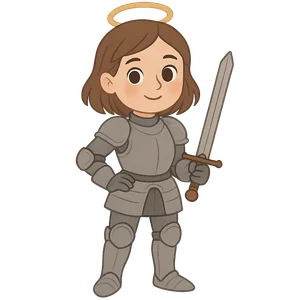
At first, the idea that a young, uneducated peasant girl could lead soldiers into battle was unbelievable to most people. They questioned me and dismissed my words, but I knew with all my heart what I had been called to do. My faith was unwavering. In 1429, at the age of 17, I knew I could wait no longer. I undertook a long and dangerous journey to meet the Dauphin, Charles, at his castle in Chinon. He was skeptical and decided to test me. When I arrived, he disguised himself by hiding among his many courtiers, but I was not fooled. I walked straight to him and told him of my divine mission. After I was carefully questioned by church officials who wanted to be certain my visions were authentic, Charles made a brave decision. He decided to trust me. He provided me with a suit of white armor to protect me in battle, a banner with the names of Jesus and Mary on it to carry before the troops, and command of an army. I was filled with a sense of purpose, and my faith gave me the strength to face the enormous responsibility ahead.
Joan of Arc: The Maid of Orléans
Hello, my name is Joan. You may know me as Joan of Arc, a young girl who followed her faith to lead an army. I was born into a humble family of farmers around the year 1412 in Domrémy, a small village in the French countryside. My childhood was simple; I spent my days helping on our farm and found great comfort in prayer. My country, France, was not at peace during this time. We were in the middle of a very long and difficult war with England, which history now calls the Hundred Years' War. It was a time of great uncertainty for my people. When I was about 13 years old, in approximately 1425, my life changed forever. I began to experience something miraculous. I saw brilliant visions and heard the voices of saints, who I believe were sent from God. They gave me a special and very important mission: I was to help Charles, the rightful heir to the French throne, become king and lead the effort to drive the English out of France. It was a task that seemed impossible for a girl like me, but the voices gave me courage.
At first, the idea that a young, uneducated peasant girl could lead soldiers into battle was unbelievable to most people. They questioned me and dismissed my words, but I knew with all my heart what I had been called to do. My faith was unwavering. In 1429, at the age of 17, I knew I could wait no longer. I undertook a long and dangerous journey to meet the Dauphin, Charles, at his castle in Chinon. He was skeptical and decided to test me. When I arrived, he disguised himself by hiding among his many courtiers, but I was not fooled. I walked straight to him and told him of my divine mission. After I was carefully questioned by church officials who wanted to be certain my visions were authentic, Charles made a brave decision. He decided to trust me. He provided me with a suit of white armor to protect me in battle, a banner with the names of Jesus and Mary on it to carry before the troops, and command of an army. I was filled with a sense of purpose, and my faith gave me the strength to face the enormous responsibility ahead.
My first great challenge was the city of Orléans. It had been under a brutal siege by the English for many months, and the French soldiers were losing hope. I arrived with my army on April 29th, 1429, and my presence seemed to ignite a new fire in the hearts of the men. We fought with renewed courage and determination. In a stunning turn of events, we managed to lift the siege in just nine days, achieving a momentous victory by May 8th. After this triumph, people began to call me 'The Maid of Orléans,' a name that has followed me through history. Our success did not stop there. We continued to win more battles, clearing a path to the city of Reims. This was incredibly important because, according to ancient tradition, all French kings had to be crowned in the grand cathedral there. On July 17th, 1429, I had the honor of standing beside Charles as he was officially crowned King Charles VII. It was a moment of pure joy, knowing that a critical part of my mission was complete.
Although the coronation was a great success, my work was not finished, and the path forward became much more dangerous. The English and their allies were determined to stop me. On May 23rd, 1430, during a minor battle, I was captured by Burgundian soldiers, who were Frenchmen allied with the English. They saw me as a valuable prize and sold me to the English. I was taken to the city of Rouen and put on trial. They accused me of heresy, which was a very serious charge. It meant they were claiming that my visions and the voices of the saints were not from God, but from an evil source. For months, I was held in a dark prison, a teenager all alone. I faced powerful judges who asked me complex, tricky questions designed to confuse me and make me seem like a liar. Throughout it all, I held tightly to my faith. I answered their questions as truthfully and simply as I could, always insisting that I had only ever done what God asked of me.
In the end, my enemies and their court found me guilty of the charges they had created. I lived to be about 19 years old, and my life came to an end on May 30th, 1431. But my story did not end there. Inspired by the victories we had won together, the French people continued to fight with great spirit, and they eventually won the Hundred Years' War. Many years later, in 1456, the Church held a new trial that examined all the evidence again and officially declared that I had been innocent of all charges. Centuries passed, and in 1920, I was named a saint of the Catholic Church. Today, I am remembered as a national hero and a patron saint of France, a symbol of courage, unwavering faith, and patriotism. My story shows that even the most humble person can change the course of history if they believe in their purpose.
Wow facts
About
A French peasant girl who, believing she was acting under divine guidance, led the French army to victory over the English during the Hundred Years' War. She was later captured, tried for heresy, and executed, becoming a martyr and patron saint of France.
Take a Quiz
Question 1 of 5
What was the first major military victory Joan led, which earned her the nickname 'The Maid of Orléans'?
Explore next




Want to do even more?
Go beyond exploring. Unlock tools that turn every story into real learning.

Storypie Plus for families
Full stories, quizzes, and printables. Nights and car rides, sorted.
- Unlimited audio stories
- Create Mode: your child stars in the story
- Offline downloads
- Printable worksheets & coloring pages

Why Storypie for Schools
Students engaged. Prep in seconds. Evenings back to you.
- Worksheets & Quizzes
- Classroom Management
- Formative Assessment
- Custom Curriculum & Lesson Plans
- 27 Languages

Why Storypie for Homeschool
Curriculum done. They'll ask for more. Hours back in your day.
- Worksheet Generator
- First-Person Audio Stories
- Built-in Comprehension Quizzes
- Custom Curriculum & Lesson Plans
- Print & Go Activities