English

Joseph Black
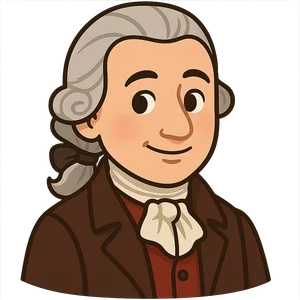
Joseph Black was a Scottish physician and chemist, a key figure in the Scottish Enlightenment…
Reads at Grades 6–8 Listens at Grades 4–8
Print & create
Answer keys·No prep·Free with an account
28 worksheets · answer keys · full story · quiz · Ages 10-12 · CEFR B2
Plus adds 164,000+ more stories in 27 languages, audio for every one, and printables for all of them.
Just want Joseph Black?
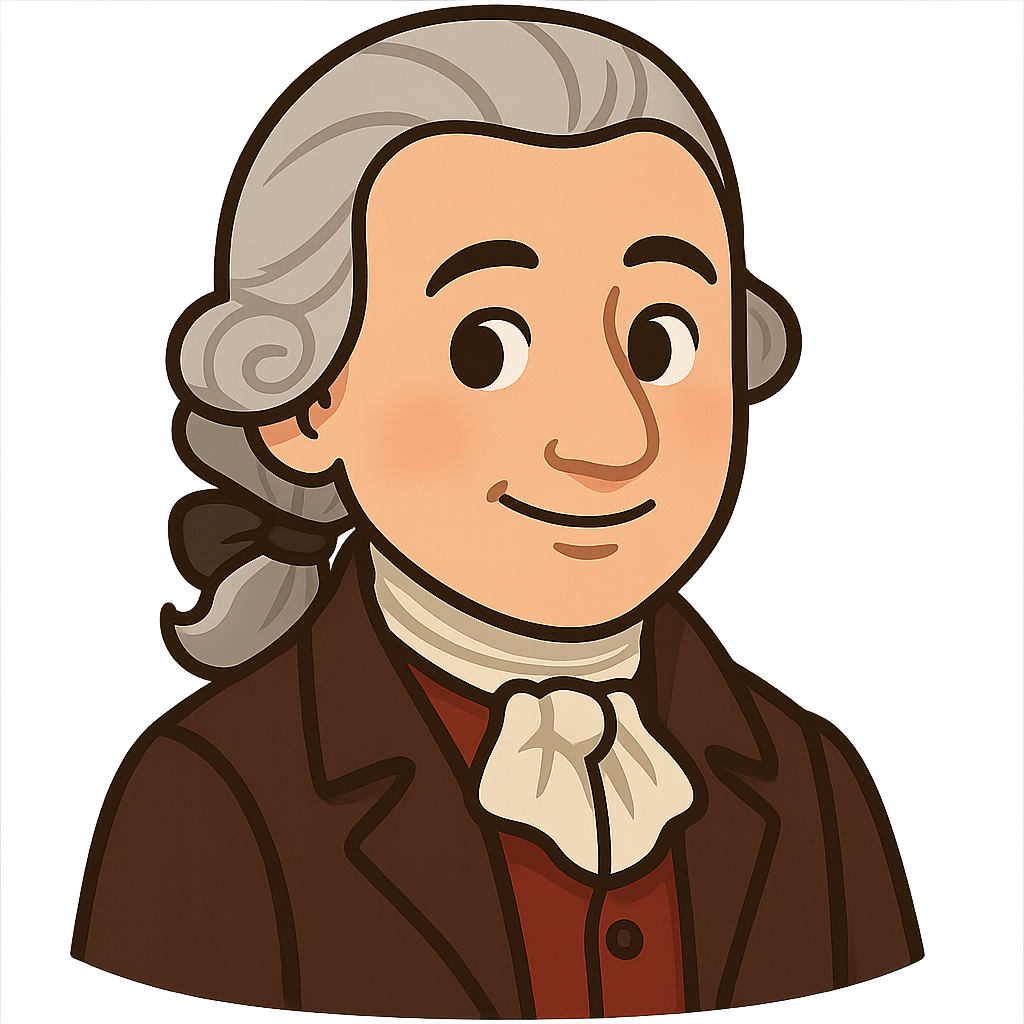
Hello, my name is Joseph Black, and I am a chemist who helped uncover some of the world's hidden secrets. My story begins on April 16th, 1728, in the sunny city of Bordeaux, France. Though I was born in France, my family's heritage was rooted in Scotland and Ireland. My father worked as a wine merchant, and our home was always filled with interesting goods from different places. Being surrounded by these materials sparked a deep curiosity in me. I was always wondering what things were made of, how they were put together, and what made them change. This early fascination with the physical world set the stage for a lifetime of scientific inquiry.
When I was 12 years old, around the year 1740, my family sent me to Belfast to begin my formal education. A few years later, I was thrilled to enroll at the University of Glasgow, where I initially planned to study arts. However, my path took a turn when I attended the lectures of a brilliant teacher named William Cullen. His chemistry classes were absolutely fascinating; he made the subject feel like a series of amazing puzzles just waiting to be solved. Professor Cullen’s lessons inspired me so much that I decided to change my focus to study medicine, which at the time was closely linked to chemistry. His guidance set me on the course for my life's work. To complete my studies, I later moved to the prestigious University of Edinburgh to earn my medical degree.
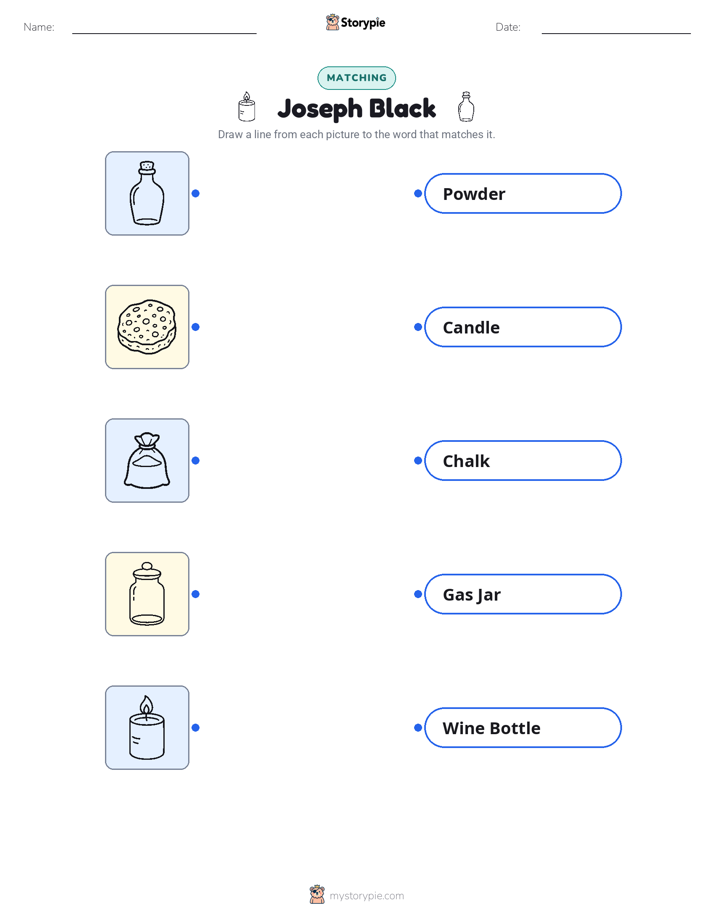
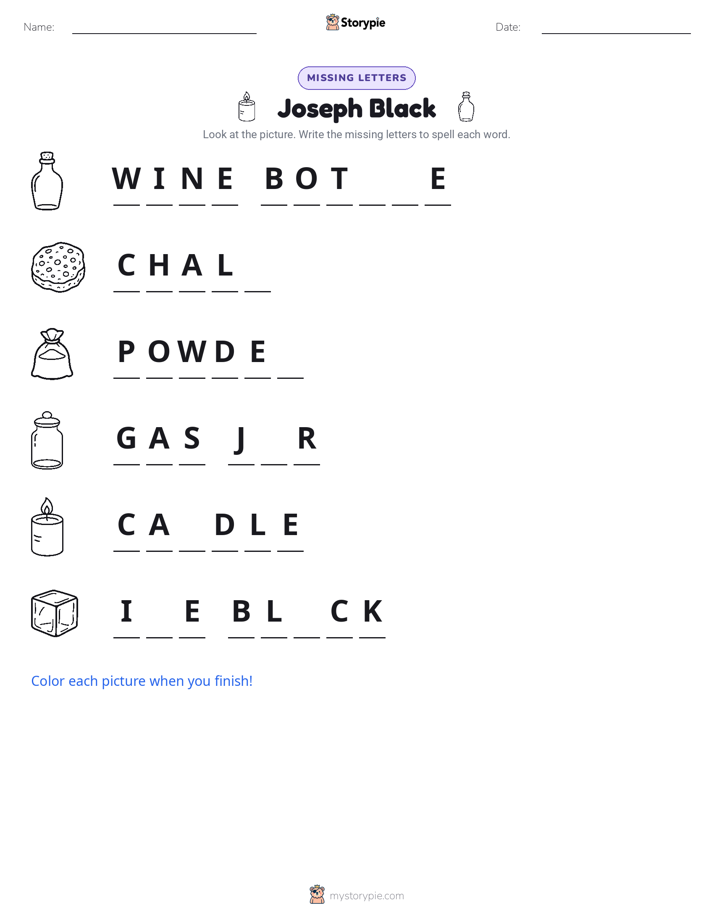
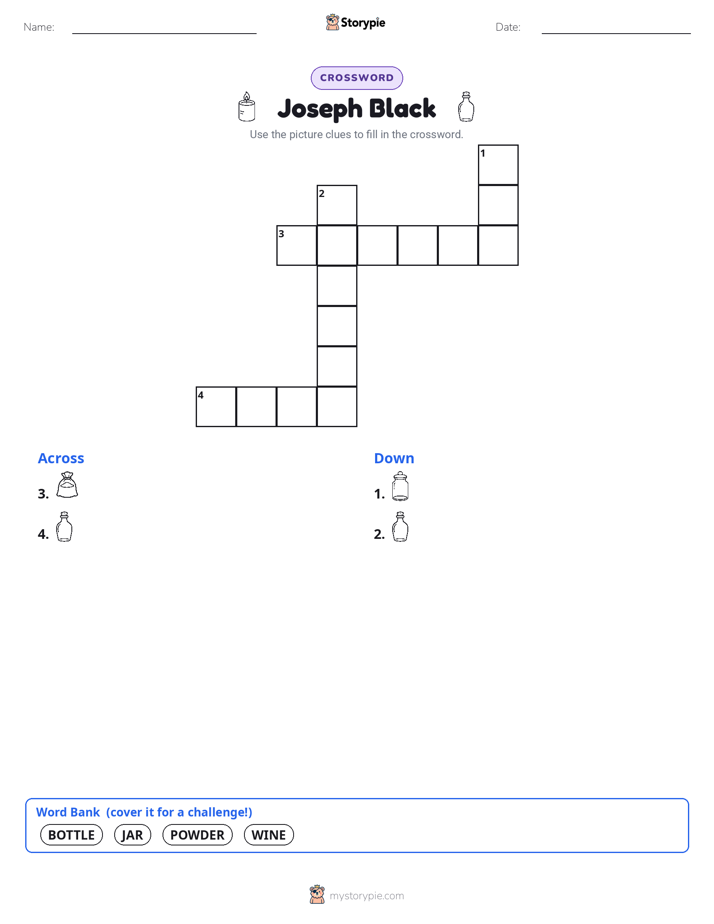
My most significant discovery came from the work I did for my final medical project at the University of Edinburgh in 1754. I was studying a chalky white powder known as magnesia alba. Through a series of very careful experiments, I began to heat the powder and observed something remarkable. As it got hot, it released a type of gas I had never encountered before. This gas was different from ordinary air; it was much heavier, and it had the peculiar ability to extinguish a candle flame. I named this substance 'fixed air' because I discovered it could be absorbed, or 'fixed,' back into certain solids. In 1756, I published my findings, which were groundbreaking. My work proved for the first time that what we call 'air' is not a single element but a mixture of different gases. The 'fixed air' I discovered is what you know today as carbon dioxide.
Joseph Black
Hello, my name is Joseph Black, and I am a chemist who helped uncover some of the world's hidden secrets. My story begins on April 16th, 1728, in the sunny city of Bordeaux, France. Though I was born in France, my family's heritage was rooted in Scotland and Ireland. My father worked as a wine merchant, and our home was always filled with interesting goods from different places. Being surrounded by these materials sparked a deep curiosity in me. I was always wondering what things were made of, how they were put together, and what made them change. This early fascination with the physical world set the stage for a lifetime of scientific inquiry.
When I was 12 years old, around the year 1740, my family sent me to Belfast to begin my formal education. A few years later, I was thrilled to enroll at the University of Glasgow, where I initially planned to study arts. However, my path took a turn when I attended the lectures of a brilliant teacher named William Cullen. His chemistry classes were absolutely fascinating; he made the subject feel like a series of amazing puzzles just waiting to be solved. Professor Cullen’s lessons inspired me so much that I decided to change my focus to study medicine, which at the time was closely linked to chemistry. His guidance set me on the course for my life's work. To complete my studies, I later moved to the prestigious University of Edinburgh to earn my medical degree.
My most significant discovery came from the work I did for my final medical project at the University of Edinburgh in 1754. I was studying a chalky white powder known as magnesia alba. Through a series of very careful experiments, I began to heat the powder and observed something remarkable. As it got hot, it released a type of gas I had never encountered before. This gas was different from ordinary air; it was much heavier, and it had the peculiar ability to extinguish a candle flame. I named this substance 'fixed air' because I discovered it could be absorbed, or 'fixed,' back into certain solids. In 1756, I published my findings, which were groundbreaking. My work proved for the first time that what we call 'air' is not a single element but a mixture of different gases. The 'fixed air' I discovered is what you know today as carbon dioxide.
After uncovering the secret of 'fixed air,' another puzzle captured my attention: the nature of heat. Around the year 1761, I was studying what happens when ice melts. I noticed something very strange. As I added heat to a block of ice, its temperature would rise until it reached the melting point, but then it would stop. The temperature stayed exactly the same until every last bit of ice had turned into water, even though I was continuously adding heat. This led me to understand that there was a hidden form of heat, which I called 'latent heat,' that was used to change the state of a substance from solid to liquid, rather than to raise its temperature. I also developed the idea of 'specific heat,' which explains that different materials need different amounts of heat to get warmer. These concepts were entirely new and fundamentally changed how scientists understood thermal energy.
Sharing knowledge was just as important to me as discovering it. In 1756, I became a professor at the University of Glasgow, and in 1766, I was honored to take over my old teacher William Cullen’s position at the University of Edinburgh. I loved teaching and spent over 30 years sharing my passion for chemistry with students. During my time as a professor, I became good friends with a brilliant inventor named James Watt. We would often discuss science and engineering. I shared my discoveries about latent heat with him, and this knowledge was crucial. It helped him to dramatically improve the design of his steam engine, making it far more powerful and efficient. It was incredibly rewarding to see my scientific theories being used to help power the new industrial age.
I lived a long and fulfilling life dedicated to discovery. I lived to be 71 years old, passing away peacefully in my home in Edinburgh in 1799. Today, I am remembered as one of the founders of modern chemistry. My discovery of 'fixed air,' or carbon dioxide, proved that air was a mixture of gases and opened up a whole new field of scientific study. Furthermore, my work on latent and specific heat provided the scientific principles that helped power the engines of the Industrial Revolution. I hope my story encourages you to look closely at the world, ask questions, and realize that a curious mind can uncover the most amazing secrets hidden in plain sight.
Wow facts
About
Joseph Black was a Scottish physician and chemist, a key figure in the Scottish Enlightenment, known for his discoveries of latent heat, specific heat, and carbon dioxide (which he called "fixed air").
Take a Quiz
Question 1 of 5
What is the main lesson or message of Joseph Black's story?
Explore next





Want to do even more?
Go beyond exploring. Unlock tools that turn every story into real learning.

Storypie Plus for families
Full stories, quizzes, and printables. Nights and car rides, sorted.
- Unlimited audio stories
- Create Mode: your child stars in the story
- Offline downloads
- Printable worksheets & coloring pages

Why Storypie for Schools
Students engaged. Prep in seconds. Evenings back to you.
- Worksheets & Quizzes
- Classroom Management
- Formative Assessment
- Custom Curriculum & Lesson Plans
- 27 Languages

Why Storypie for Homeschool
Curriculum done. They'll ask for more. Hours back in your day.
- Worksheet Generator
- First-Person Audio Stories
- Built-in Comprehension Quizzes
- Custom Curriculum & Lesson Plans
- Print & Go Activities