English

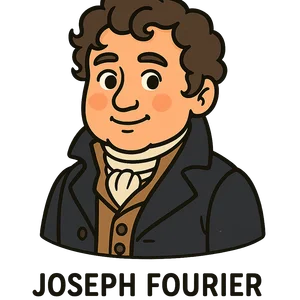
Joseph Fourier
Joseph Fourier was a French mathematician and physicist known for his work on the Fourier series and its…
Reads at Grades 3–5 Listens at Grades 1–5
Print & create
Answer keys·No prep·Free with an account
28 worksheets · answer keys · full story · quiz · Ages 8-10 · CEFR B1
Plus adds 244,000+ more stories in 27 languages, audio for every one, and printables for all of them.
Just want Joseph Fourier?
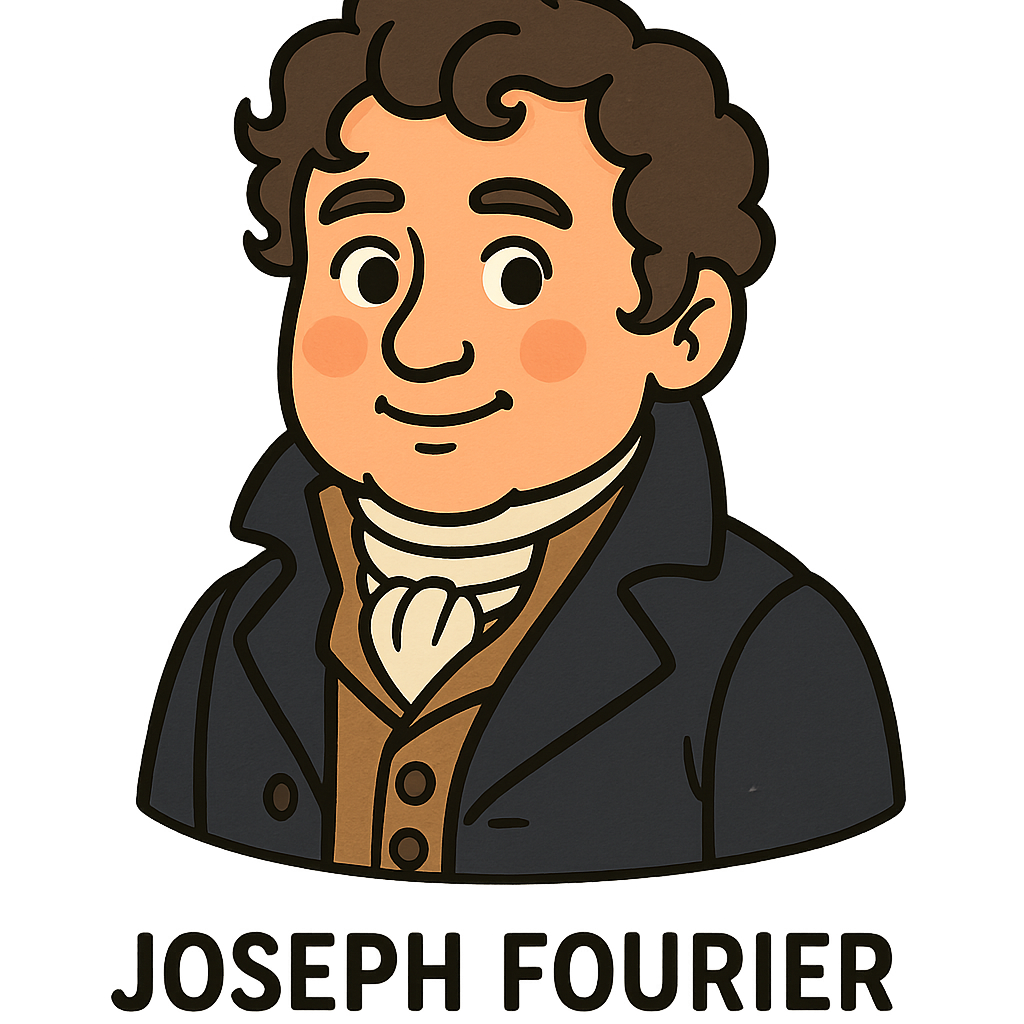
Hello, my name is Joseph Fourier, and I want to tell you the story of my life, which was filled with numbers, adventures, and big questions. I was born on March 21st, 1768, in a French town called Auxerre. My life started with a sad challenge, as both of my parents passed away when I was just a boy. Though I missed them dearly, I found a new home at a local military school run by monks. It was there, surrounded by books and blackboards, that I discovered something I loved more than anything else: mathematics. Numbers felt like a secret language, and I was determined to understand everything they could say. My first dream was to become an officer in the army, to use my math skills for things like building bridges or aiming cannons. But when the time came, I was told that because I was not from a noble family, I could not join. I was very disappointed, but that closed door pushed me toward another. I decided to pour all my energy into my studies, becoming a teacher of mathematics myself.
As I grew older, France was changing rapidly during a time called the French Revolution. This period of great change brought an unexpected and exciting opportunity my way. In 1798, a famous general named Napoleon Bonaparte was planning a journey to a faraway land, and he wanted to bring France’s best scientists and thinkers with him. I was invited to join this expedition to Egypt. My job was not to be a soldier, but a scholar. Imagine traveling across the sea to a land of pyramids and ancient history. It was a thrilling adventure. I was part of a team responsible for studying everything we could about Egypt—its incredible buildings that had stood for thousands of years, the plants and animals, and the way the land was shaped. This trip opened my eyes to the world and filled my mind with new questions. I wasn't just thinking about pure numbers anymore; I was starting to wonder how mathematics could help explain the world all around me.
Joseph Fourier: The Man Who Understood Heat
Hello, my name is Joseph Fourier, and I want to tell you the story of my life, which was filled with numbers, adventures, and big questions. I was born on March 21st, 1768, in a French town called Auxerre. My life started with a sad challenge, as both of my parents passed away when I was just a boy. Though I missed them dearly, I found a new home at a local military school run by monks. It was there, surrounded by books and blackboards, that I discovered something I loved more than anything else: mathematics. Numbers felt like a secret language, and I was determined to understand everything they could say. My first dream was to become an officer in the army, to use my math skills for things like building bridges or aiming cannons. But when the time came, I was told that because I was not from a noble family, I could not join. I was very disappointed, but that closed door pushed me toward another. I decided to pour all my energy into my studies, becoming a teacher of mathematics myself.
As I grew older, France was changing rapidly during a time called the French Revolution. This period of great change brought an unexpected and exciting opportunity my way. In 1798, a famous general named Napoleon Bonaparte was planning a journey to a faraway land, and he wanted to bring France’s best scientists and thinkers with him. I was invited to join this expedition to Egypt. My job was not to be a soldier, but a scholar. Imagine traveling across the sea to a land of pyramids and ancient history. It was a thrilling adventure. I was part of a team responsible for studying everything we could about Egypt—its incredible buildings that had stood for thousands of years, the plants and animals, and the way the land was shaped. This trip opened my eyes to the world and filled my mind with new questions. I wasn't just thinking about pure numbers anymore; I was starting to wonder how mathematics could help explain the world all around me.
When I returned to France, I was given a new and important role. In 1802, I was appointed as a prefect, which is like a governor, for an area in the city of Grenoble. While I had many duties looking after the people and the region, my scientific mind was still busy with a big puzzle that had been on my mind for years: how does heat move? I wondered how warmth spreads from a fireplace into a room, or how it travels along a metal bar. I spent countless hours conducting experiments and making careful calculations. I realized that the way heat flowed could be described with mathematics. I developed a powerful new tool, which is now called the 'Fourier Series.' My idea was that even the most complicated patterns of heat moving through an object could be understood by breaking them down into a combination of simple, repeating waves. It was like learning that a complex piece of music is really just made of many simple notes played together. I put all of my findings into a book called 'The Analytical Theory of Heat,' which was finally published in 1822.
Once I understood how heat worked in small objects, my mind started to wonder about something much, much bigger: our entire planet, Earth. In the 1820s, I used what I knew about heat to think about our world. I did some calculations and realized something fascinating. Based on the amount of sunlight that hits it, the Earth was actually much warmer than it should have been. It was like a house that stays warm even after the furnace is turned off. I came up with an idea to explain this. I proposed that the Earth's atmosphere must be acting like a kind of blanket, trapping some of the sun's heat and keeping it from escaping back into space. This was one of the very first scientific ideas describing what we now call the 'greenhouse effect,' and it showed how principles of physics on a small scale could help explain how our whole world works.
I continued my scientific work for the rest of my life, always asking questions and searching for answers using the language of mathematics. I lived to be 62 years old. Today, the ideas I developed are more important than ever. The 'Fourier Series' is used in so many things you see and use every day, from helping create clear digital photographs and music on your computers and phones, to helping engineers design stronger buildings. And my early thoughts about the Earth's atmosphere helped start the conversation that scientists are still having today about our planet's climate. My life’s work showed that by breaking big, complicated problems into smaller, simpler pieces, we can begin to find the answers to almost anything.
Wow facts
About
Joseph Fourier was a French mathematician and physicist known for his work on the Fourier series and its applications to heat transfer. He is also credited with suggesting that the Earth's atmosphere might act like a blanket, helping to keep the planet warm.
Take a Quiz
Question 1 of 5
What was the name of the book Joseph Fourier published in 1822?
Explore next






Want to do even more?
Go beyond exploring. Unlock tools that turn every story into real learning.

Storypie Plus for families
Full stories, quizzes, and printables. Nights and car rides, sorted.
- Unlimited audio stories
- Create Mode: your child stars in the story
- Offline downloads
- Printable worksheets & coloring pages

Why Storypie for Schools
Students engaged. Prep in seconds. Evenings back to you.
- Worksheets & Quizzes
- Classroom Management
- Formative Assessment
- Custom Curriculum & Lesson Plans
- 27 Languages

Why Storypie for Homeschool
Curriculum done. They'll ask for more. Hours back in your day.
- Worksheet Generator
- First-Person Audio Stories
- Built-in Comprehension Quizzes
- Custom Curriculum & Lesson Plans
- Print & Go Activities