English

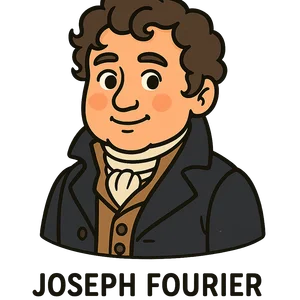
Joseph Fourier
Joseph Fourier was a French mathematician and physicist known for his work on the Fourier series and its…
Reads at Grades 6–8 Listens at Grades 4–8
Print & create
Answer keys·No prep·Free with an account
28 worksheets · answer keys · full story · quiz · Ages 10-12 · CEFR B2
Plus adds 244,000+ more stories in 27 languages, audio for every one, and printables for all of them.
Just want Joseph Fourier?
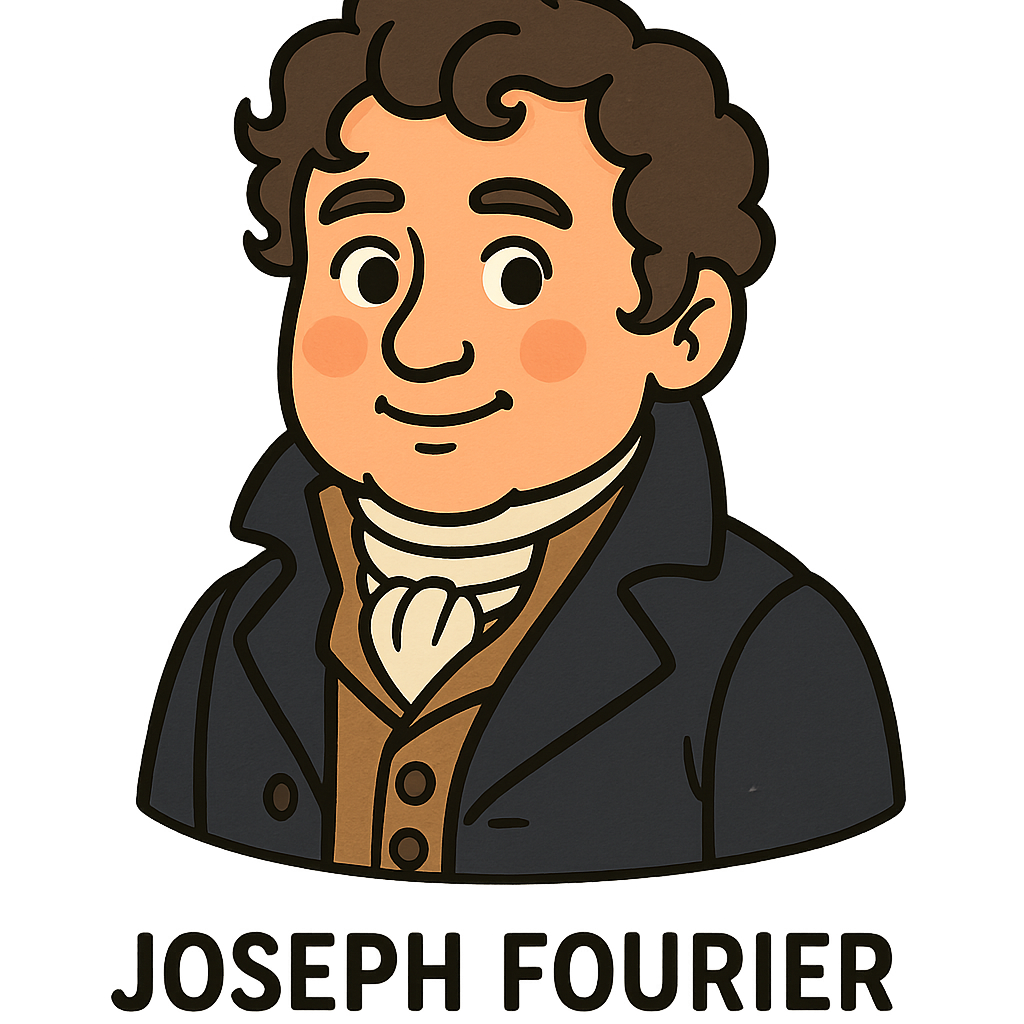
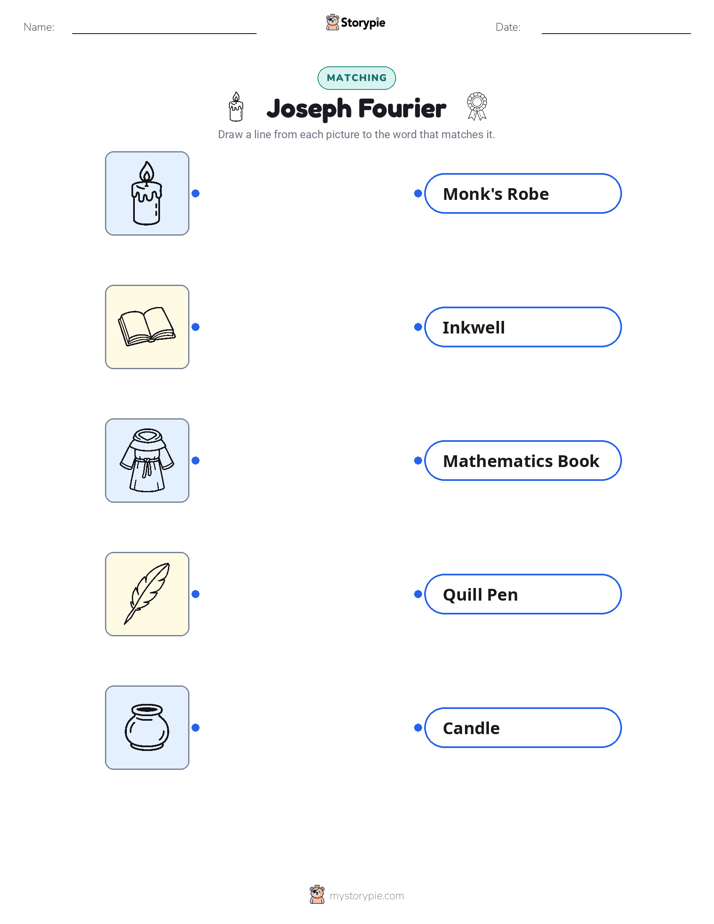
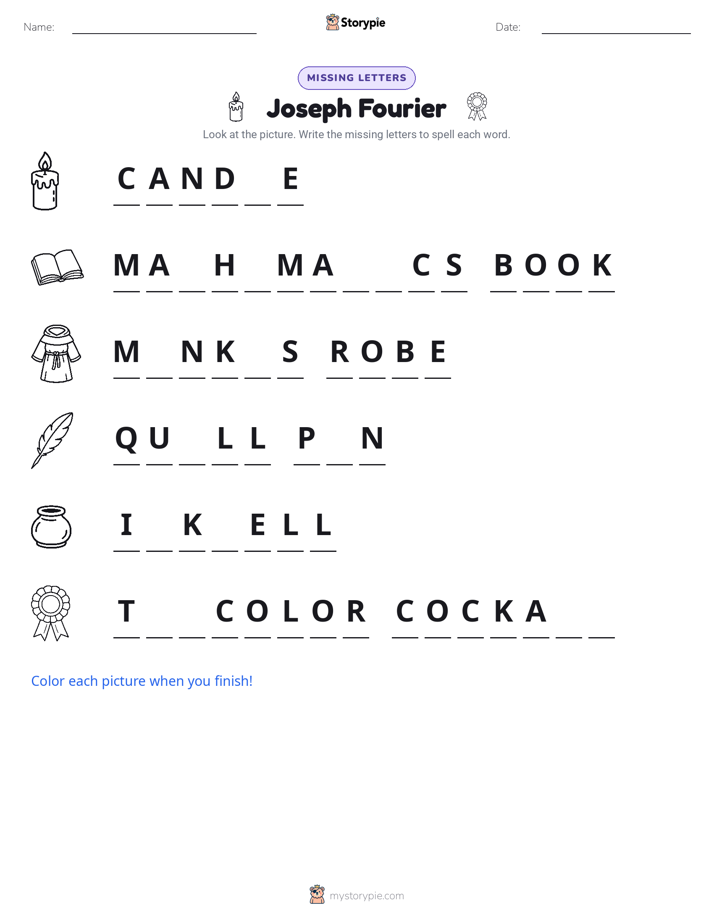
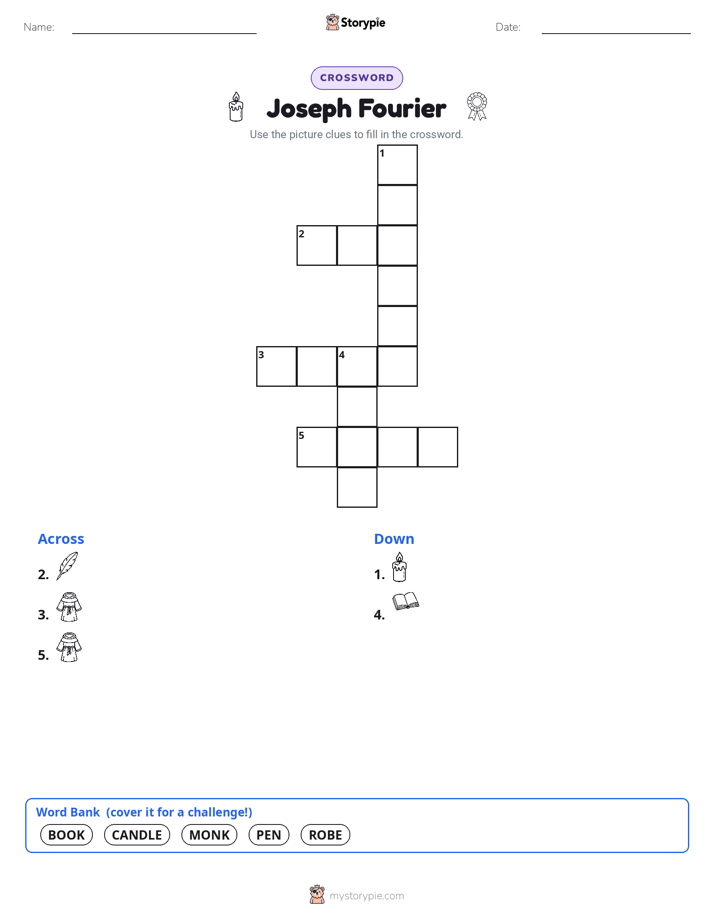
Hello! My name is Jean-Baptiste Joseph Fourier, and I’d like to share my story with you. I was born on March 21st, 1768, in a town called Auxerre, France. My father was a tailor, but my life changed when both my parents passed away before I turned ten. It was a challenging start, but I found a new home at the local military school, which was run by Benedictine monks. They encouraged me to study religion, but my true passion was for mathematics. I was so fascinated by numbers that I would sneak candles to my room to study my math books late into the night. For me, solving puzzles and finding patterns felt like I was learning a secret, powerful language that could describe the world.
As I grew into a young man, my country was transformed by a massive historical event. The French Revolution began in 1789, bringing big, and sometimes frightening, changes to everyone's lives. I strongly believed in the revolution's ideals of liberty and reason, so I became involved in local politics. This new era opened up different paths for me. Instead of joining the clergy as the monks had hoped, I pursued my love for learning and became a teacher. In 1795, I was given a great honor: I was appointed a professor at the new and prestigious École Normale Supérieure in Paris. There, I had the incredible opportunity to help train the next generation of France’s teachers and scientists. It was truly a dream come true.
Then, in 1798, I was invited on the greatest adventure of my life. A brilliant general named Napoleon Bonaparte was leading a military campaign to Egypt, but he wasn't just bringing soldiers. He also wanted France’s best scientists and scholars to join him on a scientific expedition, and I was chosen to be one of them. For the next three years, my life was about more than just mathematics; I was an explorer. I helped establish scientific institutes, I studied magnificent ancient monuments, and I worked to catalog the incredible discoveries we were making. I was honored to serve as the secretary of the Cairo Institute, which Napoleon founded. My time in Egypt gave me a profound appreciation for history and the remarkable achievements of ancient civilizations.
The Story of Joseph Fourier
Hello! My name is Jean-Baptiste Joseph Fourier, and I’d like to share my story with you. I was born on March 21st, 1768, in a town called Auxerre, France. My father was a tailor, but my life changed when both my parents passed away before I turned ten. It was a challenging start, but I found a new home at the local military school, which was run by Benedictine monks. They encouraged me to study religion, but my true passion was for mathematics. I was so fascinated by numbers that I would sneak candles to my room to study my math books late into the night. For me, solving puzzles and finding patterns felt like I was learning a secret, powerful language that could describe the world.
As I grew into a young man, my country was transformed by a massive historical event. The French Revolution began in 1789, bringing big, and sometimes frightening, changes to everyone's lives. I strongly believed in the revolution's ideals of liberty and reason, so I became involved in local politics. This new era opened up different paths for me. Instead of joining the clergy as the monks had hoped, I pursued my love for learning and became a teacher. In 1795, I was given a great honor: I was appointed a professor at the new and prestigious École Normale Supérieure in Paris. There, I had the incredible opportunity to help train the next generation of France’s teachers and scientists. It was truly a dream come true.
Then, in 1798, I was invited on the greatest adventure of my life. A brilliant general named Napoleon Bonaparte was leading a military campaign to Egypt, but he wasn't just bringing soldiers. He also wanted France’s best scientists and scholars to join him on a scientific expedition, and I was chosen to be one of them. For the next three years, my life was about more than just mathematics; I was an explorer. I helped establish scientific institutes, I studied magnificent ancient monuments, and I worked to catalog the incredible discoveries we were making. I was honored to serve as the secretary of the Cairo Institute, which Napoleon founded. My time in Egypt gave me a profound appreciation for history and the remarkable achievements of ancient civilizations.
When I returned to France, Napoleon entrusted me with another important role. In 1802, he appointed me as the Prefect, which is like a governor, for a region called Isère. For more than ten years, my daily work shifted from solving equations to helping people directly. I was in charge of major projects, like building a new road over the Alps and overseeing a plan to drain swamps to create healthy farmland for communities. It was during this time, surrounded by the majestic mountains and thinking about the physical world, that a scientific puzzle began to form in my mind. I wondered, how does heat actually move? How does it travel from a warm place to a cold one through a solid object? No one had a clear answer, and I was determined to find one.
I spent years of my spare time trying to solve this puzzle about heat. I had a strong feeling that the flow of heat could be described using the language I loved most: mathematics. My major breakthrough, which I first presented in 1807, was the idea that any complex pattern of heat, or even any kind of wave, could be understood as a combination of many simple, smooth waves. You can think of it like the individual notes that come together to form a beautiful chord in music. In 1822, I published all of my research in a book titled 'The Analytical Theory of Heat.' This powerful idea, which is now known as the 'Fourier Series' or 'Fourier Analysis,' became a revolutionary tool for science and engineering. It allows scientists to break down complicated signals into their simple parts, which is essential for many modern technologies.
My studies on heat led me to think about something much, much bigger: our entire planet. I performed some calculations and realized that if Earth only received warmth from the sun, it should actually be far colder than it is. This led me to a question: what was keeping our planet warm? In a paper I wrote around the year 1824, I proposed that the Earth's atmosphere must work like the glass panes of a greenhouse. It lets sunlight pass through to warm the surface, but then it traps some of that heat, preventing it from escaping back into space. I was one of the very first scientists to describe what is now famously called the 'greenhouse effect,' which has become a fundamental concept for understanding our planet's climate.
I lived a full and exciting life, filled with revolution, exploration, and discovery. I lived to be 62 years old. Today, my ideas are all around you, even if you can't see them. The Fourier analysis I developed is used to create digital music, compress the images you see on your computer, and help engineers design safer buildings. My early thoughts about our planet’s atmosphere helped launch the important science of climatology. I hope my story shows you that curiosity can take you on the most amazing adventures, and that the secret language of mathematics can help us understand the world in a whole new way.
Wow facts
About
Joseph Fourier was a French mathematician and physicist known for his work on the Fourier series and its applications to heat transfer. He is also credited with suggesting that the Earth's atmosphere might act like a blanket, helping to keep the planet warm.
Take a Quiz
Question 1 of 5
In your own words, retell the main events of Joseph Fourier's life, from his childhood to his return from Egypt.
Explore next






Want to do even more?
Go beyond exploring. Unlock tools that turn every story into real learning.

Storypie Plus for families
Full stories, quizzes, and printables. Nights and car rides, sorted.
- Unlimited audio stories
- Create Mode: your child stars in the story
- Offline downloads
- Printable worksheets & coloring pages

Why Storypie for Schools
Students engaged. Prep in seconds. Evenings back to you.
- Worksheets & Quizzes
- Classroom Management
- Formative Assessment
- Custom Curriculum & Lesson Plans
- 27 Languages

Why Storypie for Homeschool
Curriculum done. They'll ask for more. Hours back in your day.
- Worksheet Generator
- First-Person Audio Stories
- Built-in Comprehension Quizzes
- Custom Curriculum & Lesson Plans
- Print & Go Activities