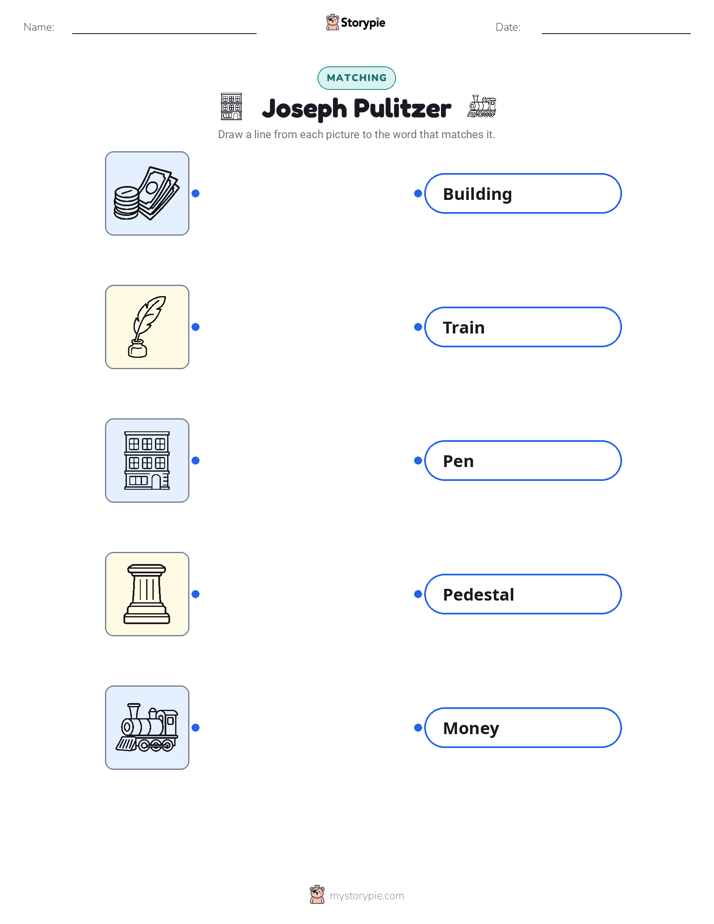
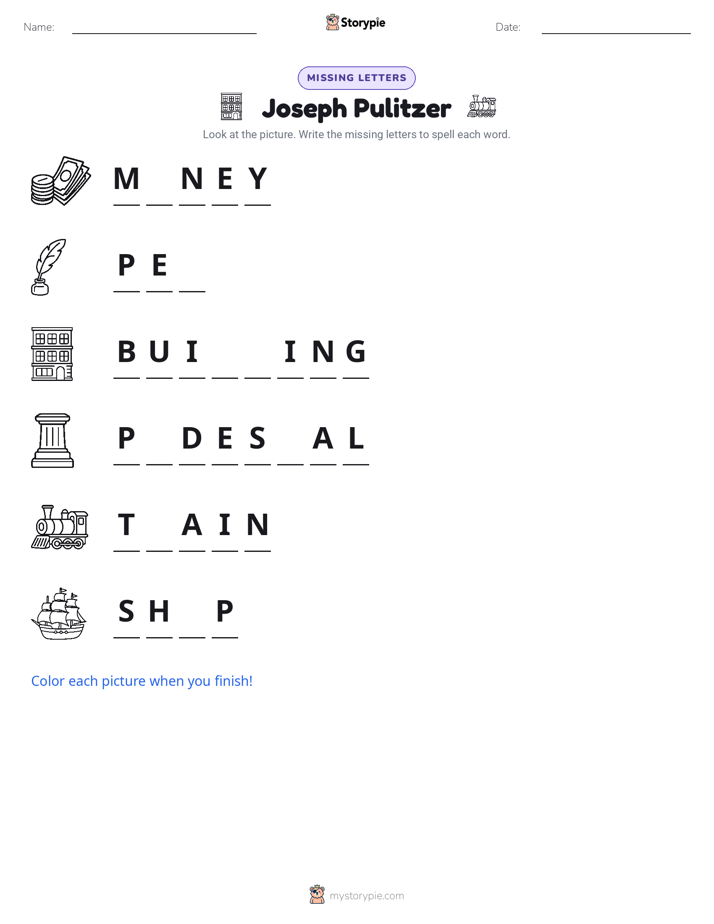
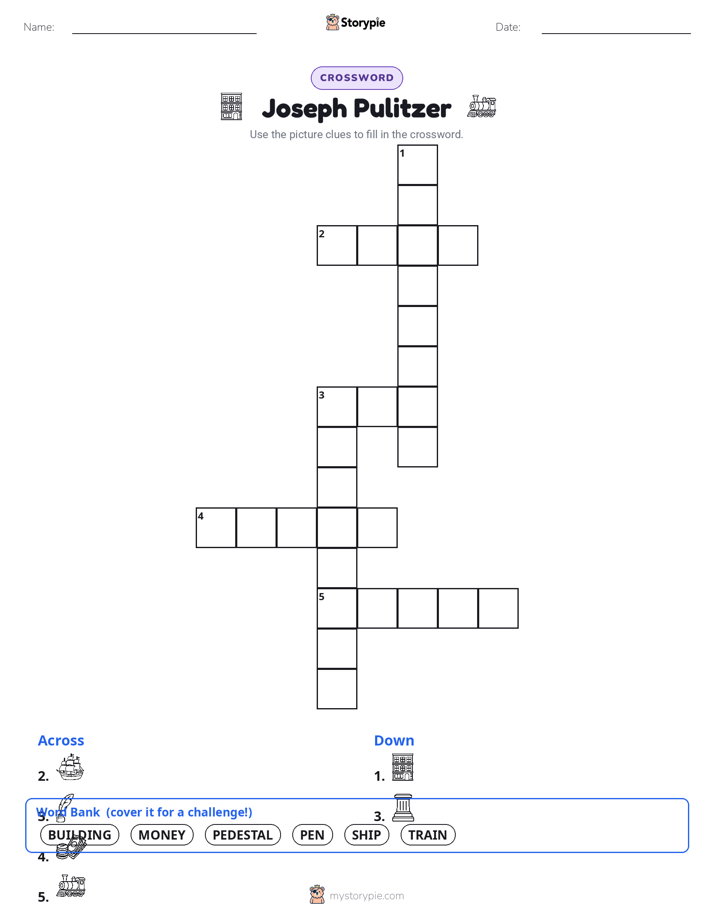
English


Joseph Pulitzer
A Hungarian-American newspaper publisher of the St.
Reads at Grades 6–8 Listens at Grades 4–8
Print & create
Answer keys·No prep·Free with an account
28 worksheets · answer keys · full story · quiz · Ages 10-12 · CEFR B2
Plus adds 244,000+ more stories in 27 languages, audio for every one, and printables for all of them.
Just want Joseph Pulitzer?
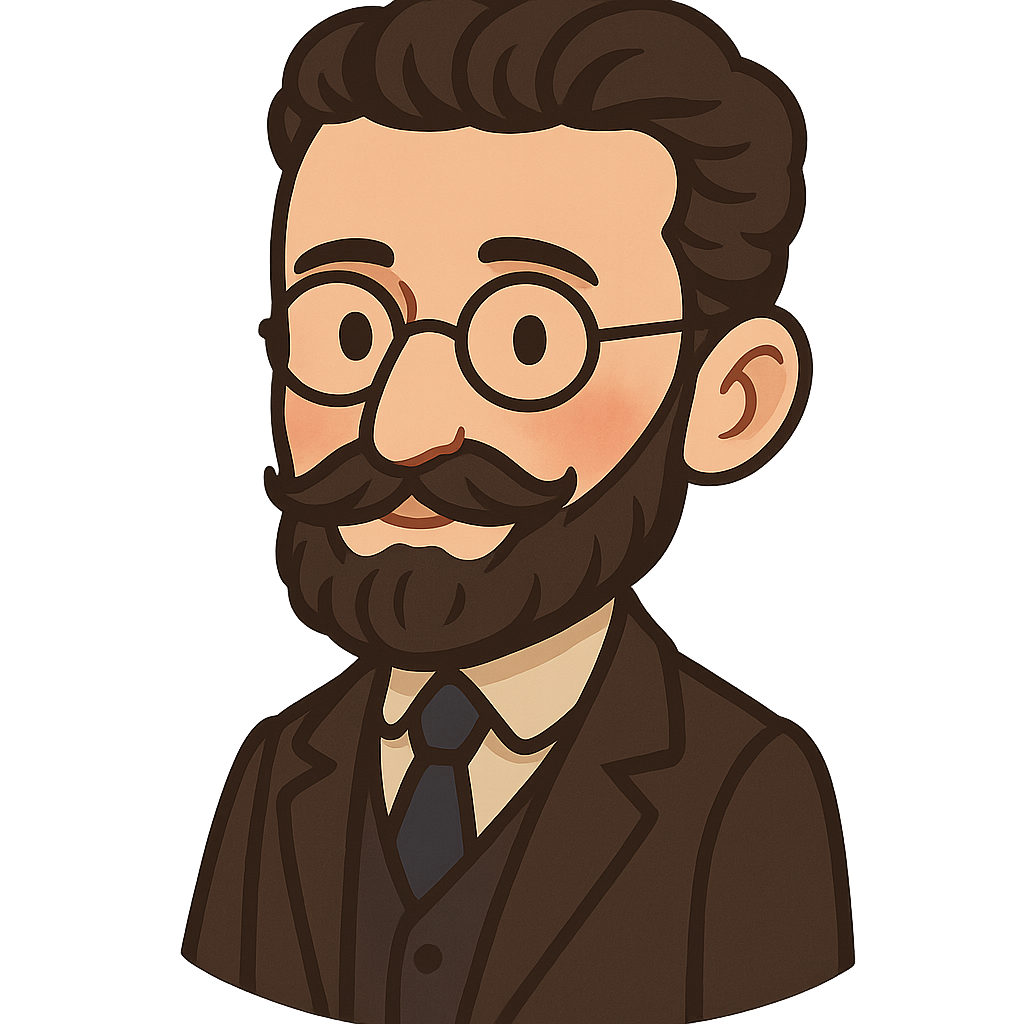
Hello, my name is Joseph Pulitzer, and I believe that a newspaper should be a voice for the people. My story, however, begins far from the bustling cities of America. I was born on April 10th, 1847, in a small town called Makó, in Hungary. Growing up, my head was filled with dreams of adventure and making a name for myself in a new world. As a teenager, I was determined to find that adventure, so I set my sights on America. In 1864, I finally arrived, a young man with very little money but a great deal of hope. My new life began almost immediately, as I joined the Union Army to fight in the final year of the American Civil War. It was a challenging and difficult start in a foreign land, but that journey shaped me and set me on a path I could never have imagined.
After the war ended, I made my way to St. Louis, Missouri, to build a new life for myself. It was not easy. I took on any odd job I could find, from waiting tables to caring for mules, all while struggling to master the English language. My big opportunity finally came in 1868, when my knowledge of German landed me a job as a reporter for a German-language newspaper. It was there I discovered my true calling: journalism. I loved investigating stories, uncovering truths, and telling the stories that mattered to ordinary citizens. I worked tirelessly, and in 1878, I took the biggest risk of my life. I purchased a struggling local newspaper and merged it with another to create the St. Louis Post-Dispatch. From its very first day, I made a promise that the newspaper would always serve the public and never be afraid to challenge the powerful.
Joseph Pulitzer: The Voice of the People
Hello, my name is Joseph Pulitzer, and I believe that a newspaper should be a voice for the people. My story, however, begins far from the bustling cities of America. I was born on April 10th, 1847, in a small town called Makó, in Hungary. Growing up, my head was filled with dreams of adventure and making a name for myself in a new world. As a teenager, I was determined to find that adventure, so I set my sights on America. In 1864, I finally arrived, a young man with very little money but a great deal of hope. My new life began almost immediately, as I joined the Union Army to fight in the final year of the American Civil War. It was a challenging and difficult start in a foreign land, but that journey shaped me and set me on a path I could never have imagined.
After the war ended, I made my way to St. Louis, Missouri, to build a new life for myself. It was not easy. I took on any odd job I could find, from waiting tables to caring for mules, all while struggling to master the English language. My big opportunity finally came in 1868, when my knowledge of German landed me a job as a reporter for a German-language newspaper. It was there I discovered my true calling: journalism. I loved investigating stories, uncovering truths, and telling the stories that mattered to ordinary citizens. I worked tirelessly, and in 1878, I took the biggest risk of my life. I purchased a struggling local newspaper and merged it with another to create the St. Louis Post-Dispatch. From its very first day, I made a promise that the newspaper would always serve the public and never be afraid to challenge the powerful.
My ambition didn't stop in St. Louis. I knew I could have an even bigger impact, so in 1883, I moved my family to New York City and purchased another failing newspaper, the New York World. I had a vision to transform it into the most widely read newspaper in the entire country. To do this, I changed everything about it. I introduced bold, eye-catching headlines that grabbed people's attention and filled the pages with exciting pictures and illustrations, which were rare at the time. I even added the first color comic strips to a newspaper. Most importantly, I focused on a new kind of journalism called investigative reporting. My reporters wrote stories that exposed corruption in the government and fought for the rights of the poor, immigrants, and factory workers. I wanted the New York World to be more than just a newspaper; I wanted it to be a champion for those who had no voice in society.
One of the proudest moments of my career came in 1885 and involved a very famous gift from France. The Statue of Liberty had been given to the United States, but the massive copper statue was stuck in crates in a warehouse. There was no money to build the huge stone pedestal she needed to stand on. I saw this as a perfect opportunity to show what people could do when they worked together. Through the pages of the New York World, I launched a fundraising campaign and asked my readers for help. I promised to print the name of every single person who donated, no matter if they gave a dollar or a single penny. The response was incredible. Thousands of people, many of them schoolchildren giving up their pocket money, sent in their dimes, nickels, and pennies. In just a few months, we raised all the money needed. Together, we gave Lady Liberty her home in New York Harbor, proving that even the smallest contributions can achieve something great.
As my newspaper became more successful, so did my rivals. In the 1890s, I found myself in a fierce competition with another publisher named William Randolph Hearst. We both wanted to sell the most newspapers, and this intense rivalry led to a style of reporting that became known as 'yellow journalism.' To attract readers, our newspapers sometimes printed sensational headlines and exaggerated stories that were not always completely accurate. This method certainly sold millions of papers and made both of us incredibly wealthy and powerful. However, as I looked back on that time later in my life, I realized the immense responsibility that journalists have. It taught me a valuable lesson: telling the truth is more important than selling a newspaper, and a reporter's first duty is always to the public.
As the years went on, my health declined and my eyesight began to fail, but my vision for the future of journalism never dimmed. I wanted to ensure that the profession I loved would continue to serve the public with integrity and skill. In my will, I left a significant portion of my fortune to establish two very important things. First was the creation of a school for journalists at Columbia University, which officially opened in 1912. The second was the establishment of a series of special awards to honor the very best in American journalism, literature, and music. I lived to be 64 years old, passing away in 1911. I am incredibly proud that those awards, known today as the Pulitzer Prizes, are still given out every year to celebrate those who seek the truth and tell the important stories that shape our world.
Wow facts
About
A Hungarian-American newspaper publisher of the St. Louis Post-Dispatch and the New York World, known for helping to create exciting and in-depth news stories, funding the Statue of Liberty's pedestal, and establishing the Pulitzer Prizes.
Take a Quiz
Question 1 of 5
In your own words, retell the story of how the Statue of Liberty's pedestal was funded.
Explore next






Want to do even more?
Go beyond exploring. Unlock tools that turn every story into real learning.

Storypie Plus for families
Full stories, quizzes, and printables. Nights and car rides, sorted.
- Unlimited audio stories
- Create Mode: your child stars in the story
- Offline downloads
- Printable worksheets & coloring pages

Why Storypie for Schools
Students engaged. Prep in seconds. Evenings back to you.
- Worksheets & Quizzes
- Classroom Management
- Formative Assessment
- Custom Curriculum & Lesson Plans
- 27 Languages

Why Storypie for Homeschool
Curriculum done. They'll ask for more. Hours back in your day.
- Worksheet Generator
- First-Person Audio Stories
- Built-in Comprehension Quizzes
- Custom Curriculum & Lesson Plans
- Print & Go Activities