English

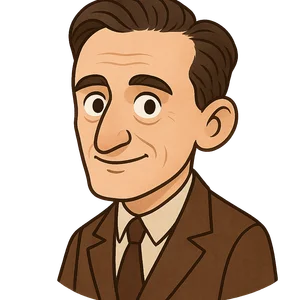
Julian Tuwim
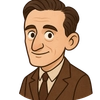
Julian Tuwim was a celebrated Polish poet, writer, and translator…
Reads at Grades 3–5 Listens at Grades 1–5
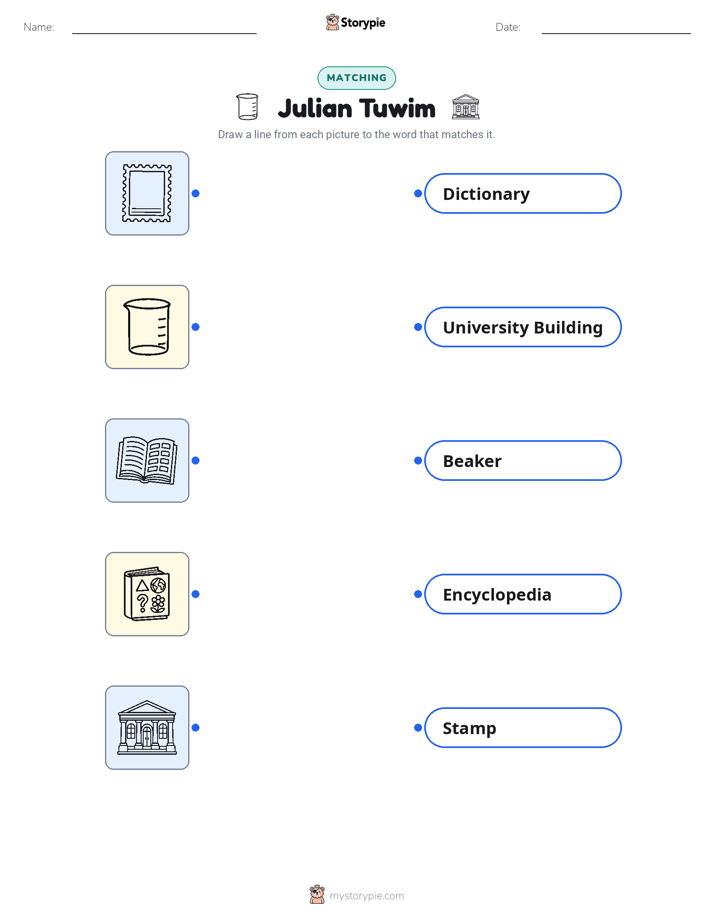
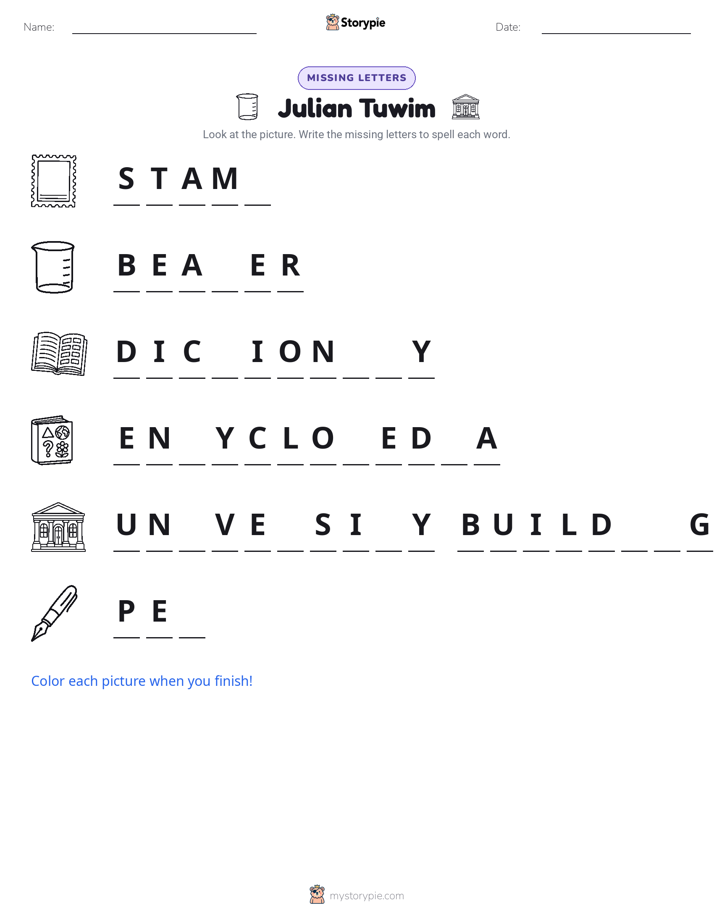
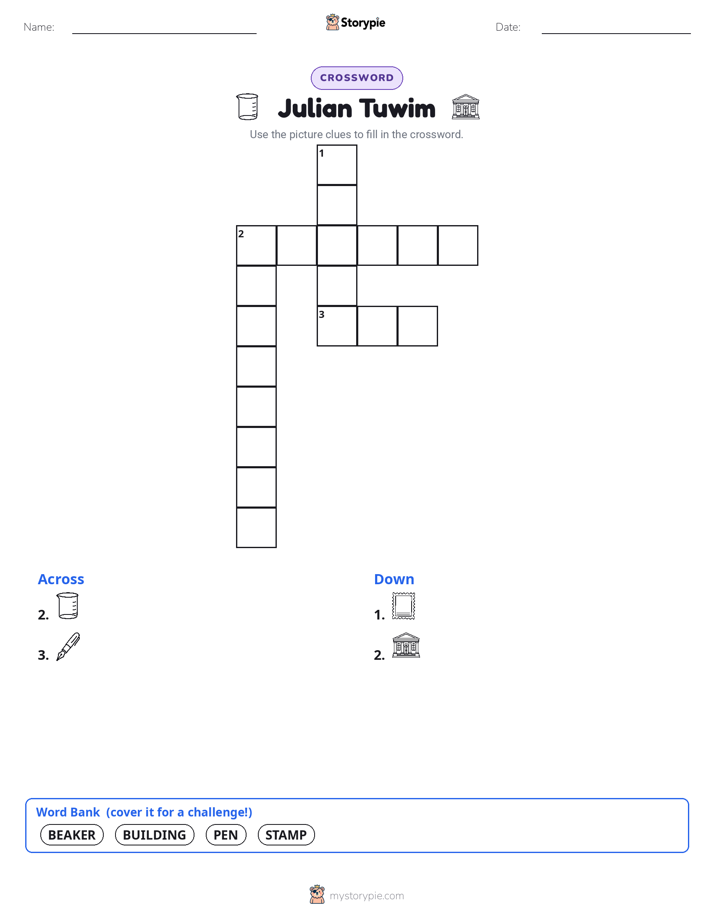
Print & create
Answer keys·No prep·Free with an account
28 worksheets · answer keys · full story · quiz · Ages 8-10 · CEFR B1
Plus adds 164,000+ more stories in 27 languages, audio for every one, and printables for all of them.
Just want Julian Tuwim?
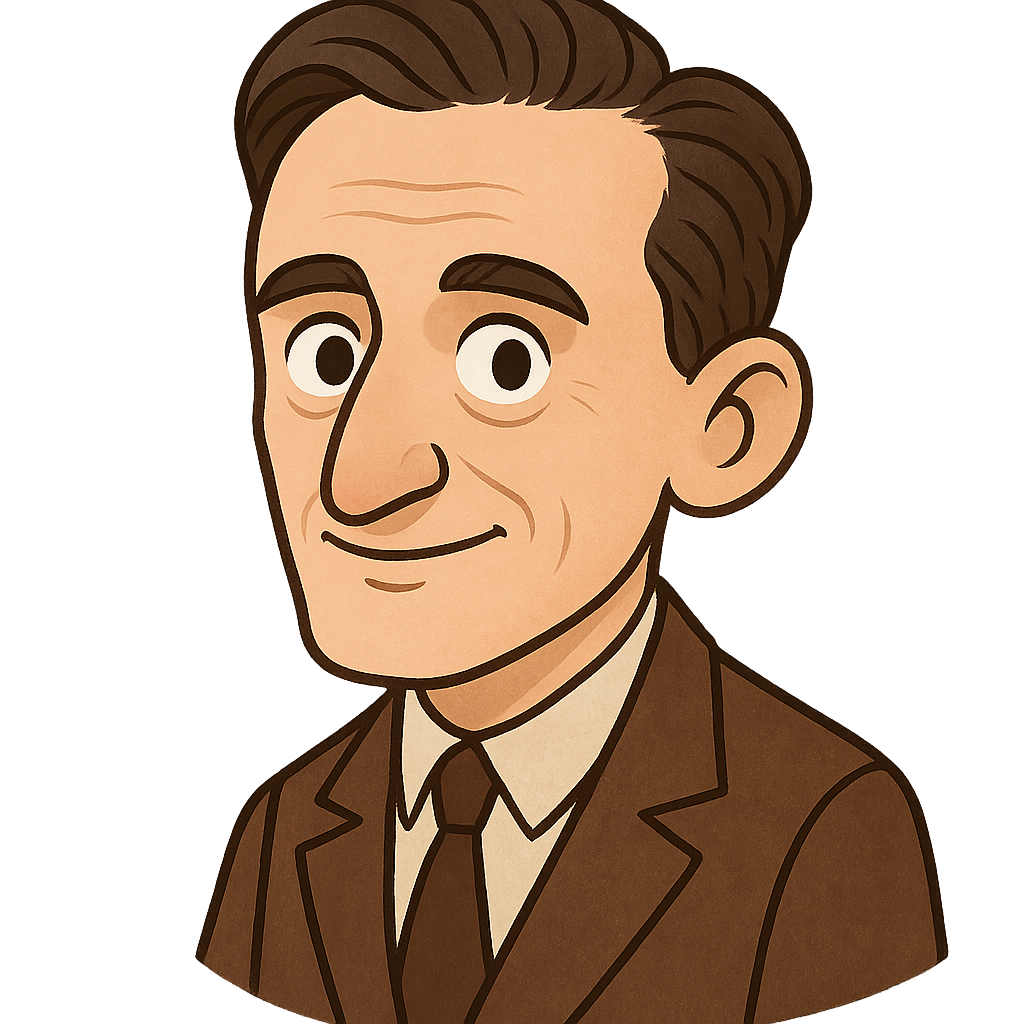
Hello. My name is Julian Tuwim, and my whole life has been a love story with words. I was born on September 13th, 1894, in a city called Łódź in Poland. Even as a young boy, I was fascinated by the world around me. I loved conducting little science experiments and learning magic tricks to amaze my family. But my biggest secret passion was words. I kept special notebooks where I would write down all the interesting, funny-sounding, and unusual words I could find. It felt like I was a collector of rare butterflies or precious stones, but my collection was made of sounds and meanings. I would listen to conversations on the street, read every book I could get my hands on, and carefully write down any word that sparked my imagination. These notebooks were my first real playground, where I could arrange and rearrange words just for the fun of it. This early love for language was the foundation for everything I would create later in my life.
When I grew older, around the year 1916, I moved to Warsaw, the capital city of Poland, to study at the university. I enrolled in classes for law and philosophy, which were very serious subjects. My parents were proud, but my heart was not truly in it. My real passion, the one that kept me up at night writing in my notebooks, was poetry. Warsaw was an exciting place, buzzing with new ideas and creative people. I soon met other young writers who felt the same way I did. We wanted to write poetry that was fresh and alive, not stuffy and old-fashioned. So, in 1918, we started our own poetry group and called it 'Skamander'. Our goal was to break free from the old rules. We believed that a poem could be about anything—a train, a flower in a city park, or a conversation overheard on a tram. We wanted our poems to sound like the world around us, full of the energy of the city and the language of everyday people. This time in Warsaw shaped me as a poet and gave me the courage to write from the heart.
Julian Tuwim: The Boy Who Collected Words
Hello. My name is Julian Tuwim, and my whole life has been a love story with words. I was born on September 13th, 1894, in a city called Łódź in Poland. Even as a young boy, I was fascinated by the world around me. I loved conducting little science experiments and learning magic tricks to amaze my family. But my biggest secret passion was words. I kept special notebooks where I would write down all the interesting, funny-sounding, and unusual words I could find. It felt like I was a collector of rare butterflies or precious stones, but my collection was made of sounds and meanings. I would listen to conversations on the street, read every book I could get my hands on, and carefully write down any word that sparked my imagination. These notebooks were my first real playground, where I could arrange and rearrange words just for the fun of it. This early love for language was the foundation for everything I would create later in my life.
When I grew older, around the year 1916, I moved to Warsaw, the capital city of Poland, to study at the university. I enrolled in classes for law and philosophy, which were very serious subjects. My parents were proud, but my heart was not truly in it. My real passion, the one that kept me up at night writing in my notebooks, was poetry. Warsaw was an exciting place, buzzing with new ideas and creative people. I soon met other young writers who felt the same way I did. We wanted to write poetry that was fresh and alive, not stuffy and old-fashioned. So, in 1918, we started our own poetry group and called it 'Skamander'. Our goal was to break free from the old rules. We believed that a poem could be about anything—a train, a flower in a city park, or a conversation overheard on a tram. We wanted our poems to sound like the world around us, full of the energy of the city and the language of everyday people. This time in Warsaw shaped me as a poet and gave me the courage to write from the heart.
While I enjoyed writing for adults, I discovered a special joy in writing for children. I believed that words could be a wonderful playground, and I wanted to invite young readers to come and play. I began to write poems filled with fun, rhythm, and imagination. One of my most famous poems for children is called 'Lokomotywa,' which means The Locomotive. I published it in 1938, and it describes a big, noisy steam train getting ready to leave the station. I used words that sounded just like the train itself—the huffing, puffing, and clattering of the wheels. I wanted children to feel the excitement and energy of the journey just by listening to the poem. In another poem, 'Rzepka,' or The Turnip, I told a silly story about a whole family trying to pull a giant turnip out of the ground. The rhymes are playful, and the story gets funnier and funnier as more people and animals join in to help. For me, writing for children was about showing them the magic of language and making reading a joyful experience.
My life, and the life of my country, changed very suddenly. In 1939, World War II began. It was a terribly sad and dangerous time for everyone in Poland. Because of the danger, I had to make the difficult decision to leave my home. For several years, I lived in different countries, far away from the streets and language that I loved so much. I missed Poland every single day—the sights, the sounds, and the people. I continued to write, but my heart longed to return. Finally, after the war ended, I was able to go back. In 1946, I returned home to Poland. The happiness I felt seeing my homeland again is hard to describe. It was a time of rebuilding, both for the country and for my own life.
After returning to Poland, I continued to write with all my heart. My life was full of words until the very end. I lived to be 59 years old and passed away on December 27th, 1953. It brings me great happiness to know that even though I am no longer here, my words live on. My poems like 'Lokomotywa' and 'Rzepka' are still read by children in Poland and have been translated into many languages for children all over the world to enjoy. I hope that my stories continue to bring laughter and help new generations discover the wonderful magic of words.
Wow facts
About
Julian Tuwim was a celebrated Polish poet, writer, and translator, renowned for his influential poetry for adults and his beloved, whimsical verses for children.
Take a Quiz
Question 1 of 5
What did Julian Tuwim collect in his secret notebooks when he was a child?
Explore next




Want to do even more?
Go beyond exploring. Unlock tools that turn every story into real learning.

Storypie Plus for families
Full stories, quizzes, and printables. Nights and car rides, sorted.
- Unlimited audio stories
- Create Mode: your child stars in the story
- Offline downloads
- Printable worksheets & coloring pages

Why Storypie for Schools
Students engaged. Prep in seconds. Evenings back to you.
- Worksheets & Quizzes
- Classroom Management
- Formative Assessment
- Custom Curriculum & Lesson Plans
- 27 Languages

Why Storypie for Homeschool
Curriculum done. They'll ask for more. Hours back in your day.
- Worksheet Generator
- First-Person Audio Stories
- Built-in Comprehension Quizzes
- Custom Curriculum & Lesson Plans
- Print & Go Activities