English

Lord Rayleigh
Lord Rayleigh was a British physicist who co-discovered the element argon…
Reads at Grades 3–5 Listens at Grades 1–5
Print & create
Answer keys·No prep·Free with an account
28 worksheets · answer keys · full story · quiz · Ages 8-10 · CEFR B1
Plus adds 244,000+ more stories in 27 languages, audio for every one, and printables for all of them.
Just want Lord Rayleigh?
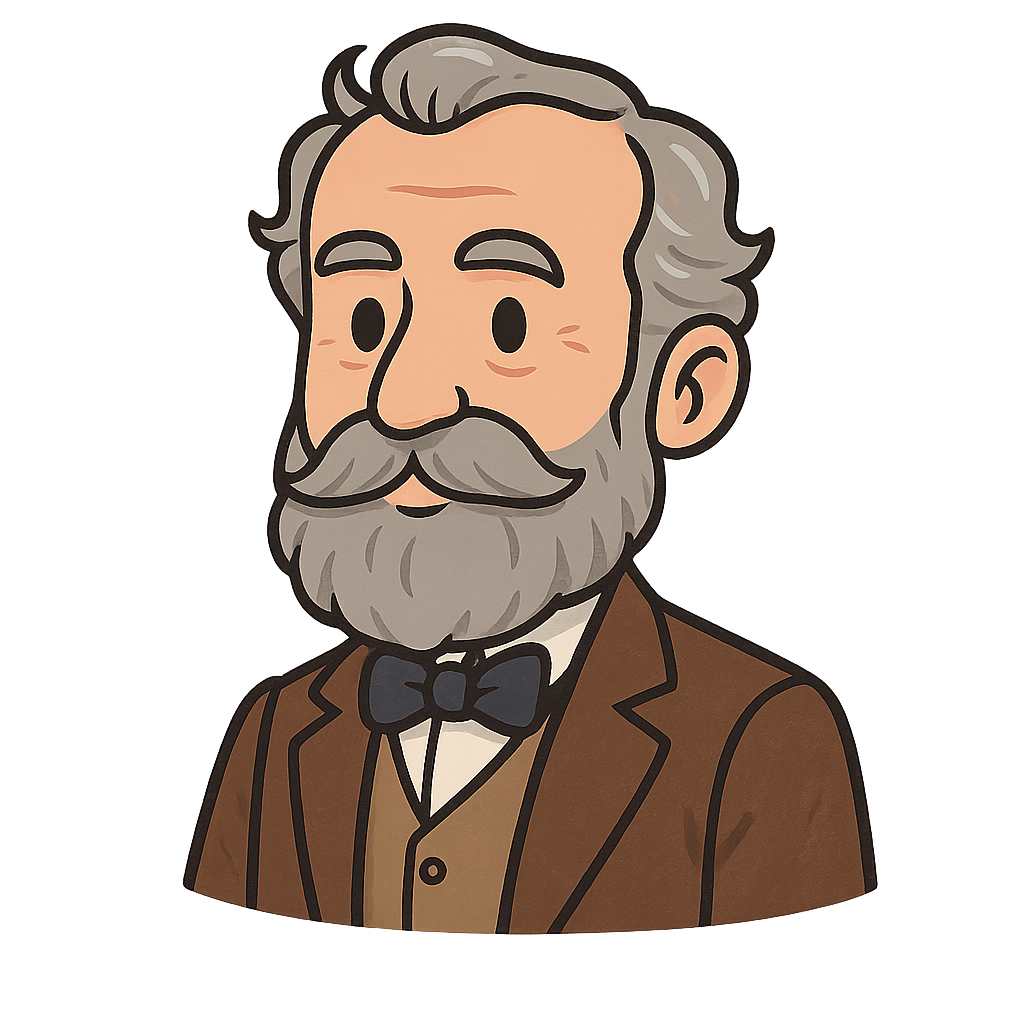
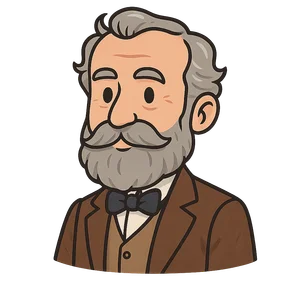
Hello! My name is John William Strutt, but most people know me by my title, Lord Rayleigh. I was born on November 12th, 1842, in a town called Maldon in Essex, England. Even as a boy, I was fascinated by how the world worked. I loved conducting experiments and solving puzzles. I wasn't always the healthiest child, but that never stopped my curiosity. I went to one of the best universities in the world, the University of Cambridge, where I studied my two favorite subjects: mathematics and physics. I loved learning so much that in 1865, I graduated at the very top of my class in math! It was a wonderful start to a life of scientific adventure.
After I finished university, I set up a laboratory at my family home. It was my special place to explore all my scientific questions. In 1871, I married the clever Evelyn Balfour, who was also interested in science and supported my work. One of the things that puzzled me most was sound. How did it travel? What were sound waves? I spent years studying them and wrote a very important book called *The Theory of Sound* in 1877. It helped other scientists understand sound for many years to come. I also solved another mystery that you might wonder about every day: why is the sky blue? I figured out that when sunlight enters our atmosphere, the blue light scatters more than other colors because it hits tiny air molecules. That scattering is what makes the sky look like a beautiful blue blanket above us.
In 1879, I became a professor at Cambridge, where I got to share my love of physics with students. Around this time, I stumbled upon a new puzzle that would become one of my greatest challenges. I was doing very careful experiments with gases, and I noticed something strange. The nitrogen I got from the air was just a tiny bit heavier than the nitrogen I made in my lab. It was such a small difference that many people would have ignored it, but my curiosity wouldn't let it go! I thought, 'There must be something else in the air that we don't know about.' I started working with another scientist named William Ramsay to solve the mystery. We worked together for months, running tests and checking our results over and over again. Finally, in 1894, we made a huge discovery.
Lord Rayleigh: The Man Who Discovered a Lazy Gas
Hello! My name is John William Strutt, but most people know me by my title, Lord Rayleigh. I was born on November 12th, 1842, in a town called Maldon in Essex, England. Even as a boy, I was fascinated by how the world worked. I loved conducting experiments and solving puzzles. I wasn't always the healthiest child, but that never stopped my curiosity. I went to one of the best universities in the world, the University of Cambridge, where I studied my two favorite subjects: mathematics and physics. I loved learning so much that in 1865, I graduated at the very top of my class in math! It was a wonderful start to a life of scientific adventure.
After I finished university, I set up a laboratory at my family home. It was my special place to explore all my scientific questions. In 1871, I married the clever Evelyn Balfour, who was also interested in science and supported my work. One of the things that puzzled me most was sound. How did it travel? What were sound waves? I spent years studying them and wrote a very important book called The Theory of Sound in 1877. It helped other scientists understand sound for many years to come. I also solved another mystery that you might wonder about every day: why is the sky blue? I figured out that when sunlight enters our atmosphere, the blue light scatters more than other colors because it hits tiny air molecules. That scattering is what makes the sky look like a beautiful blue blanket above us.
In 1879, I became a professor at Cambridge, where I got to share my love of physics with students. Around this time, I stumbled upon a new puzzle that would become one of my greatest challenges. I was doing very careful experiments with gases, and I noticed something strange. The nitrogen I got from the air was just a tiny bit heavier than the nitrogen I made in my lab. It was such a small difference that many people would have ignored it, but my curiosity wouldn't let it go! I thought, 'There must be something else in the air that we don't know about.' I started working with another scientist named William Ramsay to solve the mystery. We worked together for months, running tests and checking our results over and over again. Finally, in 1894, we made a huge discovery.
We had found a brand-new gas hiding in the air! It was mixed in with the nitrogen, which is why the air nitrogen was heavier all along. This new gas was very unusual because it didn't seem to do anything. It wouldn't mix or react with other chemicals, no matter what we tried. Because it was so inactive, we decided to name it 'argon,' from a Greek word that means 'the lazy one.' Discovering a whole new element was incredibly exciting. It was like finding a missing piece of the puzzle of the universe. Ten years later, in 1904, I was awarded the Nobel Prize in Physics for my work. It was one of the proudest moments of my life to know that my careful work had helped us understand the world a little bit better.
I continued my scientific work for the rest of my life, always asking questions and searching for answers. I even became the head of Cambridge University in 1908. I lived to be 76 years old. Today, people remember me for discovering argon, which helped add a whole new family of elements called noble gases to the periodic table. And every time you look up and wonder why the sky is blue, you can think of my work. I hope my story reminds you that sometimes the biggest discoveries come from noticing the smallest details.
Wow facts
About
Lord Rayleigh was a British physicist who co-discovered the element argon, explained why the sky is blue through a phenomenon now named Rayleigh scattering, and won the Nobel Prize in Physics in 1904.
Take a Quiz
Question 1 of 5
According to the story, what two major scientific questions did Lord Rayleigh solve?
Explore next






Want to do even more?
Go beyond exploring. Unlock tools that turn every story into real learning.

Storypie Plus for families
Full stories, quizzes, and printables. Nights and car rides, sorted.
- Unlimited audio stories
- Create Mode: your child stars in the story
- Offline downloads
- Printable worksheets & coloring pages

Why Storypie for Schools
Students engaged. Prep in seconds. Evenings back to you.
- Worksheets & Quizzes
- Classroom Management
- Formative Assessment
- Custom Curriculum & Lesson Plans
- 27 Languages

Why Storypie for Homeschool
Curriculum done. They'll ask for more. Hours back in your day.
- Worksheet Generator
- First-Person Audio Stories
- Built-in Comprehension Quizzes
- Custom Curriculum & Lesson Plans
- Print & Go Activities