English

M. C. Escher
Maurits Cornelis Escher was a Dutch graphic artist known for his mathematically inspired woodcuts…
Reads at Grades 3–5 Listens at Grades 1–5
Print & create
Answer keys·No prep·Free with an account
28 worksheets · answer keys · full story · quiz · Ages 8-10 · CEFR B1
Plus adds 164,000+ more stories in 27 languages, audio for every one, and printables for all of them.
Just want M. C. Escher?
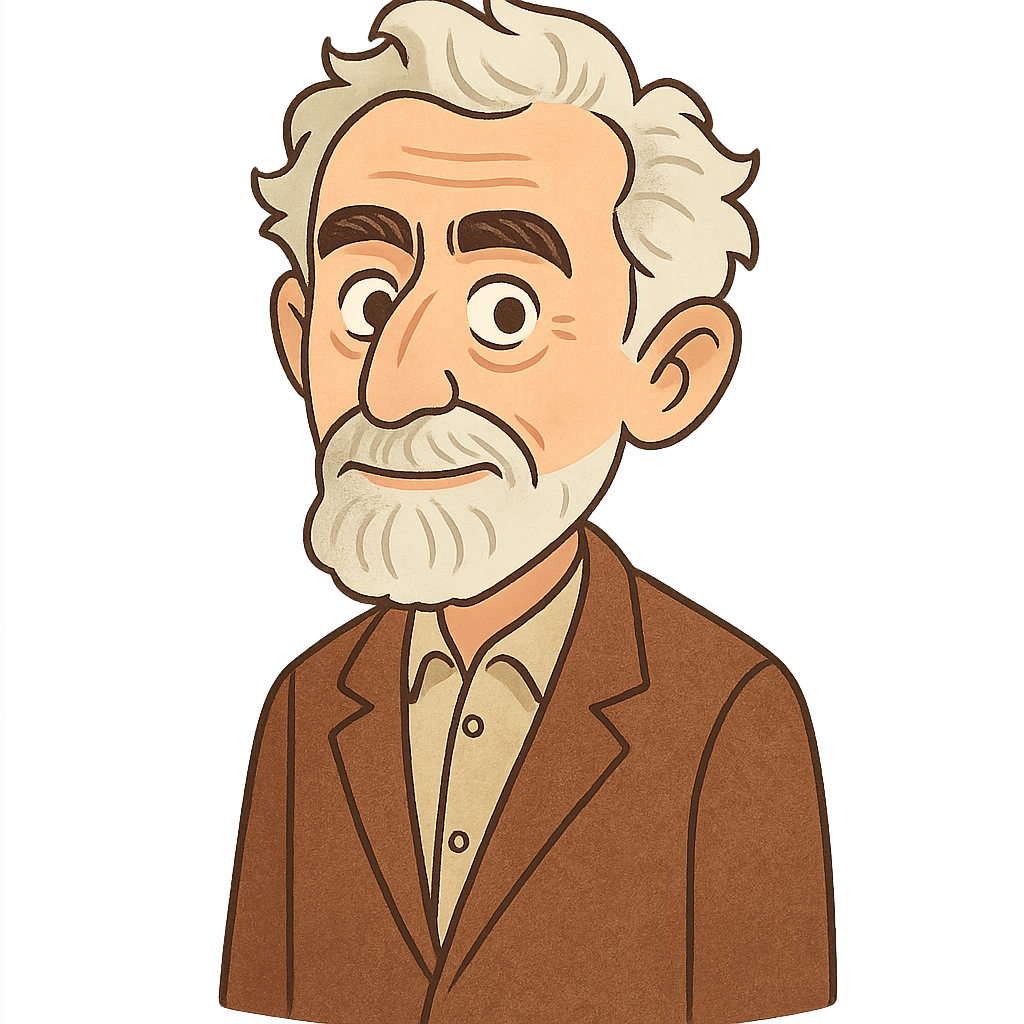
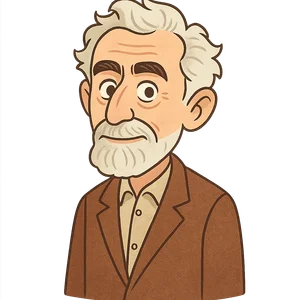
Hello! My name is Maurits Cornelis Escher, but my family always called me Mauk. I was born a long time ago, on June 17th, 1898, in a city called Leeuwarden in the Netherlands. I was the youngest of five boys, and while I wasn't the best student in subjects like math or history, there was one thing I loved more than anything: drawing. I would spend hours creating pictures, letting my imagination run wild on paper. My teachers might have thought I was a daydreamer, but I was just busy building worlds with my pencils. It was clear from a young age that art was my favorite way to explore the world around me.
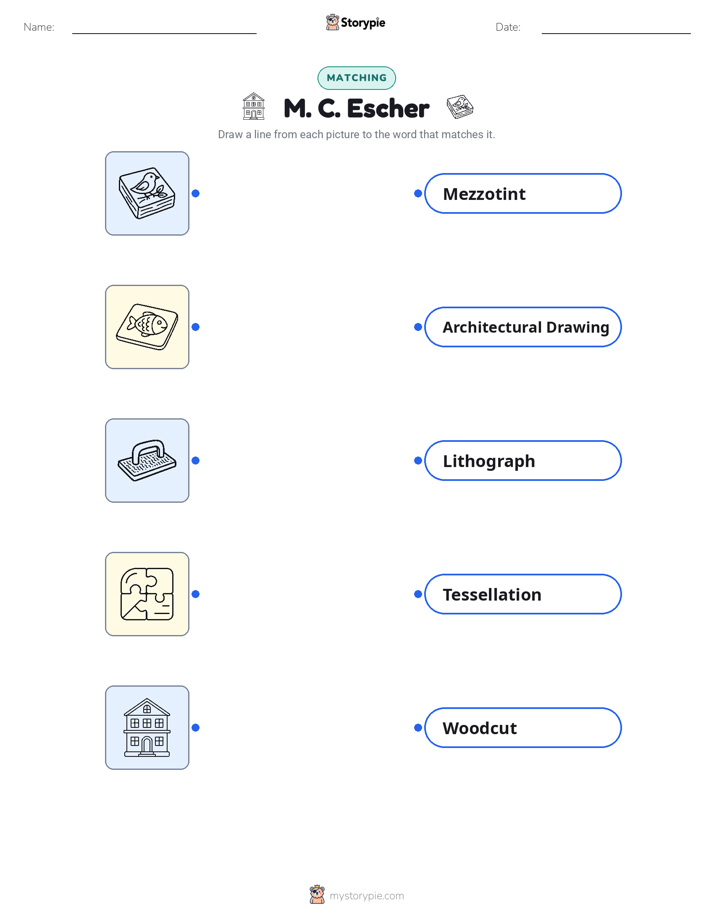
When I grew up, I thought I should study architecture to design buildings. So, in 1919, I went to the School for Architecture and Decorative Arts in a city called Haarlem. But one of my teachers, a wonderful artist named Samuel Jessurun de Mesquita, saw my drawings and woodcuts. He told me that my real talent was in graphic arts—making prints. He showed my work to my parents and convinced them that I should be an artist, not an architect. It was one of the most important moments of my life! His belief in me changed my direction and helped me find my true path.
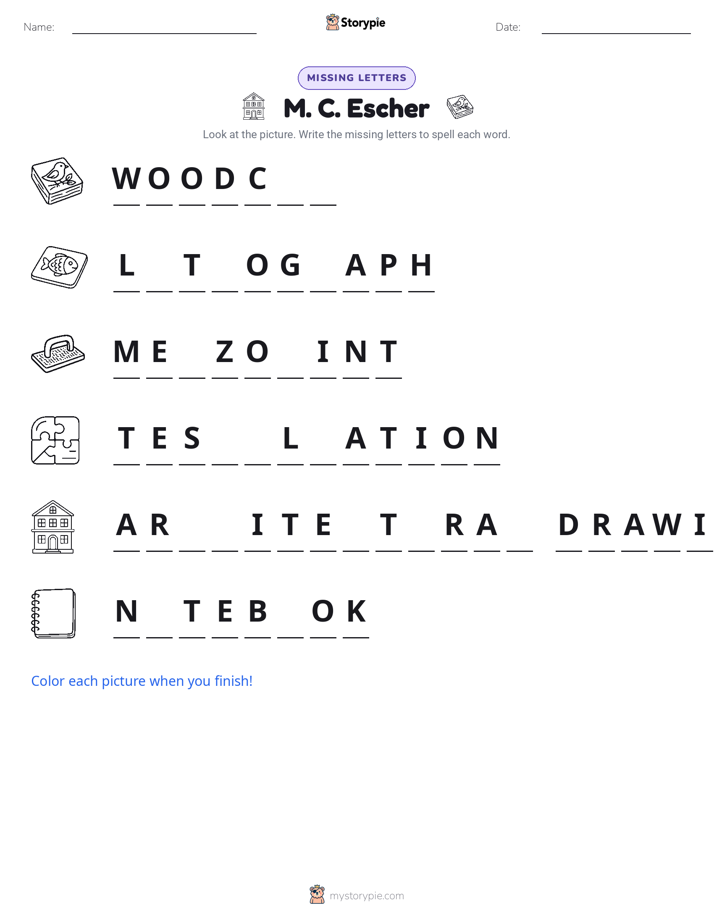
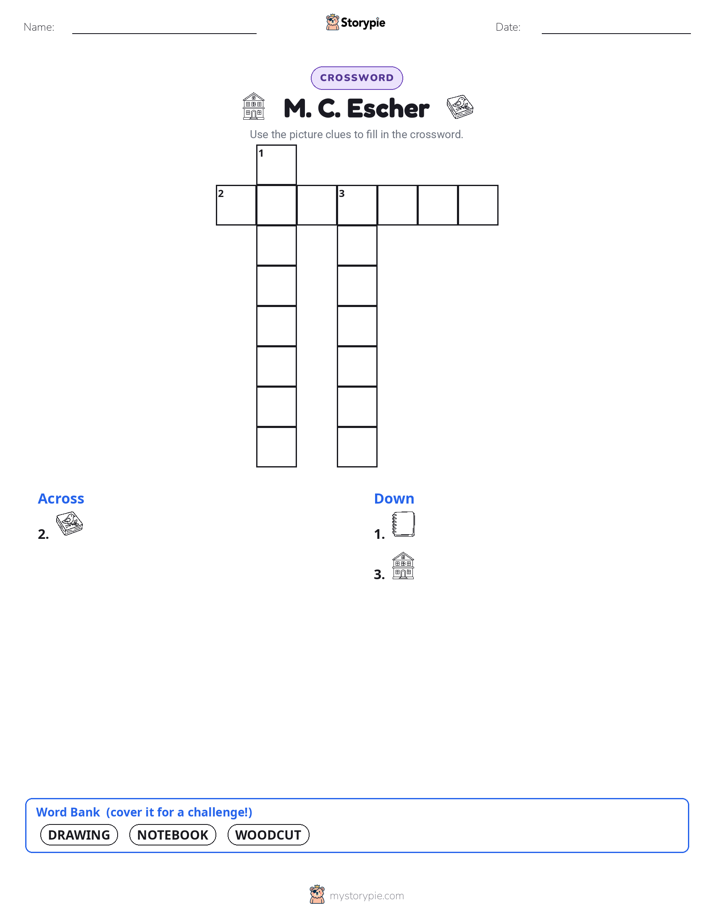
I loved to travel and see new things. A journey I took in 1922, and again in 1936, changed my art forever. I visited a beautiful, ancient palace in Spain called the Alhambra. It wasn't like any place I had ever seen. The walls and floors were covered in amazing tiles with repeating patterns of shapes—birds, fish, and lizards that all fit together perfectly without any gaps. This is called a 'tessellation.' I was completely mesmerized. I spent days sketching these patterns, trying to understand how they worked. This visit sparked an idea that would fill my artwork for the rest of my life: the regular division of the plane.
The Impossible Worlds of Maurits Cornelis Escher
Hello! My name is Maurits Cornelis Escher, but my family always called me Mauk. I was born a long time ago, on June 17th, 1898, in a city called Leeuwarden in the Netherlands. I was the youngest of five boys, and while I wasn't the best student in subjects like math or history, there was one thing I loved more than anything: drawing. I would spend hours creating pictures, letting my imagination run wild on paper. My teachers might have thought I was a daydreamer, but I was just busy building worlds with my pencils. It was clear from a young age that art was my favorite way to explore the world around me.
When I grew up, I thought I should study architecture to design buildings. So, in 1919, I went to the School for Architecture and Decorative Arts in a city called Haarlem. But one of my teachers, a wonderful artist named Samuel Jessurun de Mesquita, saw my drawings and woodcuts. He told me that my real talent was in graphic arts—making prints. He showed my work to my parents and convinced them that I should be an artist, not an architect. It was one of the most important moments of my life! His belief in me changed my direction and helped me find my true path.
I loved to travel and see new things. A journey I took in 1922, and again in 1936, changed my art forever. I visited a beautiful, ancient palace in Spain called the Alhambra. It wasn't like any place I had ever seen. The walls and floors were covered in amazing tiles with repeating patterns of shapes—birds, fish, and lizards that all fit together perfectly without any gaps. This is called a 'tessellation.' I was completely mesmerized. I spent days sketching these patterns, trying to understand how they worked. This visit sparked an idea that would fill my artwork for the rest of my life: the regular division of the plane.
After my visits to the Alhambra, the patterns I saw made me wonder: what else could I draw that played with rules and reality? I started creating pictures that looked real at first, but if you looked closer, you'd see they were impossible! In 1948, I drew a piece called 'Drawing Hands,' where two hands are drawing each other into existence. In another one from 1953, called 'Relativity,' people walk up and down stairs that are all connected in ways that couldn't happen in real life. My art became a playground for the mind, where I could explore ideas like infinity and create worlds that tricked your eyes and challenged you to look more closely at what you thought was real.
I spent my whole life exploring the magical space where art and mathematics meet. My pictures weren't always understood by art critics at first, but mathematicians and scientists loved them! I continued making my mind-bending art for many years. I lived to be 73 years old, passing away on March 27th, 1972. Today, people all over the world still enjoy my work. I hope that when you see my pictures of endless staircases or interlocking animals, it makes you smile, think, and realize that the world is full of wonderful, impossible patterns if you just know how to look.
Wow facts
About
Maurits Cornelis Escher was a Dutch graphic artist known for his mathematically inspired woodcuts, lithographs, and mezzotints featuring impossible constructions, tessellations, and explorations of infinity.
Take a Quiz
Question 1 of 5
What is a 'tessellation,' according to the story?
Explore next




Want to do even more?
Go beyond exploring. Unlock tools that turn every story into real learning.

Storypie Plus for families
Full stories, quizzes, and printables. Nights and car rides, sorted.
- Unlimited audio stories
- Create Mode: your child stars in the story
- Offline downloads
- Printable worksheets & coloring pages

Why Storypie for Schools
Students engaged. Prep in seconds. Evenings back to you.
- Worksheets & Quizzes
- Classroom Management
- Formative Assessment
- Custom Curriculum & Lesson Plans
- 27 Languages

Why Storypie for Homeschool
Curriculum done. They'll ask for more. Hours back in your day.
- Worksheet Generator
- First-Person Audio Stories
- Built-in Comprehension Quizzes
- Custom Curriculum & Lesson Plans
- Print & Go Activities