English

M. C. Escher
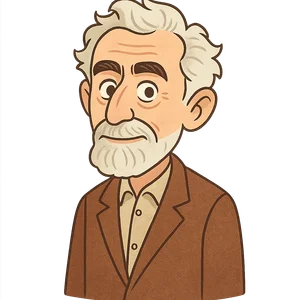
Maurits Cornelis Escher was a Dutch graphic artist known for his mathematically inspired woodcuts…
Reads at Grades 6–8 Listens at Grades 4–8
Print & create
Answer keys·No prep·Free with an account
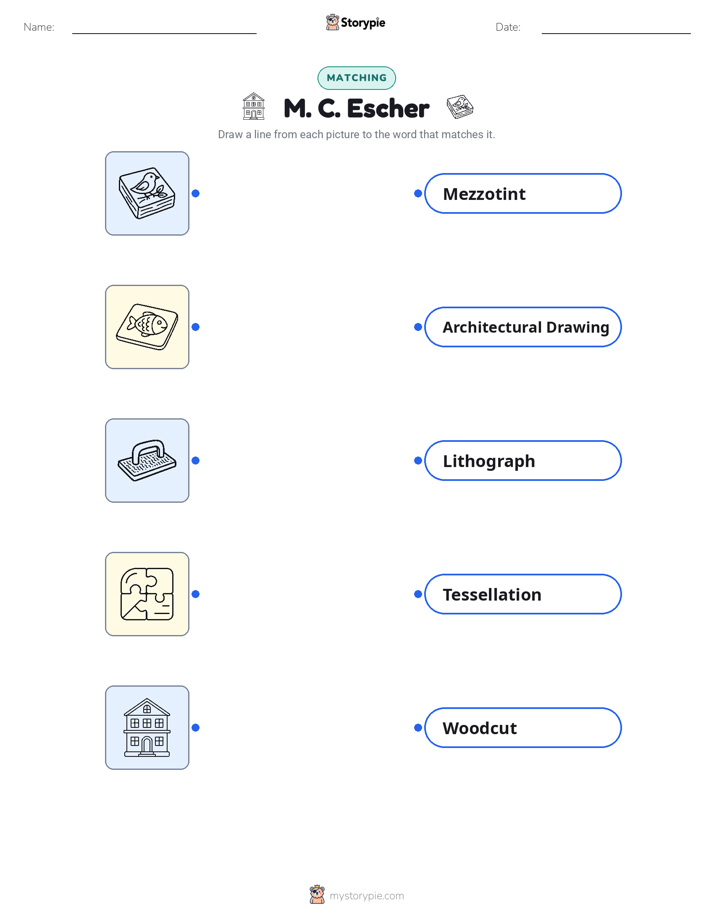
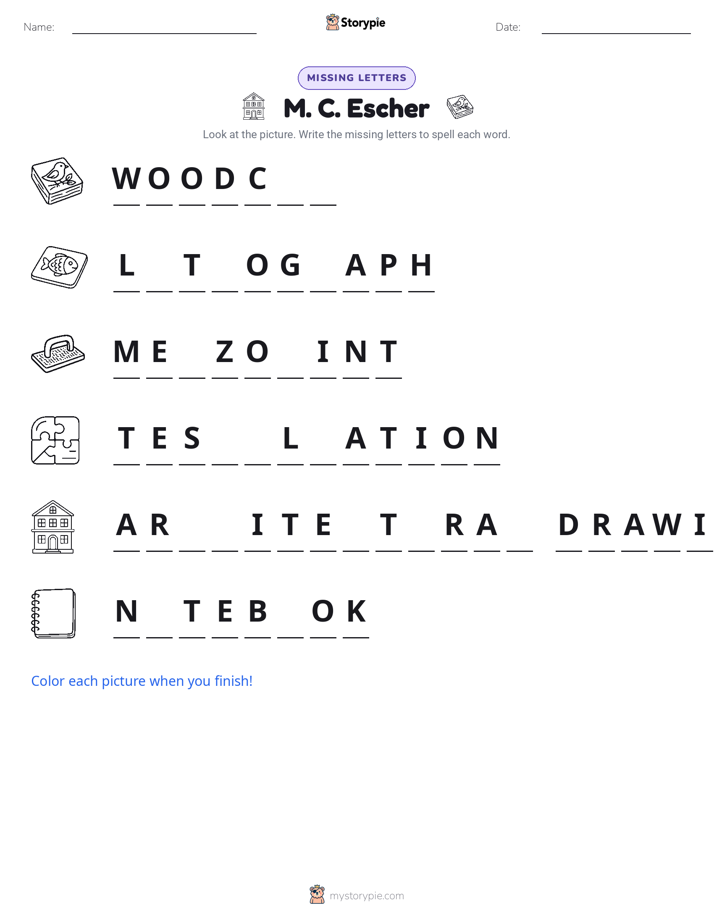
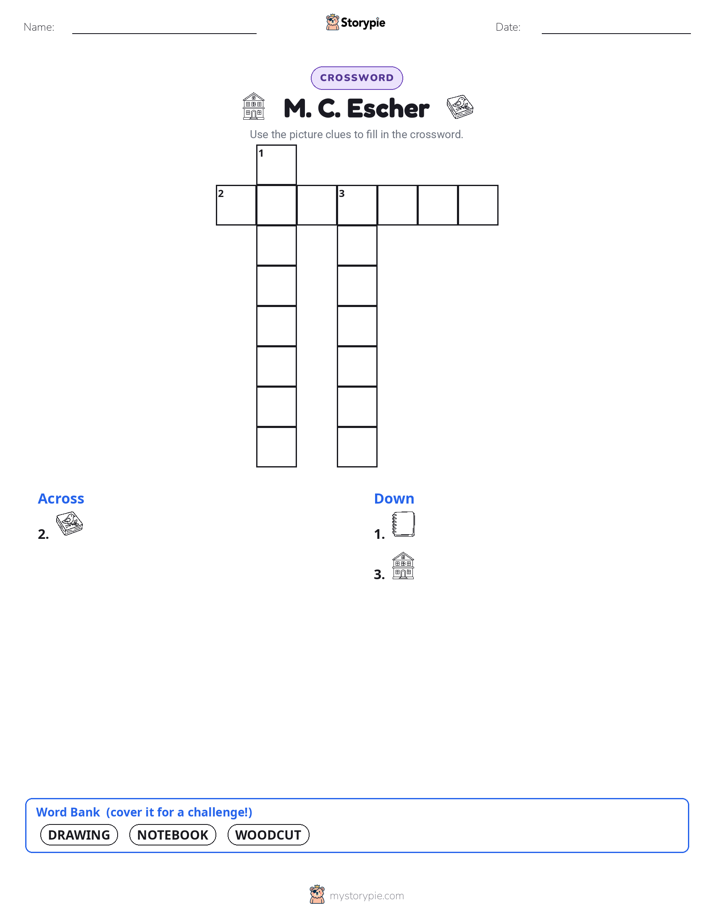
28 worksheets · answer keys · full story · quiz · Ages 10-12 · CEFR B2
Plus adds 164,000+ more stories in 27 languages, audio for every one, and printables for all of them.
Just want M. C. Escher?
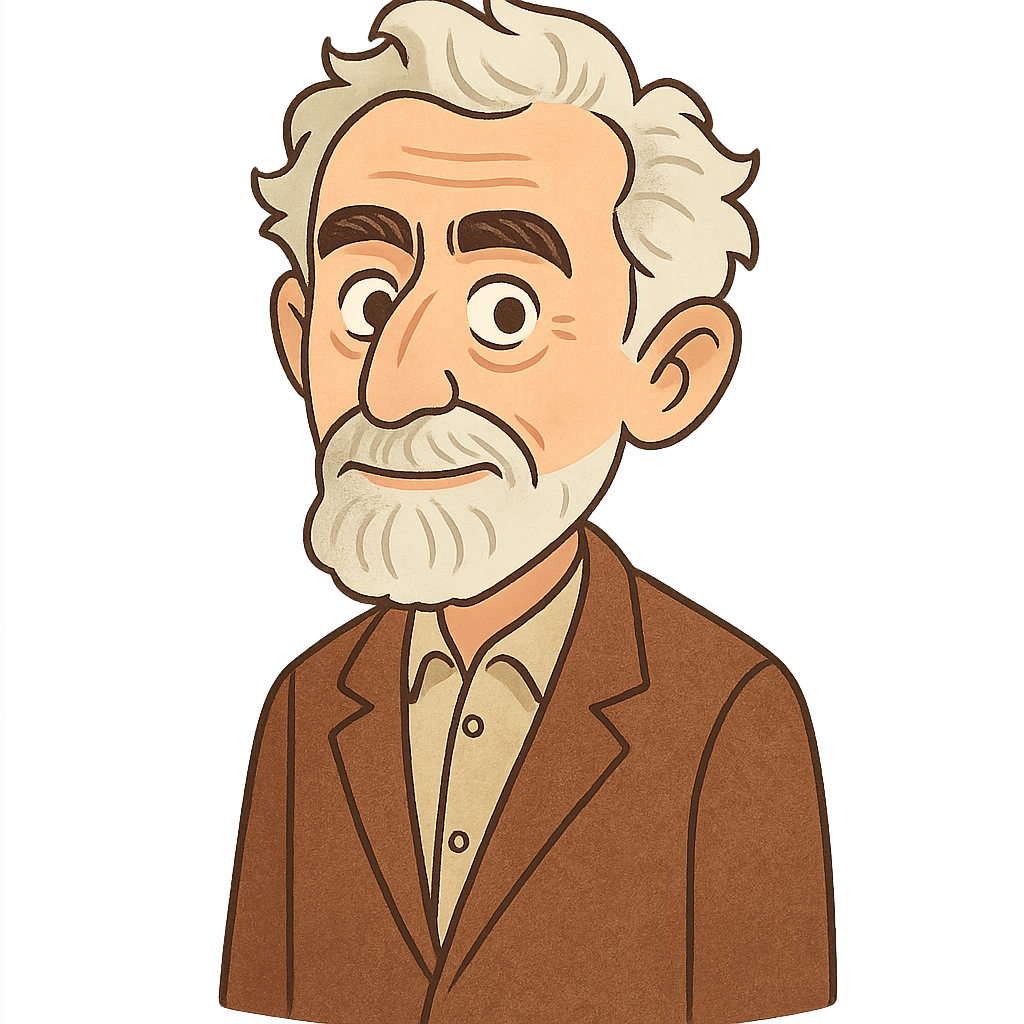
Hello. My name is Maurits Cornelis Escher, but you can call me Mauk, as my family did. I was born in the Netherlands, in a city called Leeuwarden, on June 17th, 1898. As the youngest of five sons, I often felt a little different from everyone else. In school, I found subjects like arithmetic to be quite difficult, and my grades were never very good. But while numbers and formulas confused me, the world of pictures and drawings made perfect sense. From a young age, I was always sketching. I didn't just see trees and houses; I saw the spaces between the branches and the repeating patterns of the bricks. I noticed how shapes could fit together in interesting ways, and this unique way of seeing the world around me became the foundation for everything I would create.
My father had practical hopes for my future; he wanted me to become an architect. Following his wishes, I enrolled at the School for Architecture and Decorative Arts in the city of Haarlem in 1919. I tried my best to learn how to design buildings, but my true passion kept pulling me in another direction. I filled my notebooks with sketches and woodcuts, not blueprints. Fortunately, one of my teachers, a man named Samuel Jessurun de Mesquita, noticed my work. He saw something special in my detailed drawings and prints. He took me aside and told me that my talent was not in architecture, but in the graphic arts. With his encouragement, I made the decision to leave my architectural studies behind and focus on what I truly loved. I became fascinated with printmaking, especially the technical challenge of carving an image into a block of wood, inking it, and pressing it onto paper to bring my vision to life.
M. C. Escher: Drawing Impossible Worlds
Hello. My name is Maurits Cornelis Escher, but you can call me Mauk, as my family did. I was born in the Netherlands, in a city called Leeuwarden, on June 17th, 1898. As the youngest of five sons, I often felt a little different from everyone else. In school, I found subjects like arithmetic to be quite difficult, and my grades were never very good. But while numbers and formulas confused me, the world of pictures and drawings made perfect sense. From a young age, I was always sketching. I didn't just see trees and houses; I saw the spaces between the branches and the repeating patterns of the bricks. I noticed how shapes could fit together in interesting ways, and this unique way of seeing the world around me became the foundation for everything I would create.
My father had practical hopes for my future; he wanted me to become an architect. Following his wishes, I enrolled at the School for Architecture and Decorative Arts in the city of Haarlem in 1919. I tried my best to learn how to design buildings, but my true passion kept pulling me in another direction. I filled my notebooks with sketches and woodcuts, not blueprints. Fortunately, one of my teachers, a man named Samuel Jessurun de Mesquita, noticed my work. He saw something special in my detailed drawings and prints. He took me aside and told me that my talent was not in architecture, but in the graphic arts. With his encouragement, I made the decision to leave my architectural studies behind and focus on what I truly loved. I became fascinated with printmaking, especially the technical challenge of carving an image into a block of wood, inking it, and pressing it onto paper to bring my vision to life.
After I finished school, I felt a strong desire to see more of the world. I spent years traveling through Europe, finding endless inspiration in the landscapes and cities I visited. The dramatic cliffs and winding roads of Italy, for instance, appeared in many of my early prints. However, the most important journey of my life was to Spain. I first visited the Alhambra, a magnificent palace in Granada, in 1922, and was so captivated that I returned for a longer study in 1936. I wasn't just impressed by the palace's beauty; I was mesmerized by its details. The walls and floors were covered in the most incredible tilework, with complex, repeating patterns of interlocking shapes that fit together perfectly without any gaps. These patterns are called tessellations. Seeing them sparked a powerful idea in my mind. I wondered if I could create my own tessellations, not with geometric shapes, but with figures like birds, fish, and lizards. This question would become a central obsession for the rest of my artistic career.
Back in my studio, my work began to change. I was no longer interested in just drawing what I could see with my eyes; I wanted to draw what I could build in my mind. I began creating what I called my 'mental imagery,' pictures that explored ideas of infinity, reflection, and impossible perspectives. In 1938, I created a woodcut called 'Day and Night,' which shows a landscape that transforms in the middle. On one side, a flock of white birds flies over a dark village at night, and on the other, they seamlessly become black birds flying over a sunlit village. In 1948, I made 'Drawing Hands,' a picture of two hands emerging from a piece of paper, each one sketching the other into existence. Perhaps one of my most famous works is 'Relativity,' from 1953, which depicts a bizarre world with multiple sources of gravity, where people walk up and down staircases that are connected in ways that defy logic. People often called my work mathematical, but I always considered myself an artist first. I simply used the principles of logic and geometry as my tools to create a sense of wonder and to make the impossible look real.
My strange, mind-bending art became very popular later in my life, and I was happy that so many people found joy and curiosity in the worlds I created. I lived to be 73 years old, passing away in 1972, and I spent my entire life filling sketchbooks with new ideas and puzzles. Even now, people look at my prints and find something new to discover every time they look. I hope my work reminds you that art and science are not opposites, but can be wonderful partners in creativity. More than anything, I hope my story encourages you to remember that there is always another, more interesting way to look at the world around you.
Wow facts
About
Maurits Cornelis Escher was a Dutch graphic artist known for his mathematically inspired woodcuts, lithographs, and mezzotints featuring impossible constructions, tessellations, and explorations of infinity.
Take a Quiz
Question 1 of 5
In your own words, describe M. C. Escher's journey from a student of architecture to a famous graphic artist.
Explore next




Want to do even more?
Go beyond exploring. Unlock tools that turn every story into real learning.

Storypie Plus for families
Full stories, quizzes, and printables. Nights and car rides, sorted.
- Unlimited audio stories
- Create Mode: your child stars in the story
- Offline downloads
- Printable worksheets & coloring pages

Why Storypie for Schools
Students engaged. Prep in seconds. Evenings back to you.
- Worksheets & Quizzes
- Classroom Management
- Formative Assessment
- Custom Curriculum & Lesson Plans
- 27 Languages

Why Storypie for Homeschool
Curriculum done. They'll ask for more. Hours back in your day.
- Worksheet Generator
- First-Person Audio Stories
- Built-in Comprehension Quizzes
- Custom Curriculum & Lesson Plans
- Print & Go Activities