English


Margaret Hamilton (software engineer)
Margaret Hamilton is an American computer scientist and systems engineer who was Director of the Software…
Reads at Grades 6–8 Listens at Grades 4–8
Print & create
Answer keys·No prep·Free with an account
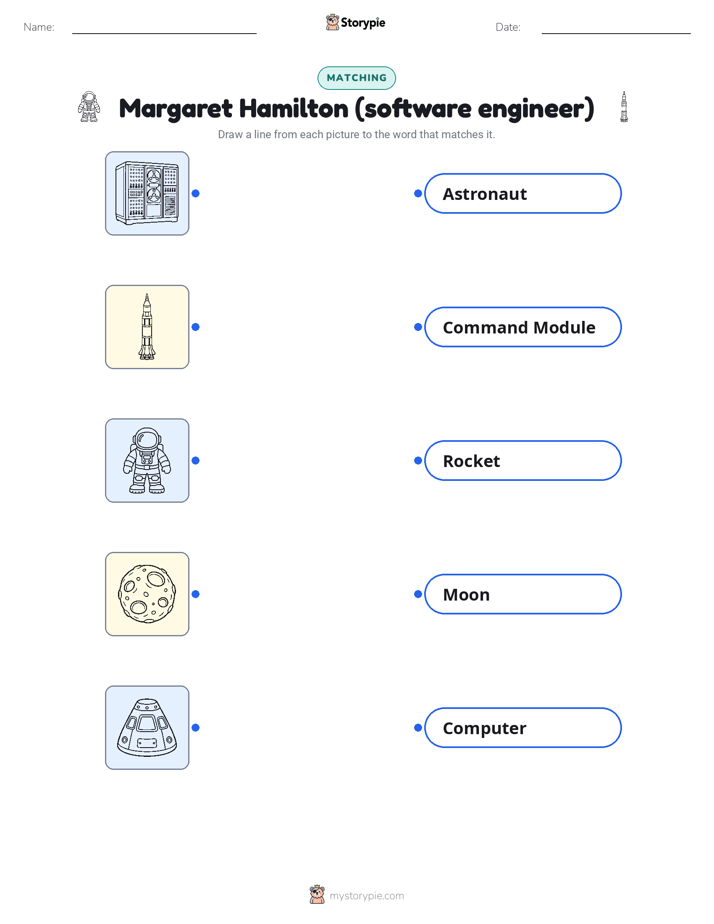
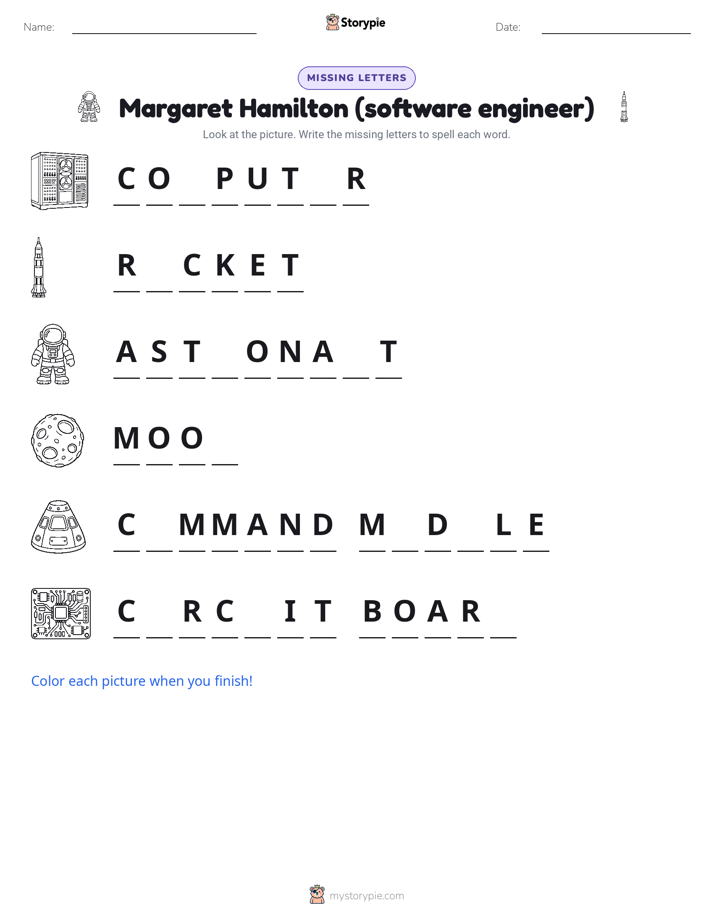
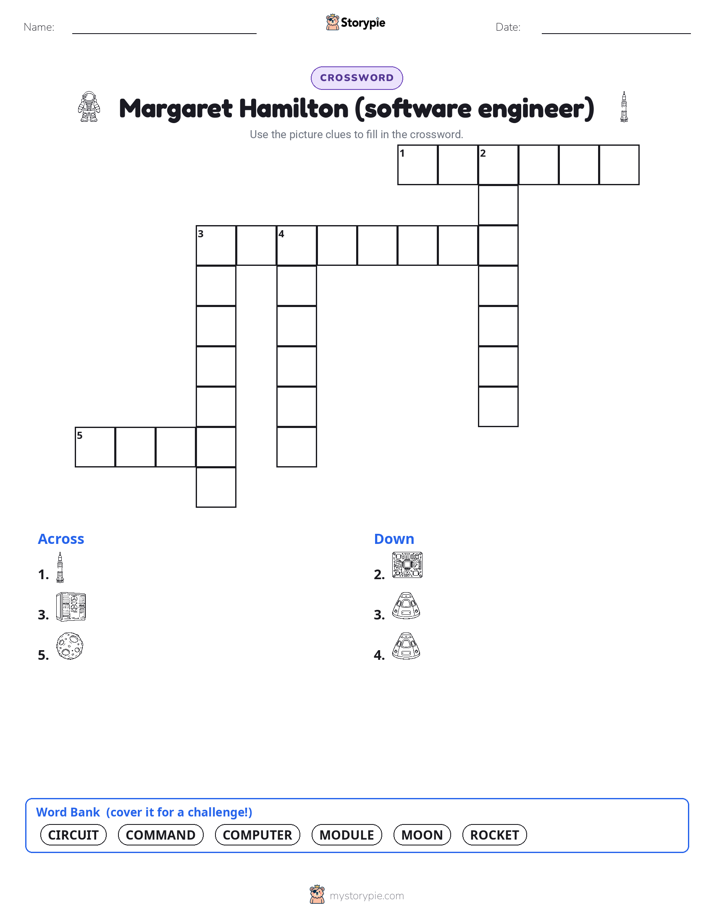
28 worksheets · answer keys · full story · quiz · Ages 10-12 · CEFR B2
Plus adds 290,000+ more stories in 27 languages, audio for every one, and printables for all of them.
Just want Margaret Hamilton (software engineer)?

Hello! My name is Margaret Hamilton. I want to tell you my story, which starts back when I was a little girl who loved asking 'why?' and 'how?'. I was born on August 17th, 1936, in a small town called Paoli, Indiana. Even as a kid, I was fascinated by numbers and puzzles, always looking for a problem to solve. My curiosity for how things worked guided me through school. After graduating from high school in 1954, I went to college to study mathematics. I graduated in 1958, filled with a love for how math had clear rules and logic that could be used to solve almost any problem you could think of. It felt like a powerful tool, and I was excited to see where it would take me.
After college, my first job was briefly teaching high school math, but a much bigger adventure was just around the corner. In 1960, I moved to Boston, Massachusetts, and got a job at the prestigious Massachusetts Institute of Technology, which you probably know as MIT. My job was to write computer code. This was an exciting time because computers were still very new and mysterious to most people. They were giant machines that filled entire rooms! I worked on a project called SAGE, where I wrote software that helped the United States military track airplanes. This was my first taste of writing code for something incredibly important, where mistakes could have serious consequences. That experience prepared me for the biggest challenge, and greatest opportunity, of my life.
In 1961, I joined a special team at MIT's Draper Laboratory that was working with a new organization called NASA. Our mission was one of the most ambitious goals in human history: to help send astronauts to the Moon! I was hired as one of the very first programmers for the Apollo space program. The work was so new and complex that by 1965, I was leading the team in charge of writing all the on-board flight software for the Apollo command module and the lunar module. This was brand new territory. The field of 'software engineering' didn't even exist yet, so we were inventing the rules as we went along. I knew our code had to be perfect because there were no second chances in space. Sometimes I worked so late that I had to bring my young daughter, Lauren, to the lab with me. Seeing her play near the spaceship simulators reminded me every day how important it was to build systems that would keep our astronauts safe and bring them home.
Margaret Hamilton: The Girl Who Wrote the Code to the Moon
Hello! My name is Margaret Hamilton. I want to tell you my story, which starts back when I was a little girl who loved asking 'why?' and 'how?'. I was born on August 17th, 1936, in a small town called Paoli, Indiana. Even as a kid, I was fascinated by numbers and puzzles, always looking for a problem to solve. My curiosity for how things worked guided me through school. After graduating from high school in 1954, I went to college to study mathematics. I graduated in 1958, filled with a love for how math had clear rules and logic that could be used to solve almost any problem you could think of. It felt like a powerful tool, and I was excited to see where it would take me.
After college, my first job was briefly teaching high school math, but a much bigger adventure was just around the corner. In 1960, I moved to Boston, Massachusetts, and got a job at the prestigious Massachusetts Institute of Technology, which you probably know as MIT. My job was to write computer code. This was an exciting time because computers were still very new and mysterious to most people. They were giant machines that filled entire rooms! I worked on a project called SAGE, where I wrote software that helped the United States military track airplanes. This was my first taste of writing code for something incredibly important, where mistakes could have serious consequences. That experience prepared me for the biggest challenge, and greatest opportunity, of my life.
In 1961, I joined a special team at MIT's Draper Laboratory that was working with a new organization called NASA. Our mission was one of the most ambitious goals in human history: to help send astronauts to the Moon! I was hired as one of the very first programmers for the Apollo space program. The work was so new and complex that by 1965, I was leading the team in charge of writing all the on-board flight software for the Apollo command module and the lunar module. This was brand new territory. The field of 'software engineering' didn't even exist yet, so we were inventing the rules as we went along. I knew our code had to be perfect because there were no second chances in space. Sometimes I worked so late that I had to bring my young daughter, Lauren, to the lab with me. Seeing her play near the spaceship simulators reminded me every day how important it was to build systems that would keep our astronauts safe and bring them home.
The most famous and nerve-wracking moment of my career came on July 20th, 1969. The Apollo 11 lunar module, named the Eagle, was just minutes away from landing on the Moon. Inside were astronauts Neil Armstrong and Buzz Aldrin, and the whole world was watching. Suddenly, alarms started going off inside the cockpit! The guidance computer was getting overloaded with too much information from a radar system that had been accidentally left on. For a moment, it looked like they might have to abort the landing and turn back. But I had designed the software to be smart and resilient. It was programmed to recognize which jobs were the most important. The code automatically dropped the low-priority tasks and focused all its power on the one critical job: landing the spacecraft safely. Because of that software design, the computer kept working, the alarms stopped, and the Eagle landed safely on the Moon. We had done it!
After that historic success, I wanted to make sure people understood that building software was just as complex and important as building the physical parts of a rocket or a bridge. To give our work the respect it deserved, I started calling what we did 'software engineering.' At first, people thought it was a funny name, but it caught on and is now a major field of study and work. My journey with NASA didn't end with Apollo. I continued my work on other projects like Skylab, which was the first American space station. Later, in 1986, I wanted to take the lessons I had learned about building ultra-reliable software to the rest of the world. So, I started my own company, Hamilton Technologies, Inc., to create new systems based on the principles we developed during our mission to the Moon.
My contributions were recognized many years later in a very special way. On November 22nd, 2016, I received the Presidential Medal of Freedom from President Barack Obama, which is one of the highest honors a civilian can receive in the United States. It was an amazing honor, not just for me, but for my entire team. My work on the Apollo program showed the world that software wasn't just a small part of a project—it could be the very thing that ensures its success in the most critical moments. The programming principles my team and I developed are still used today in everything from airplanes to smartphones. I am still living today, and I hope my story shows you that if you are curious and work hard to solve problems, you can help change the world, and maybe even reach the stars.
Wow facts
About
Margaret Hamilton is an American computer scientist and systems engineer who was Director of the Software Engineering Division of the MIT Instrumentation Laboratory, which developed the on-board flight software for NASA's Apollo program.
Take a Quiz
Question 1 of 5
What was the major problem during the Apollo 11 landing, and how was it resolved?
Explore next
Want to do even more?
Go beyond exploring. Unlock tools that turn every story into real learning.

Storypie Plus for families
Full stories, quizzes, and printables. Nights and car rides, sorted.
- Unlimited audio stories
- Create Mode: your child stars in the story
- Offline downloads
- Printable worksheets & coloring pages

Why Storypie for Schools
Students engaged. Prep in seconds. Evenings back to you.
- Worksheets & Quizzes
- Classroom Management
- Formative Assessment
- Custom Curriculum & Lesson Plans
- 27 Languages

Why Storypie for Homeschool
Curriculum done. They'll ask for more. Hours back in your day.
- Worksheet Generator
- First-Person Audio Stories
- Built-in Comprehension Quizzes
- Custom Curriculum & Lesson Plans
- Print & Go Activities