English


Margaret Hamilton (software engineer)
Margaret Hamilton is an American computer scientist and systems engineer who was Director of the Software…
Reads at Grades 3–5 Listens at Grades 1–5
Print & create
Answer keys·No prep·Free with an account
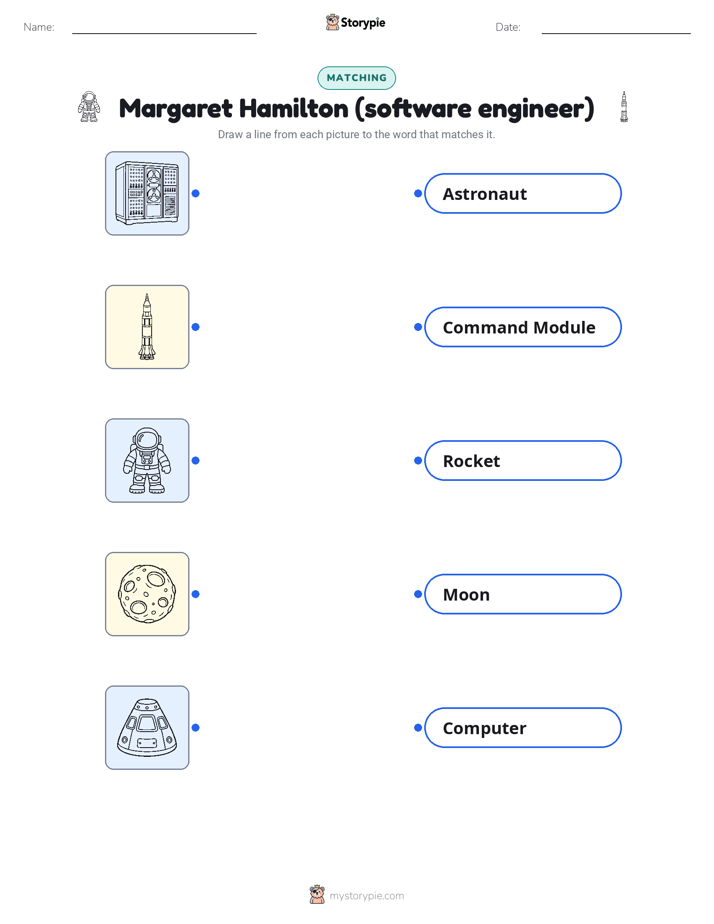
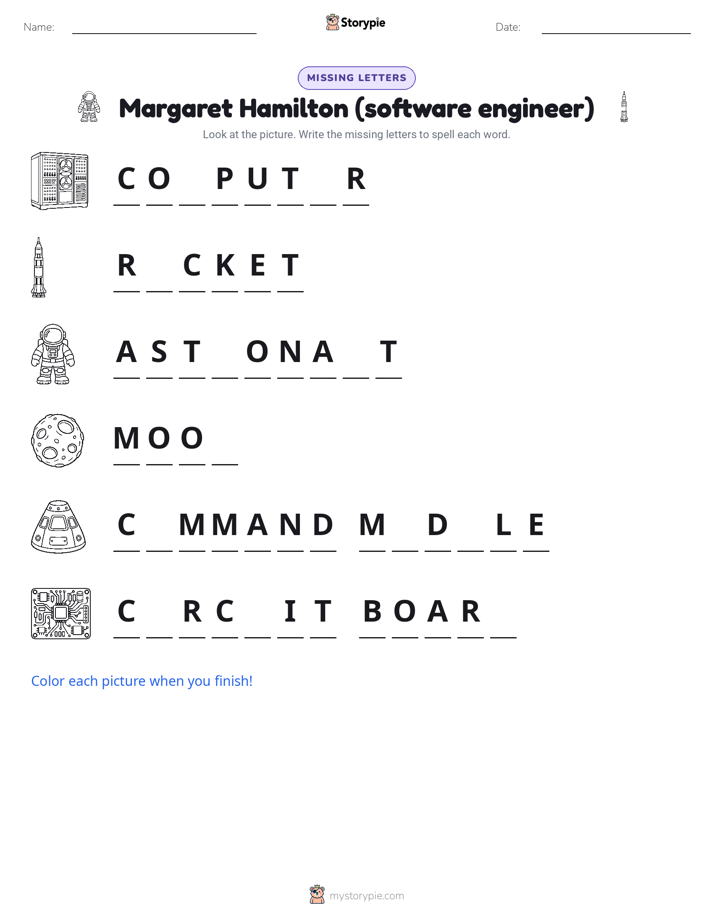
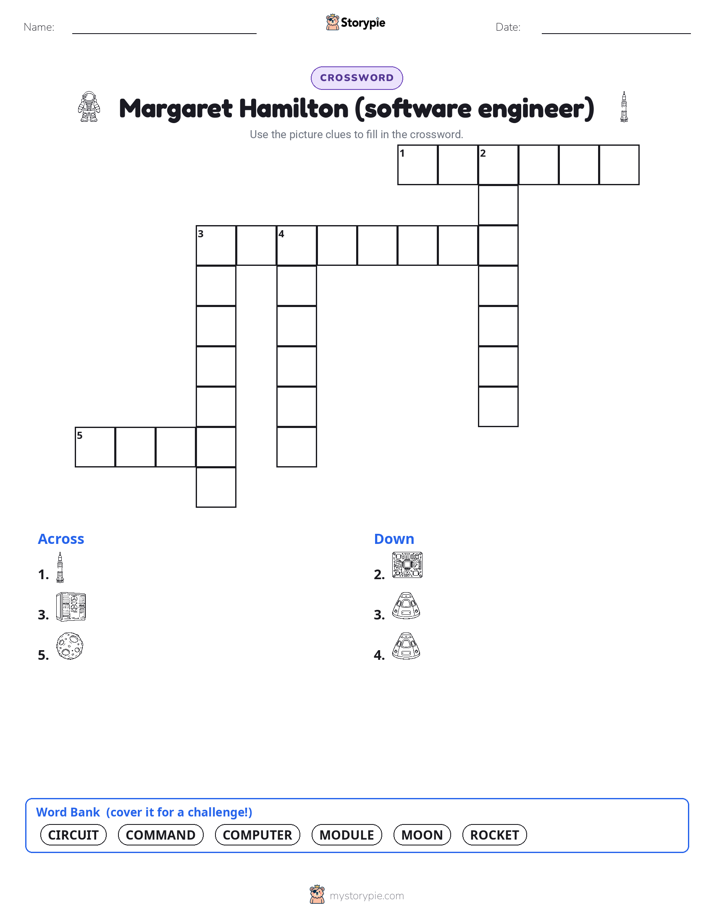
28 worksheets · answer keys · full story · quiz · Ages 8-10 · CEFR B1
Plus adds 290,000+ more stories in 27 languages, audio for every one, and printables for all of them.
Just want Margaret Hamilton (software engineer)?

Hello, my name is Margaret Hamilton. I was born on August 17th, 1936, in a small town in Indiana. Even as a little girl, my mind was always buzzing with questions. I loved asking 'why?' and figuring out how things worked. Puzzles were my favorite games, and that's exactly what mathematics felt like to me—a giant, exciting puzzle. I always believed that math wasn't just for schoolwork; it was a powerful tool you could use to solve big, important problems in the world. I couldn't wait to grow up and find a puzzle big enough to challenge me.
After I finished college, my family and I moved to Boston in the early 1960s. I found a job at a famous university called MIT, which stands for the Massachusetts Institute of Technology. At first, my work involved using computers to predict the weather. It was interesting, but soon, an even bigger opportunity came my way. I was asked to join a brand-new project with NASA. Their goal was incredible: they wanted to send astronauts to land on the Moon! I was absolutely thrilled to become part of the Apollo space program. It felt like the biggest and most important puzzle I could ever imagine trying to solve.
My job was to write the instructions for the computers inside the Apollo spacecraft. These instructions are called code, and they tell the computer exactly what to do, step by step. In 1965, I became the leader of the team that wrote all the on-board flight software. You may have seen a famous picture of me standing next to a stack of books that was as tall as I was. Those weren't regular books! They were binders filled with page after page of the computer code that my team and I had written to guide the astronauts to the Moon and back. I also came up with the name 'software engineering' for our work. I wanted to make sure people understood that creating the software was just as important and difficult as building the physical rocket hardware.
Margaret Hamilton: The Woman Who Coded the Moon Landing
Hello, my name is Margaret Hamilton. I was born on August 17th, 1936, in a small town in Indiana. Even as a little girl, my mind was always buzzing with questions. I loved asking 'why?' and figuring out how things worked. Puzzles were my favorite games, and that's exactly what mathematics felt like to me—a giant, exciting puzzle. I always believed that math wasn't just for schoolwork; it was a powerful tool you could use to solve big, important problems in the world. I couldn't wait to grow up and find a puzzle big enough to challenge me.
After I finished college, my family and I moved to Boston in the early 1960s. I found a job at a famous university called MIT, which stands for the Massachusetts Institute of Technology. At first, my work involved using computers to predict the weather. It was interesting, but soon, an even bigger opportunity came my way. I was asked to join a brand-new project with NASA. Their goal was incredible: they wanted to send astronauts to land on the Moon! I was absolutely thrilled to become part of the Apollo space program. It felt like the biggest and most important puzzle I could ever imagine trying to solve.
My job was to write the instructions for the computers inside the Apollo spacecraft. These instructions are called code, and they tell the computer exactly what to do, step by step. In 1965, I became the leader of the team that wrote all the on-board flight software. You may have seen a famous picture of me standing next to a stack of books that was as tall as I was. Those weren't regular books! They were binders filled with page after page of the computer code that my team and I had written to guide the astronauts to the Moon and back. I also came up with the name 'software engineering' for our work. I wanted to make sure people understood that creating the software was just as important and difficult as building the physical rocket hardware.
My most famous day at work happened on July 20th, 1969, during the Apollo 11 mission. Astronauts Neil Armstrong and Buzz Aldrin were in their spacecraft, the Eagle, getting very close to the Moon's surface. Everything seemed to be going perfectly, but then, alarm bells started ringing inside the cockpit! The landing computer was getting overloaded with too much information at once, and it was getting confused. It was a very tense moment. But the special software my team and I designed was prepared for this. It was smart enough to ignore the less important tasks and focus only on the most critical job: landing the spaceship. Our code worked perfectly, the alarms stopped, and the Eagle landed safely on the Moon. The mission was a success!
After the Apollo program ended, I didn't stop solving problems. I started my own software companies to tackle other complex challenges right here on Earth. My work on the Apollo missions was remembered for many years. In 2016, I was very proud to receive the Presidential Medal of Freedom from President Barack Obama for my contributions to the moon landing. My story shows that if you stay curious and work hard, you can solve even the biggest challenges—ones as big as flying to the Moon. I hope my work inspires you to keep asking questions, to solve the puzzles you find interesting, and to never be afraid to reach for the stars.
Wow facts
About
Margaret Hamilton is an American computer scientist and systems engineer who was Director of the Software Engineering Division of the MIT Instrumentation Laboratory, which developed the on-board flight software for NASA's Apollo program.
Take a Quiz
Question 1 of 5
Why did Margaret Hamilton call her work 'software engineering'?
Explore next

Want to do even more?
Go beyond exploring. Unlock tools that turn every story into real learning.

Storypie Plus for families
Full stories, quizzes, and printables. Nights and car rides, sorted.
- Unlimited audio stories
- Create Mode: your child stars in the story
- Offline downloads
- Printable worksheets & coloring pages

Why Storypie for Schools
Students engaged. Prep in seconds. Evenings back to you.
- Worksheets & Quizzes
- Classroom Management
- Formative Assessment
- Custom Curriculum & Lesson Plans
- 27 Languages

Why Storypie for Homeschool
Curriculum done. They'll ask for more. Hours back in your day.
- Worksheet Generator
- First-Person Audio Stories
- Built-in Comprehension Quizzes
- Custom Curriculum & Lesson Plans
- Print & Go Activities