English


Mencius
Mencius was an ancient Chinese philosopher, second only to Confucius in importance…
Reads at Grades 6–8 Listens at Grades 4–8
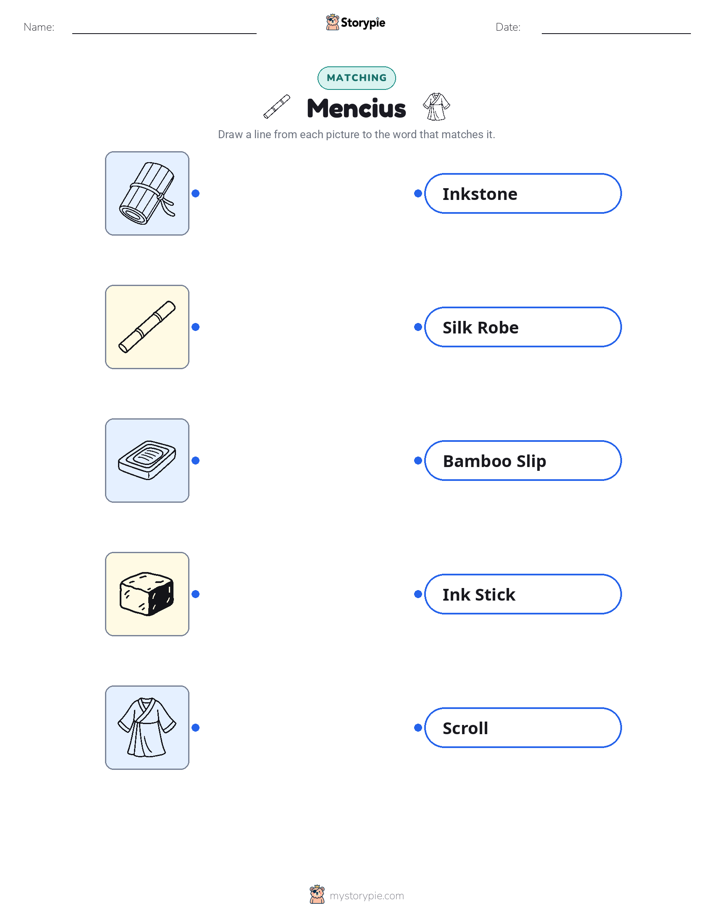
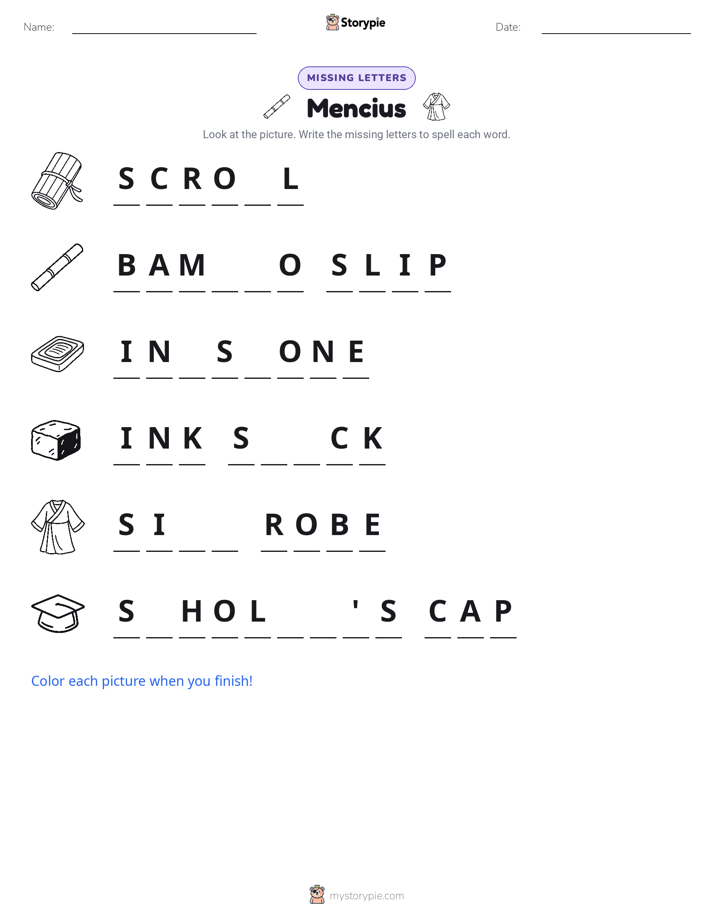
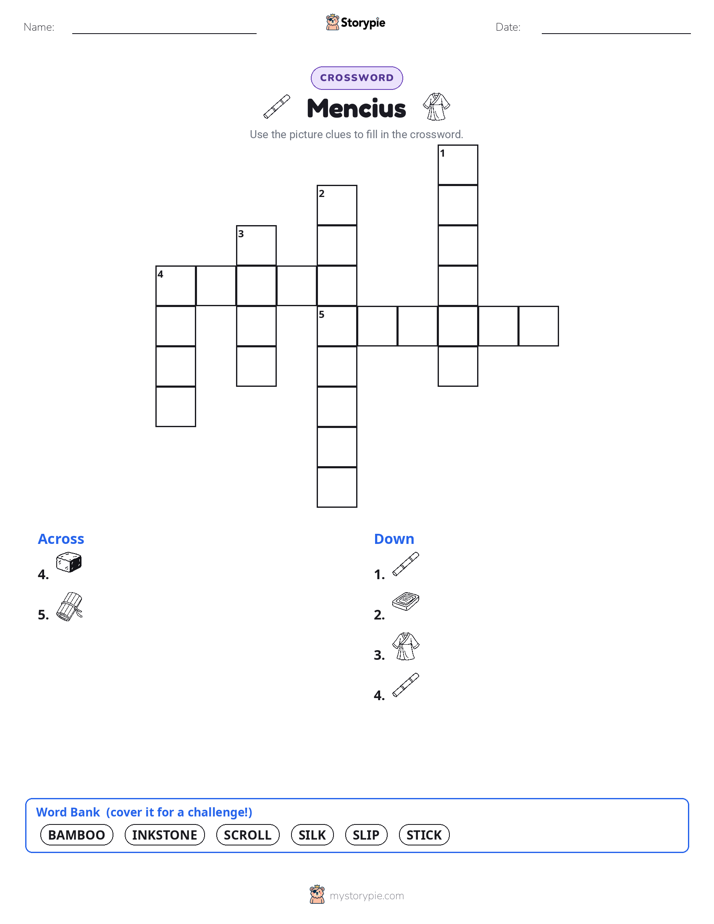
Print & create
Answer keys·No prep·Free with an account
28 worksheets · answer keys · full story · quiz · Ages 10-12 · CEFR B2
Plus adds 244,000+ more stories in 27 languages, audio for every one, and printables for all of them.
Just want Mencius?

Hello! My name is Meng Ke, but you probably know me by another name: Mencius. I was born around the year 372 BCE in a small state called Zou, in a land that would one day become China. This was a time of great turmoil known as the Warring States period. My father passed away when I was very young, and my mother raised me on her own. She was determined to give me the best education possible. A famous story says she moved our home three times to find the right environment for me to study—first from near a cemetery, then from near a marketplace, and finally to a home next to a school. Her dedication showed me how important our surroundings are for becoming good people.
As I grew, I became fascinated by the teachings of a great sage who had lived about a century before me: Confucius. Though I never met him, his ideas about how to live a good and honorable life inspired me deeply. I wanted to learn everything I could, so I went to study with students of his own grandson, a wise man named Zisi. They taught me about Confucius's ideas of 'ren', which means benevolence or humaneness, and 'yi', which means righteousness or justice. I felt a fire light up inside me. I knew it was my life's work to understand these ideas and share them with the world, especially with the kings and rulers who had so much power over people's lives.
For many years, starting around 320 BCE, I traveled from state to state, hoping to advise powerful rulers. I visited the courts of Qi, Song, Teng, and Lu. I did not offer them strategies for winning wars or gaining more land. Instead, I tried to convince them that a true king rules not through force, but through goodness. I argued that a good ruler must care for the people's well-being, ensuring they have food, shelter, and education. I believed that if a ruler was virtuous, the people would naturally be loyal and the kingdom would be strong and peaceful. Many rulers listened politely, but few were willing to put down their weapons and follow my advice.
Mencius: The Goodness in Everyone's Heart
Hello! My name is Meng Ke, but you probably know me by another name: Mencius. I was born around the year 372 BCE in a small state called Zou, in a land that would one day become China. This was a time of great turmoil known as the Warring States period. My father passed away when I was very young, and my mother raised me on her own. She was determined to give me the best education possible. A famous story says she moved our home three times to find the right environment for me to study—first from near a cemetery, then from near a marketplace, and finally to a home next to a school. Her dedication showed me how important our surroundings are for becoming good people.
As I grew, I became fascinated by the teachings of a great sage who had lived about a century before me: Confucius. Though I never met him, his ideas about how to live a good and honorable life inspired me deeply. I wanted to learn everything I could, so I went to study with students of his own grandson, a wise man named Zisi. They taught me about Confucius's ideas of 'ren', which means benevolence or humaneness, and 'yi', which means righteousness or justice. I felt a fire light up inside me. I knew it was my life's work to understand these ideas and share them with the world, especially with the kings and rulers who had so much power over people's lives.
For many years, starting around 320 BCE, I traveled from state to state, hoping to advise powerful rulers. I visited the courts of Qi, Song, Teng, and Lu. I did not offer them strategies for winning wars or gaining more land. Instead, I tried to convince them that a true king rules not through force, but through goodness. I argued that a good ruler must care for the people's well-being, ensuring they have food, shelter, and education. I believed that if a ruler was virtuous, the people would naturally be loyal and the kingdom would be strong and peaceful. Many rulers listened politely, but few were willing to put down their weapons and follow my advice.
My most important idea was simple: I believed that every single person is born with a good heart. I would ask people to imagine seeing a small child about to fall into a well. Anyone, I said, would instantly feel alarm and compassion. You would not stop to think if you knew the parents or if you would get a reward; you would just want to save the child. I explained that this feeling is proof that goodness is part of our nature. I called the foundations of this goodness the 'Four Sprouts.' They are the sprout of compassion, the sprout of shame, the sprout of courtesy, and the sprout of knowing right from wrong. I taught that with education and effort, we could all grow these sprouts into the beautiful virtues of benevolence, righteousness, propriety, and wisdom.
I also had strong ideas about government. I taught about the 'Mandate of Heaven,' the idea that a ruler's right to rule was a gift from a higher power. But this gift was not permanent. It came with a condition: the ruler had to be just and care for the people. If a ruler became a cruel tyrant and made the people suffer, he would lose the Mandate of Heaven. In such a case, I argued, the people had the right to rebel and remove him from power. This was a very bold idea for its time, as it placed the well-being of the common people above the desires of the king.
After years of travel, I realized the rulers were too focused on war to listen. Around 312 BCE, I retired from public life and returned to my home state. There, with my students, I dedicated my final years to teaching and writing. Our conversations and my teachings were collected into a book that is now simply called the 'Mencius.' I lived to be about 83 years old, passing away around 289 BCE. For over two thousand years, my ideas about the goodness of human nature and the responsibility of leaders have been studied by countless people. I am remembered as the 'Second Sage' of Confucianism, right after Confucius himself, and I hope my belief in the good inside every person continues to inspire people to be kind and just.
Wow facts
About
Mencius was an ancient Chinese philosopher, second only to Confucius in importance, who believed in the innate goodness of human nature and advised rulers on how to govern with compassion and righteousness.
Take a Quiz
Question 1 of 5
What was the main reason my mother moved our home three times when I was a child?
Explore next





Want to do even more?
Go beyond exploring. Unlock tools that turn every story into real learning.

Storypie Plus for families
Full stories, quizzes, and printables. Nights and car rides, sorted.
- Unlimited audio stories
- Create Mode: your child stars in the story
- Offline downloads
- Printable worksheets & coloring pages

Why Storypie for Schools
Students engaged. Prep in seconds. Evenings back to you.
- Worksheets & Quizzes
- Classroom Management
- Formative Assessment
- Custom Curriculum & Lesson Plans
- 27 Languages

Why Storypie for Homeschool
Curriculum done. They'll ask for more. Hours back in your day.
- Worksheet Generator
- First-Person Audio Stories
- Built-in Comprehension Quizzes
- Custom Curriculum & Lesson Plans
- Print & Go Activities