English

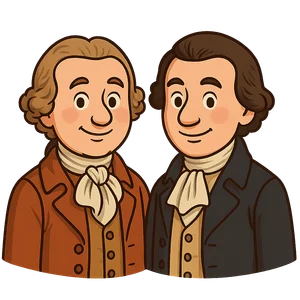
Montgolfier Brothers
Joseph-Michel and Jacques-Étienne Montgolfier were French brothers and aviation pioneers who invented the…
Reads at Grades 6–8 Listens at Grades 4–8
Print & create
Answer keys·No prep·Free with an account
28 worksheets · answer keys · full story · quiz · Ages 10-12 · CEFR B2
Plus adds 164,000+ more stories in 27 languages, audio for every one, and printables for all of them.
Just want Montgolfier Brothers?
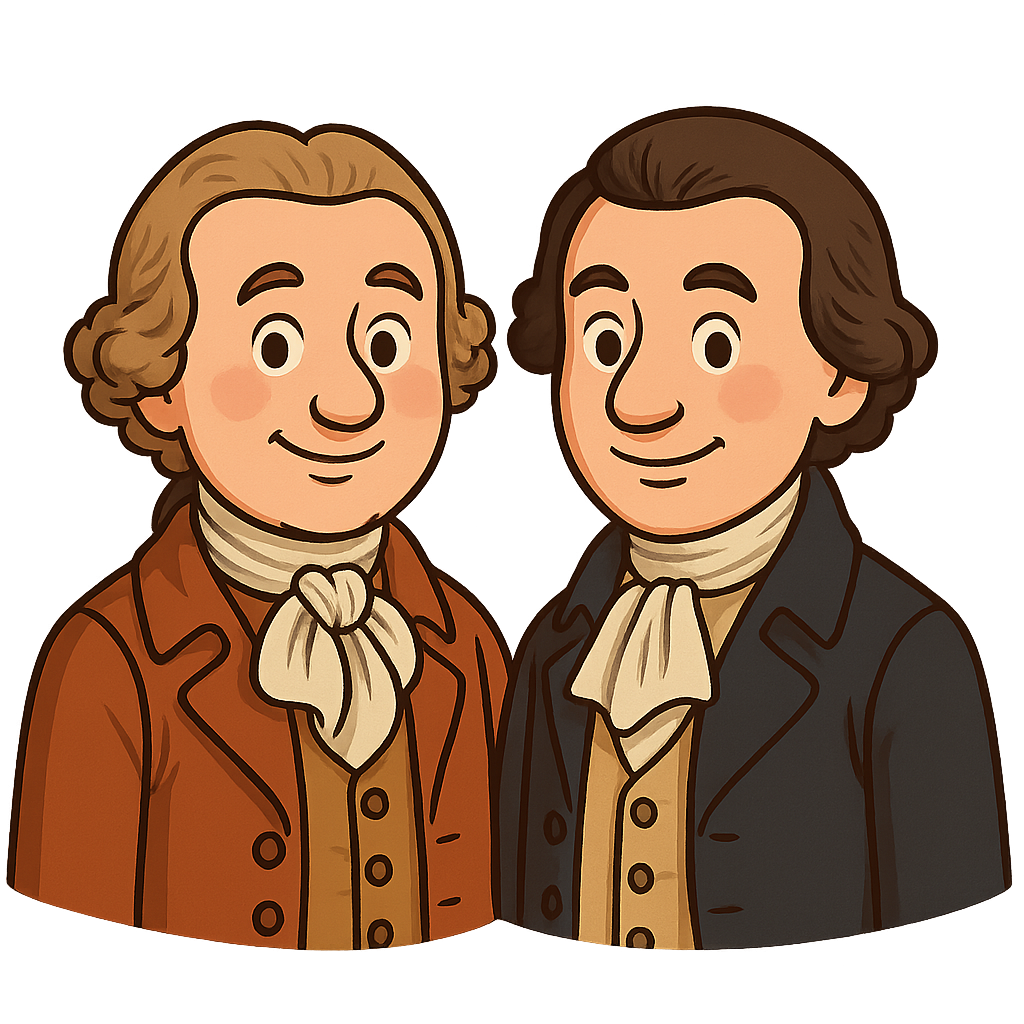
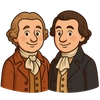
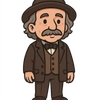
We are the Montgolfier brothers, Joseph-Michel and Jacques-Étienne, and we were born in the town of Annonay, France. Our family was well-known for its successful paper-making business, and we grew up surrounded by industry and invention. We were quite different from each other. I, Jacques-Étienne, was the practical one, with a mind for business and science. My brother, Joseph, was the dreamer, always looking at the world with imagination and curiosity. Despite our different personalities, we both shared a deep fascination with the sky. In the late 1700s, the idea of humans flying was something found only in myths. Yet, we often looked up at the clouds and wondered if it might be possible for people to float among them.
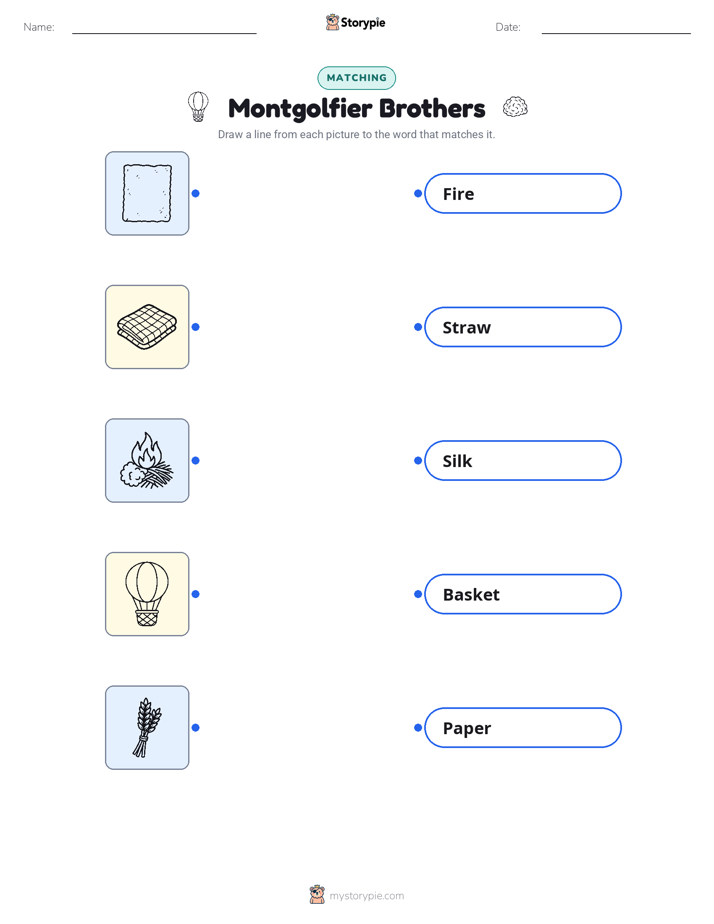
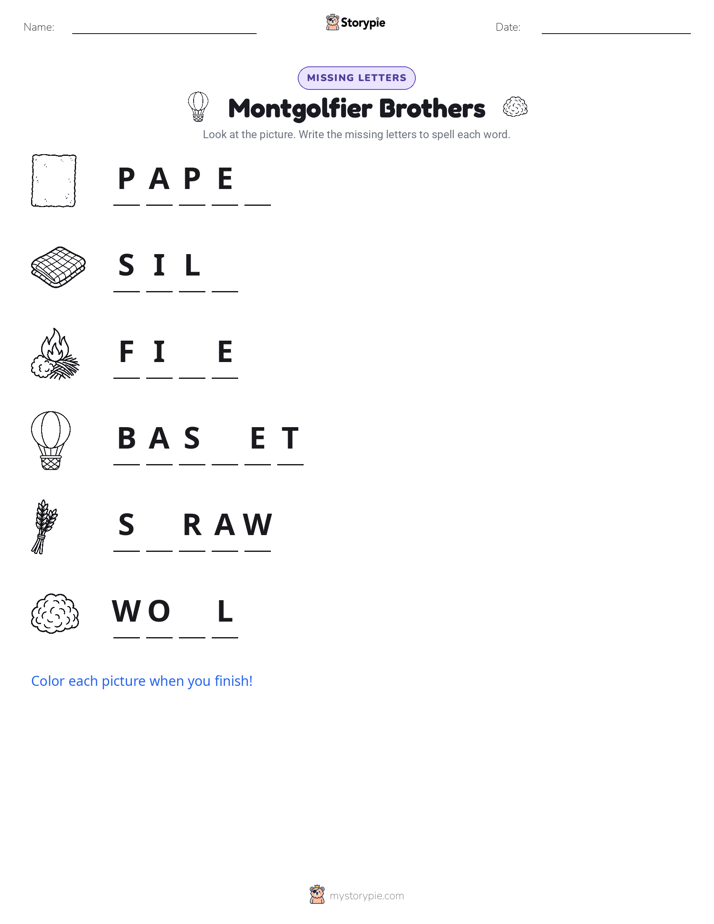
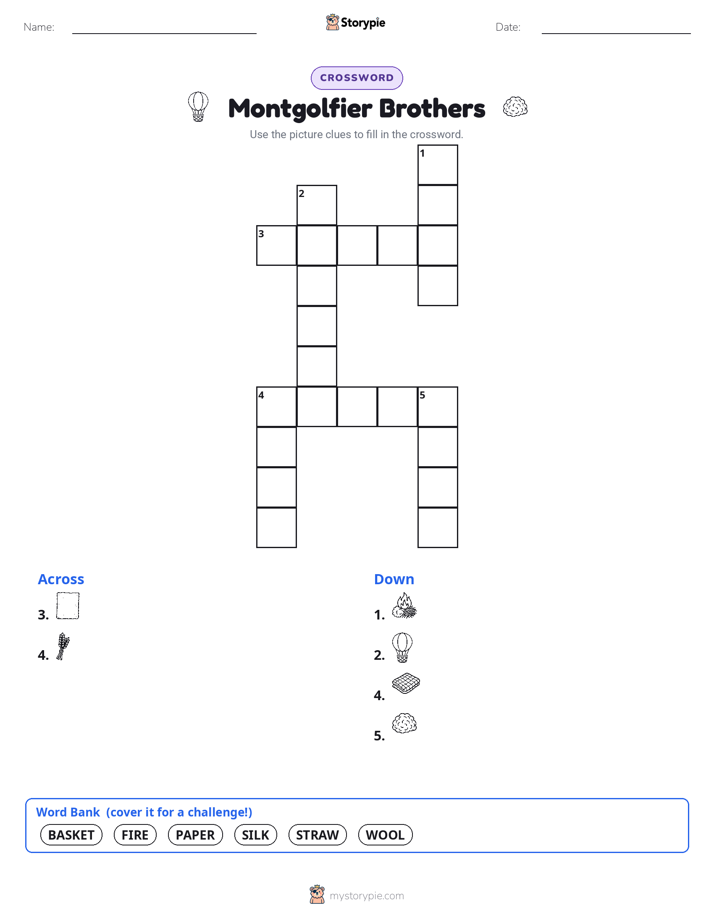
Our journey began with a simple observation. In November of 1782, my brother Joseph was sitting by the fire, watching the smoke and glowing embers rise up the chimney. A thought sparked in his mind: if smoke could rise with such force, could that same lifting power be captured inside a lightweight bag and make it float? We were determined to find out. We began our first experiments in secret, not wanting anyone to think our ideas were foolish. We constructed a small, box-shaped container from silk and paper. Holding it over a fire, we watched as it filled with hot air. To our immense excitement, when we let it go, it floated right up to the ceiling. We realized we had discovered a fundamental principle of physics: hot air is lighter and less dense than the cooler air around it, and this difference creates a lifting force known as buoyancy.
The Montgolfier Brothers: First to Fly
We are the Montgolfier brothers, Joseph-Michel and Jacques-Étienne, and we were born in the town of Annonay, France. Our family was well-known for its successful paper-making business, and we grew up surrounded by industry and invention. We were quite different from each other. I, Jacques-Étienne, was the practical one, with a mind for business and science. My brother, Joseph, was the dreamer, always looking at the world with imagination and curiosity. Despite our different personalities, we both shared a deep fascination with the sky. In the late 1700s, the idea of humans flying was something found only in myths. Yet, we often looked up at the clouds and wondered if it might be possible for people to float among them.
Our journey began with a simple observation. In November of 1782, my brother Joseph was sitting by the fire, watching the smoke and glowing embers rise up the chimney. A thought sparked in his mind: if smoke could rise with such force, could that same lifting power be captured inside a lightweight bag and make it float? We were determined to find out. We began our first experiments in secret, not wanting anyone to think our ideas were foolish. We constructed a small, box-shaped container from silk and paper. Holding it over a fire, we watched as it filled with hot air. To our immense excitement, when we let it go, it floated right up to the ceiling. We realized we had discovered a fundamental principle of physics: hot air is lighter and less dense than the cooler air around it, and this difference creates a lifting force known as buoyancy.
After our small, successful experiments, we knew we had to think bigger. We were ready to share our discovery with the world. We spent weeks constructing a much larger balloon, one that was nearly 35 feet wide. It was an enormous globe made of pieces of taffeta cloth, a type of silk, all held together and reinforced with paper. We planned our first public demonstration for June 4th, 1783, in the central marketplace of our hometown, Annonay. As the townspeople gathered, a sense of anticipation filled the air. We lit a fire of straw and wool beneath the opening of our balloon. As it filled with hot smoke and air, it began to swell and rise from the ground. When we cut the ropes, our creation, which we called an 'Aérostat,' soared into the sky. The crowd gasped in amazement as it climbed to an altitude of nearly 6,000 feet and traveled over a mile before landing. We had proven that flight was possible.
Word of our unmanned balloon flight in Annonay spread quickly, eventually reaching the French Academy of Sciences in Paris. We were invited to the capital to demonstrate our invention for the most important people in the country, including King Louis XVI and Queen Marie Antoinette. We knew this demonstration had to be spectacular. We built our most magnificent balloon yet, the 'Aérostat Réveillon.' It was painted a brilliant sky blue and decorated with golden flourishes and royal symbols. On September 19th, 1783, we prepared for launch on the grounds of the grand Palace of Versailles. Before sending a human into the sky, scientists needed to know if living creatures could even survive at high altitudes. So, we decided that the world's very first air travelers would be a sheep, a duck, and a rooster. We placed them in a basket attached to the balloon, and before the king and queen and a massive crowd, our animal astronauts ascended gracefully into the air for a flight that lasted about eight minutes.
Now that we had proven that animals could travel safely through the air, the final and most daring step was to send a person. A brave science teacher named Jean-François Pilâtre de Rozier volunteered for the dangerous mission. To be cautious, we first attempted a tethered flight on October 15th, 1783. This meant the balloon was tied to the ground with long ropes, allowing Pilâtre de Rozier to rise into the air and experience flight without floating away. After several successful tethered ascents, the time had come for the first free flight in human history. On November 21st, 1783, Pilâtre de Rozier, accompanied by an army officer named François Laurent d'Arlandes, climbed into the basket of our balloon. They rose above the rooftops of Paris, becoming the first humans to ever fly freely. For 25 incredible minutes, they floated over the city, waving to the astonished crowds below before landing safely several miles away.
Our dream had become a reality. My brother and I both lived long enough to see our invention spark a worldwide passion for flight and exploration. I, Jacques-Étienne, lived to be 54 years old and passed away in 1799. My older brother, Joseph, the dreamer who first saw the possibility in a wisp of smoke, lived to be 69, passing away in 1810. Our work proved that with curiosity and perseverance, humans could achieve what was once thought impossible. We opened the door for every airplane, rocket, and spacecraft that would one day follow. Even now, when people see a colorful hot air balloon drifting silently across the sky, they are seeing a beautiful reminder of the day humankind first touched the clouds.
Wow facts
About
Joseph-Michel and Jacques-Étienne Montgolfier were French brothers and aviation pioneers who invented the Montgolfière-style hot air balloon. They launched the first public demonstration in 1783, followed by the first crewed human flight later that year.
Take a Quiz
Question 1 of 5
Summarize the key steps the Montgolfier brothers took to achieve the first human free flight.
Explore next



Want to do even more?
Go beyond exploring. Unlock tools that turn every story into real learning.

Storypie Plus for families
Full stories, quizzes, and printables. Nights and car rides, sorted.
- Unlimited audio stories
- Create Mode: your child stars in the story
- Offline downloads
- Printable worksheets & coloring pages

Why Storypie for Schools
Students engaged. Prep in seconds. Evenings back to you.
- Worksheets & Quizzes
- Classroom Management
- Formative Assessment
- Custom Curriculum & Lesson Plans
- 27 Languages

Why Storypie for Homeschool
Curriculum done. They'll ask for more. Hours back in your day.
- Worksheet Generator
- First-Person Audio Stories
- Built-in Comprehension Quizzes
- Custom Curriculum & Lesson Plans
- Print & Go Activities