English


Nancy Grace Roman
Nancy Grace Roman was an American astronomer known as the 'Mother of Hubble' for her pivotal role in planning…
Reads at Grades 6–8 Listens at Grades 4–8
Print & create
Answer keys·No prep·Free with an account
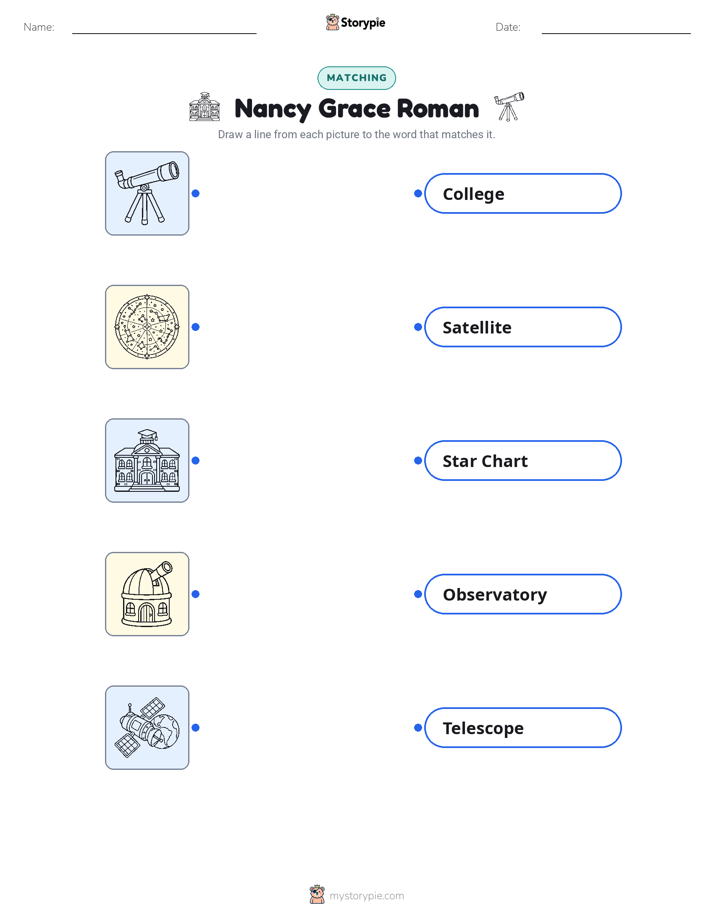
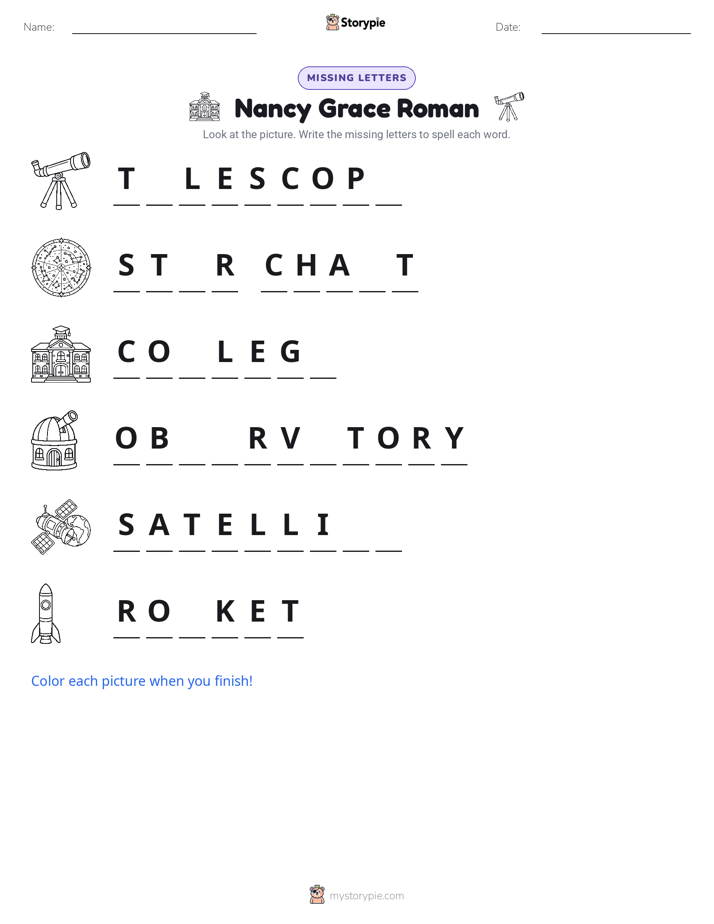
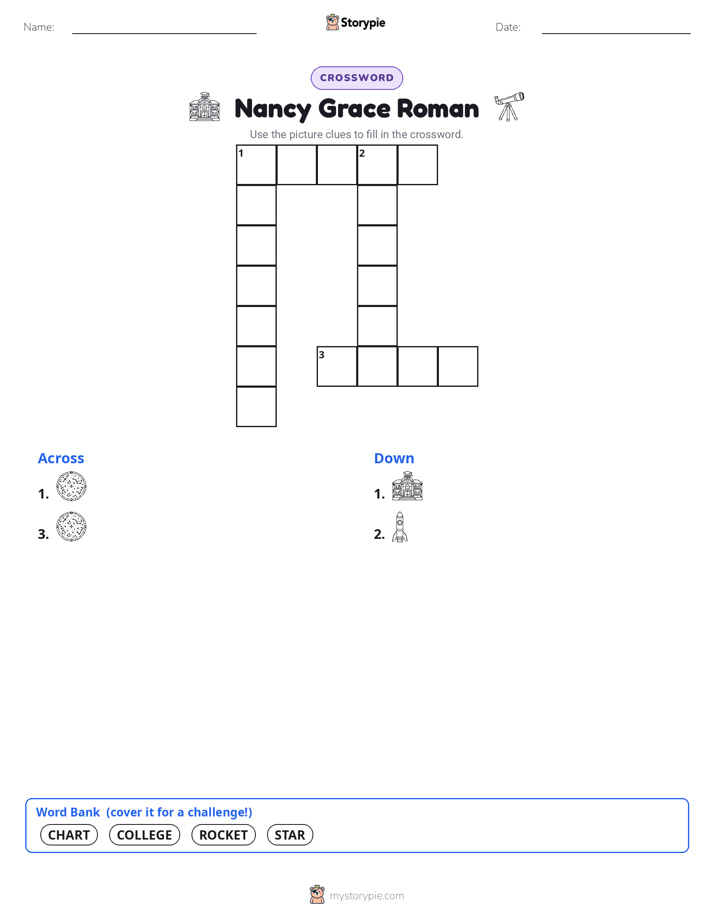
28 worksheets · answer keys · full story · quiz · Ages 10-12 · CEFR B2
Plus adds 290,000+ more stories in 27 languages, audio for every one, and printables for all of them.
Just want Nancy Grace Roman?

Hello. My name is Nancy Grace Roman, and I want to tell you my story, which is a story about reaching for the stars. I was born on May 16th, 1925, in Nashville, Tennessee. From my earliest memories, the night sky was a source of endless fascination. My mother, who was a science teacher, nurtured my curiosity. She would take me outside on clear nights, point out the constellations, and share the scientific wonders of our moon and planets. Her lessons went far beyond simple stargazing; she taught me to ask questions and seek answers. When I was eleven years old, my passion for the cosmos led me to start my very own astronomy club with my friends in the neighborhood. We would gather to read books about the solar system, learn to identify distant stars, and dream about what might lie beyond our world. That early love for the universe wasn't just a childhood hobby; it became the guiding star for my entire life, setting me on a remarkable journey into the field of astronomy.
Pursuing a career in science was not a simple path for a young woman in the 1930s and 1940s. The world had very different expectations for girls back then, and many people believed that fields like astronomy were only for men. I remember a particularly discouraging moment in high school when a guidance counselor looked at my interests and told me that women couldn't be scientists. She suggested I choose a different career. But I had already found my passion, and I wasn't going to let someone else's opinion stop me. I knew that I was good at science and math, and my heart was set on becoming a professional astronomer. I was determined to prove that anyone with curiosity and dedication could succeed. I enrolled at Swarthmore College, where I poured myself into my studies and earned my degree in astronomy in 1946. That was just the beginning. I continued my education at the University of Chicago, a place known for its excellent astronomy program, and in 1949, I successfully earned my Ph.D. The road was challenging, but every obstacle only strengthened my resolve to follow my dream.
Nancy Grace Roman: Mother of Hubble
Hello. My name is Nancy Grace Roman, and I want to tell you my story, which is a story about reaching for the stars. I was born on May 16th, 1925, in Nashville, Tennessee. From my earliest memories, the night sky was a source of endless fascination. My mother, who was a science teacher, nurtured my curiosity. She would take me outside on clear nights, point out the constellations, and share the scientific wonders of our moon and planets. Her lessons went far beyond simple stargazing; she taught me to ask questions and seek answers. When I was eleven years old, my passion for the cosmos led me to start my very own astronomy club with my friends in the neighborhood. We would gather to read books about the solar system, learn to identify distant stars, and dream about what might lie beyond our world. That early love for the universe wasn't just a childhood hobby; it became the guiding star for my entire life, setting me on a remarkable journey into the field of astronomy.
Pursuing a career in science was not a simple path for a young woman in the 1930s and 1940s. The world had very different expectations for girls back then, and many people believed that fields like astronomy were only for men. I remember a particularly discouraging moment in high school when a guidance counselor looked at my interests and told me that women couldn't be scientists. She suggested I choose a different career. But I had already found my passion, and I wasn't going to let someone else's opinion stop me. I knew that I was good at science and math, and my heart was set on becoming a professional astronomer. I was determined to prove that anyone with curiosity and dedication could succeed. I enrolled at Swarthmore College, where I poured myself into my studies and earned my degree in astronomy in 1946. That was just the beginning. I continued my education at the University of Chicago, a place known for its excellent astronomy program, and in 1949, I successfully earned my Ph.D. The road was challenging, but every obstacle only strengthened my resolve to follow my dream.
After earning my doctorate, I spent several years working at astronomical observatories, studying stars and contributing to the scientific community. Then, in 1959, an incredible opportunity arose that would change the course of my career. I was invited to join a brand-new government agency called the National Aeronautics and Space Administration, or NASA, which had been formed just one year earlier in 1958. This was the dawn of the Space Age, and everything felt possible. I accepted the position and made history as the first person to hold the title of Chief of Astronomy in NASA's Office of Space Science. This role also made me one of the very first female executives at the agency, which was a significant step forward for women in science and leadership. My job was to help shape the future of space exploration. I was responsible for planning scientific missions, which involved developing programs to send satellites and powerful telescopes into orbit around the Earth. These instruments were designed to study everything from our own sun to distant stars and vast galaxies. It was a thrilling time to be an astronomer, and I was right at the heart of it all.
While working at NASA, I began to champion a revolutionary idea. From my years of experience, I knew that observing the universe from Earth had a major limitation: our own atmosphere. The air around our planet, though essential for life, distorts and blurs the light from distant stars, much like looking up from the bottom of a swimming pool. I dreamed of a solution: placing a large, powerful telescope in space, high above the atmospheric interference. This would allow us to capture the clearest, most detailed images of the cosmos ever seen. At the time, many people thought the idea was impossible. The project was seen as far too complex, technologically challenging, and incredibly expensive. But I was convinced of its scientific importance. I spent years traveling across the United States, meeting with brilliant astronomers and engineers to collaborate on the design and build support for the concept. My mission wasn't just scientific; I also had to persuade the leaders at NASA and even members of the U.S. Congress that investing in this space telescope was crucial for the future of astronomy. After countless presentations and a great deal of persistence, we finally received the approval to move forward. This ambitious project would one day become the Hubble Space Telescope, and for my role in bringing it to life, people began calling me the 'Mother of Hubble,' a nickname that I have always cherished.
I continued my work at NASA until I retired in 1979, but my passion for the stars never faded. The dream we all worked so hard for finally came to fruition when the Hubble Space Telescope was launched into orbit in 1990. Since then, it has transformed our understanding of the universe, capturing breathtaking images of distant galaxies, the birth and death of stars, and even planets orbiting other suns. I lived a full life of 93 years, filled with the joy of discovery. I am remembered for my perseverance and my role in making the Hubble Space Telescope a reality. I hope my story shows you that curiosity is a powerful force. Never be afraid to ask big questions, and don't let anyone convince you that your dreams are out of reach. Always keep looking up.
Wow facts
About
Nancy Grace Roman was an American astronomer known as the 'Mother of Hubble' for her pivotal role in planning the Hubble Space Telescope. She was also the first woman to hold an executive position at NASA.
Take a Quiz
Question 1 of 5
Based on the story, which character trait best describes Nancy Grace Roman when she was told women couldn't be scientists?
Explore next





Want to do even more?
Go beyond exploring. Unlock tools that turn every story into real learning.

Storypie Plus for families
Full stories, quizzes, and printables. Nights and car rides, sorted.
- Unlimited audio stories
- Create Mode: your child stars in the story
- Offline downloads
- Printable worksheets & coloring pages

Why Storypie for Schools
Students engaged. Prep in seconds. Evenings back to you.
- Worksheets & Quizzes
- Classroom Management
- Formative Assessment
- Custom Curriculum & Lesson Plans
- 27 Languages

Why Storypie for Homeschool
Curriculum done. They'll ask for more. Hours back in your day.
- Worksheet Generator
- First-Person Audio Stories
- Built-in Comprehension Quizzes
- Custom Curriculum & Lesson Plans
- Print & Go Activities