English


Nancy Grace Roman
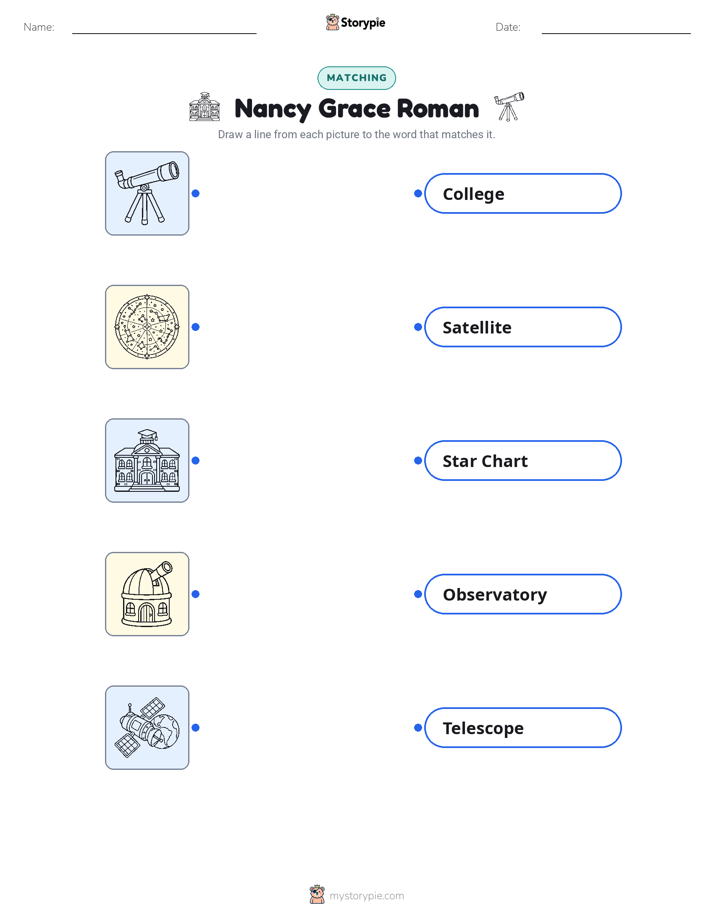
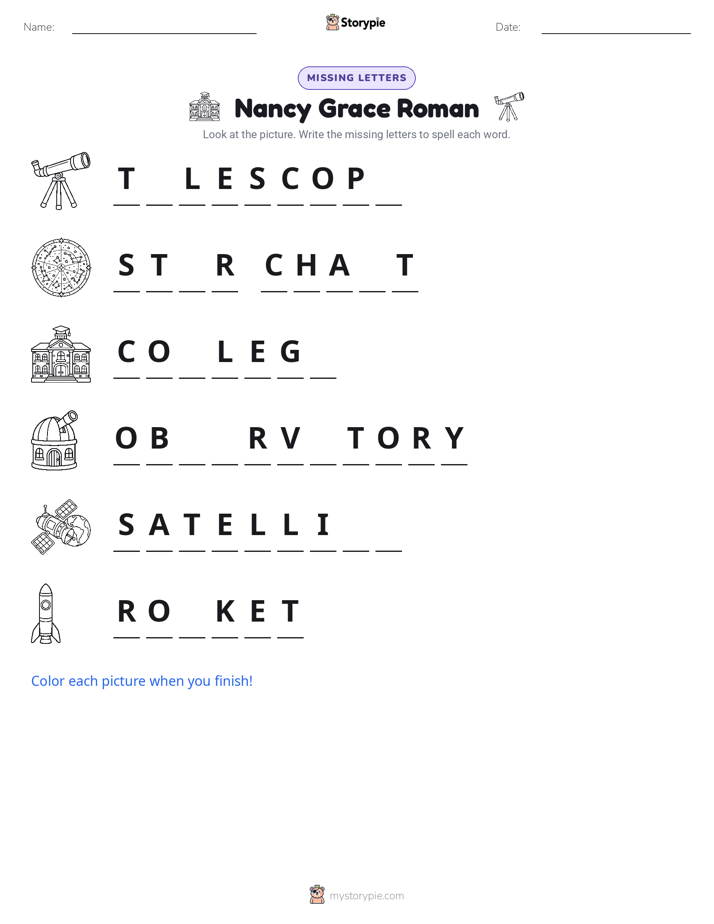
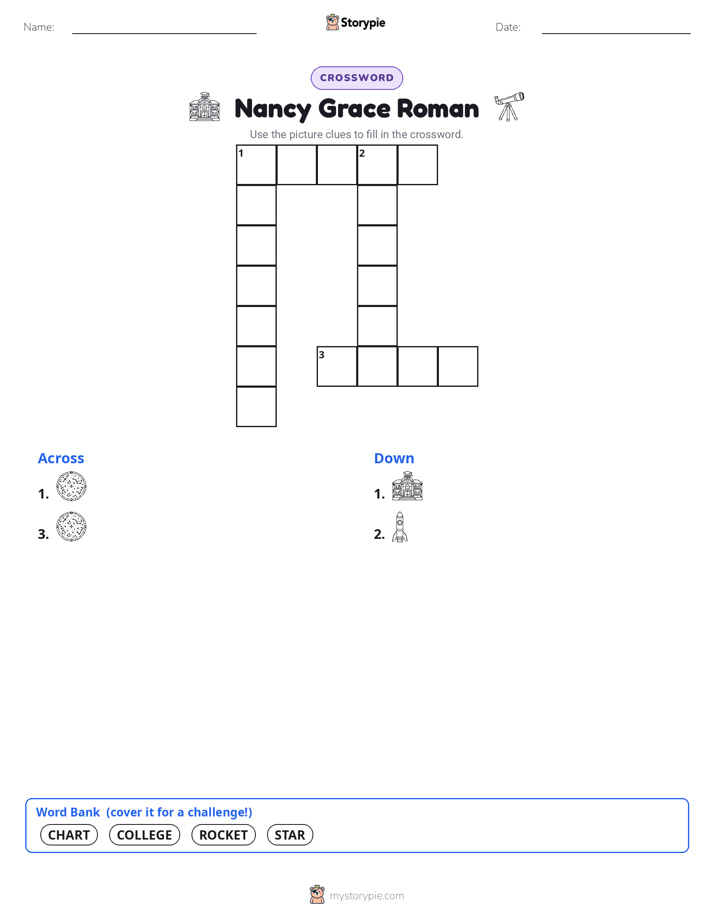
Nancy Grace Roman was an American astronomer known as the 'Mother of Hubble' for her pivotal role in planning…
Reads at Grades 3–5 Listens at Grades 1–5
Print & create
Answer keys·No prep·Free with an account
28 worksheets · answer keys · full story · quiz · Ages 8-10 · CEFR B1
Plus adds 290,000+ more stories in 27 languages, audio for every one, and printables for all of them.
Just want Nancy Grace Roman?

Hello. My name is Nancy Grace Roman. I was born in Nashville, Tennessee, on May 16th, 1925. Even when I was a very young girl, the night sky filled me with wonder. My mother, Georgia, would take me outside on clear nights to show me the beautiful patterns of stars called constellations and the dancing colors of the northern lights. I loved learning about space so much that when I was 11 years old, around the year 1936, I started my very own astronomy club with my friends. We spent our time reading books about the stars and learning everything we could about the amazing universe above us.
As I grew up in the 1930s and 1940s, it was not common for girls to dream of becoming scientists. Some of my teachers even told me that I should choose a different path, but I knew in my heart that studying the stars was what I was meant to do. I was determined to follow my dream, no matter what anyone said. I went to Swarthmore College and studied very hard, earning my degree in astronomy in 1946. But I wasn't finished learning. I continued my education at the University of Chicago, where I earned my doctorate in 1949. A doctorate is the highest degree a person can get in their field. I wanted to prove that anyone who has a passion for science could succeed if they worked hard.
In 1959, I received an amazing opportunity. A new agency called NASA, which you might know as the organization that sends astronauts and rockets into space, offered me a job. I said yes, and I became NASA’s very first Chief of Astronomy. This was a very important role, and it also made me the first woman to hold an executive, or leadership, position at NASA. My main job was to help plan our country’s future space science missions. I got to think about what kinds of powerful telescopes and scientific instruments we should build and send into space to learn more about distant planets, stars, and entire galaxies.
Nancy Grace Roman: Mother of Hubble
Hello. My name is Nancy Grace Roman. I was born in Nashville, Tennessee, on May 16th, 1925. Even when I was a very young girl, the night sky filled me with wonder. My mother, Georgia, would take me outside on clear nights to show me the beautiful patterns of stars called constellations and the dancing colors of the northern lights. I loved learning about space so much that when I was 11 years old, around the year 1936, I started my very own astronomy club with my friends. We spent our time reading books about the stars and learning everything we could about the amazing universe above us.
As I grew up in the 1930s and 1940s, it was not common for girls to dream of becoming scientists. Some of my teachers even told me that I should choose a different path, but I knew in my heart that studying the stars was what I was meant to do. I was determined to follow my dream, no matter what anyone said. I went to Swarthmore College and studied very hard, earning my degree in astronomy in 1946. But I wasn't finished learning. I continued my education at the University of Chicago, where I earned my doctorate in 1949. A doctorate is the highest degree a person can get in their field. I wanted to prove that anyone who has a passion for science could succeed if they worked hard.
In 1959, I received an amazing opportunity. A new agency called NASA, which you might know as the organization that sends astronauts and rockets into space, offered me a job. I said yes, and I became NASA’s very first Chief of Astronomy. This was a very important role, and it also made me the first woman to hold an executive, or leadership, position at NASA. My main job was to help plan our country’s future space science missions. I got to think about what kinds of powerful telescopes and scientific instruments we should build and send into space to learn more about distant planets, stars, and entire galaxies.
I had an idea that I believed could change how we see the universe. On Earth, even on the clearest night, a telescope has to look through our planet's atmosphere. The air is always moving and shimmering, which makes the stars look a little blurry. I thought, what if we could put a giant telescope into space, high above all that wobbly air? From there, it could capture incredibly clear pictures of the universe. Starting in the 1960s, I spent many years traveling across the country. I spoke with scientists and engineers to help plan this special space telescope. It took a lot of work to convince people that it was a good idea, but we finally did it. I retired from NASA in 1979, but the work on the telescope continued. In 1990, it was finally launched into space and named the Hubble Space Telescope. Because I helped get the project started from the very beginning, many people call me the 'Mother of Hubble'.
I lived a long and starry life, reaching the age of 93. Even after I retired from NASA, I spent my years encouraging young people, especially girls, to get excited about science and to pursue their dreams. People remember me for helping make the Hubble Space Telescope a reality, a tool that has shown us amazing pictures of our universe and led to countless discoveries. My work continues to inspire new generations of astronomers. In 2020, NASA honored me by naming a powerful new space telescope after me: the Nancy Grace Roman Space Telescope. I hope my story reminds you to always look up at the sky, stay curious about the world around you, and never let anyone stop you from reaching for the stars.
Wow facts
About
Nancy Grace Roman was an American astronomer known as the 'Mother of Hubble' for her pivotal role in planning the Hubble Space Telescope. She was also the first woman to hold an executive position at NASA.
Take a Quiz
Question 1 of 5
Why is Nancy Grace Roman often called the 'Mother of Hubble'?
Explore next





Want to do even more?
Go beyond exploring. Unlock tools that turn every story into real learning.

Storypie Plus for families
Full stories, quizzes, and printables. Nights and car rides, sorted.
- Unlimited audio stories
- Create Mode: your child stars in the story
- Offline downloads
- Printable worksheets & coloring pages

Why Storypie for Schools
Students engaged. Prep in seconds. Evenings back to you.
- Worksheets & Quizzes
- Classroom Management
- Formative Assessment
- Custom Curriculum & Lesson Plans
- 27 Languages

Why Storypie for Homeschool
Curriculum done. They'll ask for more. Hours back in your day.
- Worksheet Generator
- First-Person Audio Stories
- Built-in Comprehension Quizzes
- Custom Curriculum & Lesson Plans
- Print & Go Activities