English

Pierre de Fermat
Pierre de Fermat was a 17th-century French lawyer and an amateur mathematician who made significant…
Reads at Grades 6–8 Listens at Grades 4–8
Print & create
Answer keys·No prep·Free with an account
28 worksheets · answer keys · full story · quiz · Ages 10-12 · CEFR B2
Plus adds 208,000+ more stories in 27 languages, audio for every one, and printables for all of them.
Just want Pierre de Fermat?
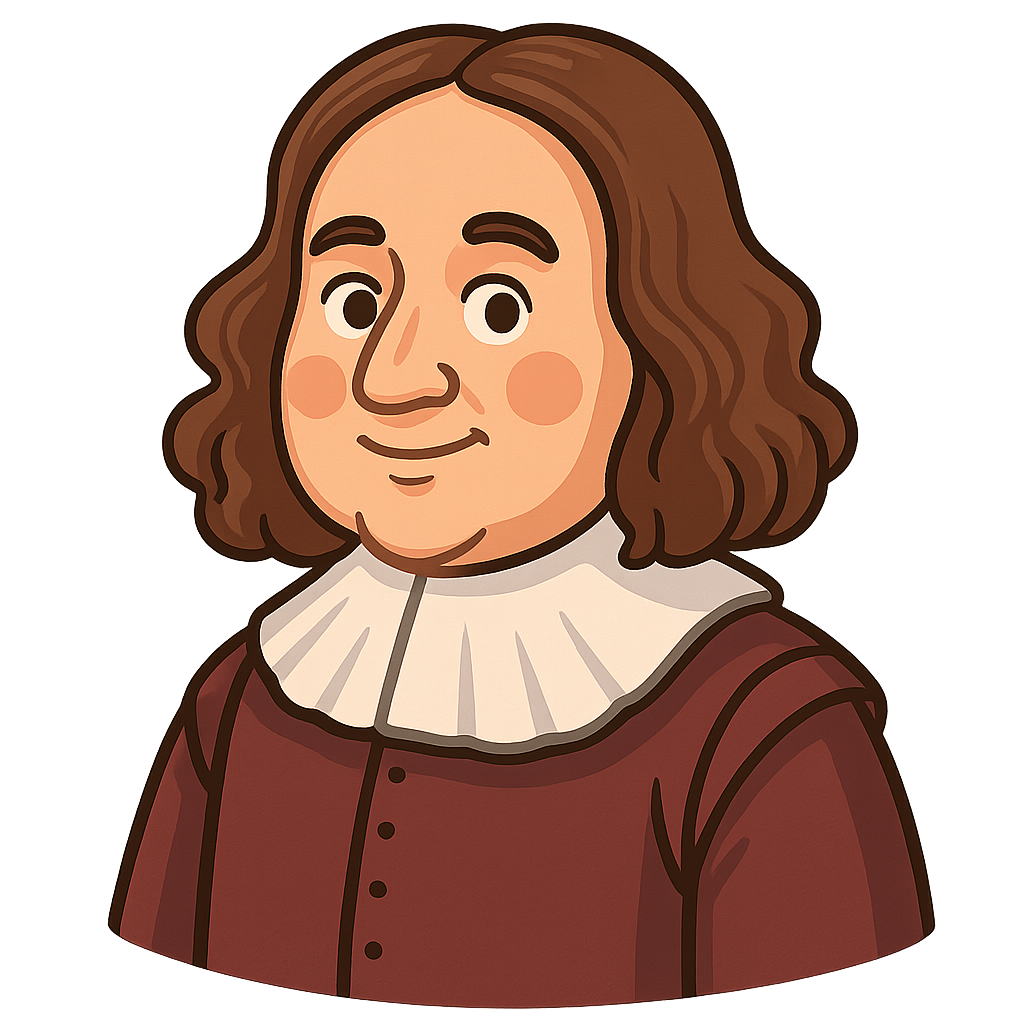
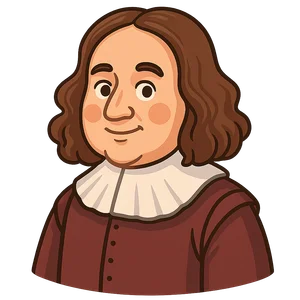
Hello, my name is Pierre de Fermat, and while you may know my name from your mathematics classes, I have a secret to share. I was not a professional mathematician; my actual job was as a lawyer in 17th-century France. I was born in a lovely town called Beaumont-de-Lomagne, France, around the year 1607. The world was quite different then, a time of great intellectual curiosity. I pursued my formal education at the University of Orléans, where I studied civil law, a field that requires careful logic and reason. After graduating around 1626, I began my legal career in 1631 when I was appointed as a councillor at the Parlement of Toulouse. My work in the court was demanding and important, but in my private time, my mind was captivated by something else entirely: the elegant and beautiful world of numbers. Mathematics was my great passion, a hobby I explored simply for the joy of solving a difficult puzzle, not for seeking fame or earning money.
During the 17th century, we did not have the internet or academic journals as you do today. Instead, great thinkers shared their ideas by writing letters to one another, creating a vibrant community of minds across Europe. This was how I chose to share my mathematical discoveries. Instead of publishing my work in formal books, I wrote detailed letters to my contemporaries, challenging them with problems and sharing my solutions. My most significant correspondence began in the year 1654 with another brilliant mathematician you may have heard of, Blaise Pascal. Through a series of letters, we tackled questions about games of chance. We wondered if we could predict the outcomes of these games using logic and numbers. Our exchange laid the foundation for a completely new field of mathematics known as probability theory. In a similar way, I also worked on connecting the worlds of geometry and algebra, which is now called analytic geometry. Another great thinker, René Descartes, was working on similar ideas, but I developed my methods independently, driven by my own curiosity.
Pierre de Fermat
Hello, my name is Pierre de Fermat, and while you may know my name from your mathematics classes, I have a secret to share. I was not a professional mathematician; my actual job was as a lawyer in 17th-century France. I was born in a lovely town called Beaumont-de-Lomagne, France, around the year 1607. The world was quite different then, a time of great intellectual curiosity. I pursued my formal education at the University of Orléans, where I studied civil law, a field that requires careful logic and reason. After graduating around 1626, I began my legal career in 1631 when I was appointed as a councillor at the Parlement of Toulouse. My work in the court was demanding and important, but in my private time, my mind was captivated by something else entirely: the elegant and beautiful world of numbers. Mathematics was my great passion, a hobby I explored simply for the joy of solving a difficult puzzle, not for seeking fame or earning money.
During the 17th century, we did not have the internet or academic journals as you do today. Instead, great thinkers shared their ideas by writing letters to one another, creating a vibrant community of minds across Europe. This was how I chose to share my mathematical discoveries. Instead of publishing my work in formal books, I wrote detailed letters to my contemporaries, challenging them with problems and sharing my solutions. My most significant correspondence began in the year 1654 with another brilliant mathematician you may have heard of, Blaise Pascal. Through a series of letters, we tackled questions about games of chance. We wondered if we could predict the outcomes of these games using logic and numbers. Our exchange laid the foundation for a completely new field of mathematics known as probability theory. In a similar way, I also worked on connecting the worlds of geometry and algebra, which is now called analytic geometry. Another great thinker, René Descartes, was working on similar ideas, but I developed my methods independently, driven by my own curiosity.
My greatest love was reading the works of ancient mathematicians. I was especially fascinated by a book titled 'Arithmetica,' written centuries earlier by a Greek mathematician named Diophantus. Around the year 1637, I was studying a section about a famous equation from Pythagoras. You likely know it as a² + b² = c², which describes the relationship between the sides of a right-angled triangle. As I sat with the book, a new thought sparked in my mind. I wondered if a similar equation would work for higher powers. Could you find whole numbers that would solve a³ + b³ = c³? Or a⁴ + b⁴ = c⁴? After much thought, I came to a stunning conclusion: it was impossible. No whole numbers, other than zero, could ever solve that equation for any power higher than two. I was so sure of my discovery that I grabbed my pen and, right there in the margin of my copy of 'Arithmetica,' I wrote a little note. It said that I had found a 'truly marvelous proof' for this idea, but the margin was simply too small to contain it.
That brief note would become my most enduring legacy. I lived a full and satisfying life dedicated to the law, my family, and my private passion for numbers. My journey came to an end on January 12th, 1665. I lived to be about 57 years old. Because I never published my work formally, that little note about my 'marvelous proof' was left behind as an irresistible puzzle. For centuries, the greatest mathematical minds in the world tried to rediscover my proof, but no one could solve it. My claim became known as Fermat's Last Theorem, and it stood as one of the most famous unsolved problems in the history of mathematics. It was not until 1994, more than 350 years after I wrote that note, that a determined English mathematician named Andrew Wiles finally constructed a complete proof, confirming I had been correct all along. I hope my story shows you that a great passion can be pursued for its own sake, and sometimes, a single question can inspire centuries of discovery.
Wow facts
About
Pierre de Fermat was a 17th-century French lawyer and an amateur mathematician who made significant contributions to number theory, probability theory, and the early development of calculus. He is most famous for his contributions to number theory, including Fermat's Last Theorem, Fermat's Little Theorem, and Fermat's Principle in optics.
Take a Quiz
Question 1 of 5
What was Pierre de Fermat's main profession, and what was his passion?
Explore next





Want to do even more?
Go beyond exploring. Unlock tools that turn every story into real learning.

Storypie Plus for families
Full stories, quizzes, and printables. Nights and car rides, sorted.
- Unlimited audio stories
- Create Mode: your child stars in the story
- Offline downloads
- Printable worksheets & coloring pages

Why Storypie for Schools
Students engaged. Prep in seconds. Evenings back to you.
- Worksheets & Quizzes
- Classroom Management
- Formative Assessment
- Custom Curriculum & Lesson Plans
- 27 Languages

Why Storypie for Homeschool
Curriculum done. They'll ask for more. Hours back in your day.
- Worksheet Generator
- First-Person Audio Stories
- Built-in Comprehension Quizzes
- Custom Curriculum & Lesson Plans
- Print & Go Activities