English

Samuel F. B. Morse
Samuel F.
Reads at Grades 6–8 Listens at Grades 4–8
Print & create
Answer keys·No prep·Free with an account
28 worksheets · answer keys · full story · quiz · Ages 10-12 · CEFR B2
Plus adds 164,000+ more stories in 27 languages, audio for every one, and printables for all of them.
Just want Samuel F. B. Morse?
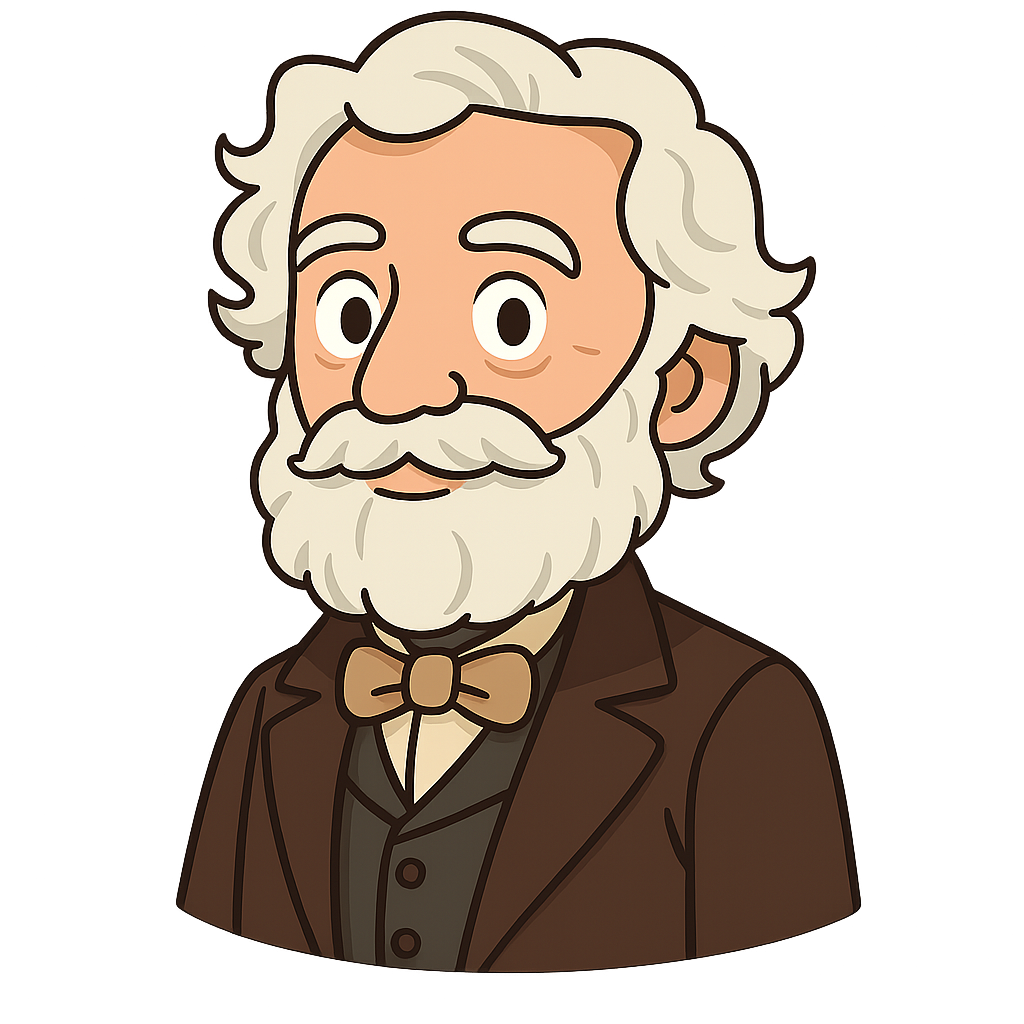
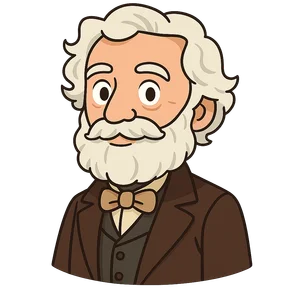
Hello! My name is Samuel F. B. Morse, and you might know me as an inventor, but my first love was art. I was born on April 27th, 1791, in Charlestown, Massachusetts. My father was a well-known pastor and geographer, so our home was always filled with books and interesting conversations about the world. From a young age, I loved to draw and paint more than anything. I attended Yale College, and while I was a curious student in all subjects, especially the new discoveries about electricity, my heart was truly set on becoming a great artist. After I graduated in 1810, I worked hard to convince my parents to let me travel to England to study painting. In 1811, I finally sailed across the ocean to London, ready to learn from the great masters and paint epic scenes from history that I hoped would inspire people for generations.
I spent years in Europe and became a successful portrait painter. It was a wonderful way to make a living, and I had the distinct honor of painting famous people, including President John Adams and the Marquis de Lafayette. But my true ambition was to create large, historical paintings that told important stories from the past. Unfortunately, these giant paintings were very expensive to create and did not sell well, and I often struggled with money. In 1832, my life took an unexpected turn. I was sailing home to America on a ship called the Sully. During the long voyage, I overheard a conversation among some fellow passengers about electromagnets. They discussed how electricity could be sent through a wire almost instantly. A thought struck me like a bolt of lightning: if electricity could travel down a wire, couldn't it be used to carry a message?
Samuel F. B. Morse: The Artist Who Connected the World
Hello! My name is Samuel F. B. Morse, and you might know me as an inventor, but my first love was art. I was born on April 27th, 1791, in Charlestown, Massachusetts. My father was a well-known pastor and geographer, so our home was always filled with books and interesting conversations about the world. From a young age, I loved to draw and paint more than anything. I attended Yale College, and while I was a curious student in all subjects, especially the new discoveries about electricity, my heart was truly set on becoming a great artist. After I graduated in 1810, I worked hard to convince my parents to let me travel to England to study painting. In 1811, I finally sailed across the ocean to London, ready to learn from the great masters and paint epic scenes from history that I hoped would inspire people for generations.
I spent years in Europe and became a successful portrait painter. It was a wonderful way to make a living, and I had the distinct honor of painting famous people, including President John Adams and the Marquis de Lafayette. But my true ambition was to create large, historical paintings that told important stories from the past. Unfortunately, these giant paintings were very expensive to create and did not sell well, and I often struggled with money. In 1832, my life took an unexpected turn. I was sailing home to America on a ship called the Sully. During the long voyage, I overheard a conversation among some fellow passengers about electromagnets. They discussed how electricity could be sent through a wire almost instantly. A thought struck me like a bolt of lightning: if electricity could travel down a wire, couldn't it be used to carry a message?
For the next several years, I lived a double life. By day, I was a professor of art at New York University, painting to earn a living. But by night, I worked tirelessly in my workshop, trying to build a machine that could send messages over a wire. It was incredibly difficult, and many people thought my idea was foolish and impossible. I ran out of money many times and faced constant setbacks, but I refused to give up because I knew this invention could change the world. Fortunately, I found partners who believed in my vision. Leonard Gale, a science professor, helped me understand the complex principles of electromagnetism, and a brilliant young mechanic named Alfred Vail helped me build better and more reliable telegraph machines. Together, around 1838, we developed a special language for the telegraph. It was a system of short sounds, or dots, and long sounds, or dashes, that stood for letters and numbers. We called it Morse Code, and it was the key to making the telegraph a practical tool for communication.
After years of work, we finally had a working model, but we needed to prove it could send a message over a long distance. I asked the United States Congress for money to build an experimental telegraph line. For years, they said no, dismissing my invention as a fantasy. Finally, in 1843, they agreed to give me $30,000 to build a 40-mile line from Washington, D.C., to Baltimore, Maryland. It was a huge undertaking. We carefully strung the wire along posts next to the railroad tracks, facing challenges every step of the way. The big day came on May 24th, 1844. I sat in the Supreme Court chamber in Washington, D.C., with a crowd of important people watching. My assistant, Alfred Vail, was in Baltimore, waiting. I carefully tapped out the first message, a quote from the Bible: 'What hath God wrought.' A few moments later, the telegraph in my room began to click. It was Alfred, sending the exact same message back to me. It had worked! The message had traveled 40 miles and back in an instant. The room erupted in cheers. We had just launched the age of instant communication.
After that first message, the telegraph spread like wildfire. Wires were strung across America and then under the oceans, connecting continents. News that once took weeks to travel by ship or horse now took only minutes. This invention changed how businesses worked, how newspapers reported stories, and how people connected with loved ones far away. I spent many years in court defending my invention against others who claimed it as their own, but in the end, I was recognized as its creator. I lived a long and full life, seeing my invention shrink the world and bring people closer together. I lived to be 80 years old, passing away on April 2nd, 1872. I began my life as an artist who wanted to capture moments on canvas, and I ended it as an inventor who helped the world share moments in an instant. I hope my story reminds you that a single idea, powered by curiosity and perseverance, truly can change the world.
Wow facts
About
Samuel F. B. Morse was an American painter and inventor best known for his co-invention of the single-wire telegraph system and the development of Morse code, a system for transmitting information as a series of electronic signals.
Take a Quiz
Question 1 of 5
What was the main problem Samuel Morse had to solve after he had a working model of the telegraph?
Explore next




Want to do even more?
Go beyond exploring. Unlock tools that turn every story into real learning.

Storypie Plus for families
Full stories, quizzes, and printables. Nights and car rides, sorted.
- Unlimited audio stories
- Create Mode: your child stars in the story
- Offline downloads
- Printable worksheets & coloring pages

Why Storypie for Schools
Students engaged. Prep in seconds. Evenings back to you.
- Worksheets & Quizzes
- Classroom Management
- Formative Assessment
- Custom Curriculum & Lesson Plans
- 27 Languages

Why Storypie for Homeschool
Curriculum done. They'll ask for more. Hours back in your day.
- Worksheet Generator
- First-Person Audio Stories
- Built-in Comprehension Quizzes
- Custom Curriculum & Lesson Plans
- Print & Go Activities