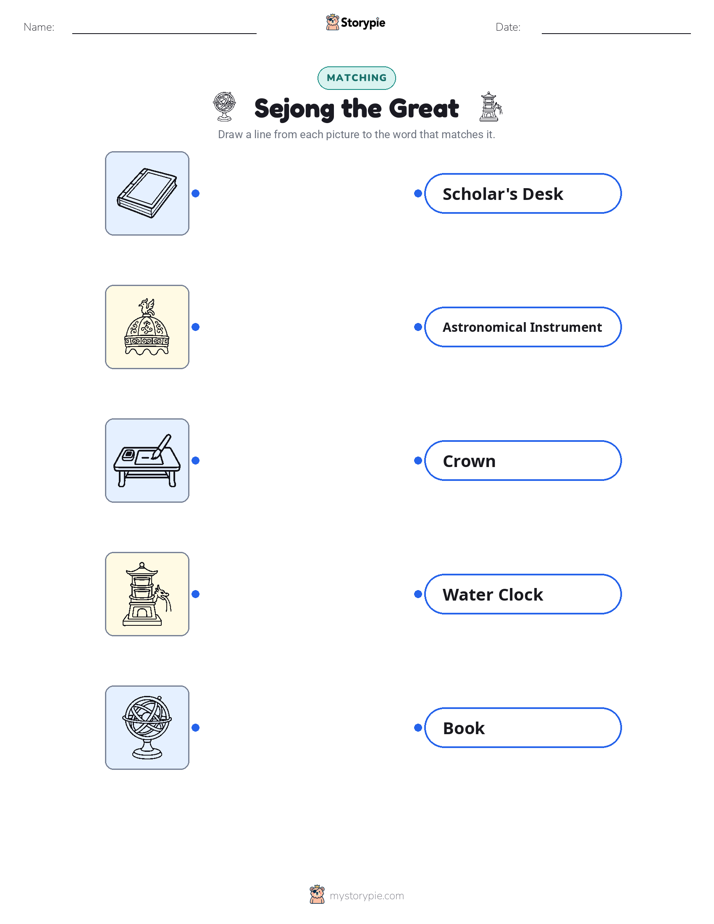
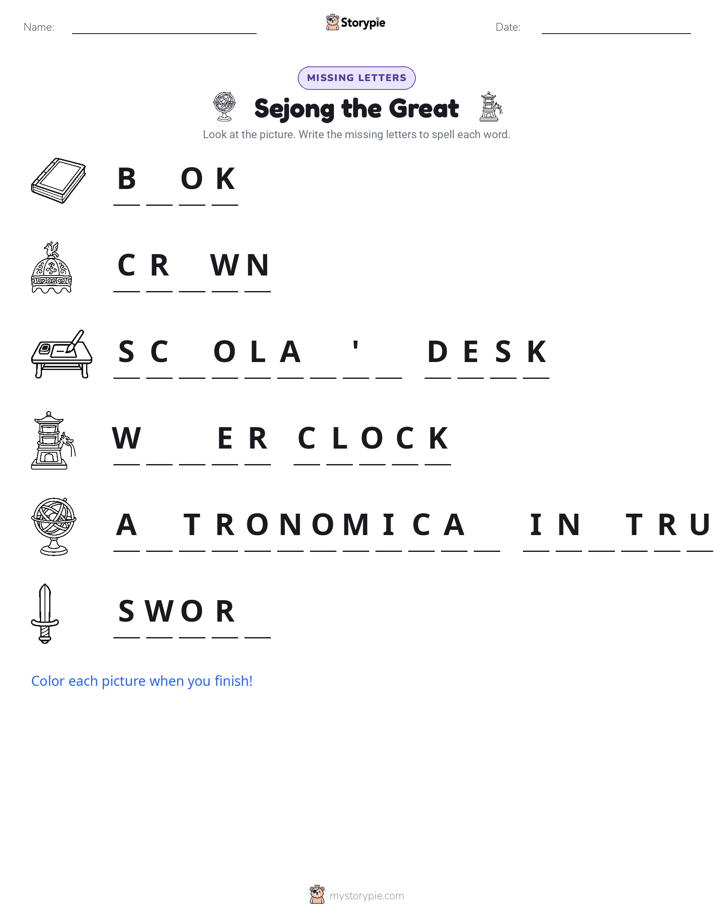
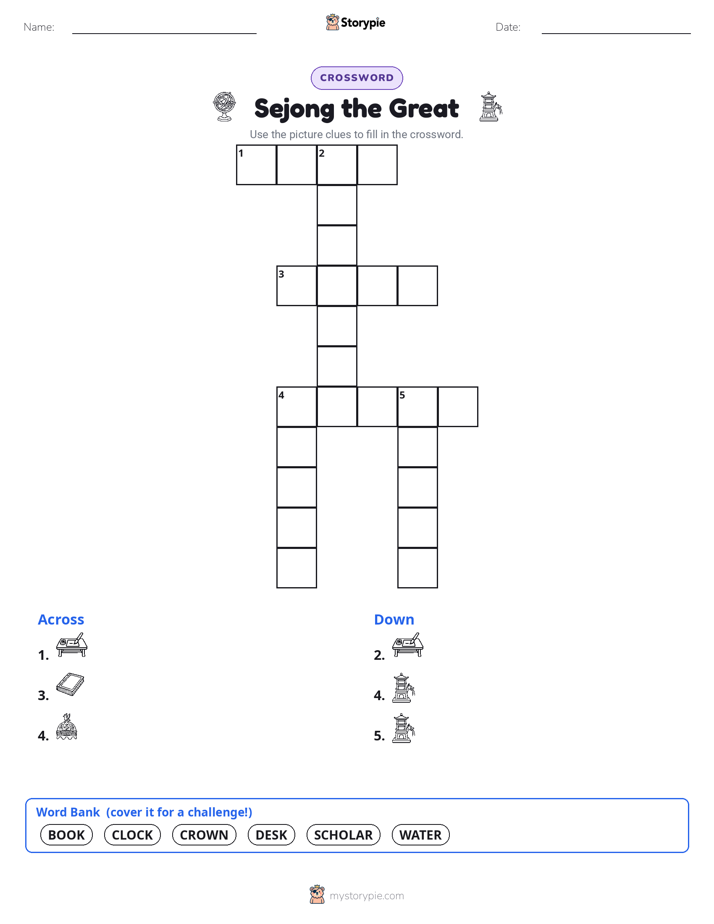
English


Sejong the Great
The fourth king of the Joseon Dynasty of Korea…
Reads at Grades 6–8 Listens at Grades 4–8
Print & create
Answer keys·No prep·Free with an account
28 worksheets · answer keys · full story · quiz · Ages 10-12 · CEFR B2
Plus adds 208,000+ more stories in 27 languages, audio for every one, and printables for all of them.
Just want Sejong the Great?
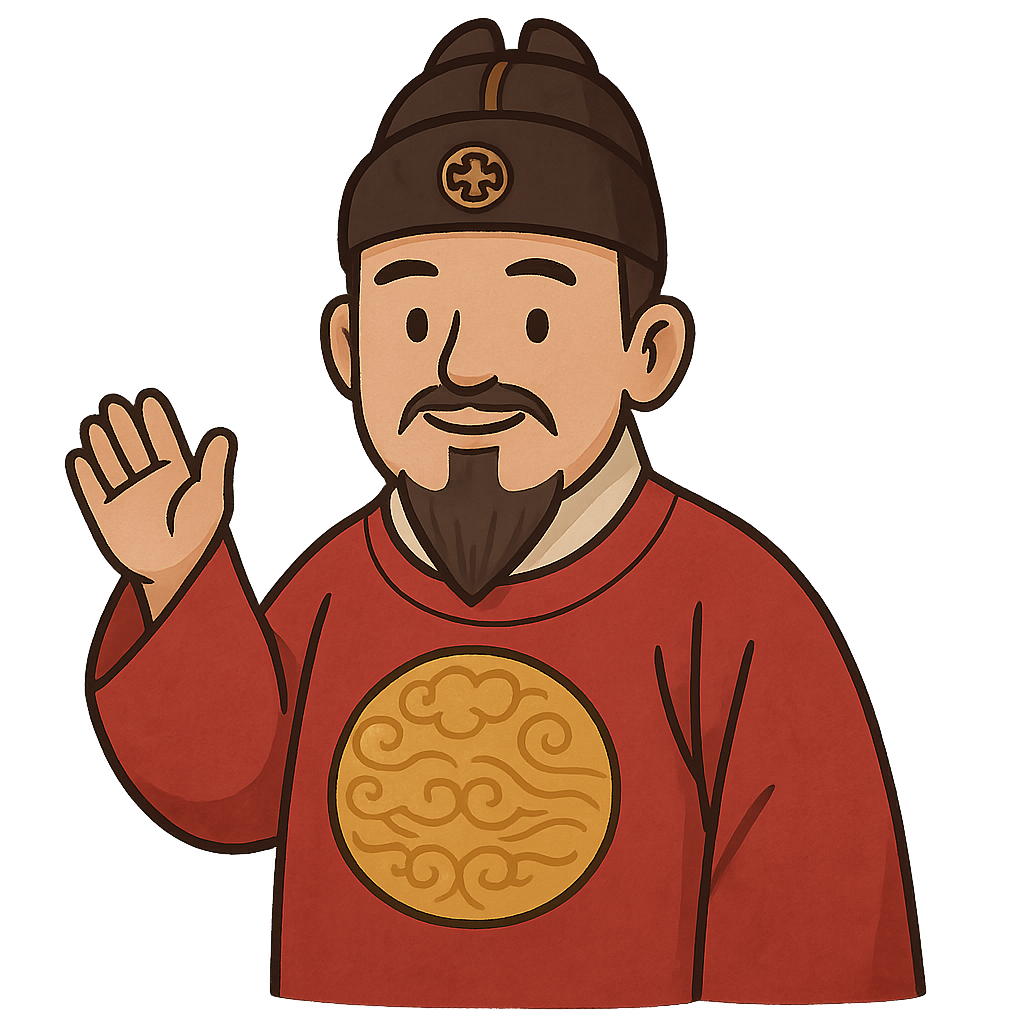
Hello! My name is Yi Do, but today you might know me as Sejong the Great. I was born on May 15th, 1397, in Hanseong, the capital of the great Joseon Kingdom in Korea. As the third son of King Taejong, no one expected me to one day wear the crown. This left me free to pursue my greatest passion: reading. I would spend countless hours with books about history, government, science, and art. My father often worried that I would read until I fell ill, but for me, learning was as important as breathing. This deep love for knowledge would guide every decision I made for the rest of my life.
Life has a funny way of surprising you. My two older brothers were in line for the throne before me, but my father saw a different path. He believed my dedication to learning and my calm nature were the qualities our kingdom needed in a leader. In the summer of 1418, he named me Crown Prince. Then, just two months later, on September 9th, 1418, he stepped down and I became the fourth king of Joseon. At just 21 years old, I felt the weight of an entire nation on my shoulders. One of my first acts as king was to establish the Hall of Worthies, or Jiphyeonjeon, a special academy where I gathered the most brilliant scholars in the land to help me study and find the best ways to govern our people.
I believed that a strong kingdom was built on more than just powerful armies—it was built on great ideas. I looked for talented people everywhere, regardless of their social class. One such person was a brilliant inventor named Jang Yeong-sil. Together, we created amazing things to help our people. In 1441, we developed the world's first standardized rain gauge, the 'cheugugi', which helped farmers better predict harvests. We built incredible automated water clocks and intricate astronomical instruments to map the stars. At the same time, I knew we had to be strong to protect our peace. In the 1430s, I ordered military campaigns to secure our northern borders and keep our kingdom safe, ensuring that our golden age of discovery could continue.
Sejong the Great: The King Who Gave His People a Voice
Hello! My name is Yi Do, but today you might know me as Sejong the Great. I was born on May 15th, 1397, in Hanseong, the capital of the great Joseon Kingdom in Korea. As the third son of King Taejong, no one expected me to one day wear the crown. This left me free to pursue my greatest passion: reading. I would spend countless hours with books about history, government, science, and art. My father often worried that I would read until I fell ill, but for me, learning was as important as breathing. This deep love for knowledge would guide every decision I made for the rest of my life.
Life has a funny way of surprising you. My two older brothers were in line for the throne before me, but my father saw a different path. He believed my dedication to learning and my calm nature were the qualities our kingdom needed in a leader. In the summer of 1418, he named me Crown Prince. Then, just two months later, on September 9th, 1418, he stepped down and I became the fourth king of Joseon. At just 21 years old, I felt the weight of an entire nation on my shoulders. One of my first acts as king was to establish the Hall of Worthies, or Jiphyeonjeon, a special academy where I gathered the most brilliant scholars in the land to help me study and find the best ways to govern our people.
I believed that a strong kingdom was built on more than just powerful armies—it was built on great ideas. I looked for talented people everywhere, regardless of their social class. One such person was a brilliant inventor named Jang Yeong-sil. Together, we created amazing things to help our people. In 1441, we developed the world's first standardized rain gauge, the 'cheugugi', which helped farmers better predict harvests. We built incredible automated water clocks and intricate astronomical instruments to map the stars. At the same time, I knew we had to be strong to protect our peace. In the 1430s, I ordered military campaigns to secure our northern borders and keep our kingdom safe, ensuring that our golden age of discovery could continue.
My greatest concern was that knowledge was only available to a lucky few. At the time, we wrote using thousands of complex Chinese characters called Hanja. Learning them took years of expensive education, meaning most of my people could not read or write. I knew this was not fair. I believed that every person deserved the power of literacy. So, in secret, I worked with my most trusted scholars in the Hall of Worthies. We created something revolutionary: a simple, scientific alphabet designed specifically for the Korean language. It was based on the shapes the mouth, tongue, and teeth make when you speak. In 1446, we presented it to the world. We called it 'Hunminjeongeum', or 'The Proper Sounds for the Instruction of the People.' Today, it is known as Hangul. Some nobles resisted the change, but I knew it was a gift that would empower Koreans for centuries to come.
I poured my heart and soul into serving my kingdom, but over time, my health began to fade. I lived to be 52 years old, passing away on April 8th, 1450. My greatest hope was that my work would outlive me and continue to help my people thrive. Today, the alphabet I created, Hangul, is celebrated as one of the most logical and easy-to-learn writing systems in the world. It is a symbol of Korean identity and pride. I am remembered not just as a king, but as a leader who believed that knowledge, science, and culture should belong to everyone.
Wow facts
About
The fourth king of the Joseon Dynasty of Korea, renowned for being widely credited with the creation of the Korean alphabet, Hangul, and promoting science, technology, and culture during his reign.
Take a Quiz
Question 1 of 5
What major problem did King Sejong see with the writing system used in Korea at the time, and what was his solution?
Explore next





Want to do even more?
Go beyond exploring. Unlock tools that turn every story into real learning.

Storypie Plus for families
Full stories, quizzes, and printables. Nights and car rides, sorted.
- Unlimited audio stories
- Create Mode: your child stars in the story
- Offline downloads
- Printable worksheets & coloring pages

Why Storypie for Schools
Students engaged. Prep in seconds. Evenings back to you.
- Worksheets & Quizzes
- Classroom Management
- Formative Assessment
- Custom Curriculum & Lesson Plans
- 27 Languages

Why Storypie for Homeschool
Curriculum done. They'll ask for more. Hours back in your day.
- Worksheet Generator
- First-Person Audio Stories
- Built-in Comprehension Quizzes
- Custom Curriculum & Lesson Plans
- Print & Go Activities