English

Thales of Miletus
Thales of Miletus was an ancient Greek philosopher, mathematician, and astronomer.
Reads at Grades 6–8 Listens at Grades 4–8
Print & create
Answer keys·No prep·Free with an account
28 worksheets · answer keys · full story · quiz · Ages 10-12 · CEFR B2
Plus adds 208,000+ more stories in 27 languages, audio for every one, and printables for all of them.
Just want Thales of Miletus?
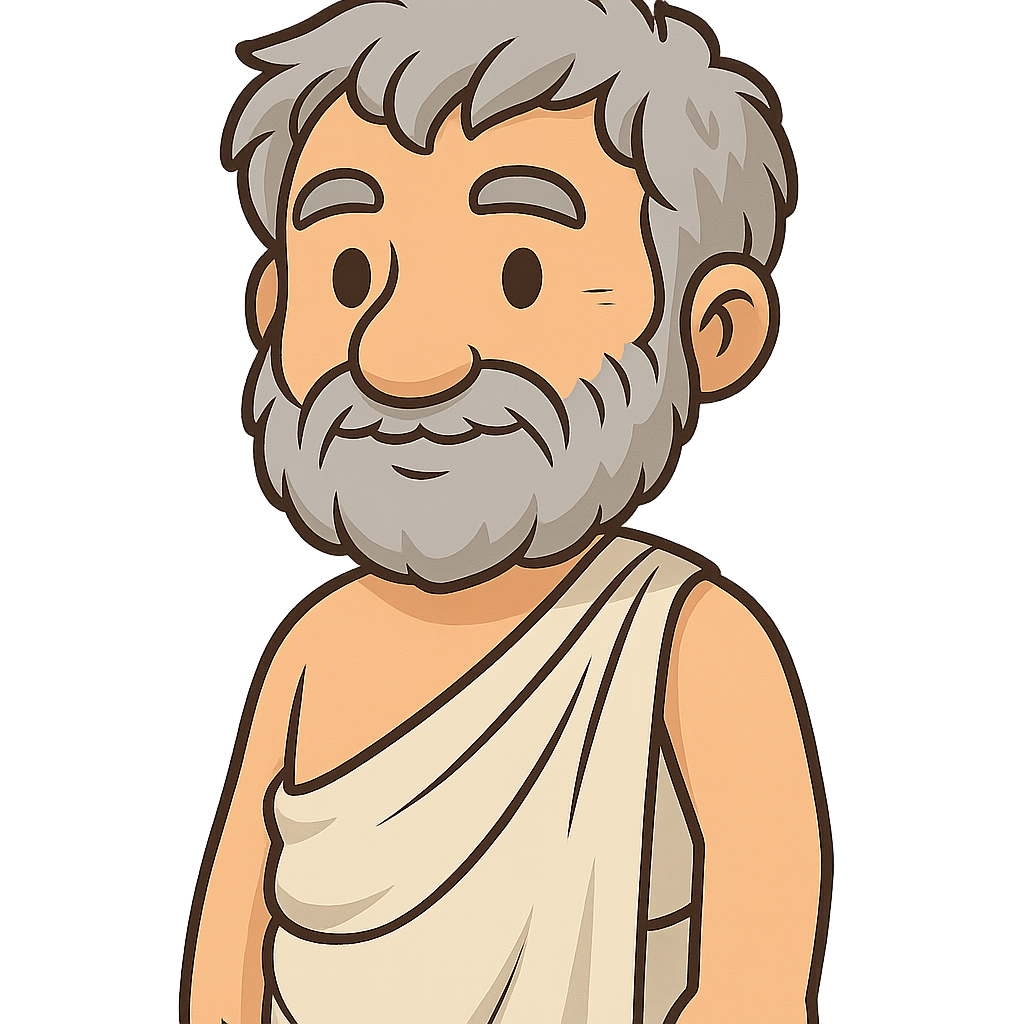
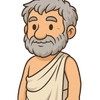
Hello! My name is Thales, and I lived a very long time ago in ancient Greece. I am known as one of the very first philosophers and scientists because I spent my life asking big questions about the world. I was born around the year 624 BCE in a bustling port city called Miletus. Because Miletus was a center for trade, ships were always arriving from faraway places like Egypt and Babylon, bringing new goods, people, and ideas. This environment fueled my curiosity. While many people around me believed that the world was controlled by gods and goddesses who made the sun rise and the wind blow, I was never satisfied with those explanations. I wanted to understand the natural causes behind everything I saw, so I dedicated my life to observing the world and trying to find logical answers for how it all worked.
After years of observation and deep thought, I proposed a big idea that changed how people viewed the world. I suggested that everything, from the tallest tree to the smallest bug, originated from a single fundamental substance: water. It might seem like a simple idea today, but consider its properties. Water can exist as a liquid we drink, a solid block of ice, or a steamy vapor that rises into the air. Furthermore, every living thing we know of depends on water to survive. This was a revolutionary way of thinking. Instead of attributing creation to the actions of a god, I was suggesting that the universe was made of a natural element that we could see, touch, and study. This was one of the first attempts to explain the world using reason and observation, which is why many people call me the first philosopher and the first scientist.
Thales of Miletus: The First Philosopher
Hello! My name is Thales, and I lived a very long time ago in ancient Greece. I am known as one of the very first philosophers and scientists because I spent my life asking big questions about the world. I was born around the year 624 BCE in a bustling port city called Miletus. Because Miletus was a center for trade, ships were always arriving from faraway places like Egypt and Babylon, bringing new goods, people, and ideas. This environment fueled my curiosity. While many people around me believed that the world was controlled by gods and goddesses who made the sun rise and the wind blow, I was never satisfied with those explanations. I wanted to understand the natural causes behind everything I saw, so I dedicated my life to observing the world and trying to find logical answers for how it all worked.
After years of observation and deep thought, I proposed a big idea that changed how people viewed the world. I suggested that everything, from the tallest tree to the smallest bug, originated from a single fundamental substance: water. It might seem like a simple idea today, but consider its properties. Water can exist as a liquid we drink, a solid block of ice, or a steamy vapor that rises into the air. Furthermore, every living thing we know of depends on water to survive. This was a revolutionary way of thinking. Instead of attributing creation to the actions of a god, I was suggesting that the universe was made of a natural element that we could see, touch, and study. This was one of the first attempts to explain the world using reason and observation, which is why many people call me the first philosopher and the first scientist.
My curiosity wasn't limited to the earth; I was also fascinated by the secrets of the sky. I spent countless hours studying the stars and planets, carefully tracking their movements across the night sky. I realized that these celestial bodies were not wandering randomly but followed predictable patterns. My most famous astronomical achievement came in the year 585 BCE. Using my calculations, I predicted that on a specific day, May 28th, the sun would vanish from the sky during the day. We now call this event a solar eclipse. By chance, two powerful armies, the Lydians and the Medes, were fighting a fierce battle on that very day. When the sky suddenly went dark, just as I had predicted, the soldiers were so stunned and frightened that they stopped fighting and agreed to make peace. This incredible event showed people that the universe operated on understandable rules, not just on the whims of the gods.
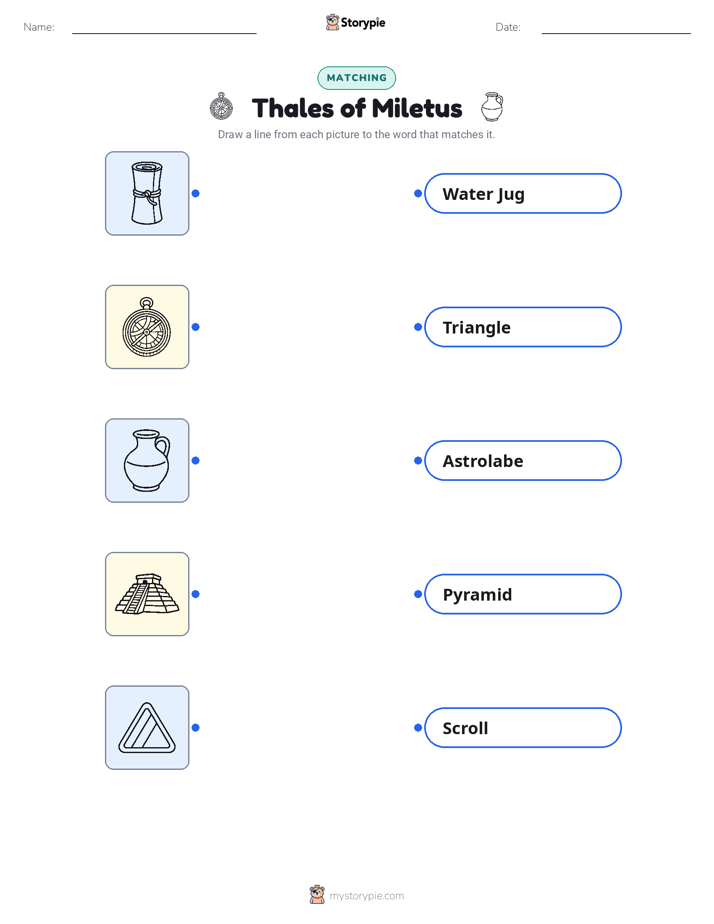
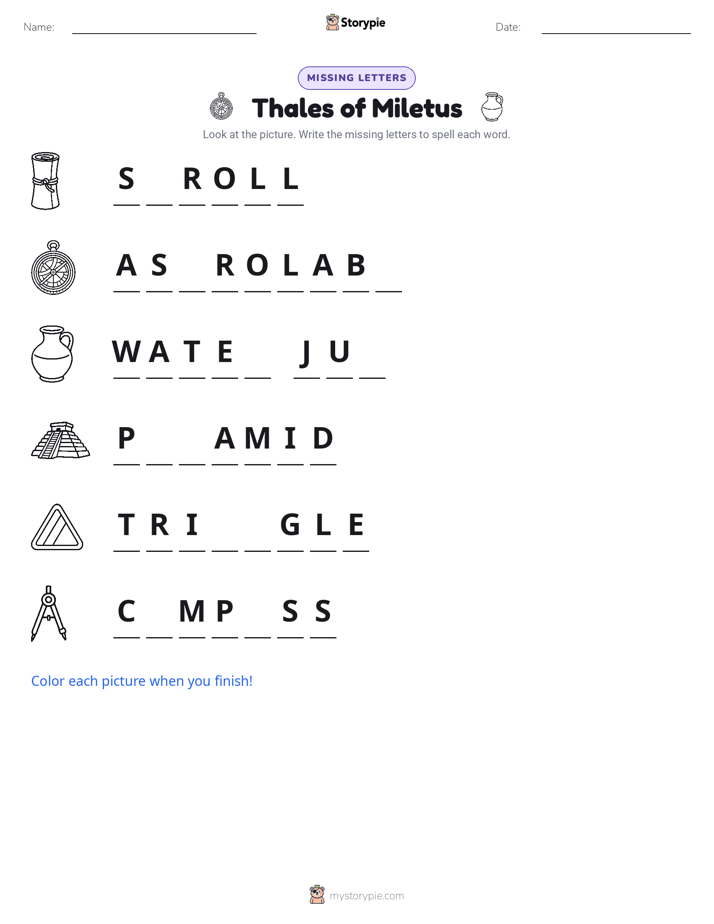
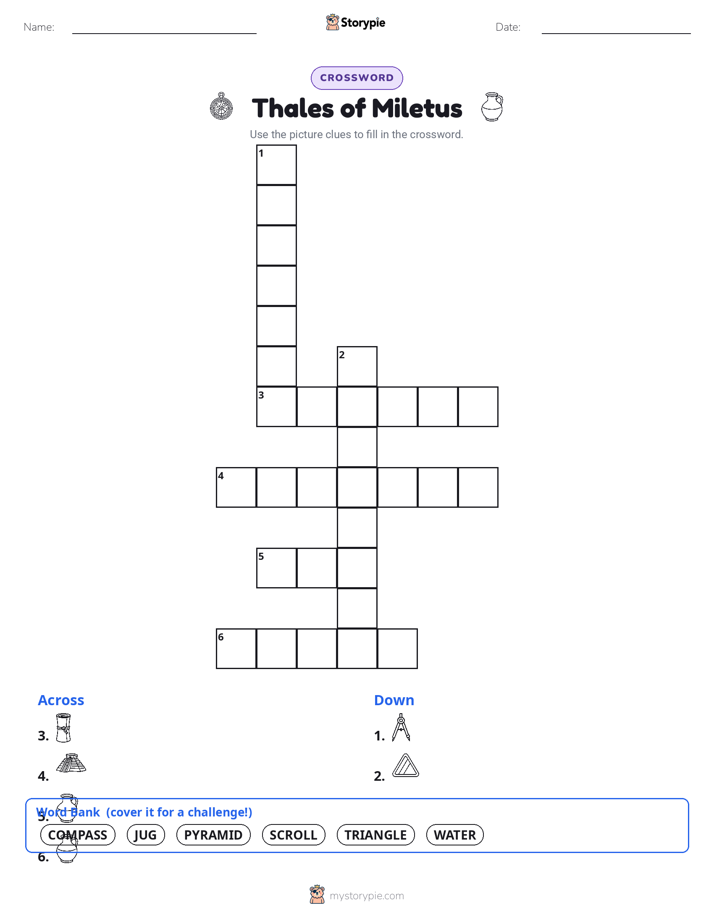
I also believed that mathematics was a key to unlocking the secrets of the universe. I traveled to Egypt, where I was amazed by their magnificent pyramids. The Egyptians knew how to build them, but I wanted to find a way to measure their height precisely. I devised a clever method. I waited for the time of day when my own shadow was exactly the same length as my body. I reasoned that at that specific moment, the length of the pyramid's shadow would be equal to its actual height. It worked! I also contributed to the field of geometry by developing principles, or theorems. One of my theorems helps explain the properties of triangles that are drawn inside of circles. I demonstrated that mathematics was more than just a tool for counting; it was a powerful language that could be used to describe, measure, and understand the world around us.
I lived a long and full life, to be about 78 years old. While I never wrote any books, I loved sharing my knowledge and encouraging others to think critically. One of my students, Anaximander, continued my work, asking his own profound questions about the universe and seeking answers in nature. My greatest legacy wasn't any single discovery, but rather the introduction of a new way of thinking: the idea that we should use our minds to ask 'why?' and to seek knowledge through reason and evidence. This spirit of inquiry is the foundation of all science and philosophy, and it lives on in every person who looks at the world with wonder and tries to understand how it works.
Wow facts
About
Thales of Miletus was an ancient Greek philosopher, mathematician, and astronomer. He is widely regarded as the first philosopher in the Greek tradition and the father of Western science for seeking natural explanations for worldly phenomena.
Take a Quiz
Question 1 of 5
Based on the story, what was Thales's most important contribution to the world?
Explore next






Want to do even more?
Go beyond exploring. Unlock tools that turn every story into real learning.

Storypie Plus for families
Full stories, quizzes, and printables. Nights and car rides, sorted.
- Unlimited audio stories
- Create Mode: your child stars in the story
- Offline downloads
- Printable worksheets & coloring pages

Why Storypie for Schools
Students engaged. Prep in seconds. Evenings back to you.
- Worksheets & Quizzes
- Classroom Management
- Formative Assessment
- Custom Curriculum & Lesson Plans
- 27 Languages

Why Storypie for Homeschool
Curriculum done. They'll ask for more. Hours back in your day.
- Worksheet Generator
- First-Person Audio Stories
- Built-in Comprehension Quizzes
- Custom Curriculum & Lesson Plans
- Print & Go Activities