English


Vitus Bering
Vitus Bering was a Danish-born navigator and explorer in Russian service who led two major expeditions to…
Reads at Grades 6–8 Listens at Grades 4–8
Print & create
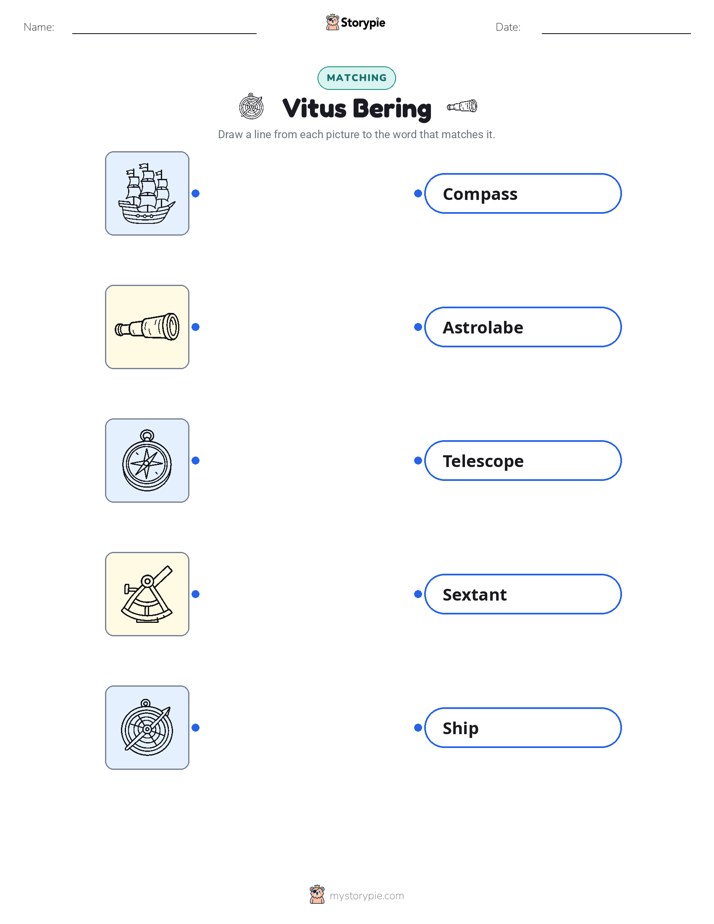
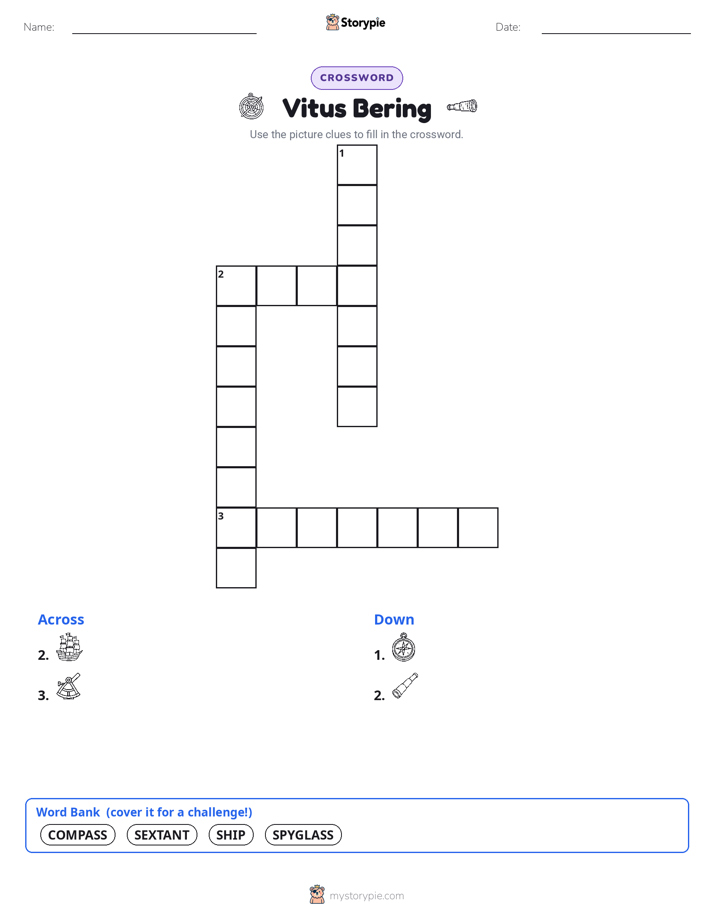
Answer keys·No prep·Free with an account
28 worksheets · answer keys · full story · quiz · Ages 10-12 · CEFR B2
Plus adds 244,000+ more stories in 27 languages, audio for every one, and printables for all of them.
Just want Vitus Bering?

Hello! My name is Vitus Bering, and I was an explorer who sailed the coldest, most mysterious seas in the world. My story begins not in the icy north, but in a cozy town called Horsens in Denmark, where I was born on August 5th, 1681. From a very young age, I felt the pull of the ocean. I would spend hours watching the tall ships in the harbor, imagining all the faraway lands they came from and the adventures their crews had experienced. I knew that a life at sea was the life for me. When I became a young man, I turned that dream into a reality and became a sailor. My travels took me to many corners of the globe, but my greatest adventure began in 1704. That was the year I joined the navy of a powerful and curious leader, Tsar Peter the Great of Russia. He was building a modern navy and looking for skilled officers. He saw a spark in me—a determination and a love for exploration—and believed I had the courage to take on a challenge that no one had ever completed before.
In 1725, Tsar Peter the Great gave me a mission that would change my life and the maps of the world forever. He summoned me and posed a huge question that had puzzled geographers for centuries: were the continents of Asia and North America connected by a land bridge, or were they separated by water? No one knew for sure! To find the answer, I was tasked with leading an expedition across the entire width of Russia, which is the biggest country in the world. This journey across the vast, wild land of Siberia was an expedition in itself, and it took us two long years. We traveled by horse-drawn sleds over frozen ground in the harsh winters and by riverboats during the short summers. It was an incredibly difficult trek through dense forests, across wide rivers, and over rugged mountains. My men and I faced extreme cold and countless challenges, but we were determined. Our goal was to reach the Kamchatka Peninsula, a remote piece of land on the far eastern edge of Siberia. There, we would build a ship and sail into the unknown.
Vitus Bering: Explorer of the North
Hello! My name is Vitus Bering, and I was an explorer who sailed the coldest, most mysterious seas in the world. My story begins not in the icy north, but in a cozy town called Horsens in Denmark, where I was born on August 5th, 1681. From a very young age, I felt the pull of the ocean. I would spend hours watching the tall ships in the harbor, imagining all the faraway lands they came from and the adventures their crews had experienced. I knew that a life at sea was the life for me. When I became a young man, I turned that dream into a reality and became a sailor. My travels took me to many corners of the globe, but my greatest adventure began in 1704. That was the year I joined the navy of a powerful and curious leader, Tsar Peter the Great of Russia. He was building a modern navy and looking for skilled officers. He saw a spark in me—a determination and a love for exploration—and believed I had the courage to take on a challenge that no one had ever completed before.
In 1725, Tsar Peter the Great gave me a mission that would change my life and the maps of the world forever. He summoned me and posed a huge question that had puzzled geographers for centuries: were the continents of Asia and North America connected by a land bridge, or were they separated by water? No one knew for sure! To find the answer, I was tasked with leading an expedition across the entire width of Russia, which is the biggest country in the world. This journey across the vast, wild land of Siberia was an expedition in itself, and it took us two long years. We traveled by horse-drawn sleds over frozen ground in the harsh winters and by riverboats during the short summers. It was an incredibly difficult trek through dense forests, across wide rivers, and over rugged mountains. My men and I faced extreme cold and countless challenges, but we were determined. Our goal was to reach the Kamchatka Peninsula, a remote piece of land on the far eastern edge of Siberia. There, we would build a ship and sail into the unknown.
After our grueling two-year land journey, my crew and I finally reached the Pacific coast on the Kamchatka Peninsula. We had no ship waiting for us, so we had to build one from the ground up using local timber. We named her the St. Gabriel. In the summer of 1728, we finally set sail into the foggy, icy waters of the uncharted sea. We sailed north, keeping the coast of Asia to our left and carefully mapping everything we saw. The weather was harsh, and the waters were treacherous, but we pressed on. On August 10th, 1728, we spotted a large island through the mist, which is now called St. Lawrence Island. As we continued sailing north, I noticed that the coastline turned westward, and there was open water to the north and to the east. This was the proof we needed! Asia did not connect to America. We had sailed through a passage between the two great continents. That body of water would one day be named the Bering Strait, in my honor. I returned to the capital city of St. Petersburg to report my findings, proud of what my crew and I had accomplished.
The Russian rulers in St. Petersburg were so impressed with my findings that they asked me to lead another, even bigger expedition. This one, which started in 1733, was called the Great Northern Expedition, and it was one of the largest and most ambitious scientific expeditions in history. Our mission was enormous and had several goals. We were to map the entire northern coast of Siberia, a massive and frozen coastline that was mostly unknown to the world. And, most importantly, we were to finally sail east from Kamchatka and find the coast of North America, claiming any new lands for Russia. This was a massive undertaking that involved thousands of people, including scientists who studied plants and animals, artists who sketched the landscapes, and other skilled sailors. It took us many years just to prepare all the supplies and travel back across the vastness of Siberia. For this voyage, I was not alone. My second-in-command was a brave captain named Aleksei Chirikov, who commanded a second ship, the St. Paul, which would sail alongside my vessel.
Finally, after years of preparation, my ship, the St. Peter, and Captain Chirikov's ship, the St. Paul, set sail from Kamchatka in the summer of 1741. We headed east into the great unknown of the North Pacific. Unfortunately, a powerful storm soon separated our two ships, and despite our efforts to find one another, we never saw the St. Paul again on that voyage. My crew and I had to push on alone. We sailed through thick fog and past floating ice for weeks. Then, on July 16th, 1741, we saw it—a breathtaking sight. Through a break in the clouds, a range of enormous, snow-covered mountains rose from the sea. It was Mount Saint Elias on the coast of what is now called Alaska. We had officially reached the North American continent from Asia by sea! Our journey back, however, was terrible. Fierce storms battered our ship, and our food supplies dwindled. Many of my crew, including me, grew sick with a dreaded disease called scurvy, caused by a lack of fresh fruit and vegetables. Weakened and lost, we were forced to crash-land on a small, uninhabited island.
We spent that long, brutal winter of 1741 on that desolate island, trying to survive the harsh cold and biting winds with little food or shelter. Sadly, the sickness was too much for my weakened body, and my journey ended there on December 19th, 1741. I lived to be 60 years old. The survivors of my crew, showing incredible strength, eventually built a new, smaller boat from the wreckage of our ship and managed to sail back to Russia the next year. They carried with them our precious maps and the logbooks detailing our discoveries. The island where I was buried was named Bering Island in my memory. Though my final voyage was incredibly difficult, my work helped to create the first accurate maps of this remote part of the world. People remember me for confirming the existence of the Bering Strait and for putting Alaska on the map, connecting two sides of the world that had once been a complete mystery.
Wow facts
About
Vitus Bering was a Danish-born navigator and explorer in Russian service who led two major expeditions to explore the northeastern coast of Asia and the western coast of North America, providing evidence that Asia and North America were separated by a sea, especially the Bering Strait.
Take a Quiz
Question 1 of 5
In your own words, describe the main goal of Vitus Bering's first expedition in 1725 and what he discovered.
Explore next






Want to do even more?
Go beyond exploring. Unlock tools that turn every story into real learning.

Storypie Plus for families
Full stories, quizzes, and printables. Nights and car rides, sorted.
- Unlimited audio stories
- Create Mode: your child stars in the story
- Offline downloads
- Printable worksheets & coloring pages

Why Storypie for Schools
Students engaged. Prep in seconds. Evenings back to you.
- Worksheets & Quizzes
- Classroom Management
- Formative Assessment
- Custom Curriculum & Lesson Plans
- 27 Languages

Why Storypie for Homeschool
Curriculum done. They'll ask for more. Hours back in your day.
- Worksheet Generator
- First-Person Audio Stories
- Built-in Comprehension Quizzes
- Custom Curriculum & Lesson Plans
- Print & Go Activities