English

William Harvey
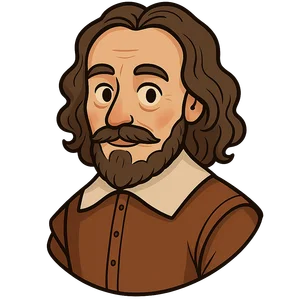
William Harvey was an English doctor who was the first to fully describe how blood moves around the body.
Reads at Grades 6–8 Listens at Grades 4–8
Print & create
Answer keys·No prep·Free with an account
28 worksheets · answer keys · full story · quiz · Ages 10-12 · CEFR B2
Plus adds 208,000+ more stories in 27 languages, audio for every one, and printables for all of them.
Just want William Harvey?
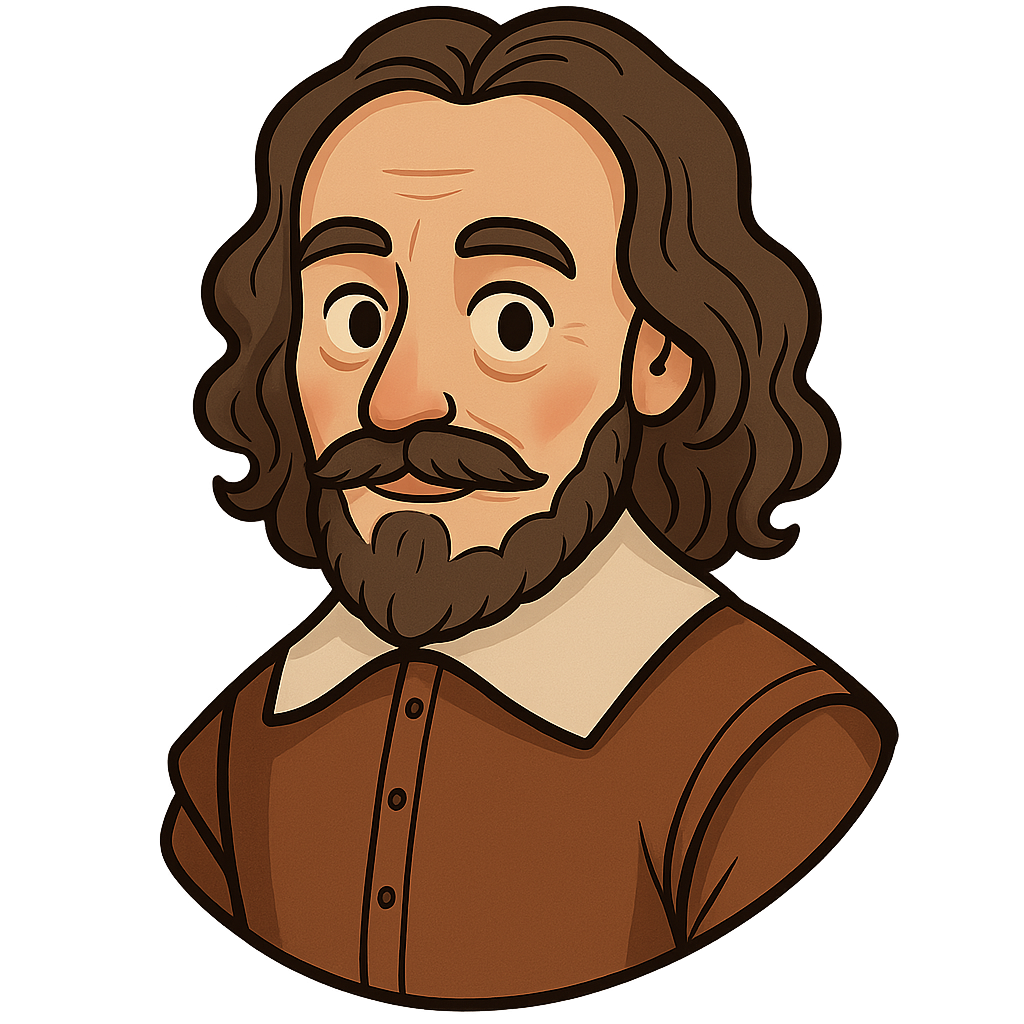
Hello! My name is William Harvey, and I want to tell you the story of how a simple question led to one of the biggest discoveries about the human body. I was born on April 1st, 1578, in a bustling seaside town called Folkestone, in England. As a boy, I was endlessly curious. While my friends played games, I was fascinated by the world around me, especially animals. I would watch them for hours, wondering what was going on inside them. How did they move? How did they breathe? My mind was always buzzing with questions about how living things worked. This constant curiosity about the natural world pushed me to study very hard. I attended The King's School in Canterbury, where I excelled in my studies, particularly in Latin, which was the language of science and medicine at the time. This education prepared me for a lifetime of learning and discovery.
When I was old enough, in 1593, I enrolled at the University of Cambridge to begin my formal studies. While I learned a great deal there, I soon realized that to truly understand the most advanced medical theories, I had to travel. The center of medical innovation during that era was in Italy. So, in 1599, I made the journey and enrolled at the prestigious University of Padua. The atmosphere there was electric, filled with brilliant minds who were challenging old ideas. My most influential teacher was a famous anatomist named Hieronymus Fabricius. He had recently made a fascinating discovery: our veins contain tiny, one-way doors, which he called valves. Fabricius believed their purpose was simply to slow down the flow of blood, ensuring it was evenly distributed throughout the body. But I wasn't convinced that was the whole story. His discovery planted a seed of an idea in my mind, a question I couldn't ignore. On April 25th, 1602, I graduated with my medical degree, armed with new knowledge and a burning desire to solve the mystery of those valves.
William Harvey: The Doctor Who Solved the Mystery of the Heart
Hello! My name is William Harvey, and I want to tell you the story of how a simple question led to one of the biggest discoveries about the human body. I was born on April 1st, 1578, in a bustling seaside town called Folkestone, in England. As a boy, I was endlessly curious. While my friends played games, I was fascinated by the world around me, especially animals. I would watch them for hours, wondering what was going on inside them. How did they move? How did they breathe? My mind was always buzzing with questions about how living things worked. This constant curiosity about the natural world pushed me to study very hard. I attended The King's School in Canterbury, where I excelled in my studies, particularly in Latin, which was the language of science and medicine at the time. This education prepared me for a lifetime of learning and discovery.
When I was old enough, in 1593, I enrolled at the University of Cambridge to begin my formal studies. While I learned a great deal there, I soon realized that to truly understand the most advanced medical theories, I had to travel. The center of medical innovation during that era was in Italy. So, in 1599, I made the journey and enrolled at the prestigious University of Padua. The atmosphere there was electric, filled with brilliant minds who were challenging old ideas. My most influential teacher was a famous anatomist named Hieronymus Fabricius. He had recently made a fascinating discovery: our veins contain tiny, one-way doors, which he called valves. Fabricius believed their purpose was simply to slow down the flow of blood, ensuring it was evenly distributed throughout the body. But I wasn't convinced that was the whole story. His discovery planted a seed of an idea in my mind, a question I couldn't ignore. On April 25th, 1602, I graduated with my medical degree, armed with new knowledge and a burning desire to solve the mystery of those valves.
After returning to England, I established myself as a doctor in London. I married a wonderful woman named Elizabeth Browne and, in 1609, I secured a highly respected position as a physician at St. Bartholomew’s Hospital. Day after day, I treated patients and tended to their illnesses, but my mind constantly drifted back to the puzzle of the heart and blood. What was the true purpose of the heart's constant beating? How did the blood really move through the body? My reputation as a skilled and thoughtful doctor grew over the years. This led to me being asked to serve as a physician to King James I, a great honor. After his reign, around 1631, I became the personal physician to his son, King Charles I. This royal appointment came with a unique and invaluable privilege. The king granted me permission to study the deer in his royal parks. This was a fantastic opportunity for my research, as it allowed me to observe and dissect large animals, providing crucial insights into the workings of the heart and blood vessels.
For centuries, doctors had accepted the teachings of an ancient Roman physician named Galen. He had proposed that the liver continuously created new blood from the food we ate, and that the body then consumed this blood like fuel in a lamp. This theory had been taught for over 1,500 years, but it didn't make sense to me. If blood was constantly being made and used up, why did the veins have one-way valves pointing toward the heart? And the heart itself—what was its real job? I decided to find the answers not through old books, but through direct experiments and careful observation. I studied the hearts of more than 60 different kinds of animals, from tiny shrimp to the large deer from the king's parks. My studies revealed that the heart was not a gentle heater for the blood, as Galen thought, but a powerful, muscular pump. I meticulously measured how much blood the heart could push with each beat. When I calculated the total volume of blood pumped in just one hour, the result was astounding. The heart pumped more blood in an hour than the weight of an entire person! It was simply impossible for the liver to produce that much blood so quickly. There was only one logical conclusion: the blood was not being used up. It had to be moving in a closed circle, or a circuit, traveling away from the heart in arteries and returning to it in veins. The valves were there to ensure the blood only flowed in one direction. I had discovered the circulation of the blood.
I spent years carefully gathering my evidence and confirming my calculations. Finally, in 1628, I was confident enough to share my revolutionary findings with the world. I published a small book with a long Latin title, which is now famously known as 'De Motu Cordis,' meaning 'On the Motion of the Heart.' The reaction was not what I had hoped for. At first, many established doctors and academics refused to believe me. My idea completely overturned nearly 1,500 years of accepted medical teaching, and many were not ready to let go of Galen's theories. They dismissed my ideas as foolish and strange, and some even stopped sending patients to me. It was a difficult and isolating time, but I stood firmly by my research. I had conducted the experiments myself, I had seen the proof with my own eyes, and I had used mathematics to support my conclusions. Slowly but surely, over the following years, other scientists and doctors began to repeat my experiments. They saw the same results I did, and the truth of my discovery began to spread, changing the course of medicine forever.
I continued my work as a doctor and a scientist for the rest of my days, living to be 79 years old. My discovery that the heart pumps blood in a continuous loop through the body became the foundation for all modern understanding of physiology and medicine. It demonstrated the profound importance of observation and experimentation, a process we now call the scientific method. I am remembered today not just for discovering the circulation of the blood, but for having the courage to ask a question that challenged centuries of belief and for following the evidence wherever it led.
Wow facts
About
William Harvey was an English doctor who was the first to fully describe how blood moves around the body. He showed that blood travels in a closed system through tubes called arteries and veins, being pumped to the brain and body by the heart.
Take a Quiz
Question 1 of 5
Why did William Harvey's mathematical calculations convince him that blood must circulate?
Explore next





Want to do even more?
Go beyond exploring. Unlock tools that turn every story into real learning.

Storypie Plus for families
Full stories, quizzes, and printables. Nights and car rides, sorted.
- Unlimited audio stories
- Create Mode: your child stars in the story
- Offline downloads
- Printable worksheets & coloring pages

Why Storypie for Schools
Students engaged. Prep in seconds. Evenings back to you.
- Worksheets & Quizzes
- Classroom Management
- Formative Assessment
- Custom Curriculum & Lesson Plans
- 27 Languages

Why Storypie for Homeschool
Curriculum done. They'll ask for more. Hours back in your day.
- Worksheet Generator
- First-Person Audio Stories
- Built-in Comprehension Quizzes
- Custom Curriculum & Lesson Plans
- Print & Go Activities