English

Acids and Bases
Acids and Bases are two fundamental categories of chemical compounds that exhibit opposite properties…
Reads at Grades 6–8 Listens at Grades 4–8
Print & create
Answer keys·No prep·Free with an account
28 worksheets · answer keys · full story · quiz · Ages 10-12 · CEFR B2
Plus adds 244,000+ more stories in 27 languages, audio for every one, and printables for all of them.
Just want Acids and Bases?
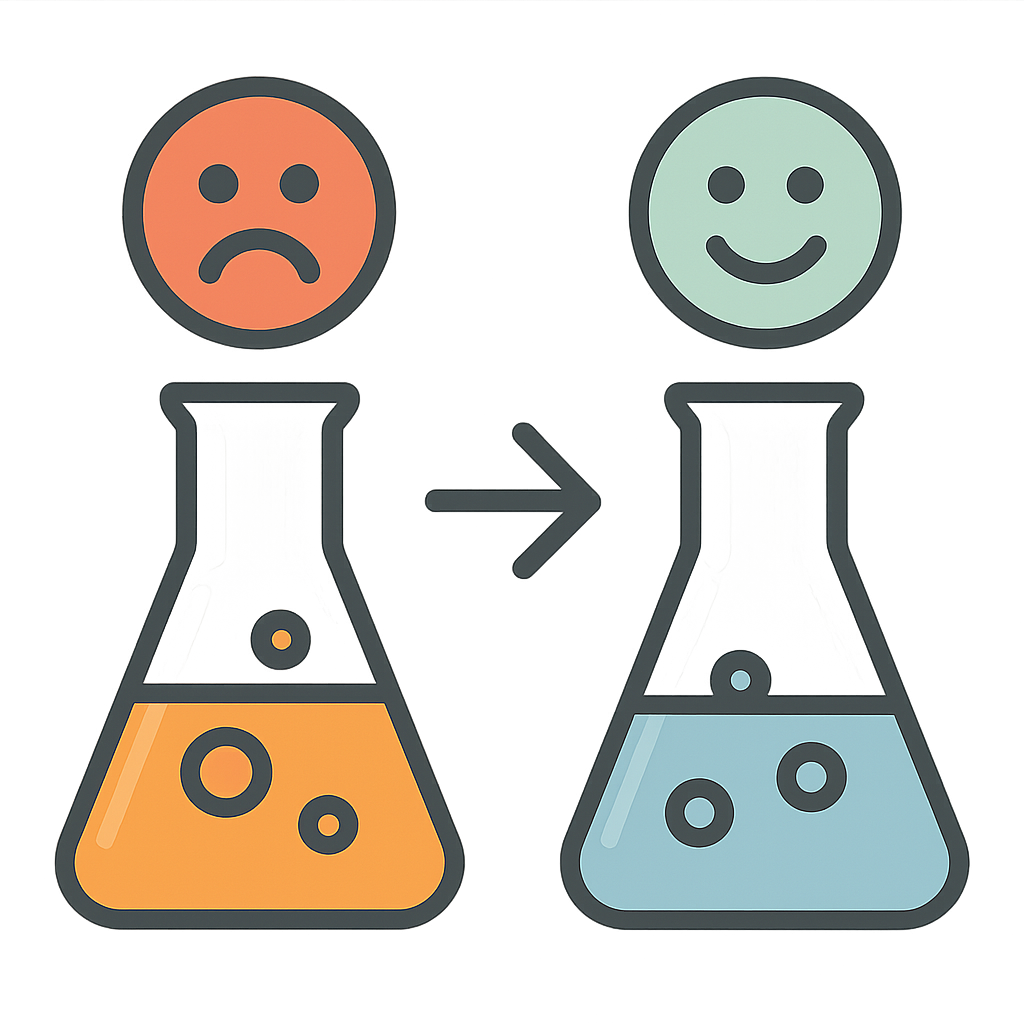
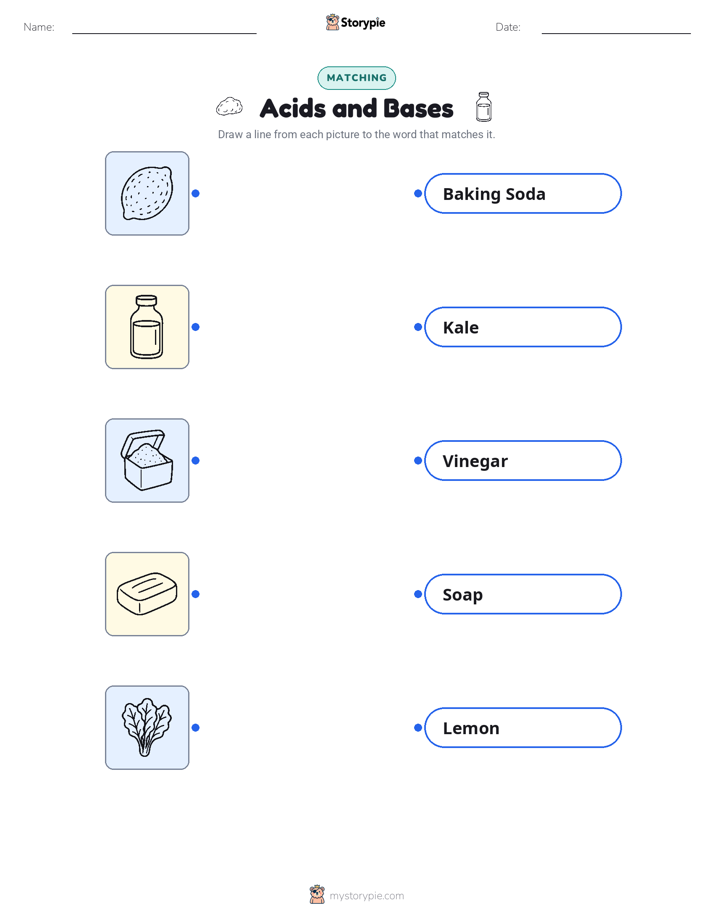
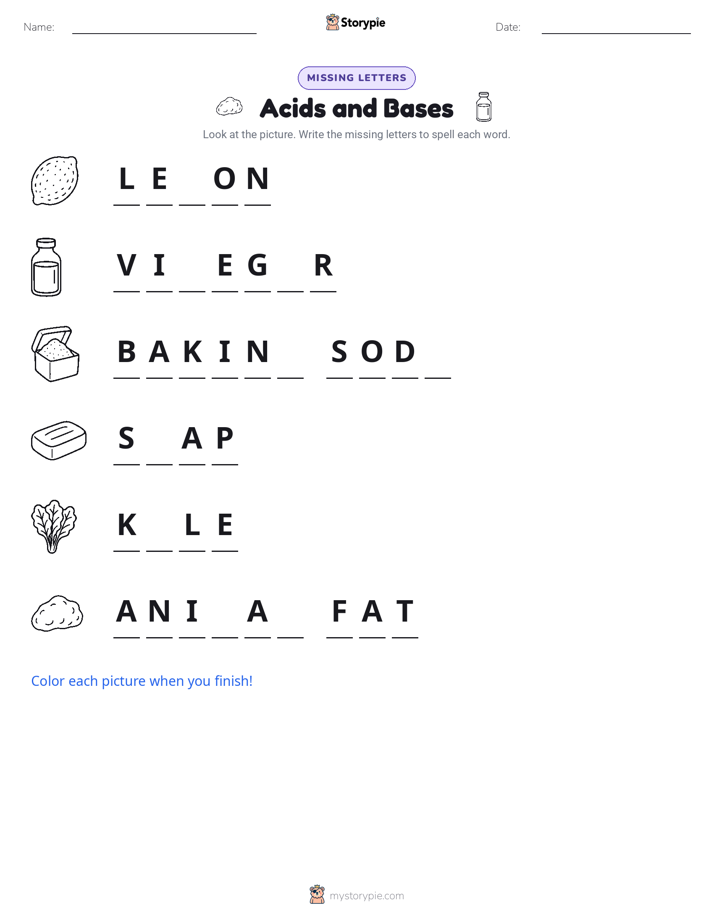
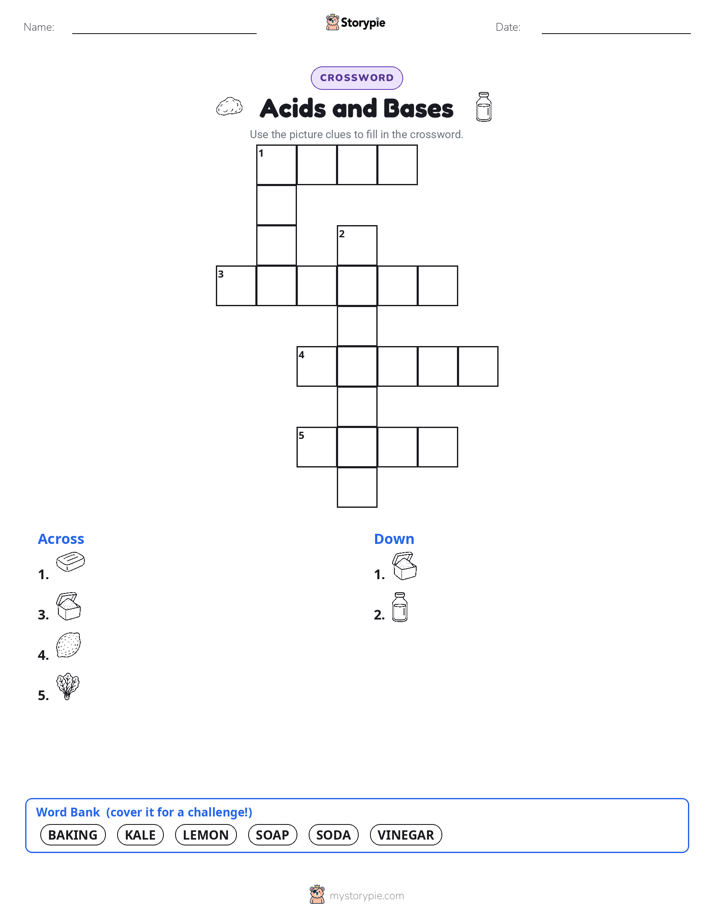
Have you ever tasted the sharp, puckering zing of a lemon or felt the exciting fizz of a volcano experiment when vinegar meets baking soda? That’s me, or at least, one side of my personality. I am the tingle on your tongue, the power that can clean a rusty penny until it shines like new. But I have another side, a quieter, smoother self. You’ve met this side, too. It’s the slippery feel of soap between your hands or the slightly bitter taste of dark leafy greens like kale. One of me is sharp and zesty; the other is slick and bitter. For thousands of years, people felt my presence, used my power, and wondered at my dual nature. They saw two opposites, but I am part of one big, interconnected family, a secret chemical team that balances the world in countless ways. From the food you eat to the blood that flows in your veins, I am there, playing my part. You might not have known my name, but you feel my power every day. I am the world of Acids and Bases.
For millennia, humans knew me by my effects but couldn't explain my existence. Long before laboratories and beakers, ancient people in Mesopotamia and Egypt, as early as 2800 BCE, used my basic side without calling it that. They mixed animal fats with wood ashes, which are rich in basic compounds, to create the world's first soap. They knew it cleaned, but the why was a complete mystery. The centuries rolled by, and alchemists in the Middle Ages got to know my acidic personality much better. A brilliant alchemist named Jabir ibn Hayyan, working around the 8th century, developed methods of distillation that allowed him to isolate powerful acids, like sulfuric and nitric acid. He called them 'spirits' because of the powerful fumes they gave off. Still, no one knew what truly connected my two sides. It wasn't until 1661 that an Irish scientist named Robert Boyle began to describe my properties systematically. He was the first to notice that my acid self would turn a dye from a plant called litmus bright red, while my base self would turn it blue. This was a huge clue. Yet, the central question remained: what am I made of? In the 1770s, the famous French chemist Antoine Lavoisier thought he had the answer. He believed that oxygen was the key ingredient that made all acids acidic. It was a good guess, but it was wrong. A few decades later, in the early 1800s, an English chemist named Humphry Davy conducted experiments that proved Lavoisier’s theory was incomplete. He showed that it wasn't oxygen but hydrogen that was the essential element in my acidic nature. The puzzle was slowly, piece by piece, being solved.
The Story of Acids and Bases
Have you ever tasted the sharp, puckering zing of a lemon or felt the exciting fizz of a volcano experiment when vinegar meets baking soda? That’s me, or at least, one side of my personality. I am the tingle on your tongue, the power that can clean a rusty penny until it shines like new. But I have another side, a quieter, smoother self. You’ve met this side, too. It’s the slippery feel of soap between your hands or the slightly bitter taste of dark leafy greens like kale. One of me is sharp and zesty; the other is slick and bitter. For thousands of years, people felt my presence, used my power, and wondered at my dual nature. They saw two opposites, but I am part of one big, interconnected family, a secret chemical team that balances the world in countless ways. From the food you eat to the blood that flows in your veins, I am there, playing my part. You might not have known my name, but you feel my power every day. I am the world of Acids and Bases.
For millennia, humans knew me by my effects but couldn't explain my existence. Long before laboratories and beakers, ancient people in Mesopotamia and Egypt, as early as 2800 BCE, used my basic side without calling it that. They mixed animal fats with wood ashes, which are rich in basic compounds, to create the world's first soap. They knew it cleaned, but the why was a complete mystery. The centuries rolled by, and alchemists in the Middle Ages got to know my acidic personality much better. A brilliant alchemist named Jabir ibn Hayyan, working around the 8th century, developed methods of distillation that allowed him to isolate powerful acids, like sulfuric and nitric acid. He called them 'spirits' because of the powerful fumes they gave off. Still, no one knew what truly connected my two sides. It wasn't until 1661 that an Irish scientist named Robert Boyle began to describe my properties systematically. He was the first to notice that my acid self would turn a dye from a plant called litmus bright red, while my base self would turn it blue. This was a huge clue. Yet, the central question remained: what am I made of? In the 1770s, the famous French chemist Antoine Lavoisier thought he had the answer. He believed that oxygen was the key ingredient that made all acids acidic. It was a good guess, but it was wrong. A few decades later, in the early 1800s, an English chemist named Humphry Davy conducted experiments that proved Lavoisier’s theory was incomplete. He showed that it wasn't oxygen but hydrogen that was the essential element in my acidic nature. The puzzle was slowly, piece by piece, being solved.
Even with Davy’s discovery, my true identity was still shrouded in mystery. Scientists knew hydrogen was important, but they didn't understand the mechanism. The big breakthrough came in 1884 from a young Swedish scientist named Svante Arrhenius. While working on his doctoral thesis, he had a revolutionary idea. He proposed that my power comes alive in water. He theorized that when you put my acid self into water, I break apart and release positively charged hydrogen ions, which are just tiny protons, really. And when you put my base self in water, I release negatively charged hydroxide ions. These tiny, charged particles were the source of all my properties. His idea was so new and strange that his professors almost failed him, but it turned out to be the key that unlocked everything. Finally, there was a clear, chemical definition for who I was. But science never stops asking questions. In 1923, two chemists working independently, Johannes Brønsted in Denmark and Thomas Lowry in England, expanded on Arrhenius's idea. They suggested a broader definition. They said my acids are simply 'proton donors,' and my bases are 'proton acceptors.' This elegant idea explained how I could react even when not in water, revealing my true versatility and showing that my balancing act could happen almost anywhere.
Today, you see the results of that long journey of discovery everywhere. To measure my strength, scientists use something called the pH scale, which runs from 0 to 14. Anything below 7 is my acidic side, and anything above 7 is my basic side. Seven is perfectly neutral, like pure water. This scale helps you understand the world around you. The powerful hydrochloric acid in your stomach has a pH between 1.5 and 3.5, perfect for digesting your lunch. The blood keeping you alive must stay at a slightly basic pH of about 7.4 to function properly. My balancing act is crucial for life itself. Farmers check the pH of their soil to grow healthy crops. Your shampoo is carefully balanced to keep your hair clean without damaging it. I am at work in the batteries that power your devices and in the recipes that make your food delicious. I am all about balance, a constant give-and-take of protons that keeps the engine of the world running. Understanding my two sides helps you see the hidden chemistry that connects a sour candy to a bar of soap, a simple battery to your own body. I am a reminder that sometimes, it is the partnership of opposites that creates the most powerful and wonderful results.
Wow facts
About
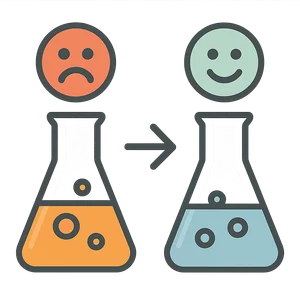
Acids and Bases are two fundamental categories of chemical compounds that exhibit opposite properties, react to neutralize each other, and are defined by their interactions involving protons or ions in a solution.
Take a Quiz
Question 1 of 5
What was the main problem that Svante Arrhenius's 1884 theory solved?
Explore next






Want to do even more?
Go beyond exploring. Unlock tools that turn every story into real learning.

Storypie Plus for families
Full stories, quizzes, and printables. Nights and car rides, sorted.
- Unlimited audio stories
- Create Mode: your child stars in the story
- Offline downloads
- Printable worksheets & coloring pages

Why Storypie for Schools
Students engaged. Prep in seconds. Evenings back to you.
- Worksheets & Quizzes
- Classroom Management
- Formative Assessment
- Custom Curriculum & Lesson Plans
- 27 Languages

Why Storypie for Homeschool
Curriculum done. They'll ask for more. Hours back in your day.
- Worksheet Generator
- First-Person Audio Stories
- Built-in Comprehension Quizzes
- Custom Curriculum & Lesson Plans
- Print & Go Activities