English

Acids and Bases
Acids and Bases are two fundamental categories of chemical compounds that exhibit opposite properties…
Reads at Grades 3–5 Listens at Grades 1–5
Print & create
Answer keys·No prep·Free with an account
28 worksheets · answer keys · full story · quiz · Ages 8-10 · CEFR B1
Plus adds 244,000+ more stories in 27 languages, audio for every one, and printables for all of them.
Just want Acids and Bases?
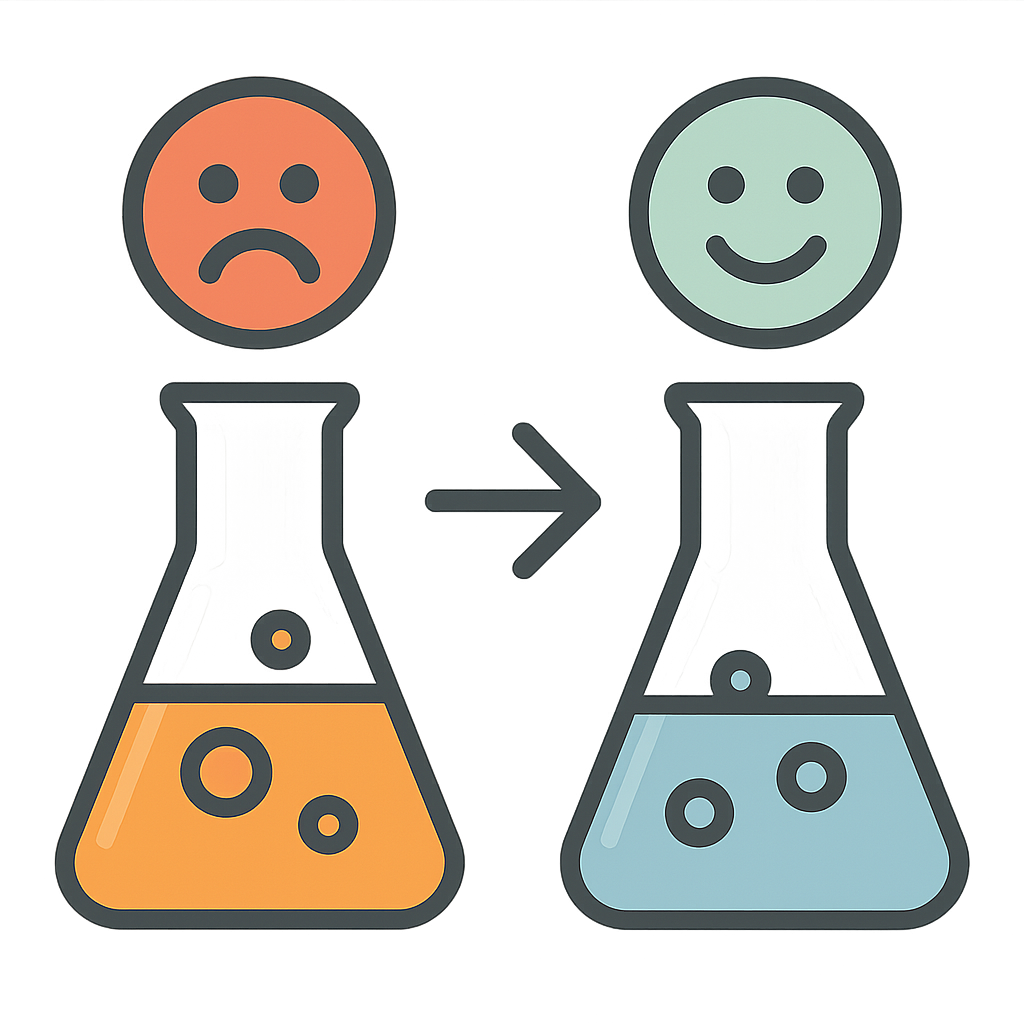
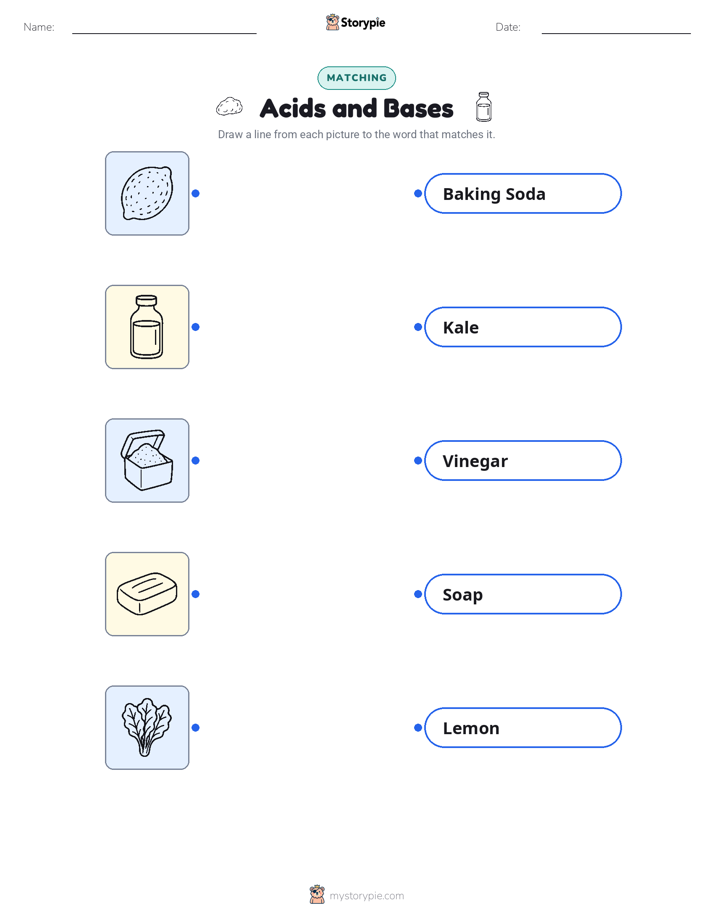
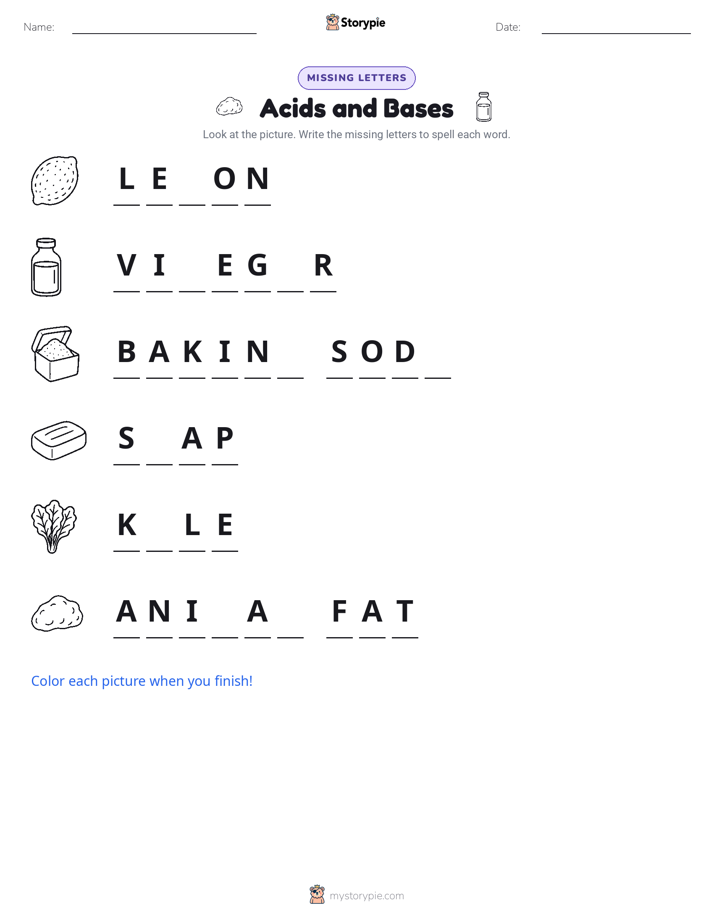
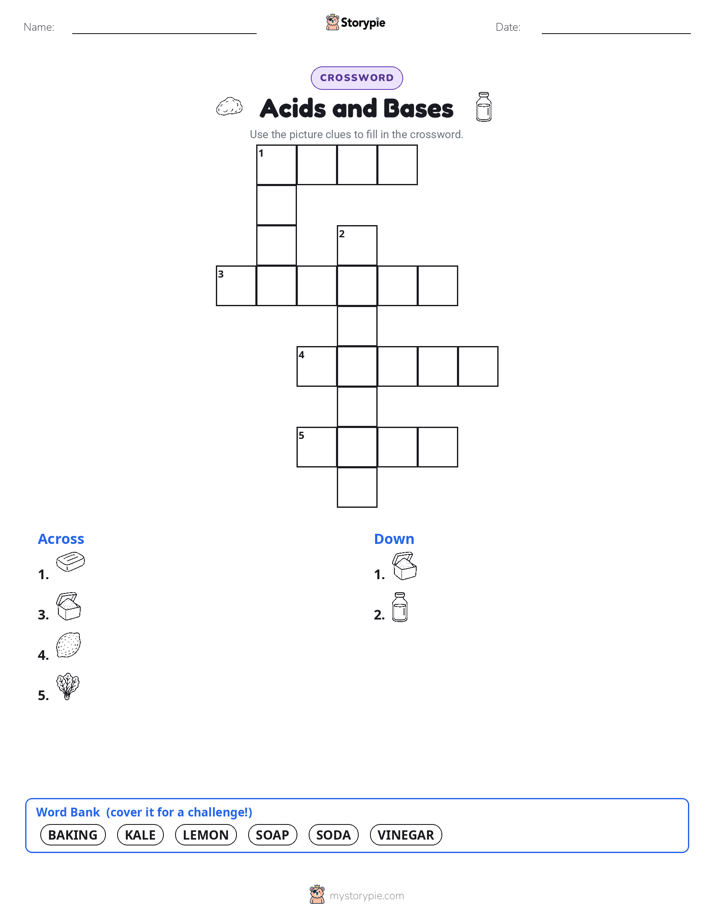
Have you ever bitten into a lemon and felt your mouth pucker up in a super sour surprise. Or maybe you’ve felt how slippery soap gets when you try to hold it with wet hands. That’s me at work. I am a team of opposites, a zesty zing on your tongue and a smooth, slick feeling on your skin. I show up in the fizzy bubbles when you mix vinegar and baking soda for a volcano experiment. For a very long time, people knew about my different sides and saw what I could do, but they didn’t have a name for me. They just knew I could be sour or slippery, but they didn’t know why. Well, hello there. We are Acids and Bases, and we are one of chemistry’s most powerful and fascinating pairs.
People started noticing me thousands of years ago, long before they had fancy laboratories. Ancient Romans knew my sour side very well in vinegar, which they called ‘acetum.’ And ancient chemists in the Middle East knew my other side from the ashes of plants, which they called ‘al-qaly’ in Arabic—that’s where the word ‘alkali,’ another name for a base, comes from. But it wasn't until much later that people started to investigate my secrets with real scientific curiosity. In the 17th century, a very observant scientist named Robert Boyle decided to write down everything he could about me. He described my acidic half as sour and my basic half as slippery. He even found that a special dye from a plant called litmus would turn bright red in my acidic form and a cool blue in my basic form. This was a huge clue, like finding a secret decoder that could finally tell my two sides apart just by looking.
A Tale of Two Tastes
Have you ever bitten into a lemon and felt your mouth pucker up in a super sour surprise. Or maybe you’ve felt how slippery soap gets when you try to hold it with wet hands. That’s me at work. I am a team of opposites, a zesty zing on your tongue and a smooth, slick feeling on your skin. I show up in the fizzy bubbles when you mix vinegar and baking soda for a volcano experiment. For a very long time, people knew about my different sides and saw what I could do, but they didn’t have a name for me. They just knew I could be sour or slippery, but they didn’t know why. Well, hello there. We are Acids and Bases, and we are one of chemistry’s most powerful and fascinating pairs.
People started noticing me thousands of years ago, long before they had fancy laboratories. Ancient Romans knew my sour side very well in vinegar, which they called ‘acetum.’ And ancient chemists in the Middle East knew my other side from the ashes of plants, which they called ‘al-qaly’ in Arabic—that’s where the word ‘alkali,’ another name for a base, comes from. But it wasn't until much later that people started to investigate my secrets with real scientific curiosity. In the 17th century, a very observant scientist named Robert Boyle decided to write down everything he could about me. He described my acidic half as sour and my basic half as slippery. He even found that a special dye from a plant called litmus would turn bright red in my acidic form and a cool blue in my basic form. This was a huge clue, like finding a secret decoder that could finally tell my two sides apart just by looking.
For a while after that, scientists were a bit stumped. They knew how to tell us apart, but they didn't know what made us who we are. In 1776, a famous chemist named Antoine Lavoisier thought he had it all figured out. He guessed that a gas called oxygen was the secret ingredient that made all acids sour. It was a good guess, based on what he knew, but it wasn’t quite right. Then, around 1810, another brilliant scientist named Humphry Davy showed that it was actually hydrogen, not oxygen, that was the key player on my acid team. The biggest breakthrough came in 1884 from a Swedish scientist named Svante Arrhenius. He realized that when acids are dissolved in water, they release tiny bits of hydrogen called ions. My other half, the bases, release different ions called hydroxide ions. When my two types of ions meet, they cancel each other out—or neutralize each other. Later, in 1923, two scientists, Johannes Brønsted and Thomas Lowry, gave me an even clearer identity: acids are ‘givers’ of protons (those tiny hydrogen bits), and bases are ‘takers’ of them.
All those ions and protons can get a little confusing. To make me easier to understand and measure, a scientist from Denmark named Søren Sørensen invented a special ruler for me in 1909. It’s called the pH scale, and it goes from 0 to 14. Anything with a pH below 7 is an acid, like lemon juice which is around a 2. Anything with a pH above 7 is a base, like soap which is around a 10. Pure water is a perfect 7, right in the neutral middle. Today, I’m everywhere you look. I’m in the orange juice you drink for breakfast, the shampoo you use to wash your hair, and even in your own stomach helping you digest your food. Farmers use me to test the soil to grow better crops, and doctors use me to make important medicines. I am all about balance, showing how two complete opposites can work together to make the world work. What amazing balance will you discover today.
Wow facts
About
Acids and Bases are two fundamental categories of chemical compounds that exhibit opposite properties, react to neutralize each other, and are defined by their interactions involving protons or ions in a solution.
Take a Quiz
Question 1 of 5
In the story, what does it mean when acids and bases 'neutralize' each other?
Explore next





Want to do even more?
Go beyond exploring. Unlock tools that turn every story into real learning.

Storypie Plus for families
Full stories, quizzes, and printables. Nights and car rides, sorted.
- Unlimited audio stories
- Create Mode: your child stars in the story
- Offline downloads
- Printable worksheets & coloring pages

Why Storypie for Schools
Students engaged. Prep in seconds. Evenings back to you.
- Worksheets & Quizzes
- Classroom Management
- Formative Assessment
- Custom Curriculum & Lesson Plans
- 27 Languages

Why Storypie for Homeschool
Curriculum done. They'll ask for more. Hours back in your day.
- Worksheet Generator
- First-Person Audio Stories
- Built-in Comprehension Quizzes
- Custom Curriculum & Lesson Plans
- Print & Go Activities