English

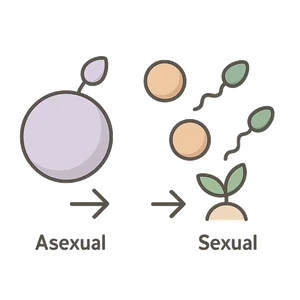
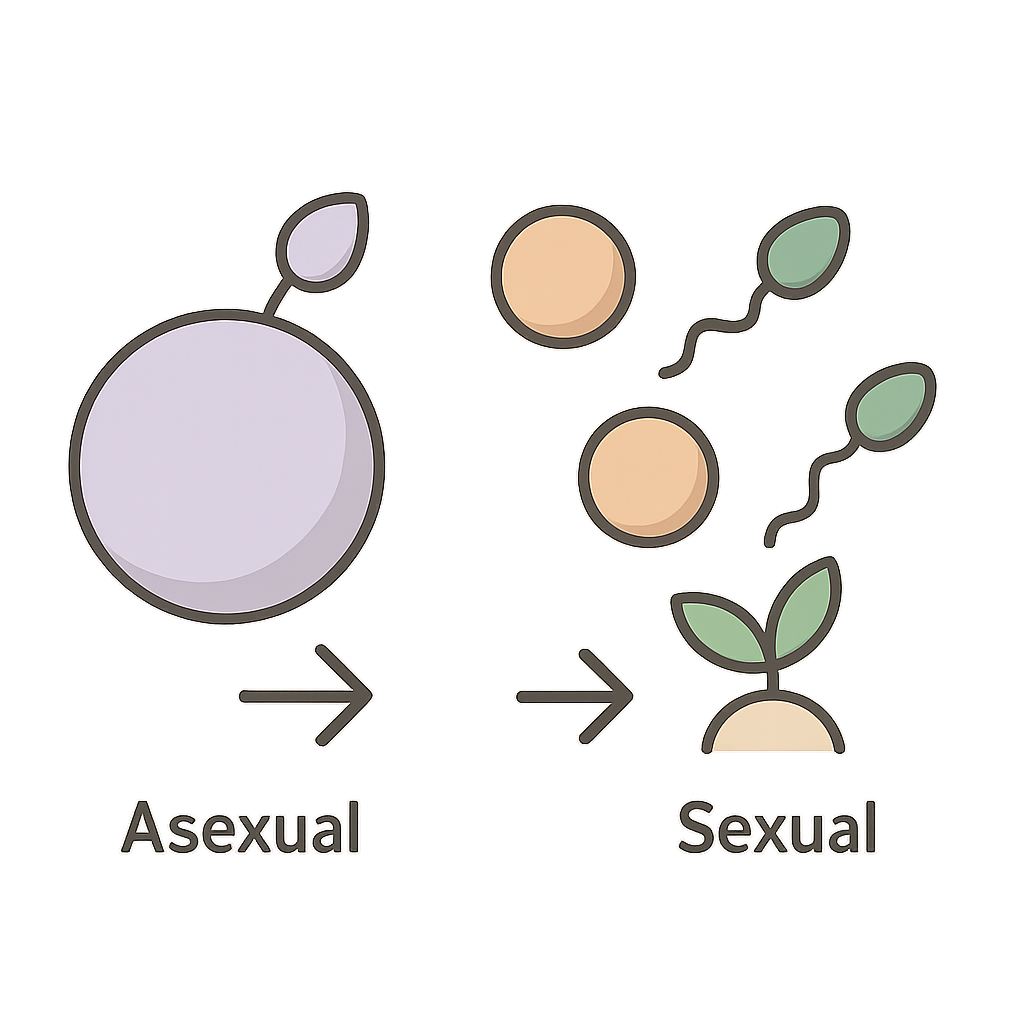
Asexual and Sexual Reproduction
Asexual and sexual reproduction are the two fundamental biological processes by which new individual…
Reads at Grades 6–8 Listens at Grades 4–8
Print & create
Answer keys·No prep·Free with an account
28 worksheets · answer keys · full story · quiz · Ages 10-12 · CEFR B2
Plus adds 244,000+ more stories in 27 languages, audio for every one, and printables for all of them.
Just want Asexual and Sexual Reproduction?
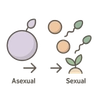
I am the quiet hum beneath the rustle of leaves, the invisible force that turns one seed into a field of wheat. I am the reason a forest floor is thick with ferns and why a flock of birds grows larger. I am present when a single bacterium splits into two perfect copies, and I am there when two wolves create a new, unique pup with its mother’s eyes and its father’s howl. I am the oldest story in the world: the story of making more life. For billions of years, I worked in a simple, direct way, making identical copies of living things. This method was fast and efficient, creating clones that were perfectly suited to their environment, as long as that environment never changed. But I am also an inventor, and I eventually developed a new trick, a clever collaboration that mixed things up and created an endless, beautiful variety of life. I am Reproduction, and I am here to tell you about my two most famous methods, Asexual and Sexual, and how curious humans finally uncovered my deepest secrets.
For most of human history, my inner workings were a complete mystery. People saw my results everywhere—babies were born, seedlings sprouted, eggs hatched—but they could not see the tiny, invisible spark where it all began. They had ideas, of course. Great thinkers like Aristotle, way back in the 4th century BCE in ancient Greece, studied me closely. He watched chicks develop inside eggs and observed how different animals created their young, writing down everything he saw. He made brilliant observations, but the real secrets remained hidden, too small for any eye to see. That all changed when a new tool arrived, a window into a world no one knew existed. In 1677, in the Netherlands, a curious cloth merchant named Antonie van Leeuwenhoek peered through a powerful microscope that he had built himself. He was not a trained scientist, but his curiosity was boundless. He looked at everything, from lake water to the plaque on his own teeth. One day, he was shocked to see tiny, swimming specks he called 'animalcules.' He had discovered sperm cells, one of my key players. For the first time, the world of the very small, where I do my most important work, was finally revealed.
The Story of Reproduction
I am the quiet hum beneath the rustle of leaves, the invisible force that turns one seed into a field of wheat. I am the reason a forest floor is thick with ferns and why a flock of birds grows larger. I am present when a single bacterium splits into two perfect copies, and I am there when two wolves create a new, unique pup with its mother’s eyes and its father’s howl. I am the oldest story in the world: the story of making more life. For billions of years, I worked in a simple, direct way, making identical copies of living things. This method was fast and efficient, creating clones that were perfectly suited to their environment, as long as that environment never changed. But I am also an inventor, and I eventually developed a new trick, a clever collaboration that mixed things up and created an endless, beautiful variety of life. I am Reproduction, and I am here to tell you about my two most famous methods, Asexual and Sexual, and how curious humans finally uncovered my deepest secrets.
For most of human history, my inner workings were a complete mystery. People saw my results everywhere—babies were born, seedlings sprouted, eggs hatched—but they could not see the tiny, invisible spark where it all began. They had ideas, of course. Great thinkers like Aristotle, way back in the 4th century BCE in ancient Greece, studied me closely. He watched chicks develop inside eggs and observed how different animals created their young, writing down everything he saw. He made brilliant observations, but the real secrets remained hidden, too small for any eye to see. That all changed when a new tool arrived, a window into a world no one knew existed. In 1677, in the Netherlands, a curious cloth merchant named Antonie van Leeuwenhoek peered through a powerful microscope that he had built himself. He was not a trained scientist, but his curiosity was boundless. He looked at everything, from lake water to the plaque on his own teeth. One day, he was shocked to see tiny, swimming specks he called 'animalcules.' He had discovered sperm cells, one of my key players. For the first time, the world of the very small, where I do my most important work, was finally revealed.
Leeuwenhoek's astonishing discovery opened the floodgates of curiosity. If these tiny 'animalcules' existed, what was their purpose? For the next two centuries, scientists designed clever experiments to figure out my secrets. In the 1780s, an Italian scientist named Lazzaro Spallanzani became fascinated with how frogs made tadpoles. He performed careful experiments, even putting tiny trousers on the male frogs, and proved that for a new tadpole to form, both the 'animalcules' from the male and something from the female's egg were absolutely necessary. The puzzle was taking shape. The next giant leap forward came on February 1st, 1827. After years of painstaking work, a brilliant biologist named Karl Ernst von Baer, working in what is now Estonia, finally saw it: the mammalian egg cell. He had found the other half of the story. But seeing the two pieces of the puzzle was one thing; seeing them come together was another. That moment arrived in 1876, when a German biologist named Oskar Hertwig pointed his microscope at the transparent eggs of a sea urchin. He watched, breathless, as a single sperm cell approached an egg, merged with it, and the two fused into one. For the very first time, a human had witnessed the exact moment of fertilization, the secret handshake that begins a new life.
Even after seeing fertilization, the biggest question remained: how did parents pass their specific features, like eye color or height, to their children? The answer came not from a famous university lab, but from a quiet monastery garden. In the 1860s, an Augustinian friar named Gregor Mendel meticulously cross-pollinated thousands of pea plants, tracking their traits for years. He discovered the fundamental laws of heredity, figuring out the mathematical rules that govern how I mix and match features. His work explained why my sexual method creates so much variety. But what was carrying these instructions? The final, crucial piece of the puzzle fell into place on February 28th, 1953. On that day, two young scientists at Cambridge University, James Watson and Francis Crick, figured out the double-helix structure of a molecule called DNA. This was it—my blueprint, the elegant, twisting instruction manual for every living thing. Today, understanding my methods helps us grow more nutritious food, protect endangered species from extinction, and understand the genetic threads that connect our own families. I am the force of continuation and the engine of change, ensuring that the amazing story of life on Earth never, ever ends.
Wow facts
About
Asexual and sexual reproduction are the two fundamental biological processes by which new individual organisms, or 'offspring,' are produced from their parents.
Take a Quiz
Question 1 of 5
What is the main idea of the section titled 'Connecting the Dots'?
Explore next


Want to do even more?
Go beyond exploring. Unlock tools that turn every story into real learning.

Storypie Plus for families
Full stories, quizzes, and printables. Nights and car rides, sorted.
- Unlimited audio stories
- Create Mode: your child stars in the story
- Offline downloads
- Printable worksheets & coloring pages

Why Storypie for Schools
Students engaged. Prep in seconds. Evenings back to you.
- Worksheets & Quizzes
- Classroom Management
- Formative Assessment
- Custom Curriculum & Lesson Plans
- 27 Languages

Why Storypie for Homeschool
Curriculum done. They'll ask for more. Hours back in your day.
- Worksheet Generator
- First-Person Audio Stories
- Built-in Comprehension Quizzes
- Custom Curriculum & Lesson Plans
- Print & Go Activities