English

Astronomy
Astronomy is the scientific study of celestial objects such as stars, planets, comets, and galaxies…
Reads at Grades 6–8 Listens at Grades 4–8
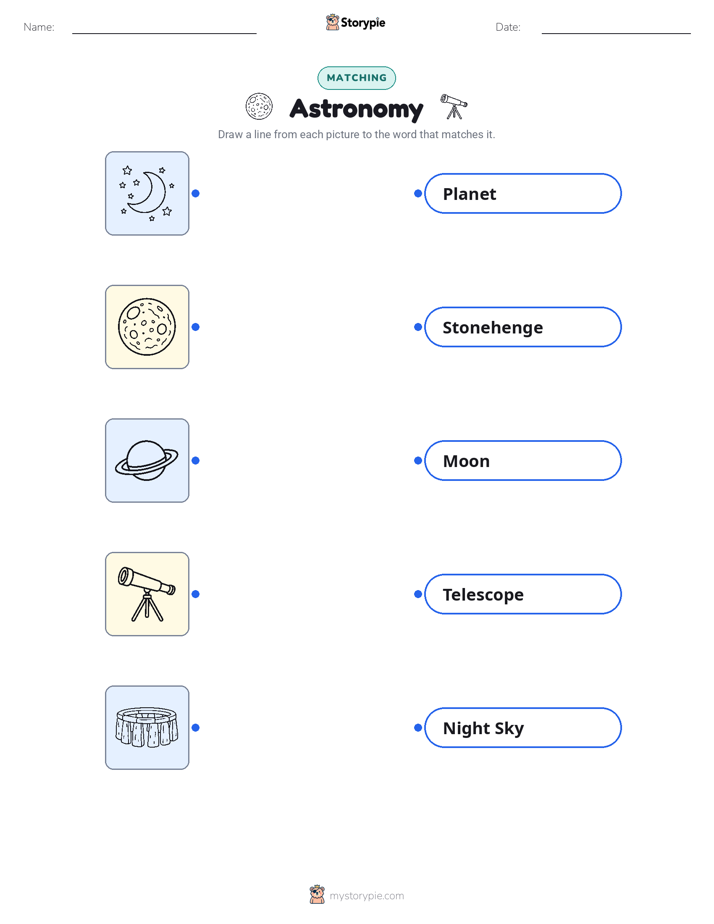
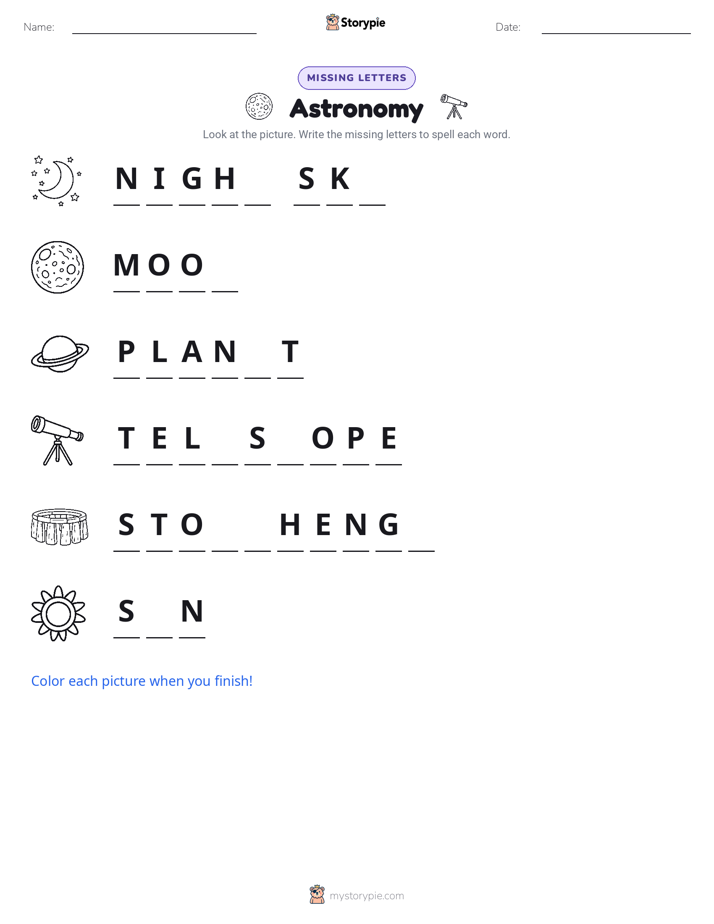
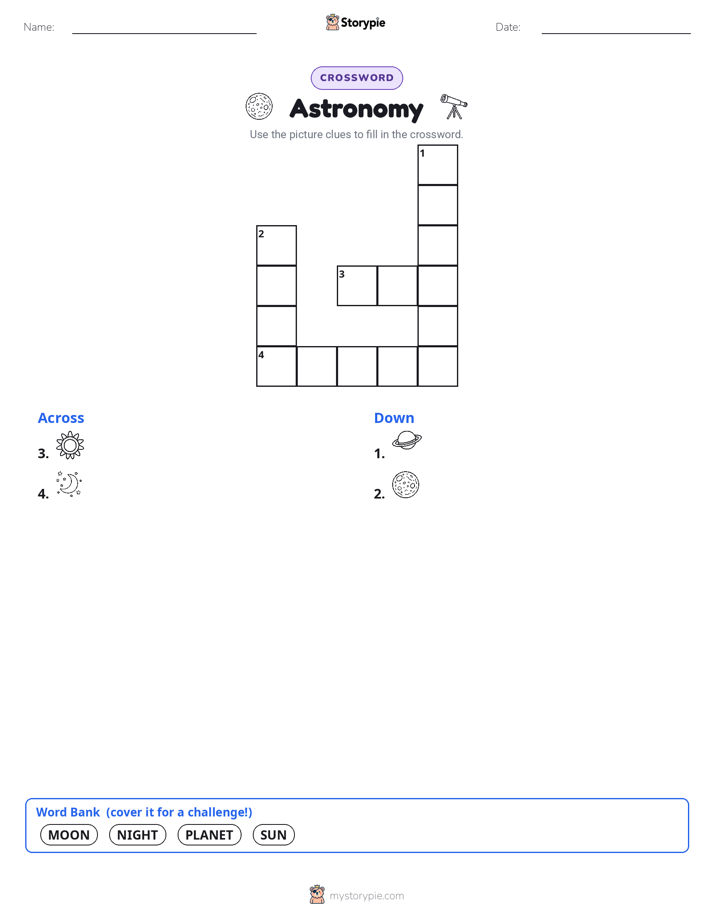
Print & create
Answer keys·No prep·Free with an account
28 worksheets · answer keys · full story · quiz · Ages 10-12 · CEFR B2
Plus adds 164,000+ more stories in 27 languages, audio for every one, and printables for all of them.
Just want Astronomy?
Have you ever laid on your back in the cool night air and just looked up. The velvet blackness is dotted with countless tiny, shimmering lights. The moon hangs like a silent lantern, its glow changing night after night. You might see a planet, a steady point of light that seems to wander among its twinkling neighbors. For thousands of years, humans have looked up at this cosmic ocean and felt a deep sense of wonder and curiosity. They saw patterns, tracked the moon's cycles, and noticed how the stars overhead shifted with the seasons, signaling when to plant and when to harvest. It was a grand, beautiful puzzle, a story written in light across the biggest canvas imaginable. I am the map to that mystery. I am the unending quest to understand it all. I am Astronomy.
Long before there were giant telescopes or spaceships, people were my students. They learned from me using only their eyes and their minds. In the fertile lands of Mesopotamia, the Babylonians began carefully recording the movements of the sun, moon, and planets around 3000 BCE. So did the ancient Egyptians, who used my cycles to predict the flooding of the Nile River, the event that brought life to their civilization. I was their calendar, their clock, and their guide. On the misty plains of what is now England, ancient people built Stonehenge between 3000 and 2000 BCE, arranging massive stones to align perfectly with the sunrise on the summer solstice, the longest day of the year. The ancient Greeks took this a step further. They weren't just content to observe; they wanted to build a model, a blueprint of the cosmos. Around 150 CE, a brilliant thinker named Ptolemy created a detailed map of the universe. He placed the Earth at the very center, with the sun, moon, and planets spinning around it in complex circles. His model was so convincing that it would guide human understanding for over a thousand years. It wasn't correct, but it was a magnificent attempt to bring order to the beautiful chaos above.
I Am Astronomy: A Story of the Stars
Have you ever laid on your back in the cool night air and just looked up. The velvet blackness is dotted with countless tiny, shimmering lights. The moon hangs like a silent lantern, its glow changing night after night. You might see a planet, a steady point of light that seems to wander among its twinkling neighbors. For thousands of years, humans have looked up at this cosmic ocean and felt a deep sense of wonder and curiosity. They saw patterns, tracked the moon's cycles, and noticed how the stars overhead shifted with the seasons, signaling when to plant and when to harvest. It was a grand, beautiful puzzle, a story written in light across the biggest canvas imaginable. I am the map to that mystery. I am the unending quest to understand it all. I am Astronomy.
Long before there were giant telescopes or spaceships, people were my students. They learned from me using only their eyes and their minds. In the fertile lands of Mesopotamia, the Babylonians began carefully recording the movements of the sun, moon, and planets around 3000 BCE. So did the ancient Egyptians, who used my cycles to predict the flooding of the Nile River, the event that brought life to their civilization. I was their calendar, their clock, and their guide. On the misty plains of what is now England, ancient people built Stonehenge between 3000 and 2000 BCE, arranging massive stones to align perfectly with the sunrise on the summer solstice, the longest day of the year. The ancient Greeks took this a step further. They weren't just content to observe; they wanted to build a model, a blueprint of the cosmos. Around 150 CE, a brilliant thinker named Ptolemy created a detailed map of the universe. He placed the Earth at the very center, with the sun, moon, and planets spinning around it in complex circles. His model was so convincing that it would guide human understanding for over a thousand years. It wasn't correct, but it was a magnificent attempt to bring order to the beautiful chaos above.
For nearly 1,500 years, Ptolemy's Earth-centered universe was the accepted truth. It made sense to people who felt the solid ground beneath their feet and saw the heavens wheeling above them. But I always leave clues for the curious. A Polish astronomer named Nicolaus Copernicus spent years quietly observing and calculating. In 1543, he published a book that turned the universe inside out. He proposed a radical idea: that the Earth was not the center of everything. Instead, he argued, the Earth and the other planets revolved around the Sun. This was a monumental, world-changing thought that challenged everything people thought they knew. A few decades later, an Italian scientist named Galileo Galilei heard about a new invention called the telescope. In 1610, he built his own and pointed it toward the heavens. The wonders he saw were staggering. He saw that the moon wasn't a smooth orb but was covered in mountains and craters. He saw that Venus had phases, just like the moon, which only made sense if it circled the Sun. Most incredibly, he discovered four tiny moons orbiting Jupiter, proving that not everything in the cosmos circled the Earth. Galileo's discoveries provided powerful evidence for Copernicus's sun-centered model. The final piece of the puzzle came from an English genius, Isaac Newton. In 1687, he published his Law of Universal Gravitation. He explained the invisible force that kept the planets in their orbits around the Sun. He gave humanity the mathematical language to understand the elegant dance of the solar system.
With the tools of mathematics and the power of the telescope, my story expanded at an incredible speed. The universe became bigger and more mysterious than anyone had ever imagined. In the 1920s, an American astronomer named Edwin Hubble used a powerful new telescope on a California mountaintop. He made a breathtaking discovery. He proved that the faint, fuzzy patches of light called nebulae were not clouds of gas within our own Milky Way. They were entire galaxies, just like our own, but millions of light-years away. Even more astonishingly, he found that these galaxies were all rushing away from each other. The entire universe was expanding. Humanity's home, the Milky Way, was just one of countless islands in a vast, growing cosmic sea. This realization fueled a new era of exploration. The Space Age began on October 4th, 1957, when the Soviet Union launched Sputnik 1, the first artificial satellite. Just over a decade later, on July 20th, 1969, humanity took its first steps on another world when the Apollo 11 mission landed on the moon. Today, incredible instruments act as humanity's eyes in the cosmos. The Hubble Space Telescope, launched on April 24th, 1990, has captured iconic images of distant nebulae and galaxies. And its successor, the James Webb Space Telescope, launched on December 25th, 2021, peers even deeper into space and time, seeing the first stars flicker to life and studying the atmospheres of planets far beyond our solar system.
My story is not a dusty tale from the past. It is an adventure that is still unfolding, every single night. I am alive in every person who looks up at the sky and asks a question. Why does the moon change its shape. What are stars made of. Are we alone in the universe. I am the reason scientists from all over the world work together, sharing their discoveries to piece together the great cosmic puzzle. I inspire artists, poets, and dreamers. I teach humanity about its place in the universe and encourage the boldest of dreams. So, stay curious. Go outside on a clear night and look up. Remember the thousands of years of human wonder that came before you. The universe is filled with more beauty and mystery than you can ever imagine, and it is waiting for you to discover it.
Wow facts
About
Astronomy is the scientific study of celestial objects such as stars, planets, comets, and galaxies, and phenomena that originate outside the Earth's atmosphere.
Take a Quiz
Question 1 of 5
According to the story, what problem did Nicolaus Copernicus's idea solve or challenge?
Explore next




Want to do even more?
Go beyond exploring. Unlock tools that turn every story into real learning.

Storypie Plus for families
Full stories, quizzes, and printables. Nights and car rides, sorted.
- Unlimited audio stories
- Create Mode: your child stars in the story
- Offline downloads
- Printable worksheets & coloring pages

Why Storypie for Schools
Students engaged. Prep in seconds. Evenings back to you.
- Worksheets & Quizzes
- Classroom Management
- Formative Assessment
- Custom Curriculum & Lesson Plans
- 27 Languages

Why Storypie for Homeschool
Curriculum done. They'll ask for more. Hours back in your day.
- Worksheet Generator
- First-Person Audio Stories
- Built-in Comprehension Quizzes
- Custom Curriculum & Lesson Plans
- Print & Go Activities