English

Astronomy
Astronomy is the scientific study of celestial objects such as stars, planets, comets, and galaxies…
Reads at Grades 3–5 Listens at Grades 1–5
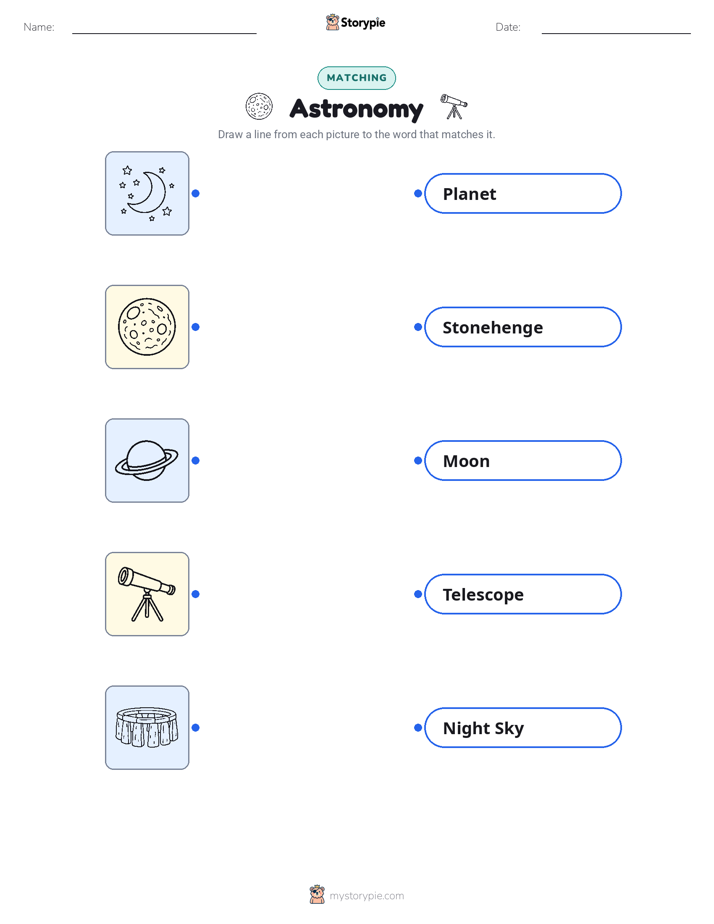
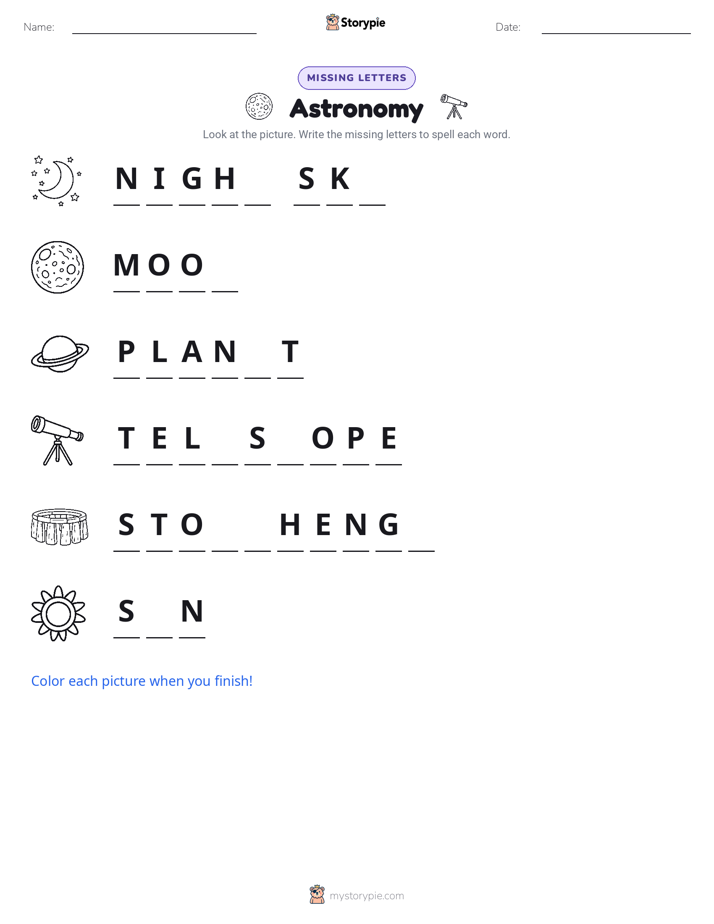
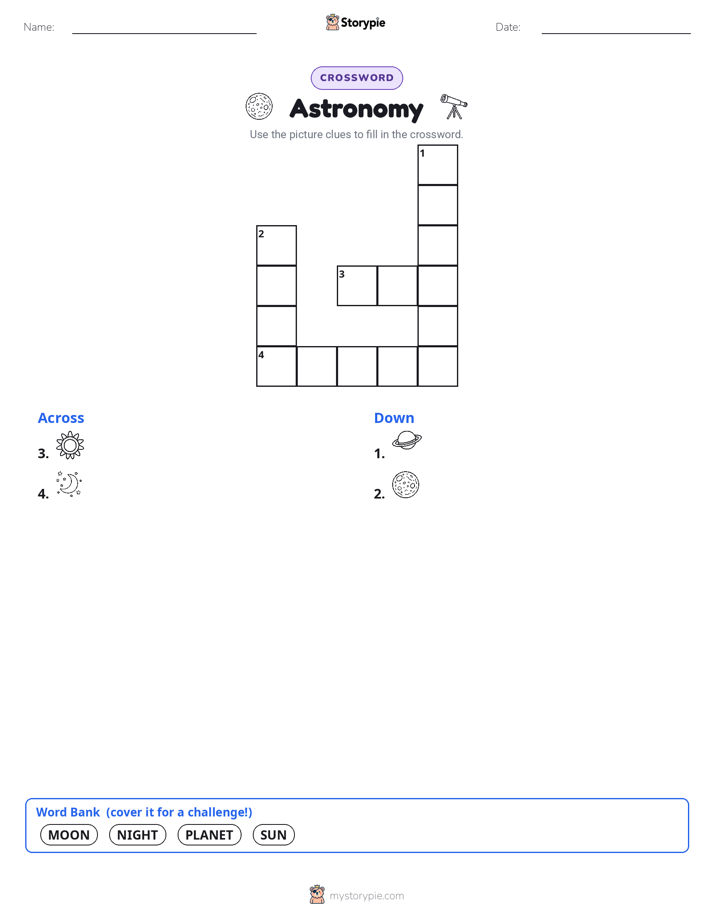
Print & create
Answer keys·No prep·Free with an account
28 worksheets · answer keys · full story · quiz · Ages 8-10 · CEFR B1
Plus adds 164,000+ more stories in 27 languages, audio for every one, and printables for all of them.
Just want Astronomy?
Have you ever laid on the grass on a clear night, far from the city lights, and just looked up? The sky is a huge, dark blanket sprinkled with tiny, twinkling diamonds of light. You can see the moon, a silent silver ship, sailing slowly across the darkness. It makes you feel very small, but also like you are part of something enormous and full of secrets. For thousands and thousands of years, people just like you have stared at that same sky, feeling that same sense of wonder. They asked questions about the dancing lights and the changing moon. Can you imagine a world where those lights were a complete mystery? I am the question in your heart when you see a shooting star. I am the story written in the patterns of the sky. Hello there, star-gazer. I am Astronomy.
For a very long time, I was a guide for humans, helping them understand their world. Long before anyone wrote down words, around 30,000 BCE, people carved the changing shapes, or phases, of the moon onto pieces of bone. I was their first calendar. Later, great civilizations used me to keep track of time and seasons. The Babylonians, starting around 1800 BCE, were amazing sky-watchers. They made detailed charts of the stars and planets, and they became so good at it they could even predict an eclipse, which is when the moon passes in front of the sun. In ancient Egypt, around 2500 BCE, people knew that when the bright star Sirius appeared in the sky just before sunrise, the great Nile River would soon flood. This flood brought rich soil to their fields, which helped them grow food. For centuries, most people, including a very smart Greek thinker named Ptolemy who lived around 150 CE, believed that the Earth was the very center of everything and that the sun, moon, and all the stars danced in perfect circles around it.
A Story Written in the Sky
Have you ever laid on the grass on a clear night, far from the city lights, and just looked up? The sky is a huge, dark blanket sprinkled with tiny, twinkling diamonds of light. You can see the moon, a silent silver ship, sailing slowly across the darkness. It makes you feel very small, but also like you are part of something enormous and full of secrets. For thousands and thousands of years, people just like you have stared at that same sky, feeling that same sense of wonder. They asked questions about the dancing lights and the changing moon. Can you imagine a world where those lights were a complete mystery? I am the question in your heart when you see a shooting star. I am the story written in the patterns of the sky. Hello there, star-gazer. I am Astronomy.
For a very long time, I was a guide for humans, helping them understand their world. Long before anyone wrote down words, around 30,000 BCE, people carved the changing shapes, or phases, of the moon onto pieces of bone. I was their first calendar. Later, great civilizations used me to keep track of time and seasons. The Babylonians, starting around 1800 BCE, were amazing sky-watchers. They made detailed charts of the stars and planets, and they became so good at it they could even predict an eclipse, which is when the moon passes in front of the sun. In ancient Egypt, around 2500 BCE, people knew that when the bright star Sirius appeared in the sky just before sunrise, the great Nile River would soon flood. This flood brought rich soil to their fields, which helped them grow food. For centuries, most people, including a very smart Greek thinker named Ptolemy who lived around 150 CE, believed that the Earth was the very center of everything and that the sun, moon, and all the stars danced in perfect circles around it.
For more than 1,400 years, almost everyone agreed with Ptolemy. It just seemed to make sense. After all, when you stand on the ground, it feels like you are perfectly still while the sun and stars move across the sky, right? But then, a new idea began to twinkle. In the year 1543, a man from Poland named Nicolaus Copernicus published a book with a truly wild thought. What if, he asked, the Earth was not the center of everything? What if the Earth and the other planets were the ones moving, all circling the giant, glowing Sun? At first, most people thought this was a silly idea. But then came an Italian scientist named Galileo Galilei. In 1610, he built one of the first telescopes and pointed it toward the heavens. He gave me new eyes to see with. What he saw was astonishing. He discovered that the planet Jupiter had its own tiny moons circling it. This was huge. It proved that not everything in the universe moved around the Earth. He also saw that our own moon wasn't a perfect, smooth ball; it had mountains and craters, just like Earth. Suddenly, the universe felt so much bigger, so much more complex, and so much more amazing.
That new way of seeing everything changed the world. Because people understood how planets move, I helped them figure out how to travel through space. I was the map that led humans to do something incredible. On July 20th, 1969, I helped guide the first astronauts to walk on the Moon. Can you imagine leaving footprints on another world? Since then, I have helped people build even more powerful tools to explore the cosmos. In 1990, the Hubble Space Telescope was launched into orbit, where it has been taking breathtaking pictures of faraway galaxies ever since. And on December 25th, 2021, an even more powerful telescope, the James Webb, was sent into space. It can see light from the very first stars being born, looking back almost to the beginning of time itself. I am still here, sparkling in every starry night and in the bright light of every new discovery. I am the adventure that begins every single time you look up and wonder.
Wow facts
About
Astronomy is the scientific study of celestial objects such as stars, planets, comets, and galaxies, and phenomena that originate outside the Earth's atmosphere.
Take a Quiz
Question 1 of 5
The story says ancient Egyptians knew the Nile would flood when the star Sirius appeared. Why was this important for them?
Explore next


Want to do even more?
Go beyond exploring. Unlock tools that turn every story into real learning.

Storypie Plus for families
Full stories, quizzes, and printables. Nights and car rides, sorted.
- Unlimited audio stories
- Create Mode: your child stars in the story
- Offline downloads
- Printable worksheets & coloring pages

Why Storypie for Schools
Students engaged. Prep in seconds. Evenings back to you.
- Worksheets & Quizzes
- Classroom Management
- Formative Assessment
- Custom Curriculum & Lesson Plans
- 27 Languages

Why Storypie for Homeschool
Curriculum done. They'll ask for more. Hours back in your day.
- Worksheet Generator
- First-Person Audio Stories
- Built-in Comprehension Quizzes
- Custom Curriculum & Lesson Plans
- Print & Go Activities