English


Atom
The atom is the smallest unit of ordinary matter that forms a chemical element.
Reads at Grades 3–5 Listens at Grades 1–5
Print & create
Answer keys·No prep·Free with an account
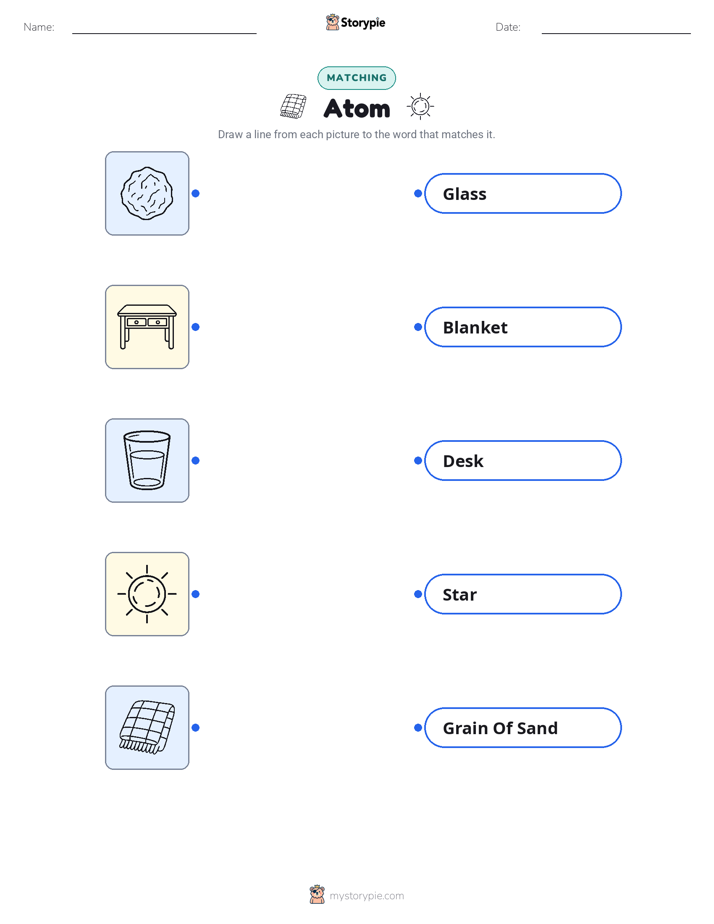
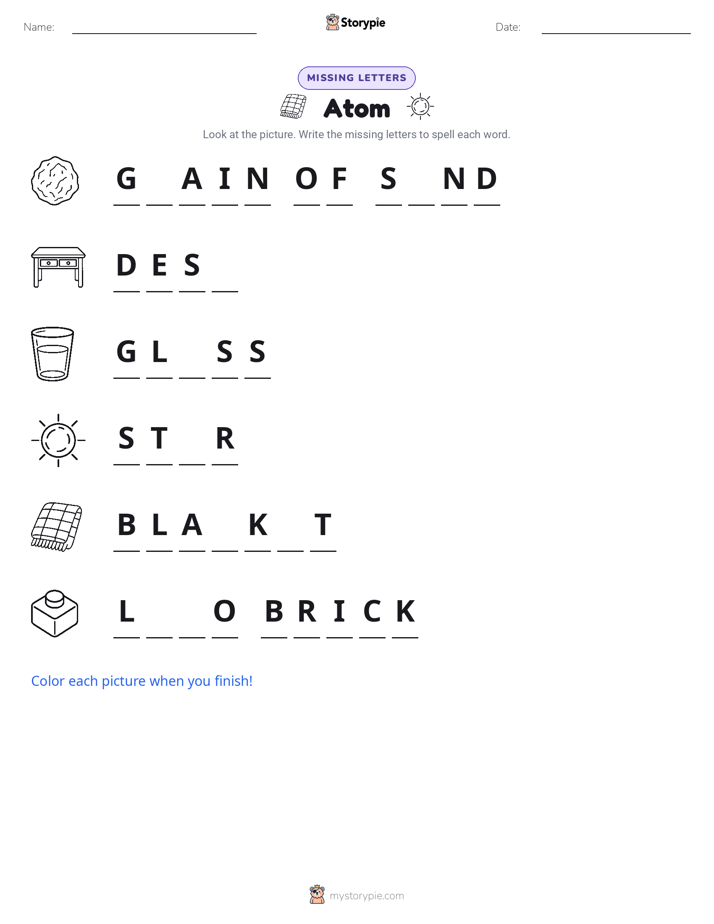
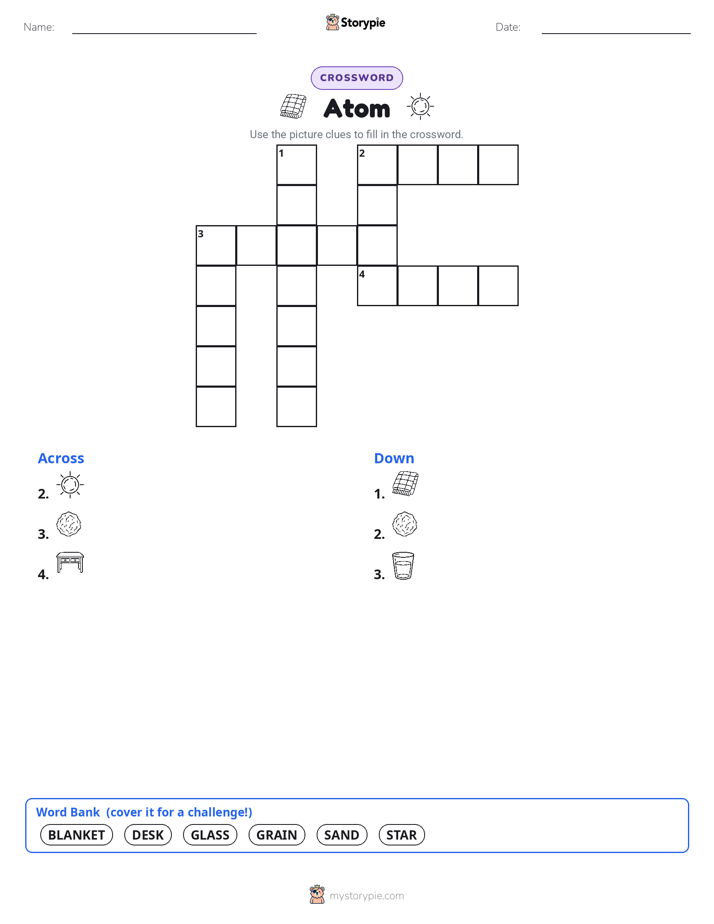
28 worksheets · answer keys · full story · quiz · Ages 8-10 · CEFR B1
Plus adds 291,000+ more stories in 27 languages, audio for every one, and printables for all of them.
Just want Atom?

I am in ordinary things all around you, but you’ve never seen me. I am in the sweet juice of a strawberry, the fluffy fur of a kitten, and the air you just breathed in. I make up the chair you’re sitting on and the cool clouds of gas between the stars. Can you imagine something so small? If you lined up about a million carbon atoms side-by-side, they would be about as wide as a strand of your hair. For a very long time, I was a complete mystery, a secret ingredient that nobody could see. I am a super-tiny, super-important building block for ordinary things. What am I? I am the Atom.
For thousands of years, nobody knew I existed. People looked around and wondered, 'What is the world made of? Is it water? Is it fire?'. Then, way back around 400 BCE in Ancient Greece, a thinker named Democritus had a brilliant idea. He wasn’t a scientist with a lab, but he was a great thinker. Imagine taking a piece of cheese and cutting it in half, then in half again, and again, and again. He thought that eventually, you would get to a piece so tiny it couldn't be cut anymore. He called that tiny, 'uncuttable' piece 'atomos,' which is Greek for 'cannot be cut.' That’s how I got my name. But it was just a guess, a story he told without any proof. For many centuries, people kept discussing the idea of me, but strong experimental evidence was still to come.
Finally, in the early 1800s, a scientist in England named John Dalton changed everything. He did many experiments and realized that I wasn't just an idea. He proved that different things, like the oxygen you breathe and the iron in a nail, were made of different types of me. To him, I was just a tiny, solid ball, like a super-small marble. But the story got more exciting. In 1897, a physicist named J.J. Thomson discovered I had even tinier parts inside me called electrons. His model was like a blueberry muffin, with the tiny electrons stuck in me like berries. Then, in 1911, Ernest Rutherford used experiments by Hans Geiger and Ernest Marsden to propose that I am mostly empty space, with a very small, heavy center called a nucleus. It was a huge surprise. A couple of years later, in 1913, another scientist, Niels Bohr, suggested my electrons could follow only certain orbits around the nucleus, jumping between them by taking in or giving off energy. Finally, in 1932, James Chadwick found another particle in my nucleus called the neutron. After all those years, people had built a useful model of me. Today, they describe regions where my electrons are likely to be found, not planet-like paths.
I Am the Atom, a Tiny Builder in the Universe
I am in ordinary things all around you, but you’ve never seen me. I am in the sweet juice of a strawberry, the fluffy fur of a kitten, and the air you just breathed in. I make up the chair you’re sitting on and the cool clouds of gas between the stars. Can you imagine something so small? If you lined up about a million carbon atoms side-by-side, they would be about as wide as a strand of your hair. For a very long time, I was a complete mystery, a secret ingredient that nobody could see. I am a super-tiny, super-important building block for ordinary things. What am I? I am the Atom.
For thousands of years, nobody knew I existed. People looked around and wondered, 'What is the world made of? Is it water? Is it fire?'. Then, way back around 400 BCE in Ancient Greece, a thinker named Democritus had a brilliant idea. He wasn’t a scientist with a lab, but he was a great thinker. Imagine taking a piece of cheese and cutting it in half, then in half again, and again, and again. He thought that eventually, you would get to a piece so tiny it couldn't be cut anymore. He called that tiny, 'uncuttable' piece 'atomos,' which is Greek for 'cannot be cut.' That’s how I got my name. But it was just a guess, a story he told without any proof. For many centuries, people kept discussing the idea of me, but strong experimental evidence was still to come.
Finally, in the early 1800s, a scientist in England named John Dalton changed everything. He did many experiments and realized that I wasn't just an idea. He proved that different things, like the oxygen you breathe and the iron in a nail, were made of different types of me. To him, I was just a tiny, solid ball, like a super-small marble. But the story got more exciting. In 1897, a physicist named J.J. Thomson discovered I had even tinier parts inside me called electrons. His model was like a blueberry muffin, with the tiny electrons stuck in me like berries. Then, in 1911, Ernest Rutherford used experiments by Hans Geiger and Ernest Marsden to propose that I am mostly empty space, with a very small, heavy center called a nucleus. It was a huge surprise. A couple of years later, in 1913, another scientist, Niels Bohr, suggested my electrons could follow only certain orbits around the nucleus, jumping between them by taking in or giving off energy. Finally, in 1932, James Chadwick found another particle in my nucleus called the neutron. After all those years, people had built a useful model of me. Today, they describe regions where my electrons are likely to be found, not planet-like paths.
Today, understanding me is the key to almost everything. Can you imagine a world without powerful computers or life-saving medicines? Scientists who know how I work can create those amazing things. They can build stronger materials for taller buildings and make screens for your favorite devices. The powerful energy locked inside my nucleus can be used to create electricity to light up whole cities. I am the secret behind chemistry, physics, and life itself. I may be the smallest thing you can imagine, but I hold the biggest secrets of the universe. So keep being curious, keep asking questions, and maybe one day you’ll discover something new about me and the wonderful world we build together.
Wow facts
About
The atom is the smallest unit of ordinary matter that forms a chemical element. Every solid, liquid, gas, and plasma is composed of neutral or ionized atoms.
Take a Quiz
Question 1 of 5
In the story, the atom says it was like a 'blueberry muffin' to one scientist. What did this really mean?
Explore next





Want to do even more?
Go beyond exploring. Unlock tools that turn every story into real learning.

Storypie Plus for families
Full stories, quizzes, and printables. Nights and car rides, sorted.
- Unlimited audio stories
- Create Mode: your child stars in the story
- Offline downloads
- Printable worksheets & coloring pages

Why Storypie for Schools
Students engaged. Prep in seconds. Evenings back to you.
- Worksheets & Quizzes
- Classroom Management
- Formative Assessment
- Custom Curriculum & Lesson Plans
- 27 Languages

Why Storypie for Homeschool
Curriculum done. They'll ask for more. Hours back in your day.
- Worksheet Generator
- First-Person Audio Stories
- Built-in Comprehension Quizzes
- Custom Curriculum & Lesson Plans
- Print & Go Activities