English

Basalt
Basalt is a dark-colored, fine-grained igneous rock formed from the rapid cooling of lava.
Reads at Grades 6–8 Listens at Grades 4–8
Print & create
Answer keys·No prep·Free with an account
28 worksheets · answer keys · full story · quiz · Ages 10-12 · CEFR B2
Plus adds 244,000+ more stories in 27 languages, audio for every one, and printables for all of them.
Just want Basalt?
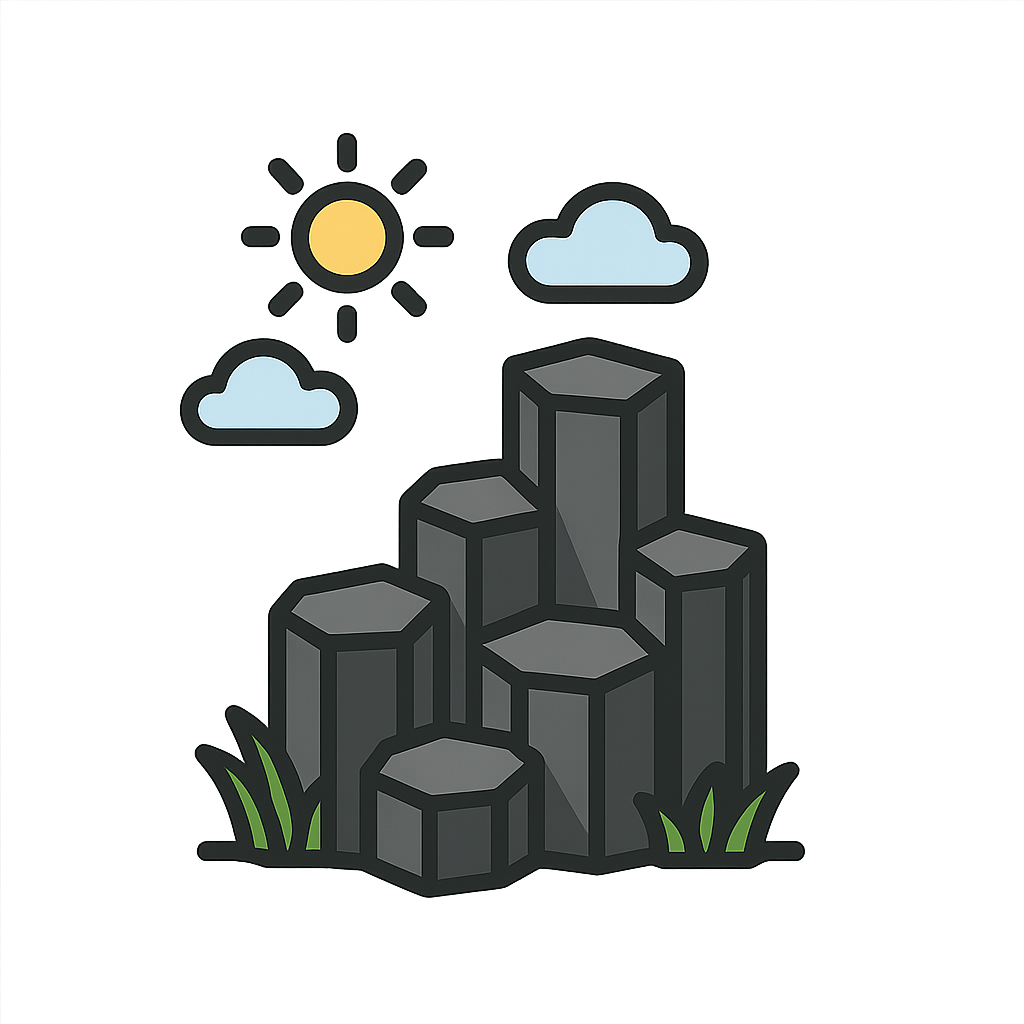
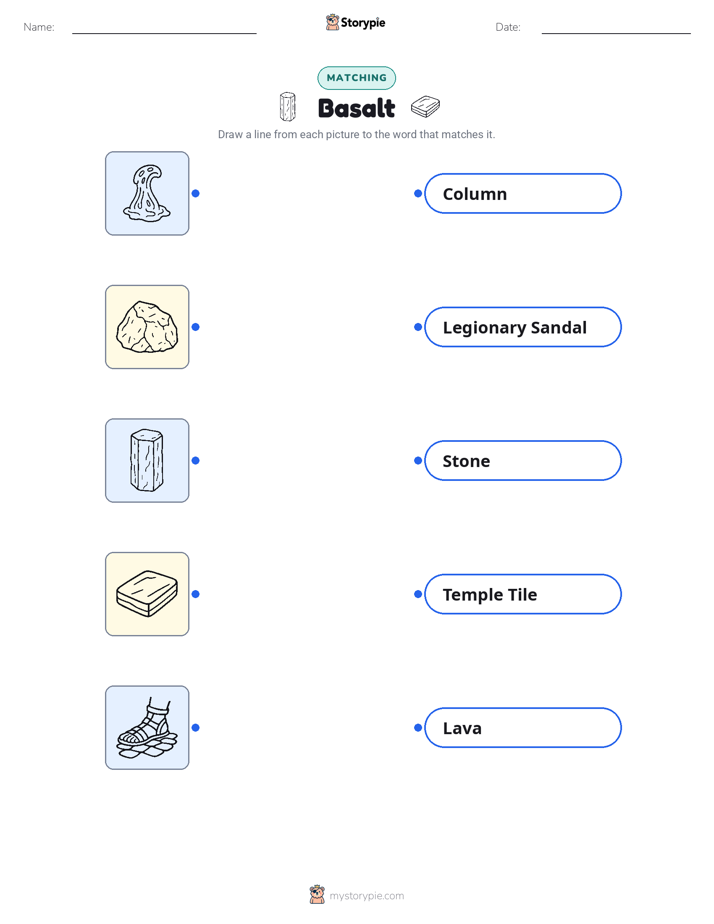
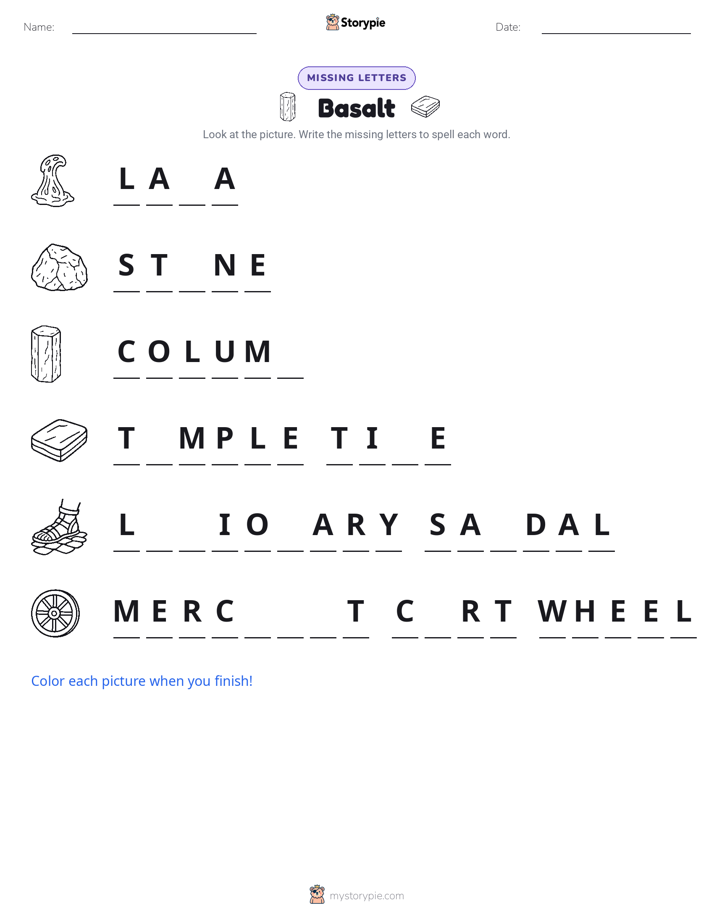
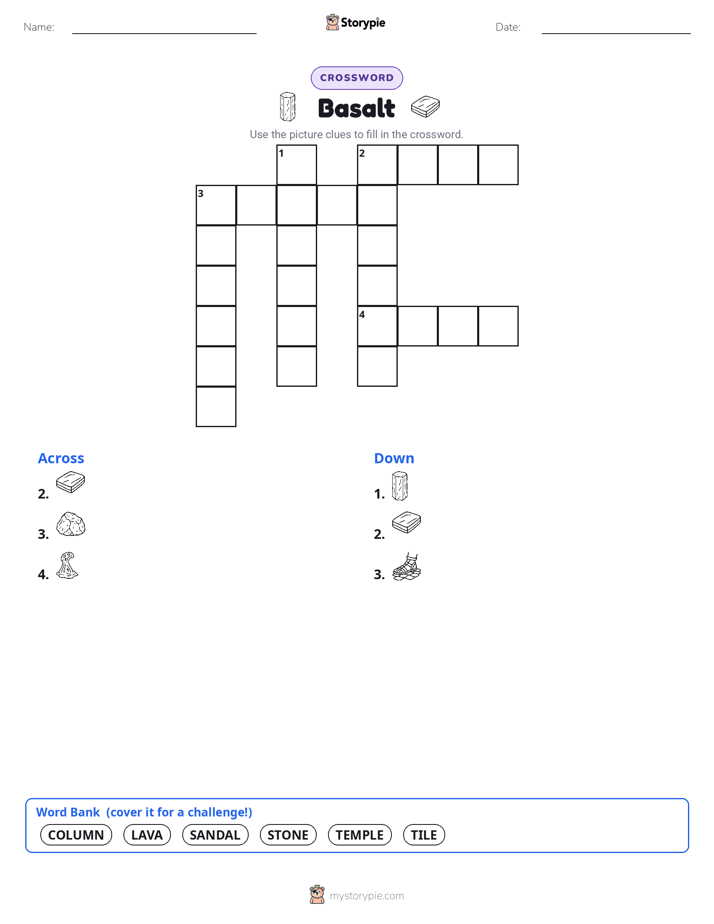
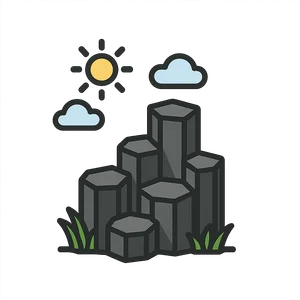
I begin as a secret, a fiery liquid heart beating deep inside the Earth. When a volcano sighs a great, rumbling breath, I am born. I rush out as glowing red lava, a river of melted rock flowing across the land or bubbling up from the bottom of the sea. The cool air and water greet me, and I harden quickly, turning from a fiery liquid into a dark, strong stone. Sometimes, as I cool, I shrink and crack into incredible shapes—thousands of tall, six-sided columns standing together like a giant’s staircase. I cover the ocean floors, build islands, and even paint vast, dark plains on the Moon. I am the silent, strong foundation of worlds. I am Basalt.
For thousands of years, humans have felt my strength. Long ago, around 3000 BCE, the ancient Egyptians noticed my dark, handsome color and my incredible toughness. They were master builders, and they chose me for important work. They carefully cut and polished me into floor tiles for their magnificent temples and carved me into statues of their gods and pharaohs, trusting me to last for eternity. Centuries later, another great civilization, the Roman Empire, fell in love with my durability. Starting in 27 BCE, their engineers used me to build the famous Roman roads. They would cut me into paving stones and lay me down so tightly that their roads stretched for thousands of miles, connecting their vast empire. I was the sturdy surface beneath the marching feet of legions, the wheels of merchants' carts, and the footsteps of emperors. Because of me, people could travel farther and faster than ever before, and many of those roads are still there today, a testament to my lasting power.
The Secret in the Stone
I begin as a secret, a fiery liquid heart beating deep inside the Earth. When a volcano sighs a great, rumbling breath, I am born. I rush out as glowing red lava, a river of melted rock flowing across the land or bubbling up from the bottom of the sea. The cool air and water greet me, and I harden quickly, turning from a fiery liquid into a dark, strong stone. Sometimes, as I cool, I shrink and crack into incredible shapes—thousands of tall, six-sided columns standing together like a giant’s staircase. I cover the ocean floors, build islands, and even paint vast, dark plains on the Moon. I am the silent, strong foundation of worlds. I am Basalt.
For thousands of years, humans have felt my strength. Long ago, around 3000 BCE, the ancient Egyptians noticed my dark, handsome color and my incredible toughness. They were master builders, and they chose me for important work. They carefully cut and polished me into floor tiles for their magnificent temples and carved me into statues of their gods and pharaohs, trusting me to last for eternity. Centuries later, another great civilization, the Roman Empire, fell in love with my durability. Starting in 27 BCE, their engineers used me to build the famous Roman roads. They would cut me into paving stones and lay me down so tightly that their roads stretched for thousands of miles, connecting their vast empire. I was the sturdy surface beneath the marching feet of legions, the wheels of merchants' carts, and the footsteps of emperors. Because of me, people could travel farther and faster than ever before, and many of those roads are still there today, a testament to my lasting power.
Even though people used me, they didn't always understand my story. For a long time, my origin was a puzzle. Some scholars in the 17th and 18th centuries believed I was formed by water, a rock that settled out of ancient oceans. They saw my strange column shapes and thought they must have crystallized in the sea. A man named Georgius Agricola had given me my modern scientific name way back in 1546, but my true birthplace was still debated. The answer was finally revealed by geologists who acted like detectives. In the 1770s, a French scientist named Nicolas Desmarest traveled through the Auvergne region of France. He saw old, worn-down volcanoes and noticed that great flows of me led away from them, just like hardened rivers. He studied the strange columns and realized they were the result of lava cooling. He proved that I wasn't from the water, but from the fire of volcanoes. This discovery helped people understand how our own planet works, showing them the powerful volcanic forces that shape the world.
My story isn't just limited to land. I am the single most common rock on the planet, but most of me is hidden. I form the very floor of Earth's vast oceans. But my biggest journey was yet to come. On July 20th, 1969, something amazing happened. Two human astronauts on a mission called Apollo 11 landed on the Moon. When they looked around the 'Sea of Tranquility,' they saw a dark, dusty plain. And what did they find when they collected rock samples? Me. The dark 'seas' on the Moon, which people had looked at for thousands of years, weren't filled with water at all. They were enormous, ancient plains of hardened basalt lava. Finding me on the Moon was incredible proof that other worlds had volcanoes long ago, and it helped scientists write the history of our entire solar system.
Today, you can still find me everywhere. I am crushed to make the roads you travel on and the concrete in your buildings. But humans have also learned new tricks with my old strength. They can now melt me down and spin me into something called basalt fiber—a material that is stronger than steel but much lighter. This fiber is used to build everything from tough car parts to giant blades for wind turbines that generate clean energy. From a fiery birth, I became the foundation for ancient empires, a clue to understanding our planet, and a piece of other worlds. I am a reminder that even the simplest stone beneath your feet has a story of fire, time, and discovery, and that strength can be used to build a better and more connected future.
Wow facts
About
Basalt is a dark-colored, fine-grained igneous rock formed from the rapid cooling of lava. It is the most common volcanic rock on Earth's surface, forming most of the ocean floor and many lava plateaus. People have used basalt for construction and tools for thousands of years.
Take a Quiz
Question 1 of 5
What was the main scientific debate about my origin, and how was it finally resolved?
Explore next






Want to do even more?
Go beyond exploring. Unlock tools that turn every story into real learning.

Storypie Plus for families
Full stories, quizzes, and printables. Nights and car rides, sorted.
- Unlimited audio stories
- Create Mode: your child stars in the story
- Offline downloads
- Printable worksheets & coloring pages

Why Storypie for Schools
Students engaged. Prep in seconds. Evenings back to you.
- Worksheets & Quizzes
- Classroom Management
- Formative Assessment
- Custom Curriculum & Lesson Plans
- 27 Languages

Why Storypie for Homeschool
Curriculum done. They'll ask for more. Hours back in your day.
- Worksheet Generator
- First-Person Audio Stories
- Built-in Comprehension Quizzes
- Custom Curriculum & Lesson Plans
- Print & Go Activities