English


Biomimicry
Biomimicry is an approach to innovation that seeks sustainable solutions to human challenges by emulating…
Reads at Grades 6–8 Listens at Grades 4–8
Print & create
Answer keys·No prep·Free with an account
28 worksheets · answer keys · full story · quiz · Ages 10-12 · CEFR B2
Plus adds 102,000+ more stories in 27 languages, audio for every one, and printables for all of them.
Just want Biomimicry?
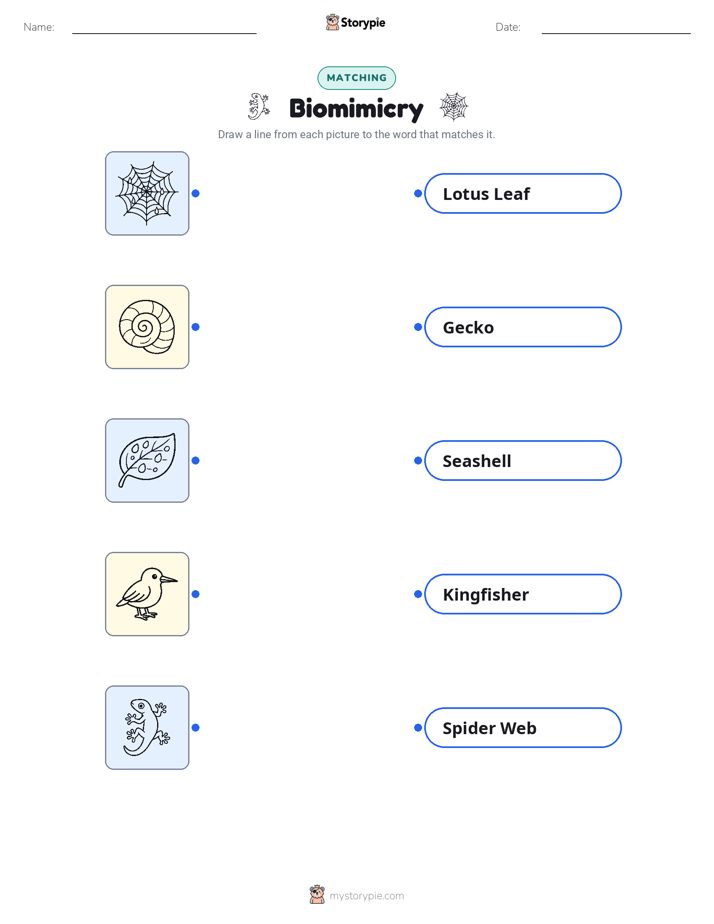
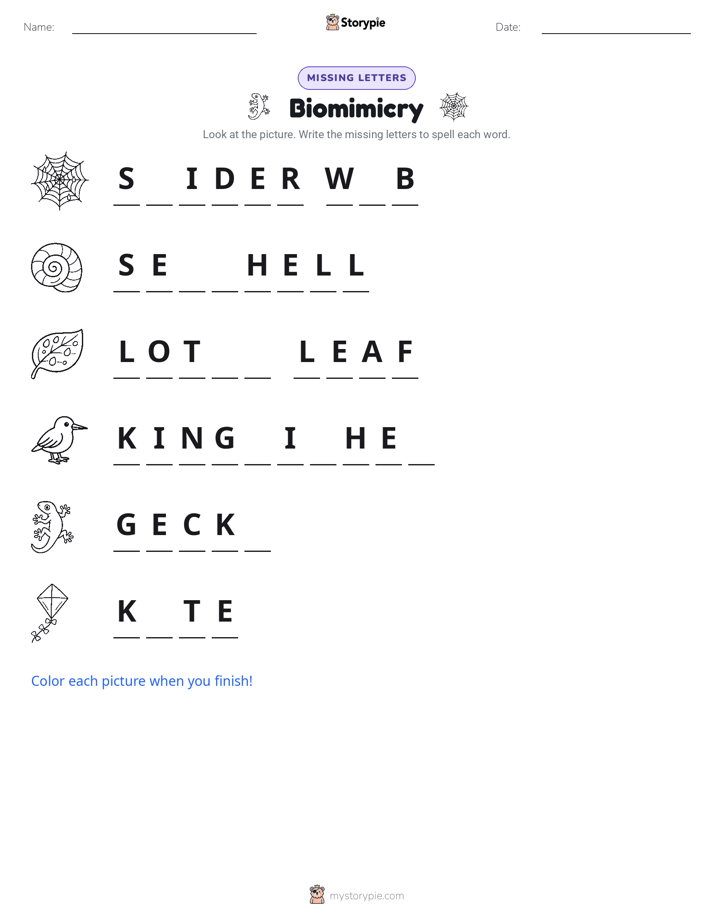
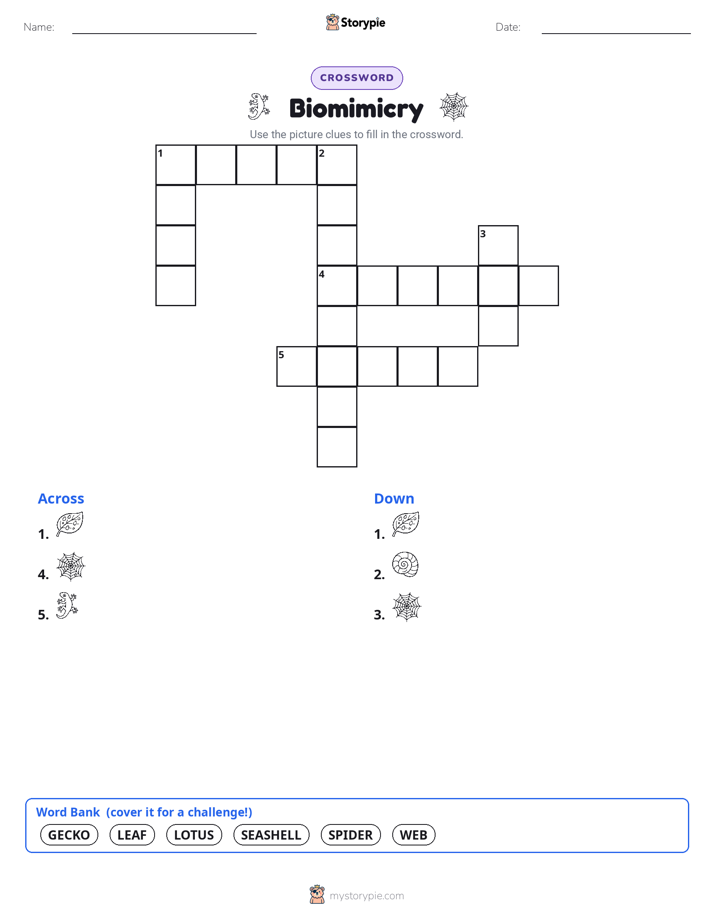
Have you ever marveled at the impossible strength of a spider’s web, glistening with dew but strong enough to catch its prey? Have you traced the perfect, swirling pattern of a seashell or wondered how a lotus leaf can emerge from muddy water looking perfectly clean and dry? For millions of years, before humans ever built a city or designed a machine, nature was already busy solving the world’s biggest problems. The secrets were hidden in plain sight: the clue to a quieter, faster train was tucked away in a kingfisher’s beak, and the design for a tape that could stick to almost anything was walking around on a gecko’s feet. I am the bridge between the genius of the natural world and the curiosity of the human mind. I am nature’s vast library of brilliant ideas, patiently waiting for someone to open a book and read my pages. I am the practice of looking at the world not just for its beauty, but for its incredible engineering. I am nature’s secret blueprint. I am Biomimicry.
While my name, Biomimicry, might sound modern and scientific, my spirit is as ancient as human curiosity itself. For thousands of years, people have looked to the living world for answers. The earliest humans survived by watching which berries the birds ate and which waterholes the animals visited. My whispers of inspiration can be found throughout history. As far back as 500 BCE, creative thinkers in China observed hawks and eagles soaring effortlessly on the wind. They studied the curve of their wings and the way they angled their bodies to catch the air currents, and from these observations, they designed the world’s first kites. I was also there, centuries later, in the mind of one of the most brilliant thinkers in history, Leonardo da Vinci. During the late 15th and early 16th centuries, he was obsessed with the idea of human flight. He spent countless hours filling his notebooks with exquisite, detailed drawings of birds, bats, and insects, trying to unlock their secrets. He meticulously documented the anatomy of their wings, the movement of their feathers, and the physics of their flight. He dreamed of building an ‘ornithopter,’ a magnificent machine with flapping wings that could lift a person into the sky. Though his machines never left the ground, Leonardo proved something vital: the answer to flight wasn't just in human imagination, but was already perfected in the wings of a bird.
Nature's Secret Blueprint
Have you ever marveled at the impossible strength of a spider’s web, glistening with dew but strong enough to catch its prey? Have you traced the perfect, swirling pattern of a seashell or wondered how a lotus leaf can emerge from muddy water looking perfectly clean and dry? For millions of years, before humans ever built a city or designed a machine, nature was already busy solving the world’s biggest problems. The secrets were hidden in plain sight: the clue to a quieter, faster train was tucked away in a kingfisher’s beak, and the design for a tape that could stick to almost anything was walking around on a gecko’s feet. I am the bridge between the genius of the natural world and the curiosity of the human mind. I am nature’s vast library of brilliant ideas, patiently waiting for someone to open a book and read my pages. I am the practice of looking at the world not just for its beauty, but for its incredible engineering. I am nature’s secret blueprint. I am Biomimicry.
While my name, Biomimicry, might sound modern and scientific, my spirit is as ancient as human curiosity itself. For thousands of years, people have looked to the living world for answers. The earliest humans survived by watching which berries the birds ate and which waterholes the animals visited. My whispers of inspiration can be found throughout history. As far back as 500 BCE, creative thinkers in China observed hawks and eagles soaring effortlessly on the wind. They studied the curve of their wings and the way they angled their bodies to catch the air currents, and from these observations, they designed the world’s first kites. I was also there, centuries later, in the mind of one of the most brilliant thinkers in history, Leonardo da Vinci. During the late 15th and early 16th centuries, he was obsessed with the idea of human flight. He spent countless hours filling his notebooks with exquisite, detailed drawings of birds, bats, and insects, trying to unlock their secrets. He meticulously documented the anatomy of their wings, the movement of their feathers, and the physics of their flight. He dreamed of building an ‘ornithopter,’ a magnificent machine with flapping wings that could lift a person into the sky. Though his machines never left the ground, Leonardo proved something vital: the answer to flight wasn't just in human imagination, but was already perfected in the wings of a bird.
Leonardo’s dream of soaring through the clouds finally came true, and I was there to help make it happen. My next partners were two clever brothers from Ohio, Orville and Wilbur Wright. At the dawn of the 20th century, they were consumed by the challenge of flight. They had built gliders that could catch the wind, but they faced a critical, dangerous problem: how could a pilot steer the machine and keep it balanced in the turbulent air? Other inventors were focused on building more powerful engines, but the Wright brothers looked to a different source for answers. They spent hours lying on the grassy hills of Kitty Hawk, North Carolina, watching buzzards and pigeons circle overhead. They noticed something remarkable. To turn or to balance themselves against a gust of wind, the birds didn't just flap their wings; they subtly twisted the tips of their wings, changing their shape. This observation sparked a brilliant idea they called ‘wing warping.’ They devised an ingenious system of pulleys and cables that allowed a pilot to twist the ends of the wings on their glider, just like a bird. This direct imitation of nature was the key that unlocked controlled flight. On the cold morning of December 17th, 1903, the Wright Flyer, with Orville at the controls, lifted into the air and stayed aloft for twelve incredible seconds. Humanity had finally touched the sky, not by conquering nature, but by listening to it carefully.
My influence isn't just for grand, sky-changing inventions like the airplane; I also inspire clever solutions for everyday life. In 1941, a Swiss engineer named George de Mestral went for a walk in the Alps with his dog. When they returned, he was annoyed to find both his pants and his dog’s fur covered in pesky burrs. But instead of just throwing them away, his curiosity took over. He put one of the burrs under a microscope and was amazed by what he saw. It was covered in hundreds of tiny, flexible hooks that latched onto the loops in the fabric of his clothes and his dog's fur. This simple, natural design gave him an idea for a new kind of fastener. He created a system with one strip of fabric covered in tiny hooks and another covered in soft loops. He called it Velcro, and it became a global success. Decades later, in the 1990s, I helped solve a much louder problem in Japan. An engineer named Eiji Nakatsu was tasked with fixing the Shinkansen bullet train, which created a deafening sonic boom every time it exited a tunnel. As an avid birdwatcher, Nakatsu remembered how the kingfisher can dive from the air into water with almost no splash. He realized the bird's long, pointed beak was perfectly shaped to move between two different environments—air and water—with minimal resistance. He redesigned the nose of the bullet train to mimic the shape of a kingfisher’s beak. The new design not only silenced the sonic boom, but it also made the train ten percent faster and used fifteen percent less electricity. It wasn't until 1997 that a scientist and author named Janine Benyus gave me the name that would inspire a new generation, writing a book called 'Biomimicry: Innovation Inspired by Nature.'
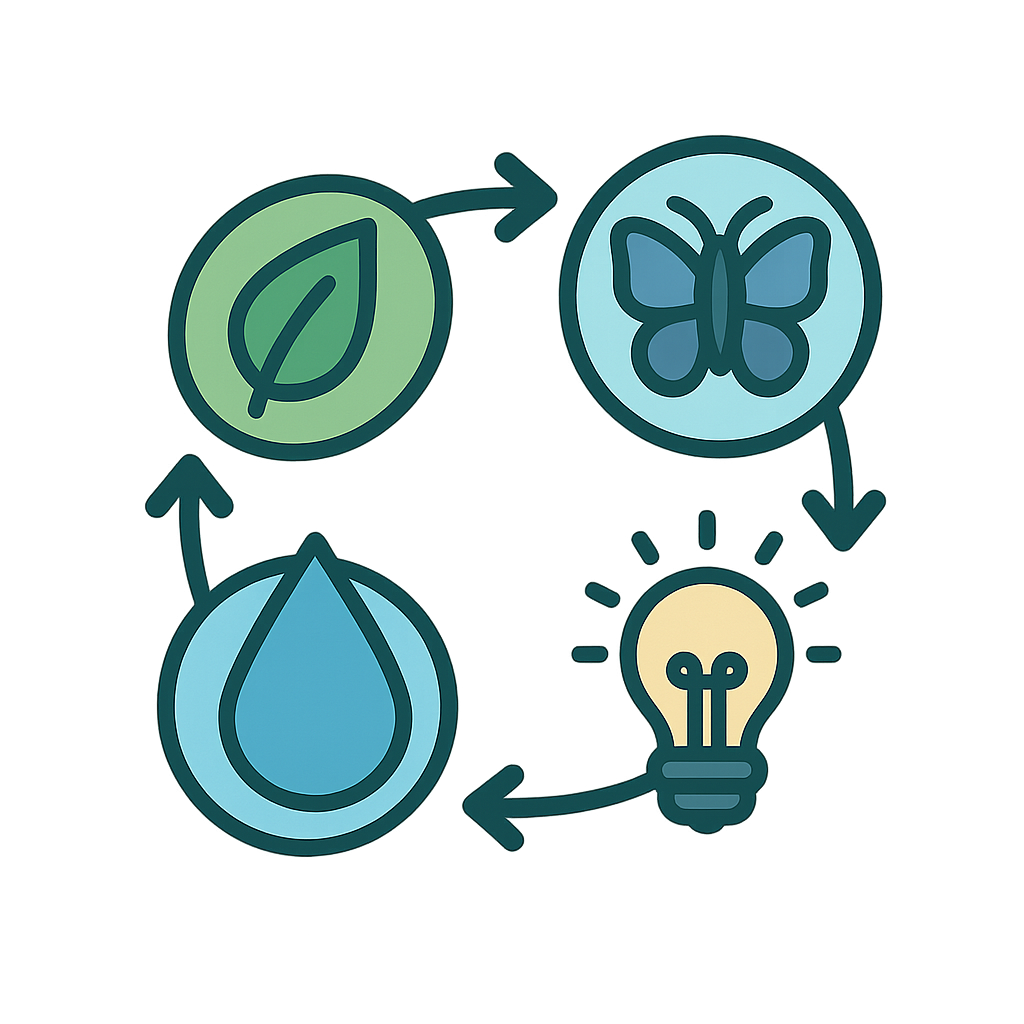
Today, as humans face challenges like climate change and dwindling resources, I am more important than ever. Scientists and engineers around the world are turning to me for sustainable solutions. They are studying the intricate, self-cooling ventilation systems of termite mounds to design buildings that stay cool without using air conditioning, like the Eastgate Centre in Zimbabwe, which opened in 1996. They are examining the microscopic patterns on shark skin, which naturally resist bacteria, to create cleaner surfaces for hospitals. They are mimicking the process of photosynthesis, learning from leaves how to turn sunlight into energy more efficiently. By using me, we can create inventions that are not only effective but also work in harmony with our planet. I am an open invitation to you to see the entire world as a giant laboratory, where the best ideas have already been tested and perfected over millions of years. So the next time you see a spider’s web, a spiraling seed pod, or a colony of ants working together, I want you to look closer. Ask yourself: What problem has this solved? What lesson is it waiting to teach? The future is in your hands, and I am here to help you build it, inspired by the wisest teacher of all: nature itself.
Wow facts
About
Biomimicry is an approach to innovation that seeks sustainable solutions to human challenges by emulating nature's time-tested patterns and strategies.
Take a Quiz
Question 1 of 5
What is the main idea of this story?
Explore next



Want to do even more?
Go beyond exploring. Unlock tools that turn every story into real learning.

Storypie Plus for families
Full stories, quizzes, and printables. Nights and car rides, sorted.
- Unlimited audio stories
- Create Mode: your child stars in the story
- Offline downloads
- Printable worksheets & coloring pages

Why Storypie for Schools
Students engaged. Prep in seconds. Evenings back to you.
- Worksheets & Quizzes
- Classroom Management
- Formative Assessment
- Custom Curriculum & Lesson Plans
- 27 Languages

Why Storypie for Homeschool
Curriculum done. They'll ask for more. Hours back in your day.
- Worksheet Generator
- First-Person Audio Stories
- Built-in Comprehension Quizzes
- Custom Curriculum & Lesson Plans
- Print & Go Activities