English

Biomimicry
Biomimicry is an approach to innovation that seeks sustainable solutions to human challenges by emulating…
Reads at Grades 3–5 Listens at Grades 1–5
Print & create
Answer keys·No prep·Free with an account
28 worksheets · answer keys · full story · quiz · Ages 8-10 · CEFR B1
Plus adds 102,000+ more stories in 27 languages, audio for every one, and printables for all of them.
Just want Biomimicry?
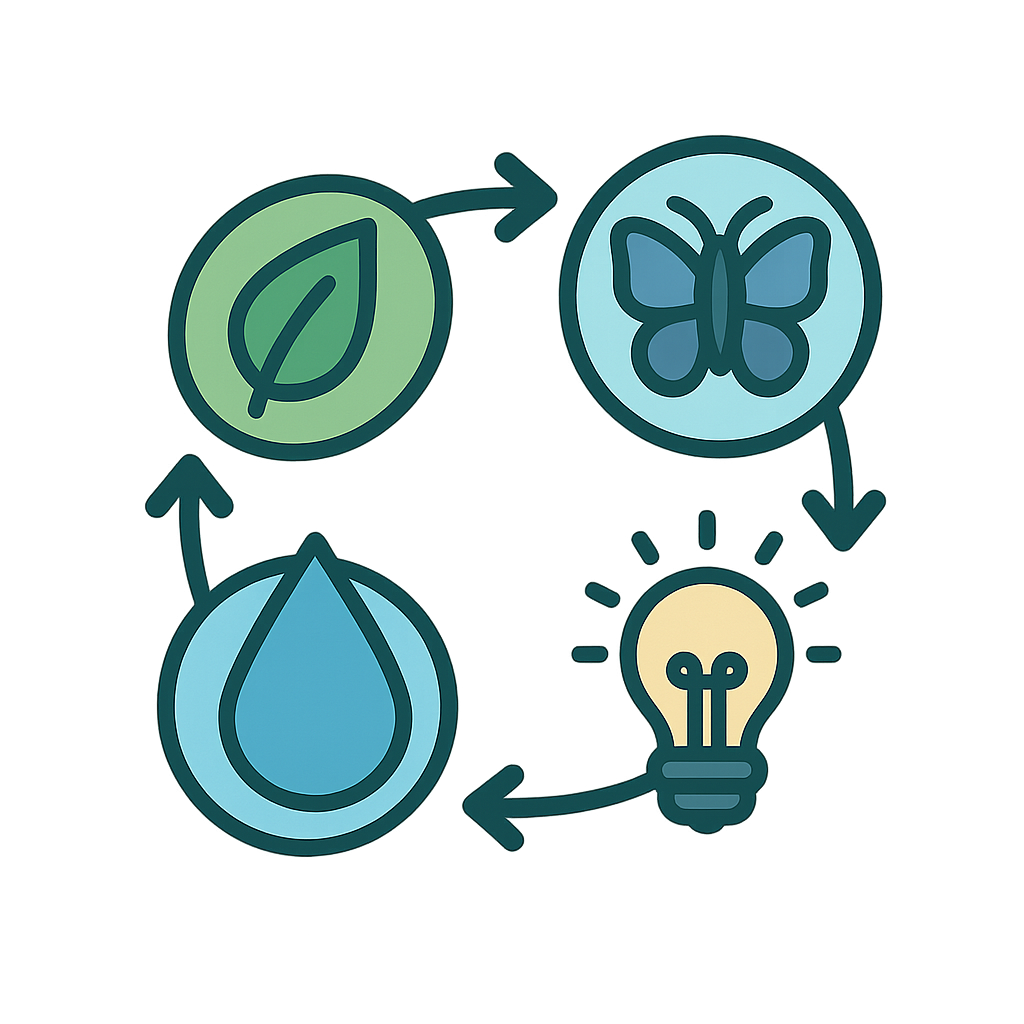
Have you ever wondered how a gecko can scurry up a wall without falling, or how a hummingbird can hang perfectly still in the air. Have you seen how water beads up and rolls off a lotus leaf, leaving it perfectly clean and dry. For thousands of years, nature has been quietly solving the world’s biggest problems. It has figured out how to stay warm, how to find water, and how to build the strongest homes. The answers are all around you, hidden in plain sight. They are tucked into the wings of a butterfly and woven into the silk of a spider's web. I am the secret that connects these amazing natural designs to the world of human invention. I am a special way of looking at the world, a whisper that says, 'Hey, nature already solved that.' I am the spark of an idea that flashes in a scientist's mind when she sees something amazing in nature and thinks, 'We could do that too.' I am Biomimicry.
I am an idea that is as old as the first humans who watched birds to learn about flight or copied the design of a thorny branch to make a better spear. But people really started to notice me when they began to write their ideas down. A man named Leonardo da Vinci was fascinated with me back in the early 1500s. Around the year 1505, he filled notebooks with detailed drawings of birds, studying how their wings caught the air. He dreamed of building a machine that would let people soar through the sky just like them. He never built one that worked, but his dream was a powerful start. Hundreds of years later, two brothers named Orville and Wilbur Wright picked up that same dream. They spent hours watching birds, noticing how they twisted their wingtips to steer and stay balanced in the wind. On December 17th, 1903, they used what they learned to make the very first successful airplane flight. I was there, in the curve of their wings and the way they controlled their machine. I showed up again in 1941 when a Swiss engineer named George de Mestral went for a walk with his dog. When they got home, he noticed little burrs from a plant were stuck all over his dog's fur and his own pants. Instead of just being annoyed, he became curious. He looked at a burr under a microscope and saw it was covered in tiny, strong hooks. This gave him the brilliant idea for a new fastener, which he called Velcro.
I am Biomimicry
Have you ever wondered how a gecko can scurry up a wall without falling, or how a hummingbird can hang perfectly still in the air. Have you seen how water beads up and rolls off a lotus leaf, leaving it perfectly clean and dry. For thousands of years, nature has been quietly solving the world’s biggest problems. It has figured out how to stay warm, how to find water, and how to build the strongest homes. The answers are all around you, hidden in plain sight. They are tucked into the wings of a butterfly and woven into the silk of a spider's web. I am the secret that connects these amazing natural designs to the world of human invention. I am a special way of looking at the world, a whisper that says, 'Hey, nature already solved that.' I am the spark of an idea that flashes in a scientist's mind when she sees something amazing in nature and thinks, 'We could do that too.' I am Biomimicry.
I am an idea that is as old as the first humans who watched birds to learn about flight or copied the design of a thorny branch to make a better spear. But people really started to notice me when they began to write their ideas down. A man named Leonardo da Vinci was fascinated with me back in the early 1500s. Around the year 1505, he filled notebooks with detailed drawings of birds, studying how their wings caught the air. He dreamed of building a machine that would let people soar through the sky just like them. He never built one that worked, but his dream was a powerful start. Hundreds of years later, two brothers named Orville and Wilbur Wright picked up that same dream. They spent hours watching birds, noticing how they twisted their wingtips to steer and stay balanced in the wind. On December 17th, 1903, they used what they learned to make the very first successful airplane flight. I was there, in the curve of their wings and the way they controlled their machine. I showed up again in 1941 when a Swiss engineer named George de Mestral went for a walk with his dog. When they got home, he noticed little burrs from a plant were stuck all over his dog's fur and his own pants. Instead of just being annoyed, he became curious. He looked at a burr under a microscope and saw it was covered in tiny, strong hooks. This gave him the brilliant idea for a new fastener, which he called Velcro.
For a long, long time, I didn't have a formal name. People used me, but they didn't know what to call me. That started to change in the 1950s when a scientist named Otto Schmitt was studying how nerves work in squids. He realized that the way a squid's nerve cell fires was a great model for building a new kind of electronic circuit. He decided to call this way of thinking 'biomimetics'. It was a good name, but it was a bit of a mouthful. Then, in 1997, a scientist and author named Janine Benyus wrote a wonderful book that made me famous. She called her book 'Biomimicry: Innovation Inspired by Nature,' and suddenly, everyone knew my name. People started seeing me everywhere. They saw me in the 1990s, when engineers in Japan redesigned their super-fast Shinkansen bullet train. The train used to make a loud booming sound when it exited tunnels, but they fixed it by shaping the train’s nose like the sleek, pointed beak of a kingfisher bird. This design not only made the train quieter, but it also made it faster and more efficient. They saw me again when a special building called the Eastgate Centre was finished in Zimbabwe in 1996. Its architect studied termite mounds and how they stay cool inside, even in the hot sun. The building uses a similar system of vents and chimneys to move air around, keeping it comfortable without a big, energy-guzzling air conditioner.
Now you know my secret. I am everywhere, waiting to be discovered. I am in the spiral of a seashell, a shape so strong it can protect a soft creature from the crushing pressure of the ocean. I am in the design of a shark's skin, which has special ridges that help it glide through water with very little effort. I am in the incredible strength of a spider's web, which is tougher than steel for its weight. The world is full of amazing teachers, and they are the plants and animals all around you. So, your turn has come. Become an observer. When you see a bee flying from flower to flower or a tree reaching for the sun, ask yourself questions. How does it do that. What problem is it solving. What can I learn from it. You don't have to be a famous scientist to have a great idea. You just have to be curious. The next brilliant invention that helps the world could start with you, simply by looking closely at the genius of nature.
Wow facts
About
Biomimicry is an approach to innovation that seeks sustainable solutions to human challenges by emulating nature's time-tested patterns and strategies.
Take a Quiz
Question 1 of 5
In the story, the word 'mimics' is used to describe a building that copies a termite mound. What is another word for 'mimics'?
Explore next



Want to do even more?
Go beyond exploring. Unlock tools that turn every story into real learning.

Storypie Plus for families
Full stories, quizzes, and printables. Nights and car rides, sorted.
- Unlimited audio stories
- Create Mode: your child stars in the story
- Offline downloads
- Printable worksheets & coloring pages

Why Storypie for Schools
Students engaged. Prep in seconds. Evenings back to you.
- Worksheets & Quizzes
- Classroom Management
- Formative Assessment
- Custom Curriculum & Lesson Plans
- 27 Languages

Why Storypie for Homeschool
Curriculum done. They'll ask for more. Hours back in your day.
- Worksheet Generator
- First-Person Audio Stories
- Built-in Comprehension Quizzes
- Custom Curriculum & Lesson Plans
- Print & Go Activities