English


Climate (Regional Climates)
The long-term pattern of weather in a particular area…
Reads at Grades 6–8 Listens at Grades 4–8
Print & create
Answer keys·No prep·Free with an account
28 worksheets · answer keys · full story · quiz · Ages 10-12 · CEFR B2
Plus adds 244,000+ more stories in 27 languages, audio for every one, and printables for all of them.
Just want Climate (Regional Climates)?
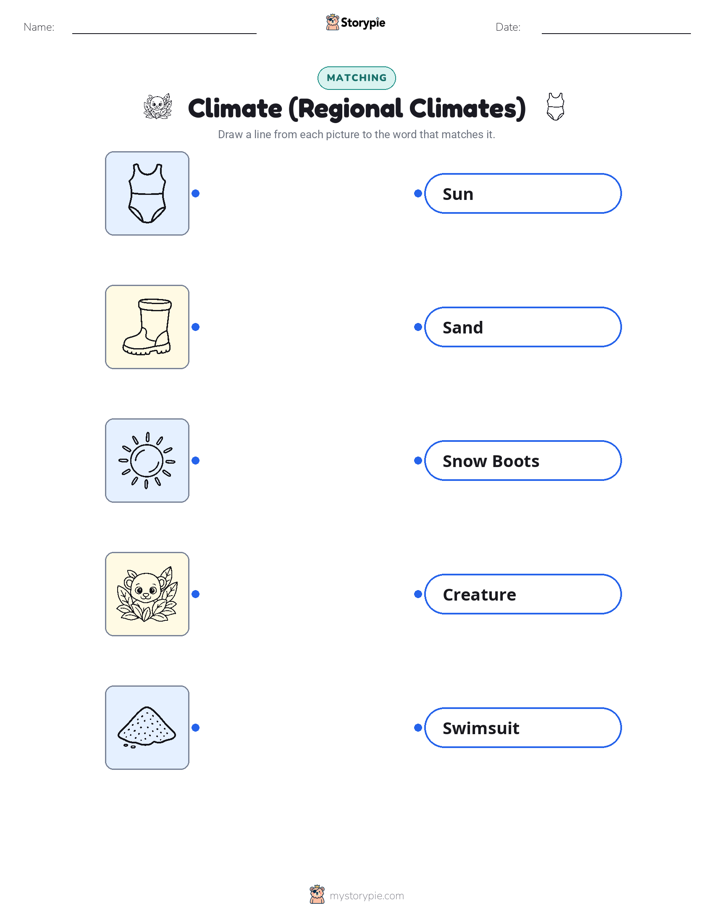
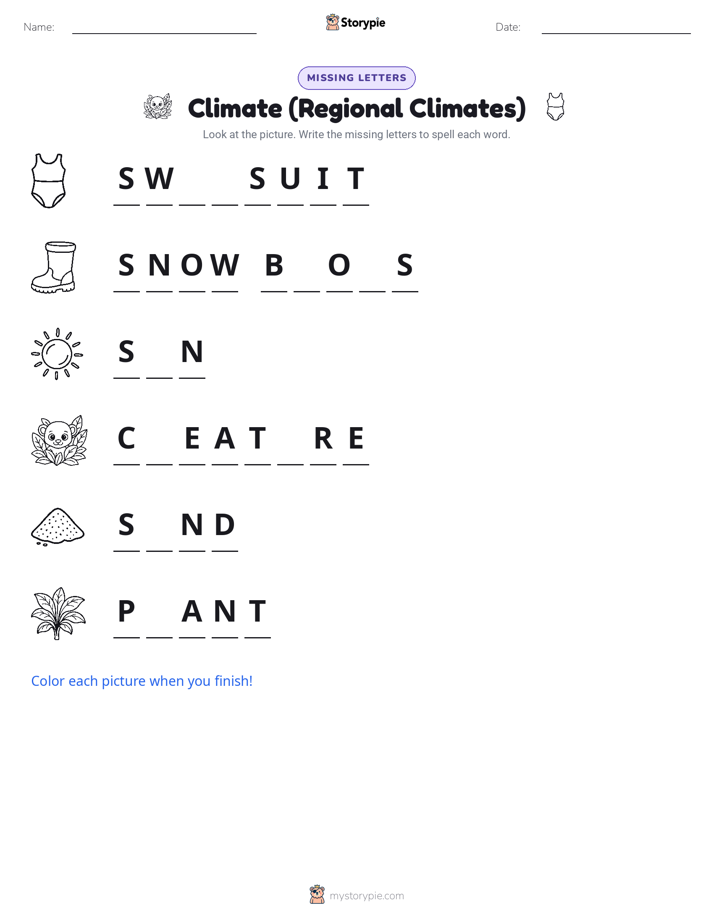
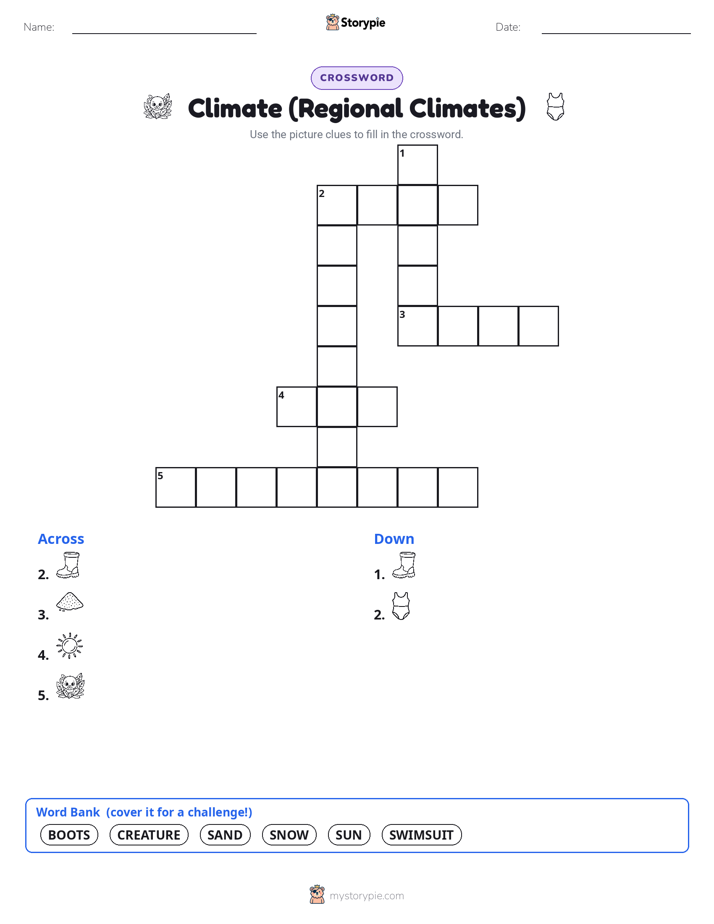
I am the reason you pack a swimsuit for a trip to Egypt but snow boots for a visit to Siberia. In the Amazon, I am warm and damp, creating a world dripping with life and filled with the calls of unseen creatures. In the Sahara, I am hot and dry, sculpting endless dunes of sand that shimmer under a relentless sun. I am not the weather you see today—that is just my fleeting mood, a passing shower or a single sunny afternoon. I am the story of a place told over many decades, centuries, and millennia. I am the predictable character of a region, the personality that shapes its plants, animals, and even its people. I am the sum of all the sunny days, chilly nights, howling gales, and gentle breezes a place has ever known, averaged out to form a stable identity. I am the deep, abiding nature of a place. I am Climate, and I give every place on Earth its own special identity.
For thousands of years, humans felt my presence but struggled to understand my grand design. The ancient Greeks were some of the first to try and draw a map of my personality. Around the 5th century BCE, a brilliant philosopher named Parmenides looked at the world and imagined it divided into zones based on my character. He reasoned there must be a fiery, uninhabitable 'torrid' zone near the Earth's equator, two bitterly cold and equally unlivable 'frigid' zones at the poles, and a perfectly comfortable 'temperate' zone in between where people could thrive. It was a simple idea, but it was the beginning of thinking about me as a global system. A bit later, around 340 BCE, the famous thinker Aristotle wrote about me in his book, 'Meteorologica.' He refined the Greek ideas, carefully linking my different personalities to a place's distance from the equator. He called these different latitudinal zones 'klimata,' from the Greek word for 'inclination,' referring to the angle of the sun's rays. It was from his word that I finally got my name.
A Story of Climate
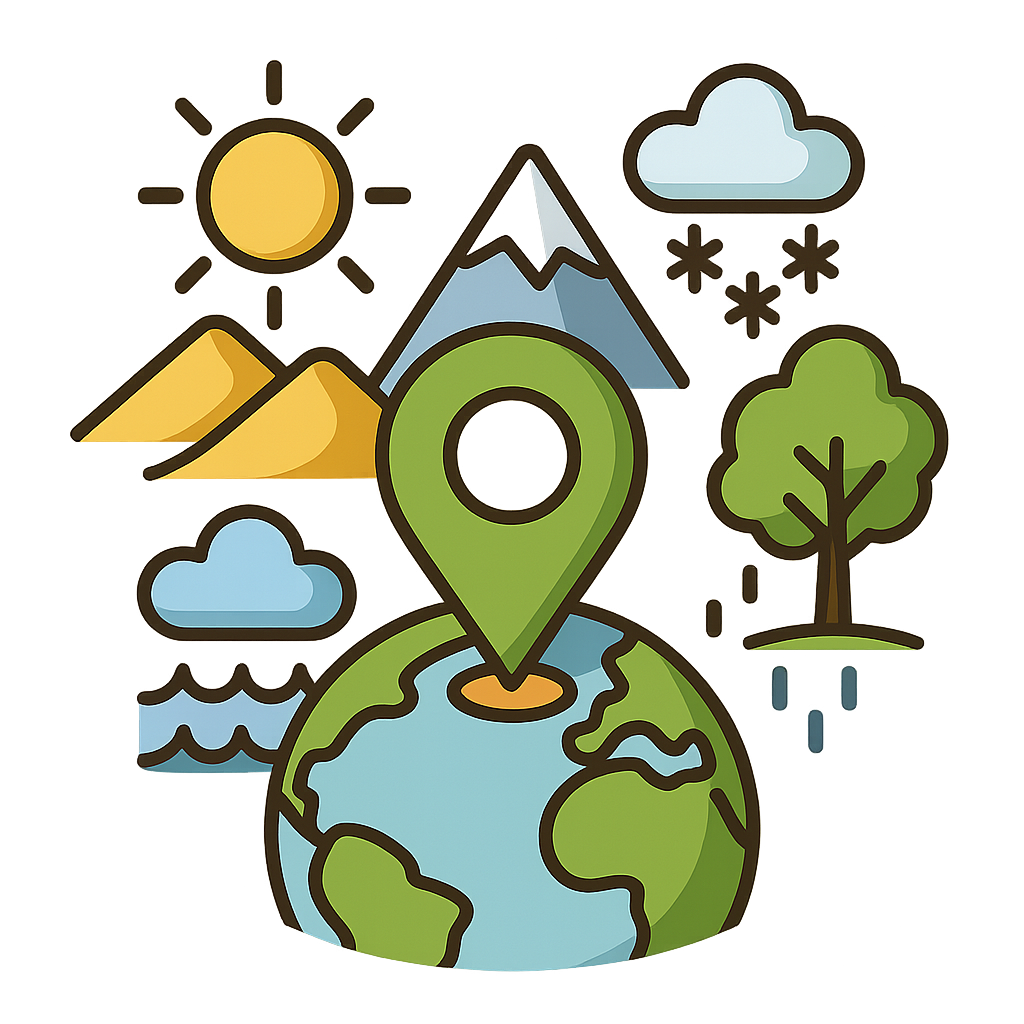
I am the reason you pack a swimsuit for a trip to Egypt but snow boots for a visit to Siberia. In the Amazon, I am warm and damp, creating a world dripping with life and filled with the calls of unseen creatures. In the Sahara, I am hot and dry, sculpting endless dunes of sand that shimmer under a relentless sun. I am not the weather you see today—that is just my fleeting mood, a passing shower or a single sunny afternoon. I am the story of a place told over many decades, centuries, and millennia. I am the predictable character of a region, the personality that shapes its plants, animals, and even its people. I am the sum of all the sunny days, chilly nights, howling gales, and gentle breezes a place has ever known, averaged out to form a stable identity. I am the deep, abiding nature of a place. I am Climate, and I give every place on Earth its own special identity.
For thousands of years, humans felt my presence but struggled to understand my grand design. The ancient Greeks were some of the first to try and draw a map of my personality. Around the 5th century BCE, a brilliant philosopher named Parmenides looked at the world and imagined it divided into zones based on my character. He reasoned there must be a fiery, uninhabitable 'torrid' zone near the Earth's equator, two bitterly cold and equally unlivable 'frigid' zones at the poles, and a perfectly comfortable 'temperate' zone in between where people could thrive. It was a simple idea, but it was the beginning of thinking about me as a global system. A bit later, around 340 BCE, the famous thinker Aristotle wrote about me in his book, 'Meteorologica.' He refined the Greek ideas, carefully linking my different personalities to a place's distance from the equator. He called these different latitudinal zones 'klimata,' from the Greek word for 'inclination,' referring to the angle of the sun's rays. It was from his word that I finally got my name.
As centuries passed, curious minds became my messengers, traveling the globe and bringing back stories of my diverse behaviors. During the great Age of Exploration, from the 15th to the 17th centuries, sailors ventured into uncharted waters and witnessed my many moods firsthand. They reported on the powerful monsoons of Asia that brought life-giving rains and the steady, reliable trade winds that blew across the Atlantic, which the English astronomer Edmund Halley carefully mapped in 1686. But a true hero in my story arrived much later. In the early 19th century, a Prussian naturalist and explorer named Alexander von Humboldt traveled the world not just to see it, but to measure it. He was obsessed with details. He climbed mountains in South America, thermometer in hand, and was the first to prove that I get colder with increasing altitude, not just with increasing latitude. He collected countless readings on temperature and pressure, and back in Europe, he created a new kind of map. He drew lines called 'isotherms' that connected places with the same average temperature, revealing my intricate global patterns to the world in a way no one had ever visualized before.
All of this incredible new information from explorers like Humboldt created a wonderful new problem: how to organize it all. I had been observed, measured, and mapped, but my many personalities were like a library full of books with no system to sort them. Then came a German-Russian scientist named Wladimir Köppen, who decided to become my librarian. Starting in 1884 and continuing for decades, he dedicated his life to creating a comprehensive classification system for me. He understood that the type of vegetation in a place was a direct expression of my character. So, he devised a brilliant system using simple letter codes to group my many types based on their yearly and monthly patterns of temperature and precipitation. A place could be labeled 'Af' for a tropical rainforest, always hot and wet, or 'ET' for a polar tundra, where it is too cold for trees to grow. His system was so logical and useful that scientists still use and adapt it today. He gave everyone a shared language to talk about me, allowing them to compare my personality in the Congo with my personality in Canada.
Today, understanding my regional personalities is more important than ever. I am not just a subject for scientists to study; I am a partner in your daily lives. My patterns tell farmers the best time to plant their crops and which ones will flourish. I inform architects how to design buildings that stay cool in my desert regions and warm in my polar zones. Knowing my history helps communities prepare for floods, droughts, and storms. As you learn about my long and fascinating past, from the ancient Greeks to the meticulous classifiers of the modern era, you learn more about the planet you call home. By studying my history and paying close attention to the ways I am changing, you become my careful observers and my thoughtful partners. Together, we can work to protect the beautiful and diverse world I have shaped and ensure that every region on Earth remains a healthy and wonderful place to live for generations to come.
Wow facts
About
The long-term pattern of weather in a particular area, which scientists classify into distinct zones or regions based on temperature, precipitation, and native vegetation.
Take a Quiz
Question 1 of 5
According to the story, what problem did Wladimir Köppen's classification system solve?
Explore next




Want to do even more?
Go beyond exploring. Unlock tools that turn every story into real learning.

Storypie Plus for families
Full stories, quizzes, and printables. Nights and car rides, sorted.
- Unlimited audio stories
- Create Mode: your child stars in the story
- Offline downloads
- Printable worksheets & coloring pages

Why Storypie for Schools
Students engaged. Prep in seconds. Evenings back to you.
- Worksheets & Quizzes
- Classroom Management
- Formative Assessment
- Custom Curriculum & Lesson Plans
- 27 Languages

Why Storypie for Homeschool
Curriculum done. They'll ask for more. Hours back in your day.
- Worksheet Generator
- First-Person Audio Stories
- Built-in Comprehension Quizzes
- Custom Curriculum & Lesson Plans
- Print & Go Activities