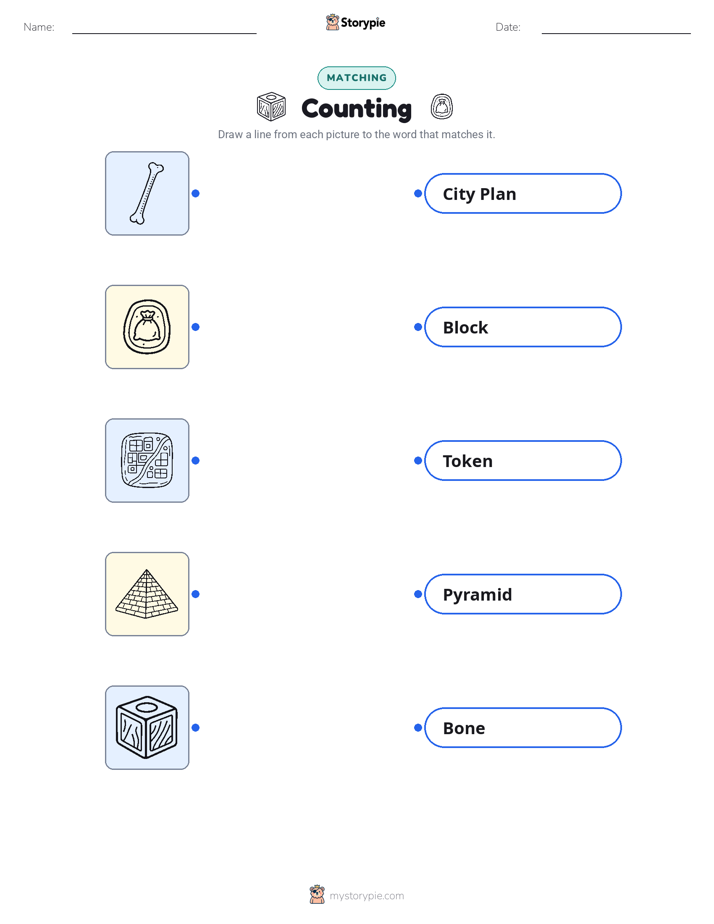
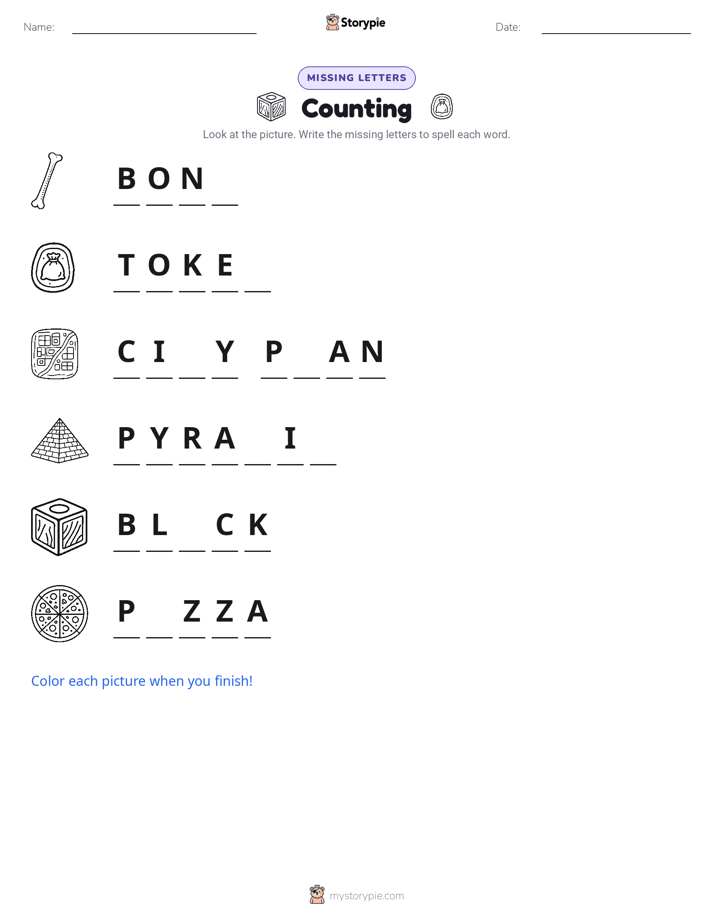
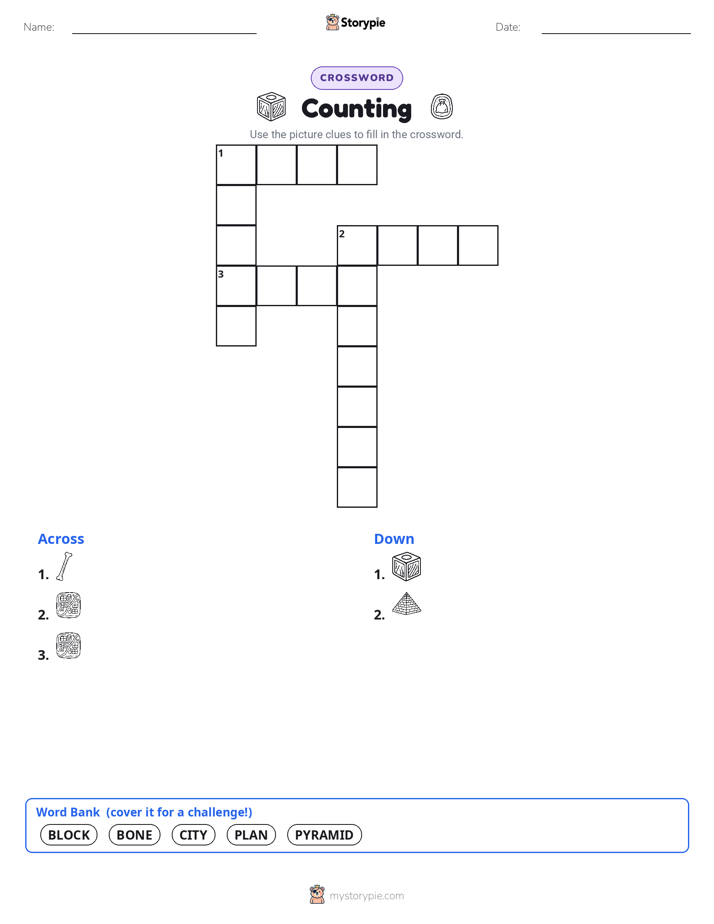
English


Counting
Counting is the fundamental mathematical process of determining the number of elements in a group.
Reads at Grades 6–8 Listens at Grades 4–8
Print & create
Answer keys·No prep·Free with an account
28 worksheets · answer keys · full story · quiz · Ages 10-12 · CEFR B2
Plus adds 102,000+ more stories in 27 languages, audio for every one, and printables for all of them.
Just want Counting?
Have you ever felt a silent, invisible friend helping you make sense of the world? I am there when you carefully line up your collection of action figures, making sure each one has its proper place in the grand formation. I am with you and your friends when you share a pizza, guaranteeing every slice is accounted for so that everything is fair. I am the whisper in your ear when you build a magnificent tower of blocks, telling you exactly how many you’ve stacked to reach a new record height. Long before you knew my name, or even how to speak, you felt my presence. I am the silent partner in your most exciting games, the invisible rule that helps you organize your toys, and the patient companion as you eagerly cross off the days on a calendar, waiting for a holiday or your birthday. You can see my handiwork everywhere you look, especially in nature. I am in the perfect five points of a starfish, the six-sided symmetry of a delicate snowflake, and the repeating patterns of petals on a flower. I take a jumble of confusing objects and give them beautiful, understandable order. I transform chaos into clarity. I help your world make sense, one piece, one object, one moment at a time. You use me every single day, in countless ways, often without even thinking about it. I am the simple, powerful idea behind every number. I am Counting.
My story began long, long ago, in the misty dawn of humanity, when the world was wild and untamed. Before people had developed words for 'one,' 'two,' or 'three,' they understood me in their bones. I was a feeling, a deep instinct of one-to-one connection that was essential for survival. One hunter needed one spear. One gathered piece of fruit was for one hungry person. This simple act of matching—this spear for this hunter, this shelter for this family—was my earliest form. For thousands upon thousands of years, I existed only in the mind and in the physical world of pairing objects. But then, a truly incredible thing happened. Humans developed the desire to remember me, to hold onto the information I represented. Around 35,000 BCE, on the continent of Africa, someone picked up a long, thin bone from a baboon and began to carve. With a sharp tool, they meticulously etched 29 distinct notches into its surface. This artifact, now known as the Lebombo bone, is one of my oldest physical forms. Each mark was a record, a memory of a quantity. Thousands of years later, around 20,000 BCE, another person did something similar with what is now called the Ishango bone, also found in Africa. This tool was even more complex, with groups of notches carved in specific patterns. Some historians and mathematicians believe it might have been used for more advanced tracking, perhaps as a kind of primitive calculator to follow lunar phases or create a calendar. I was still just a series of humble lines scratched onto a piece of bone, but this was a revolutionary leap. I could now exist outside of a person’s immediate memory. I could be stored, shared, and revisited. It was the start of something enormous.
The Story of Counting
Have you ever felt a silent, invisible friend helping you make sense of the world? I am there when you carefully line up your collection of action figures, making sure each one has its proper place in the grand formation. I am with you and your friends when you share a pizza, guaranteeing every slice is accounted for so that everything is fair. I am the whisper in your ear when you build a magnificent tower of blocks, telling you exactly how many you’ve stacked to reach a new record height. Long before you knew my name, or even how to speak, you felt my presence. I am the silent partner in your most exciting games, the invisible rule that helps you organize your toys, and the patient companion as you eagerly cross off the days on a calendar, waiting for a holiday or your birthday. You can see my handiwork everywhere you look, especially in nature. I am in the perfect five points of a starfish, the six-sided symmetry of a delicate snowflake, and the repeating patterns of petals on a flower. I take a jumble of confusing objects and give them beautiful, understandable order. I transform chaos into clarity. I help your world make sense, one piece, one object, one moment at a time. You use me every single day, in countless ways, often without even thinking about it. I am the simple, powerful idea behind every number. I am Counting.
My story began long, long ago, in the misty dawn of humanity, when the world was wild and untamed. Before people had developed words for 'one,' 'two,' or 'three,' they understood me in their bones. I was a feeling, a deep instinct of one-to-one connection that was essential for survival. One hunter needed one spear. One gathered piece of fruit was for one hungry person. This simple act of matching—this spear for this hunter, this shelter for this family—was my earliest form. For thousands upon thousands of years, I existed only in the mind and in the physical world of pairing objects. But then, a truly incredible thing happened. Humans developed the desire to remember me, to hold onto the information I represented. Around 35,000 BCE, on the continent of Africa, someone picked up a long, thin bone from a baboon and began to carve. With a sharp tool, they meticulously etched 29 distinct notches into its surface. This artifact, now known as the Lebombo bone, is one of my oldest physical forms. Each mark was a record, a memory of a quantity. Thousands of years later, around 20,000 BCE, another person did something similar with what is now called the Ishango bone, also found in Africa. This tool was even more complex, with groups of notches carved in specific patterns. Some historians and mathematicians believe it might have been used for more advanced tracking, perhaps as a kind of primitive calculator to follow lunar phases or create a calendar. I was still just a series of humble lines scratched onto a piece of bone, but this was a revolutionary leap. I could now exist outside of a person’s immediate memory. I could be stored, shared, and revisited. It was the start of something enormous.
As humans began to build permanent villages that grew into the world's first bustling cities, I grew right alongside them, becoming more organized, sophisticated, and absolutely essential. My journey took me to the fertile crescent of ancient Mesopotamia, the land between the Tigris and Euphrates rivers, where the Sumerian civilization flourished around 4,000 BCE. These people were brilliant engineers and meticulous organizers, and they needed me for everything. They used me to map out their cities, to measure the vast fields for farming that fed their people, and to keep detailed records of trade. Instead of just simple notches, they cleverly used small clay tokens of different shapes to represent quantities of different goods, like jars of oil or bushels of grain. Their most incredible contribution, however, was their base-60 number system. It might sound strange, but you use their invention every single day. The 60 seconds in a minute and 60 minutes in an hour? That is a direct gift from the Sumerians and me, a legacy that has lasted for millennia. From there, I sailed down the Nile River to ancient Egypt around 3,000 BCE. Here, my purpose reached for the heavens. The Egyptians needed me for the monumental task of building the Great Pyramids, structures of such breathtaking size and geometric precision that they still inspire awe today. To manage these projects, they developed a system of hieroglyphs to write me down: a single stroke for 1, a heel bone symbol for 10, a coil of rope for 100, and a lotus flower for 1,000. This system allowed them to record enormous numbers needed for taxes, supplies, and the vast workforce. Later, around 500 BCE, the powerful Roman Empire gave me a new, bold look. They created the famous Roman numerals—I, V, X, L, C, D, M—a system so practical and enduring that you can still find me etched on clock faces, in book chapters, and on the cornerstones of grand buildings. I was no longer just scratches on a bone; I was the bedrock of civilization.
For all my growth through these magnificent civilizations, I had a secret weakness. There was a missing piece, a hero who had not yet arrived on the stage. Without this hero, writing large or complex numbers was incredibly clumsy. Imagine trying to write the number two hundred and five. With Roman numerals, it was CCV. But what if you had a system based on place value, like we do today? How could you show the difference between 25 and 205? How could you signal that there was nothing in the tens place? This was a huge puzzle. The solution, the hero of my story, was Zero. The idea of zero as a placeholder had been toyed with by a few cultures, but it was the brilliant mathematicians in India who truly understood its power. Around the 7th century CE, they didn't just see zero as an empty space; they saw it as a number in its own right. A brilliant Indian scholar named Brahmagupta was one of the first to write down the rules for using me with zero, in the year 628 CE. He showed how to add, subtract, and multiply with it. This was revolutionary. This new system, which we now call the Hindu-Arabic numerals, was simple, elegant, and incredibly powerful. Its fame spread along the bustling trade routes of the Silk Road. It was adopted and refined by great thinkers in the Middle East, like the Persian mathematician Al-Khwarizmi. Eventually, this game-changing idea made its way to Europe. An Italian merchant and mathematician named Fibonacci learned about it on his travels and knew he had to share it. In his book, 'Liber Abaci,' published on the 1st of January, 1202, he introduced the system to Europe. It took some time to catch on, but once it did, it changed everything. Math, science, and engineering exploded with new possibilities. My hero, Zero, had finally arrived.
My long and incredible journey, from a simple scratch on a bone to the elegance of zero, has brought me here, to your world. Today, I am more important than ever. I am the silent, fundamental language of the entire digital universe. Every computer, every smartphone, every video game speaks in a version of me called binary code—a simple stream of just two digits, ones and my hero, zeros. That’s all it takes to create a complex virtual world or send a message to a friend across the planet. But I am not just in your gadgets. I am in the rhythm and beats of your favorite songs, the precise measurements in a science experiment that could lead to a new discovery, and the complex calculations that allow scientists to launch rovers to explore the dusty red surface of Mars. I am a universal tool, a common language that helps people everywhere—no matter what language they speak—to create, to explore, and to understand our universe together. From that first notch carved so many thousands of years ago to the biggest questions you will ask tomorrow, I am always here, ready to help you wonder, 'how many?' and discover the incredible answer. What new things will you and I count together?
Wow facts
About
Counting is the fundamental mathematical process of determining the number of elements in a group. Its history spans from prehistoric tally marks to the development of complex numeral systems and the revolutionary concept of zero.
Take a Quiz
Question 1 of 5
According to the story, what is the main purpose of the concept of 'Counting'?
Explore next


Want to do even more?
Go beyond exploring. Unlock tools that turn every story into real learning.

Storypie Plus for families
Full stories, quizzes, and printables. Nights and car rides, sorted.
- Unlimited audio stories
- Create Mode: your child stars in the story
- Offline downloads
- Printable worksheets & coloring pages

Why Storypie for Schools
Students engaged. Prep in seconds. Evenings back to you.
- Worksheets & Quizzes
- Classroom Management
- Formative Assessment
- Custom Curriculum & Lesson Plans
- 27 Languages

Why Storypie for Homeschool
Curriculum done. They'll ask for more. Hours back in your day.
- Worksheet Generator
- First-Person Audio Stories
- Built-in Comprehension Quizzes
- Custom Curriculum & Lesson Plans
- Print & Go Activities