English


Counting
Counting is the fundamental mathematical process of determining the number of elements in a group.
Reads at Grades 3–5 Listens at Grades 1–5
Print & create
Answer keys·No prep·Free with an account
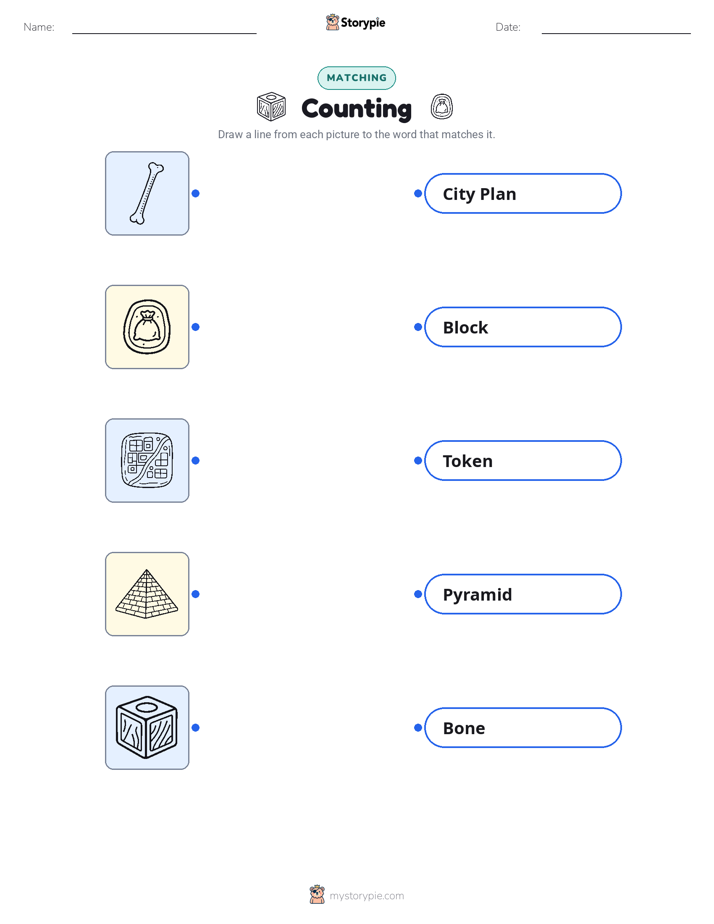
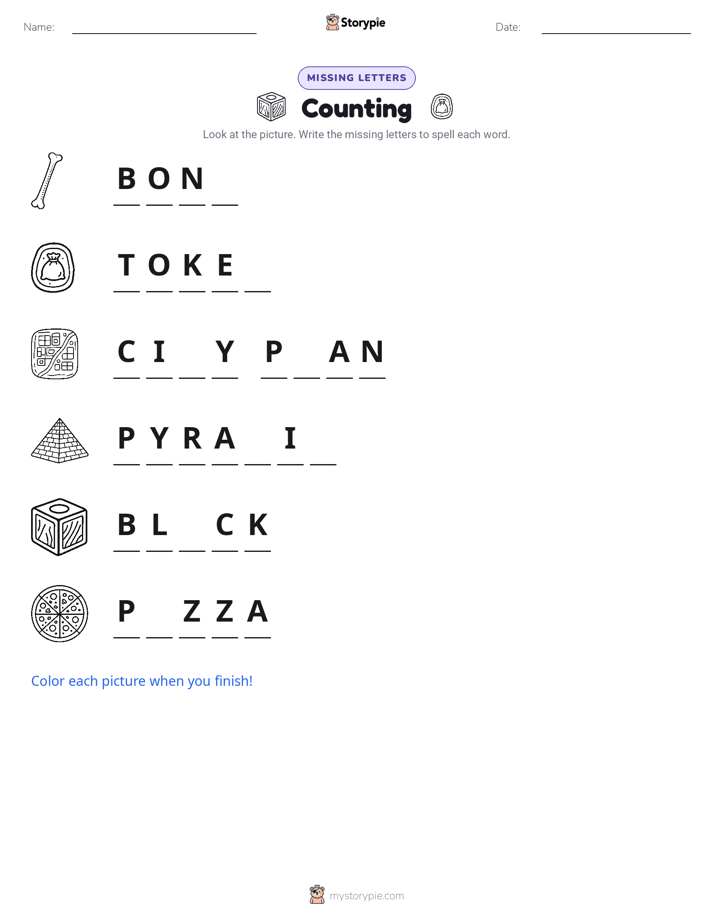
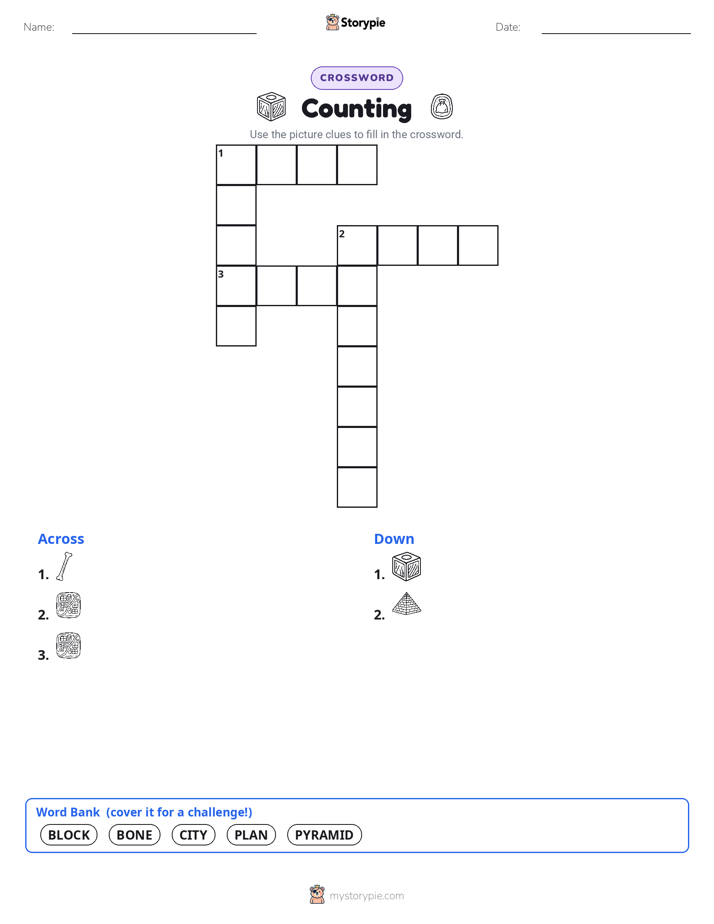
28 worksheets · answer keys · full story · quiz · Ages 8-10 · CEFR B1
Plus adds 102,000+ more stories in 27 languages, audio for every one, and printables for all of them.
Just want Counting?
How many cookies are on that plate for you and your friends to share? How many days are left until your birthday? Have you ever lined up all your toy cars or looked up at a sky full of birds and felt a little buzz in your brain, a need to know exactly how many there were? That buzz, that feeling of wanting to turn a big jumble into a neat, tidy order, is me. I am the magic that turns a guess into a fact. I am the quiet question in your head that asks, “How many?” before you even know the word for me. I help you figure out if you have enough, if something is fair, or if you’ve won the game. I bring clarity to a confusing world. Hello! I am Counting!
My story began a very, very long time ago, long before cities, schools, or even comfy beds existed. Let's travel back to the Stone Age. Can you imagine a world without numbers? It's tricky! Around 40,000 BCE, early humans realized they needed me. An ancient hunter might have wanted to remember how many deer she saw. So, she would pick up a bone and carve a single line into it for each one. One deer, one line. Two deer, two lines. These are called tally marks, and they were my very first footprints on the world! One of the oldest examples ever found is the Lebombo bone from Africa, a small piece of bone with 29 notches carved into it. Later, when people started farming around 10,000 BCE, they needed me more than ever. A farmer couldn't just guess how many sheep he had. He had to know! In a place called Mesopotamia, clever people called the Sumerians came up with a new idea around 4000 BCE. They used little clay tokens, almost like playing pieces. A cone-shaped token might mean one bag of grain, while a small sphere might mean ten. It was like having a personal toolkit for numbers, helping them trade and keep track of everything they owned.
The Story of Counting
How many cookies are on that plate for you and your friends to share? How many days are left until your birthday? Have you ever lined up all your toy cars or looked up at a sky full of birds and felt a little buzz in your brain, a need to know exactly how many there were? That buzz, that feeling of wanting to turn a big jumble into a neat, tidy order, is me. I am the magic that turns a guess into a fact. I am the quiet question in your head that asks, “How many?” before you even know the word for me. I help you figure out if you have enough, if something is fair, or if you’ve won the game. I bring clarity to a confusing world. Hello! I am Counting!
My story began a very, very long time ago, long before cities, schools, or even comfy beds existed. Let's travel back to the Stone Age. Can you imagine a world without numbers? It's tricky! Around 40,000 BCE, early humans realized they needed me. An ancient hunter might have wanted to remember how many deer she saw. So, she would pick up a bone and carve a single line into it for each one. One deer, one line. Two deer, two lines. These are called tally marks, and they were my very first footprints on the world! One of the oldest examples ever found is the Lebombo bone from Africa, a small piece of bone with 29 notches carved into it. Later, when people started farming around 10,000 BCE, they needed me more than ever. A farmer couldn't just guess how many sheep he had. He had to know! In a place called Mesopotamia, clever people called the Sumerians came up with a new idea around 4000 BCE. They used little clay tokens, almost like playing pieces. A cone-shaped token might mean one bag of grain, while a small sphere might mean ten. It was like having a personal toolkit for numbers, helping them trade and keep track of everything they owned.
As people built amazing civilizations, they helped me grow up, too. In ancient Egypt, around 3000 BCE, people needed to work with really big numbers to build their giant, pointy pyramids. So, they invented a picture language called hieroglyphs. A drawing of a rope might mean one hundred, and a picture of a tadpole could mean one hundred thousand! Next, I traveled to ancient Rome. The Romans used letters from their alphabet for numbers. You’ve probably seen them! I is for one, V is for five, and X is for ten. You can still find me dressed up in my Roman clothes on fancy clocks and in book chapters. But my biggest adventure happened in India. Around the 5th century CE, some brilliant mathematicians had a world-changing idea. What if there was a number for… nothing? It sounds strange, but think about it! They created a symbol for zero. This tiny circle was a superhero! It made it possible to show the difference between 1, 10, and 100 easily. This idea led to the ten digits we use all over the world today: 0, 1, 2, 3, 4, 5, 6, 7, 8, and 9. They are called the Hindu-Arabic numerals, and they made all kinds of math so much simpler.
From those first few scratches on a bone, I have grown to be everywhere you look. I am hiding inside the secret codes that make your video games work. I am in the careful measurements that help builders create soaring skyscrapers that touch the clouds. I am even in the complex calculations that scientists use to send rockets all the way to the moon and beyond. You can find me in the rhythm of music, the patterns in art, and even in something as simple and delicious as figuring out how to share a pizza equally with your friends. I am a tool that connects everyone, from your ancient ancestors to the explorers of the future. Every time you count your steps or add up your score, you are part of a story that is thousands of years old. I give you the power to understand your world, to solve puzzles, and to build your dreams. So, what amazing things will you count today?
Wow facts
About
Counting is the fundamental mathematical process of determining the number of elements in a group. Its history spans from prehistoric tally marks to the development of complex numeral systems and the revolutionary concept of zero.
Take a Quiz
Question 1 of 5
According to the story, what did the Sumerians in Mesopotamia use to count around 4000 BCE?
Explore next




Want to do even more?
Go beyond exploring. Unlock tools that turn every story into real learning.

Storypie Plus for families
Full stories, quizzes, and printables. Nights and car rides, sorted.
- Unlimited audio stories
- Create Mode: your child stars in the story
- Offline downloads
- Printable worksheets & coloring pages

Why Storypie for Schools
Students engaged. Prep in seconds. Evenings back to you.
- Worksheets & Quizzes
- Classroom Management
- Formative Assessment
- Custom Curriculum & Lesson Plans
- 27 Languages

Why Storypie for Homeschool
Curriculum done. They'll ask for more. Hours back in your day.
- Worksheet Generator
- First-Person Audio Stories
- Built-in Comprehension Quizzes
- Custom Curriculum & Lesson Plans
- Print & Go Activities