English

Cricket
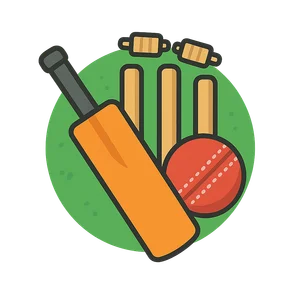
Cricket is a bat-and-ball game played between two teams of eleven players on a field with a 22-yard pitch.
Reads at Grades 3–5 Listens at Grades 1–5
Print & create
Answer keys·No prep·Free with an account
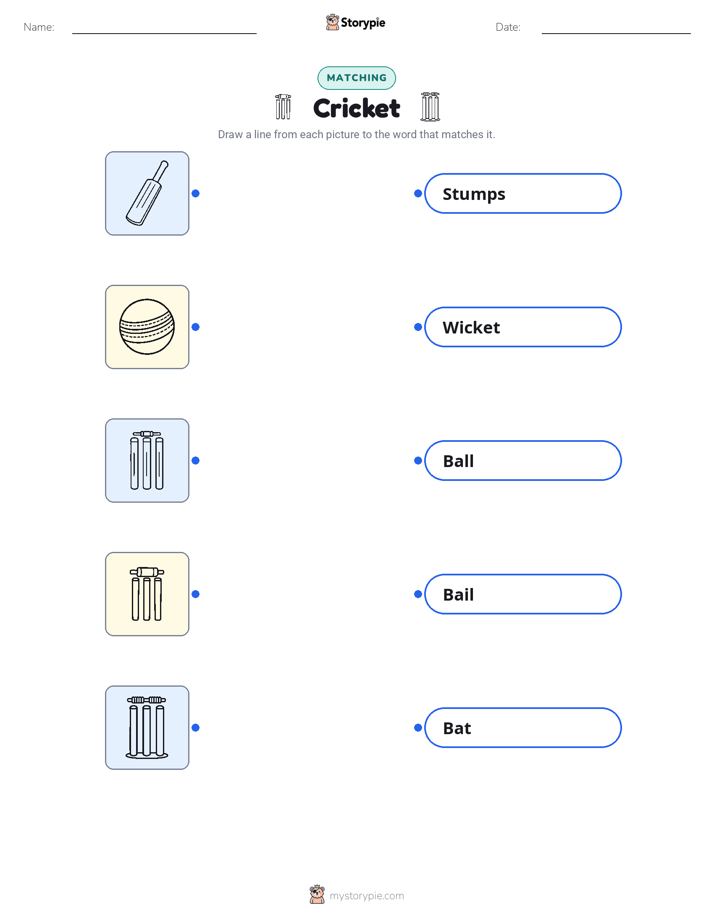
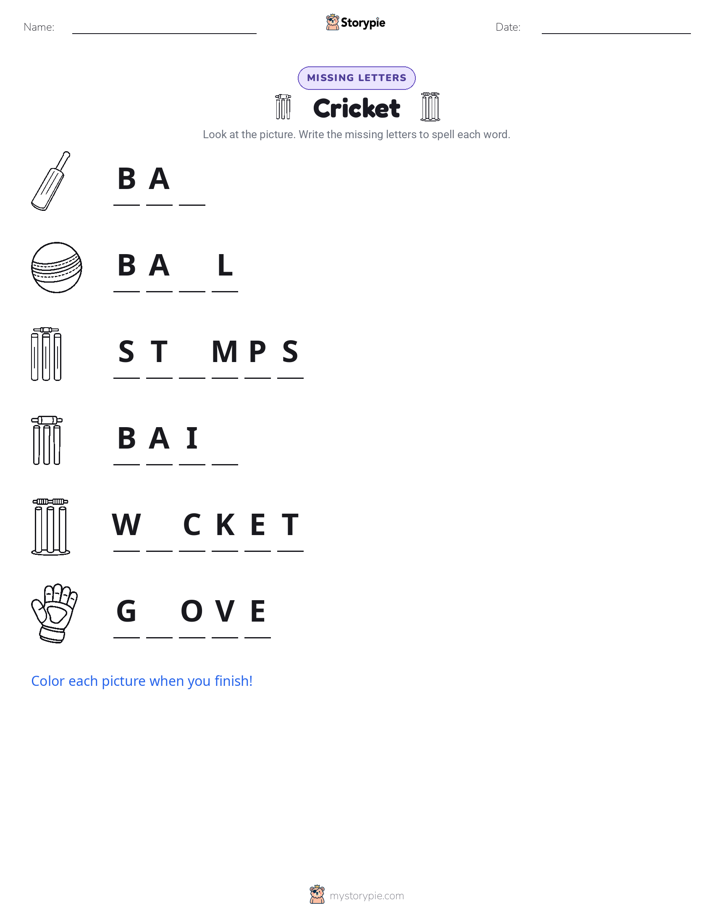
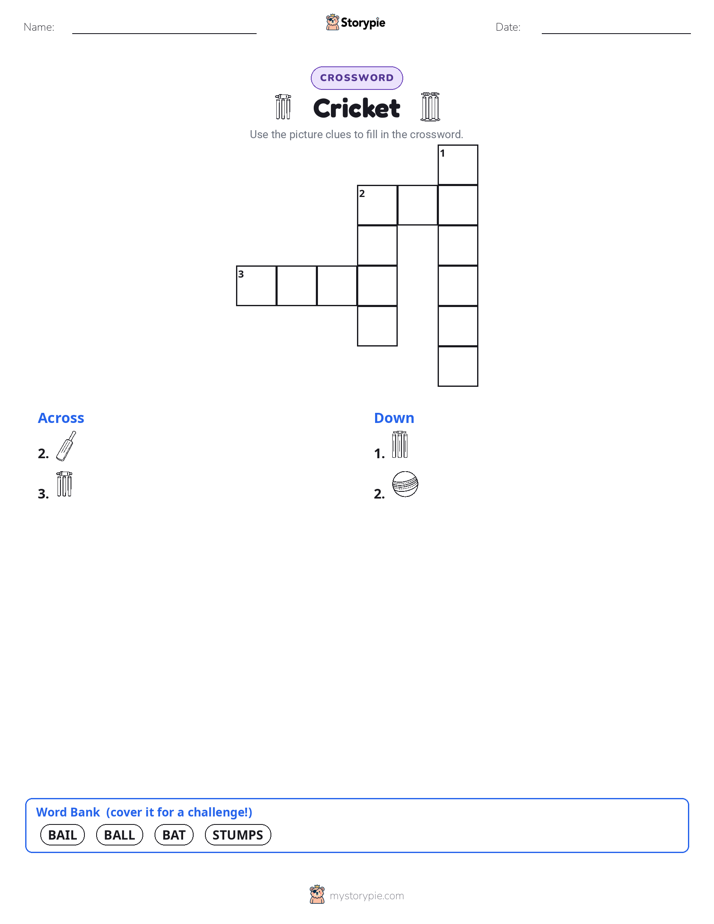
28 worksheets · answer keys · full story · quiz · Ages 8-10 · CEFR B1
Plus adds 244,000+ more stories in 27 languages, audio for every one, and printables for all of them.
Just want Cricket?
Can you feel the warm sun on a long afternoon. The grass on the field is a perfect, brilliant green, and the air is buzzing with excitement. Suddenly, you hear it—a loud *thwack*. It’s the sound of smooth, hard leather meeting strong willow wood. A crowd of people, all sitting on the grass or in stands, lets out a giant cheer. I am a game of patience, where sometimes you have to wait and watch very carefully for a long time. Then, in a flash, everything happens at once. I bring two teams together on the field, each one trying to outsmart the other. One team throws a ball very, very fast, and the other team tries to hit it with a bat and run. It’s a puzzle of sprinting between two points, catching soaring balls, and protecting three small wooden sticks stuck in the ground. But more than anything, I am a feeling of teamwork, of cheering for your friends, and shaking hands when the day is done. I am Cricket.
My story begins a very long time ago, in the beautiful, rolling fields of south-east England. I was born there way back in the 16th century, though I didn't have a fancy rulebook or big stadiums back then. At first, I was just a simple game that children loved to play in their villages. Can you imagine them. They didn't have perfect equipment. They might have used a tangled clump of sheep’s wool as a ball and a crooked stick, maybe a shepherd’s staff, as a bat. The very first time anyone wrote my name down was in a serious court case on January 17th, 1597. A man was remembering his school days from around the year 1550 and mentioned that he and his friends used to play a game called 'creckett' on a piece of land. As I grew up, adults started to see how much fun I was. By 1611, some grown-ups were even getting into a bit of trouble for playing me on Sundays instead of going to church. In those early days, I looked quite different. The bat was curved, a bit like a hockey stick, and the bowlers had to throw the ball underarm, rolling or skimming it along the ground.
The Story of Cricket
Can you feel the warm sun on a long afternoon. The grass on the field is a perfect, brilliant green, and the air is buzzing with excitement. Suddenly, you hear it—a loud thwack. It’s the sound of smooth, hard leather meeting strong willow wood. A crowd of people, all sitting on the grass or in stands, lets out a giant cheer. I am a game of patience, where sometimes you have to wait and watch very carefully for a long time. Then, in a flash, everything happens at once. I bring two teams together on the field, each one trying to outsmart the other. One team throws a ball very, very fast, and the other team tries to hit it with a bat and run. It’s a puzzle of sprinting between two points, catching soaring balls, and protecting three small wooden sticks stuck in the ground. But more than anything, I am a feeling of teamwork, of cheering for your friends, and shaking hands when the day is done. I am Cricket.
My story begins a very long time ago, in the beautiful, rolling fields of south-east England. I was born there way back in the 16th century, though I didn't have a fancy rulebook or big stadiums back then. At first, I was just a simple game that children loved to play in their villages. Can you imagine them. They didn't have perfect equipment. They might have used a tangled clump of sheep’s wool as a ball and a crooked stick, maybe a shepherd’s staff, as a bat. The very first time anyone wrote my name down was in a serious court case on January 17th, 1597. A man was remembering his school days from around the year 1550 and mentioned that he and his friends used to play a game called 'creckett' on a piece of land. As I grew up, adults started to see how much fun I was. By 1611, some grown-ups were even getting into a bit of trouble for playing me on Sundays instead of going to church. In those early days, I looked quite different. The bat was curved, a bit like a hockey stick, and the bowlers had to throw the ball underarm, rolling or skimming it along the ground.
As more and more people started playing me all across England, things got a little confusing. A team from one village might have slightly different rules than a team from another. Everyone realized we needed one official way to play. That's when a very important group of my biggest fans formed the Marylebone Cricket Club, or MCC, in London in 1787. They loved me so much that they decided to write down my official rules, called the 'Laws of Cricket,' which they first published in 1788. Many of those same laws are still used today. Around that time, I went through a big growth spurt and changed quite a bit. In the 1760s, my bats straightened out, which allowed players, called batsmen, to hit the ball with more power and control. To make things a bit fairer for the bowlers, a third wooden stump was added to the wicket, making it a smaller target to defend. But the biggest change of all happened much later, in 1864. That was the year bowlers were finally allowed to throw the ball overarm. This made the game so much faster and more thrilling for everyone watching.
I was born in England, but I was too adventurous to stay in one place. I hopped on big sailing ships and journeyed across the vast oceans. I made new friends in faraway countries like Australia, India, South Africa, and the sunny islands of the West Indies. My very first international match wasn't in England at all. It was played between the USA and Canada way back in 1844. But my most famous friendship, which is also a famous rivalry, began on March 15th, 1877. That was the day England and Australia played in the first official Test match in Melbourne, Australia. As the world changed, I learned to change too. To make things even more exciting, the first World Cup was held in 1975, bringing teams from all over the globe to compete. Then, in 2003, a super-fast version of me called Twenty20 began, with lots of action packed into just a few hours. Today, I am a global family. I teach players about fairness, respect, and working together. We call this the 'Spirit of Cricket,' and I love bringing people from all corners of the world together to play, cheer, and celebrate.
Wow facts
About
Cricket is a bat-and-ball game played between two teams of eleven players on a field with a 22-yard pitch. It is one of the world's most popular sports in certain countries, particularly in South Asia, Australia, and England, known for its rich history and emphasis on fair play.
Take a Quiz
Question 1 of 5
According to the story, when and where was Cricket first played?
Explore next






Want to do even more?
Go beyond exploring. Unlock tools that turn every story into real learning.

Storypie Plus for families
Full stories, quizzes, and printables. Nights and car rides, sorted.
- Unlimited audio stories
- Create Mode: your child stars in the story
- Offline downloads
- Printable worksheets & coloring pages

Why Storypie for Schools
Students engaged. Prep in seconds. Evenings back to you.
- Worksheets & Quizzes
- Classroom Management
- Formative Assessment
- Custom Curriculum & Lesson Plans
- 27 Languages

Why Storypie for Homeschool
Curriculum done. They'll ask for more. Hours back in your day.
- Worksheet Generator
- First-Person Audio Stories
- Built-in Comprehension Quizzes
- Custom Curriculum & Lesson Plans
- Print & Go Activities