English

Cubism
An early-20th-century art movement, developed primarily by Pablo Picasso and Georges Braque…
Reads at Grades 3–5 Listens at Grades 1–5
Print & create
Answer keys·No prep·Free with an account
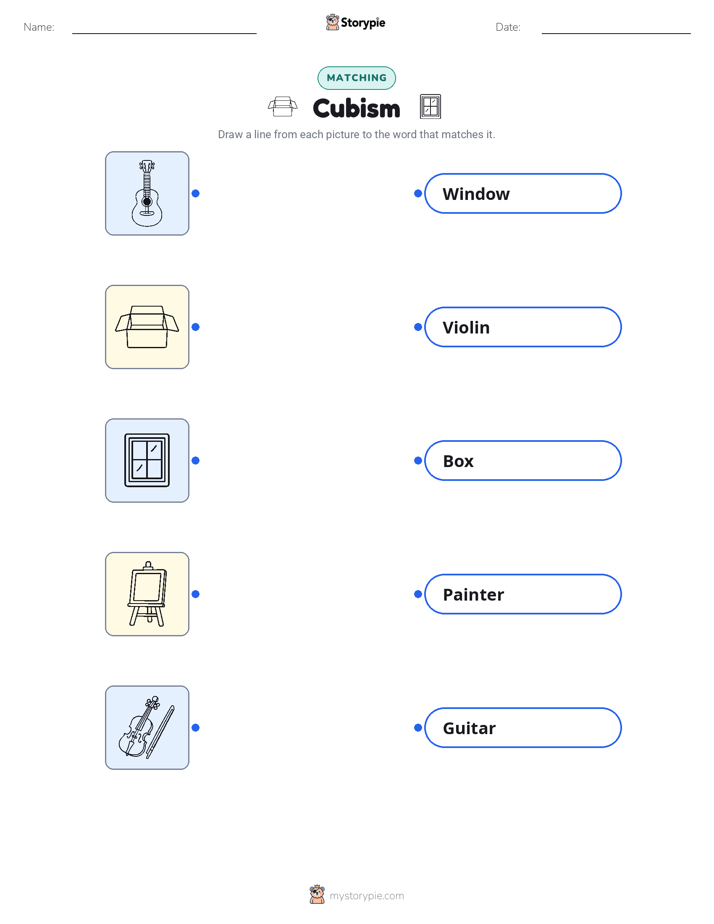
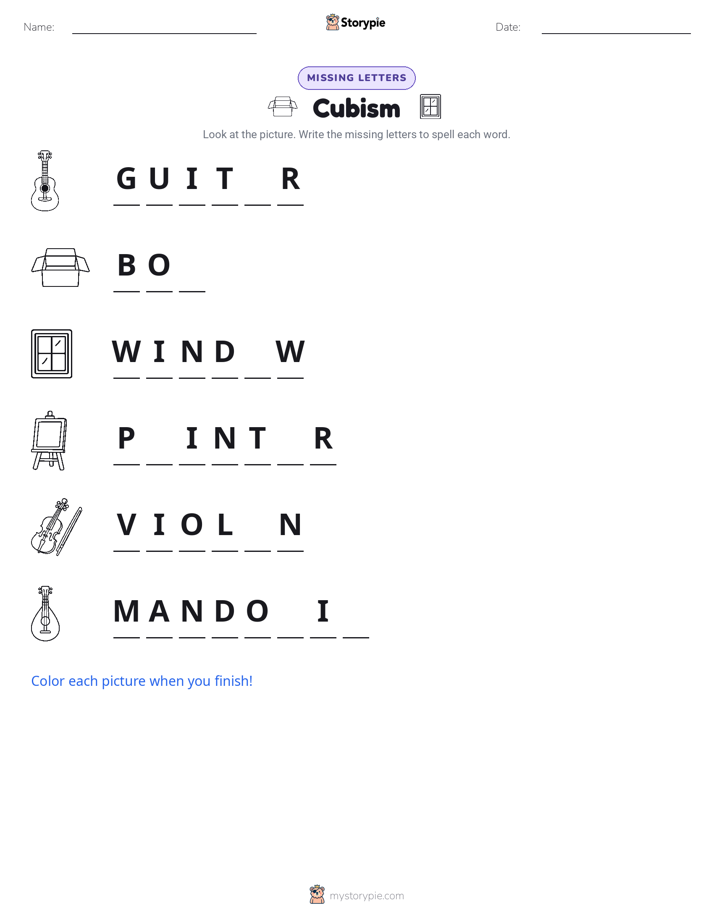
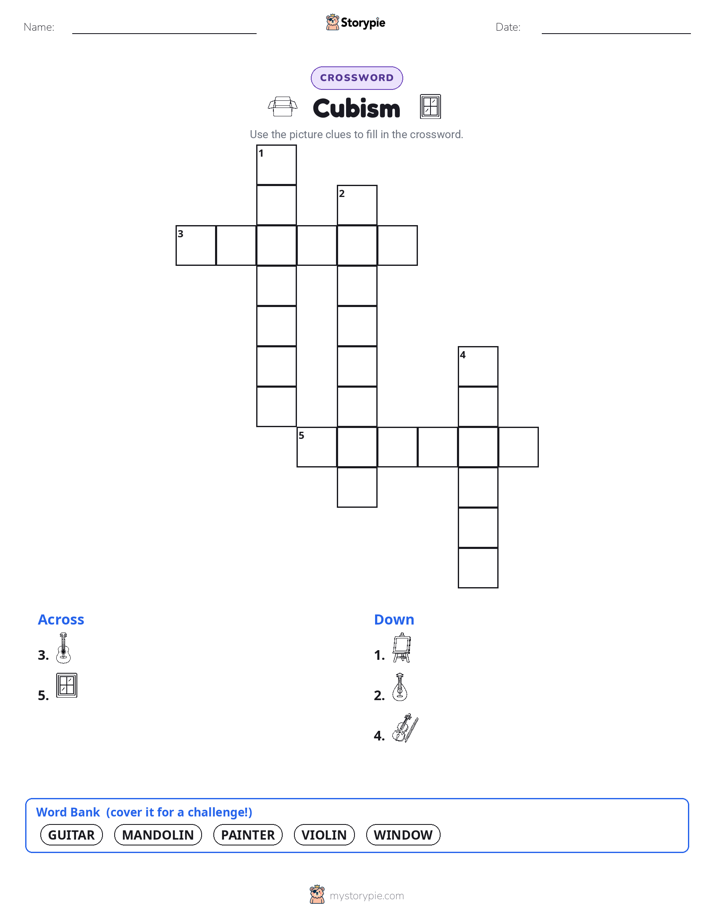
28 worksheets · answer keys · full story · quiz · Ages 8-10 · CEFR B1
Plus adds 164,000+ more stories in 27 languages, audio for every one, and printables for all of them.
Just want Cubism?

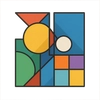
Have you ever tried to look at your friend's face from the front, the side, and the top all at the very same time? It’s impossible, right? Your eyes can only be in one place. Before I came along, most paintings were like looking through a window. You saw a person or a place from just one spot, just like in a photograph. But what if a painting could show you more? What if it could show you a guitar not just from the front, but also its curvy side and the flat back where it rests on your leg, all mixed together in a beautiful, jumbled puzzle? That was the idea that brought me to life. I wanted to break the window and show you everything, all at once, from every angle. I am a way of seeing the world in a brand new way. My name is Cubism.
My story begins in the exciting city of Paris, France, in the early 1900s. The city was buzzing with new ideas, and two artist friends, Pablo Picasso and Georges Braque, were tired of the old rules of painting. They felt that just copying what they saw wasn't enough. In 1907, Pablo Picasso painted a picture that shocked everyone. It was called 'Les Demoiselles d'Avignon,' and it showed five figures that looked like they were made of sharp, broken pieces of glass. Nothing was soft or round like it was supposed to be. He was taking things apart to see them in a new way. A year later, in 1908, his friend Georges Braque painted pictures of houses that looked like stacks of little blocks and cubes. When an art critic named Louis Vauxcelles saw them, he joked that they were made of nothing but ‘cubes.’ The name stuck. Suddenly, I had a name: Cubism. From about 1909 to 1912, my friends explored what we now call Analytic Cubism. ‘Analytic’ is a fancy word for taking something apart to understand it. They would look at a violin or a person and shatter them on the canvas into different shapes and planes, using quiet, muted colors like brown, gray, and tan so that the shapes would be the most important thing.
I Am Cubism
Have you ever tried to look at your friend's face from the front, the side, and the top all at the very same time? It’s impossible, right? Your eyes can only be in one place. Before I came along, most paintings were like looking through a window. You saw a person or a place from just one spot, just like in a photograph. But what if a painting could show you more? What if it could show you a guitar not just from the front, but also its curvy side and the flat back where it rests on your leg, all mixed together in a beautiful, jumbled puzzle? That was the idea that brought me to life. I wanted to break the window and show you everything, all at once, from every angle. I am a way of seeing the world in a brand new way. My name is Cubism.
My story begins in the exciting city of Paris, France, in the early 1900s. The city was buzzing with new ideas, and two artist friends, Pablo Picasso and Georges Braque, were tired of the old rules of painting. They felt that just copying what they saw wasn't enough. In 1907, Pablo Picasso painted a picture that shocked everyone. It was called 'Les Demoiselles d'Avignon,' and it showed five figures that looked like they were made of sharp, broken pieces of glass. Nothing was soft or round like it was supposed to be. He was taking things apart to see them in a new way. A year later, in 1908, his friend Georges Braque painted pictures of houses that looked like stacks of little blocks and cubes. When an art critic named Louis Vauxcelles saw them, he joked that they were made of nothing but ‘cubes.’ The name stuck. Suddenly, I had a name: Cubism. From about 1909 to 1912, my friends explored what we now call Analytic Cubism. ‘Analytic’ is a fancy word for taking something apart to understand it. They would look at a violin or a person and shatter them on the canvas into different shapes and planes, using quiet, muted colors like brown, gray, and tan so that the shapes would be the most important thing.
After a few years of taking everything apart, my artist friends decided to try something new. Around 1912, they started putting the pieces back together in a more playful and colorful way. This part of my life is called Synthetic Cubism, because ‘synthetic’ means to build or create something new. The shapes became bigger and simpler, and the colors became bright and cheerful. But the most exciting part was when they started adding real things to their paintings. Can you imagine gluing a piece of your morning newspaper or a scrap of wallpaper right onto a canvas? That’s exactly what they did. This was called collage, and it was a revolutionary idea. It mixed real life with the world of art. A ticket stub, a label from a bottle, a piece of sheet music—suddenly, these everyday objects were part of a masterpiece. I showed the world that a painting doesn’t have to be a perfect copy of reality to be true. It can be an idea, a feeling, or a jumble of different views. I hope I have inspired you to look closely at the world around you and see that there is always more than one way to see things.
Wow facts
About
An early-20th-century art movement, developed primarily by Pablo Picasso and Georges Braque, that depicts subjects from multiple viewpoints simultaneously using geometric shapes.
Take a Quiz
Question 1 of 5
The story says the artists used 'muted' colors. What does 'muted' mean in this sentence?
Explore next


Want to do even more?
Go beyond exploring. Unlock tools that turn every story into real learning.

Storypie Plus for families
Full stories, quizzes, and printables. Nights and car rides, sorted.
- Unlimited audio stories
- Create Mode: your child stars in the story
- Offline downloads
- Printable worksheets & coloring pages

Why Storypie for Schools
Students engaged. Prep in seconds. Evenings back to you.
- Worksheets & Quizzes
- Classroom Management
- Formative Assessment
- Custom Curriculum & Lesson Plans
- 27 Languages

Why Storypie for Homeschool
Curriculum done. They'll ask for more. Hours back in your day.
- Worksheet Generator
- First-Person Audio Stories
- Built-in Comprehension Quizzes
- Custom Curriculum & Lesson Plans
- Print & Go Activities