English


Figurative Language
Figurative Language is a way of using words and expressions with a meaning that is different from the literal…
Reads at Grades 3–5 Listens at Grades 1–5
Print & create
Answer keys·No prep·Free with an account
28 worksheets · answer keys · full story · quiz · Ages 8-10 · CEFR B1
Plus adds 244,000+ more stories in 27 languages, audio for every one, and printables for all of them.
Just want Figurative Language?

Have you ever said something that wasn't exactly, literally true, but everyone knew exactly what you meant. Maybe you’ve complained, 'My backpack weighs a ton!' after a long day at school. Of course, it doesn't really weigh two thousand pounds, but your shoulders sure feel like it does. Or have you ever looked up at the sky on a beautiful day and thought the sun was smiling down on you. The sun doesn't have a mouth, but you can feel its warmth like a happy grin. Can you imagine a world where you could only say exactly what was true. It would be so boring. That special magic in your words, the one that lets you compare your friend who runs super fast to a graceful cheetah, or a brilliant idea to a lightbulb switching on in your head, that's me. I live inside your imagination and hop into your sentences to make them more colorful, exciting, and full of feeling. I help you paint a picture for others so they can see the world just like you do. I am Figurative Language.
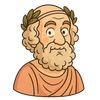
I am as old as stories themselves, maybe even older. Long before people had paper or pens, they gathered around crackling fires to share tales of great heroes, tricky animals, and faraway lands. To make their stories more exciting and easier to remember, they used me. I traveled way back in time to Ancient Greece, where a famous blind poet named Homer used me all the time. Around the 8th century BCE, he told a thrilling story called 'The Odyssey,' about a hero's long journey home. Instead of just saying 'the sun came up,' Homer described the morning as the 'rosy-fingered dawn.' Can you picture that. It’s like the sky itself had gentle, pink fingers stretching across the world to wake everyone up. It makes the morning feel gentle and beautiful. A few hundred years later, in the 4th century BCE, a very smart thinker named Aristotle decided to study me. He was fascinated by how I worked and why I was so powerful. He even gave my different parts special names, like 'metaphor,' which is when you say something *is* something else, like 'her voice is music.' Aristotle wrote that being able to create good metaphors was a sign of a truly clever mind, because it showed you could see how two different things were secretly alike. After the Greeks, the Ancient Romans loved me too. A famous Roman teacher of public speaking named Quintilian, who lived in the 1st century CE, taught his students how to use me to persuade people. He knew that if you wanted to give a powerful speech, you needed me to make your words stick in people's minds. I wasn't just for fun stories; I was a tool for smart leaders, lawyers, and anyone who wanted to change the world with their words.
The Secret Power of Words
Have you ever said something that wasn't exactly, literally true, but everyone knew exactly what you meant. Maybe you’ve complained, 'My backpack weighs a ton!' after a long day at school. Of course, it doesn't really weigh two thousand pounds, but your shoulders sure feel like it does. Or have you ever looked up at the sky on a beautiful day and thought the sun was smiling down on you. The sun doesn't have a mouth, but you can feel its warmth like a happy grin. Can you imagine a world where you could only say exactly what was true. It would be so boring. That special magic in your words, the one that lets you compare your friend who runs super fast to a graceful cheetah, or a brilliant idea to a lightbulb switching on in your head, that's me. I live inside your imagination and hop into your sentences to make them more colorful, exciting, and full of feeling. I help you paint a picture for others so they can see the world just like you do. I am Figurative Language.
I am as old as stories themselves, maybe even older. Long before people had paper or pens, they gathered around crackling fires to share tales of great heroes, tricky animals, and faraway lands. To make their stories more exciting and easier to remember, they used me. I traveled way back in time to Ancient Greece, where a famous blind poet named Homer used me all the time. Around the 8th century BCE, he told a thrilling story called 'The Odyssey,' about a hero's long journey home. Instead of just saying 'the sun came up,' Homer described the morning as the 'rosy-fingered dawn.' Can you picture that. It’s like the sky itself had gentle, pink fingers stretching across the world to wake everyone up. It makes the morning feel gentle and beautiful. A few hundred years later, in the 4th century BCE, a very smart thinker named Aristotle decided to study me. He was fascinated by how I worked and why I was so powerful. He even gave my different parts special names, like 'metaphor,' which is when you say something is something else, like 'her voice is music.' Aristotle wrote that being able to create good metaphors was a sign of a truly clever mind, because it showed you could see how two different things were secretly alike. After the Greeks, the Ancient Romans loved me too. A famous Roman teacher of public speaking named Quintilian, who lived in the 1st century CE, taught his students how to use me to persuade people. He knew that if you wanted to give a powerful speech, you needed me to make your words stick in people's minds. I wasn't just for fun stories; I was a tool for smart leaders, lawyers, and anyone who wanted to change the world with their words.
For a long time, I continued to help poets and speakers, but I really had a chance to shine when I met a man who loved words more than almost anyone. Let’s jump forward in time to England in the late 16th and early 17th centuries. A brilliant playwright named William Shakespeare invited me into every one of his plays. He used me to make his characters sound incredibly smart, sad, angry, or funny. One of his most famous lines is, 'All the world's a stage, and all the men and women merely players.' He wasn't saying you are actually in a play with a script. He was saying that life is like a play, with different parts we all act out. It's a beautiful way to think about life, isn't it. But you don't have to be a famous writer like Shakespeare to use me. I am everywhere, every single day. Have you ever heard someone say 'it's raining cats and dogs'. That's me, in a form called an idiom. It's a silly phrase that just means it's raining very hard. Or what about when you say, 'I've told you a million times!' to your brother or sister. You probably haven't said it quite that many times, but you use that exaggeration, called a hyperbole, to show how frustrated you are. I pop up in your schoolyard, at your dinner table, and in your favorite songs.
So you see, I'm not just some old idea from a history book. I am your very own creative superpower. When you have a feeling that’s too big to describe, like when you’re so happy you feel like you’re floating on a cloud, I’m there to help you share it. When you want to tell a joke that makes everyone laugh, I help you twist words in a funny way. I am the tool you use to show others your unique way of seeing the world, making your stories and poems completely your own. Think of me as a box of magical crayons for your words. So go ahead, look for me in the books you read and the songs you sing. And don't be afraid to use me. Have fun, be playful, and start painting pictures with your words. Your imagination is an amazing place, and I am here to help you let it soar.
Wow facts
About
Figurative Language is a way of using words and expressions with a meaning that is different from the literal interpretation, creating more vivid, persuasive, and impactful communication.
Take a Quiz
Question 1 of 5
The story says using figurative language is like "painting pictures with your words." What does this phrase mean?
Explore next




Want to do even more?
Go beyond exploring. Unlock tools that turn every story into real learning.

Storypie Plus for families
Full stories, quizzes, and printables. Nights and car rides, sorted.
- Unlimited audio stories
- Create Mode: your child stars in the story
- Offline downloads
- Printable worksheets & coloring pages

Why Storypie for Schools
Students engaged. Prep in seconds. Evenings back to you.
- Worksheets & Quizzes
- Classroom Management
- Formative Assessment
- Custom Curriculum & Lesson Plans
- 27 Languages

Why Storypie for Homeschool
Curriculum done. They'll ask for more. Hours back in your day.
- Worksheet Generator
- First-Person Audio Stories
- Built-in Comprehension Quizzes
- Custom Curriculum & Lesson Plans
- Print & Go Activities