English

Galilean Moons
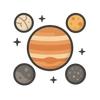
The four largest moons of Jupiter—Io, Europa, Ganymede, and Callisto—discovered by Galileo Galilei in 1610.
Reads at Grades 6–8 Listens at Grades 4–8
Print & create
Answer keys·No prep·Free with an account
28 worksheets · answer keys · full story · quiz · Ages 10-12 · CEFR B2
Plus adds 164,000+ more stories in 27 languages, audio for every one, and printables for all of them.
Just want Galilean Moons?
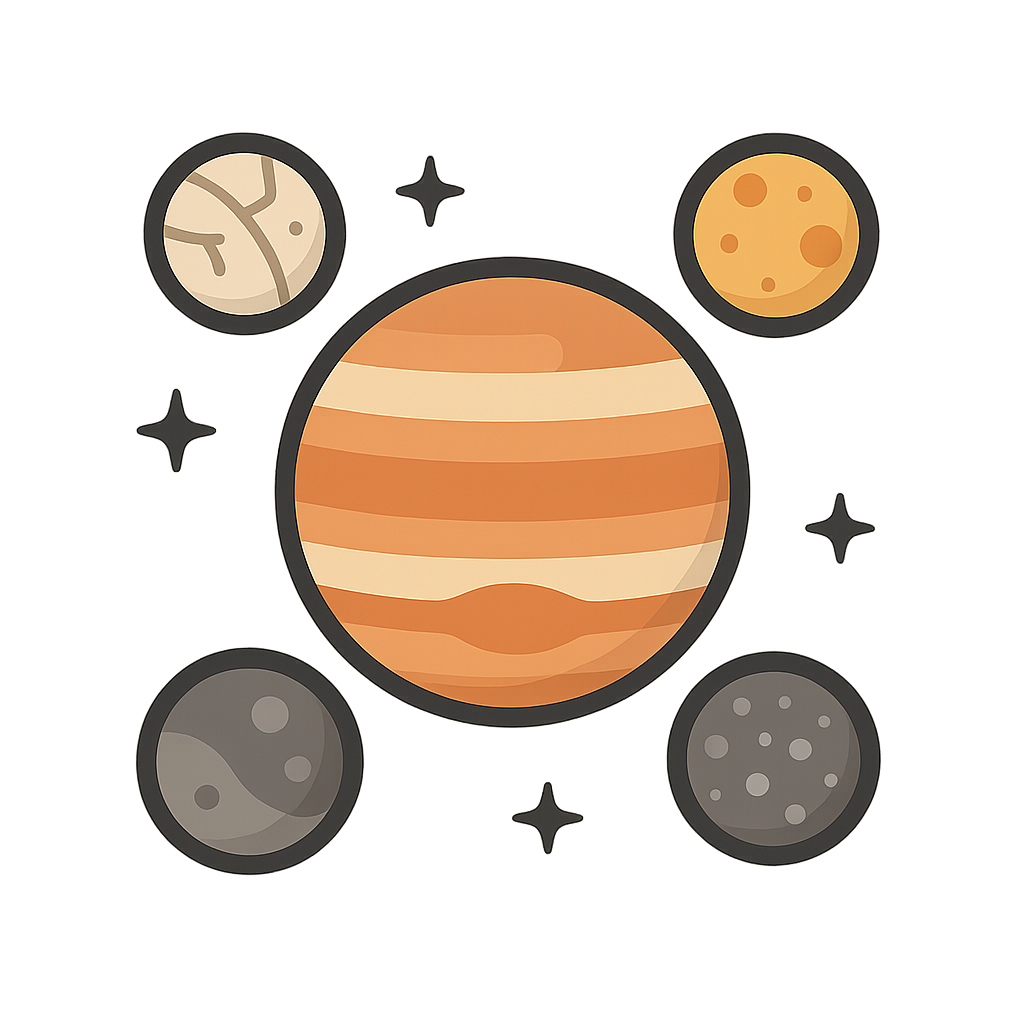
Imagine hanging in the velvet blackness of space, partners in a silent dance that has lasted for billions of years. Before your time, before any human eye had the power to see us, that was our existence. We are four sisters, forever circling our immense parent, the planet you call Jupiter. From our perspective, its surface is a breathtaking canvas of swirling storms, orange bands, and the Great Red Spot, an ancient hurricane larger than your entire world. We would glide through its long shadow, then emerge back into the brilliant light of the Sun, all while the distant blue dot of Earth remained blissfully unaware of our presence. For millennia, your ancestors looked up and saw our magnificent parent planet shining in their night sky, a bright and steady wanderer. But we remained invisible, four tiny points of light lost in the glare of the giant. We were a secret waiting for the right moment, and the right person, to be discovered. I am Io, and with me are my sisters, Europa, Ganymede, and Callisto. Together, we are the Galilean Moons, and this is the story of how we were found.
Our secret was finally revealed in the crisp winter air of Padua, Italy. A man named Galileo Galilei, a brilliant and endlessly curious astronomer, had built a new instrument. He called it a telescope, and it was a simple tube with lenses, but it had the power to bring the heavens closer than ever before. On the night of January 7th, 1610, he pointed his spyglass towards our parent, Jupiter. Instead of just seeing a bright point of light, he saw it as a distinct disc. And next to it, he noticed something astonishing: three tiny, faint 'stars' in a perfectly straight line, where no stars had ever been mapped. He was intrigued and sketched their positions in his notebook. When he looked again the following night, he expected them to be gone, or for Jupiter to have moved past them. But they were still there, and their positions had changed. This was impossible for fixed stars. Over the next week, he watched us with obsessive focus, night after night. He saw that we vanished and reappeared, realizing we must be passing behind Jupiter. He even spotted a fourth companion, my sister Callisto, who had been hiding. The truth struck him with the force of a thunderbolt: we were not stars at all. We were moons, orbiting another world. We were a family, just like your moon and your Earth. In his excitement, and to honor his wealthy patrons, he named us the 'Medicean Stars.' But history would remember us by his name, a tribute to the man who first unveiled our cosmic dance to the world.
We, The Stars That Moved
Imagine hanging in the velvet blackness of space, partners in a silent dance that has lasted for billions of years. Before your time, before any human eye had the power to see us, that was our existence. We are four sisters, forever circling our immense parent, the planet you call Jupiter. From our perspective, its surface is a breathtaking canvas of swirling storms, orange bands, and the Great Red Spot, an ancient hurricane larger than your entire world. We would glide through its long shadow, then emerge back into the brilliant light of the Sun, all while the distant blue dot of Earth remained blissfully unaware of our presence. For millennia, your ancestors looked up and saw our magnificent parent planet shining in their night sky, a bright and steady wanderer. But we remained invisible, four tiny points of light lost in the glare of the giant. We were a secret waiting for the right moment, and the right person, to be discovered. I am Io, and with me are my sisters, Europa, Ganymede, and Callisto. Together, we are the Galilean Moons, and this is the story of how we were found.
Our secret was finally revealed in the crisp winter air of Padua, Italy. A man named Galileo Galilei, a brilliant and endlessly curious astronomer, had built a new instrument. He called it a telescope, and it was a simple tube with lenses, but it had the power to bring the heavens closer than ever before. On the night of January 7th, 1610, he pointed his spyglass towards our parent, Jupiter. Instead of just seeing a bright point of light, he saw it as a distinct disc. And next to it, he noticed something astonishing: three tiny, faint 'stars' in a perfectly straight line, where no stars had ever been mapped. He was intrigued and sketched their positions in his notebook. When he looked again the following night, he expected them to be gone, or for Jupiter to have moved past them. But they were still there, and their positions had changed. This was impossible for fixed stars. Over the next week, he watched us with obsessive focus, night after night. He saw that we vanished and reappeared, realizing we must be passing behind Jupiter. He even spotted a fourth companion, my sister Callisto, who had been hiding. The truth struck him with the force of a thunderbolt: we were not stars at all. We were moons, orbiting another world. We were a family, just like your moon and your Earth. In his excitement, and to honor his wealthy patrons, he named us the 'Medicean Stars.' But history would remember us by his name, a tribute to the man who first unveiled our cosmic dance to the world.
Our discovery was more than just finding new dots in the sky; it shattered a belief that had stood for over 1,500 years. At that time, almost everyone in Europe believed in the geocentric model, the idea that the Earth was the stationary center of the entire universe, and that the Sun, the moon, the planets, and all the stars revolved around it. This was the map of the heavens that had been accepted for generations. A few decades earlier, an astronomer named Nicolaus Copernicus had proposed a radical new idea: the heliocentric model, which placed the Sun at the center and had the Earth and other planets orbiting it. It was a brilliant theory, but it lacked definitive proof that people could see with their own eyes. We became that proof. Our constant, predictable orbit around Jupiter demonstrated for all to see that celestial bodies could, and did, orbit something other than the Earth. We were a miniature solar system, a perfect model that supported Copernicus's idea. Our existence challenged authority and tradition, forcing humanity to reconsider its place in the cosmos. The universe was suddenly a much larger, more complex, and more wonderful place. This realization was a key that unlocked a scientific revolution, changing the way people thought about science, evidence, and the very nature of reality.
For centuries after Galileo first saw us, we remained distant points of light, studied through ever-improving telescopes. But in the 20th century, humanity finally came to visit. In 1979, the Voyager spacecraft flew past us, sending back the first stunning, close-up images that revealed our unique personalities. Then, on December 7th, 1995, a dedicated explorer named the Galileo probe arrived to orbit our parent and study us for years. It showed you who we truly are. I, Io, am a world of fire, the most volcanically active body in the solar system, constantly repaving my surface with sulfur. My sister Europa is a world of ice, with a smooth, cracked shell that may hide a vast liquid water ocean beneath—a place you now dream of exploring for signs of life. Ganymede is the giant, the largest moon in the entire solar system, even bigger than the planet Mercury. And Callisto is the ancient one, a quiet, heavily cratered world whose surface holds a frozen record of the solar system's long history. We are no longer just a concept that changed your maps of the sky. We are destinations, worlds in our own right. Our discovery began with one person's curiosity and a simple tube of glass, and it reminds you that there are always new secrets waiting to be found. All you have to do is look up and wonder.
Wow facts
About
The four largest moons of Jupiter—Io, Europa, Ganymede, and Callisto—discovered by Galileo Galilei in 1610. Their discovery was pivotal in changing humanity's understanding of the cosmos.
Take a Quiz
Question 1 of 5
Based on the story, what is the main reason the discovery of the Galilean moons was so revolutionary?
Explore next

Want to do even more?
Go beyond exploring. Unlock tools that turn every story into real learning.

Storypie Plus for families
Full stories, quizzes, and printables. Nights and car rides, sorted.
- Unlimited audio stories
- Create Mode: your child stars in the story
- Offline downloads
- Printable worksheets & coloring pages

Why Storypie for Schools
Students engaged. Prep in seconds. Evenings back to you.
- Worksheets & Quizzes
- Classroom Management
- Formative Assessment
- Custom Curriculum & Lesson Plans
- 27 Languages

Why Storypie for Homeschool
Curriculum done. They'll ask for more. Hours back in your day.
- Worksheet Generator
- First-Person Audio Stories
- Built-in Comprehension Quizzes
- Custom Curriculum & Lesson Plans
- Print & Go Activities