English

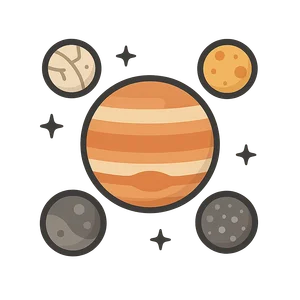
Galilean Moons
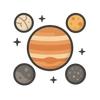
The four largest moons of Jupiter—Io, Europa, Ganymede, and Callisto—discovered by Galileo Galilei in 1610.
Reads at Grades 3–5 Listens at Grades 1–5
Print & create
Answer keys·No prep·Free with an account
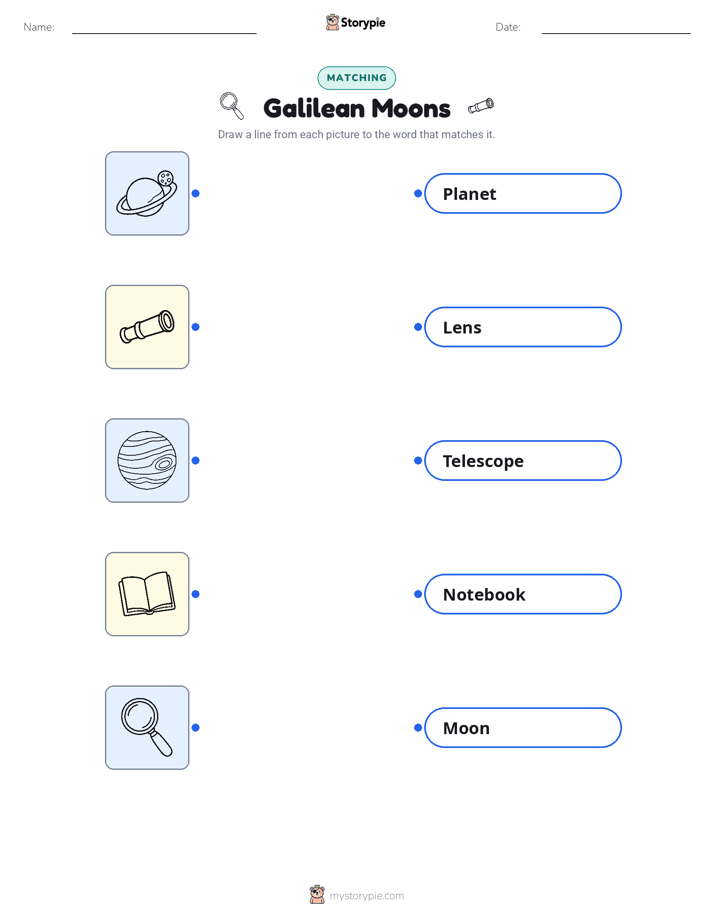
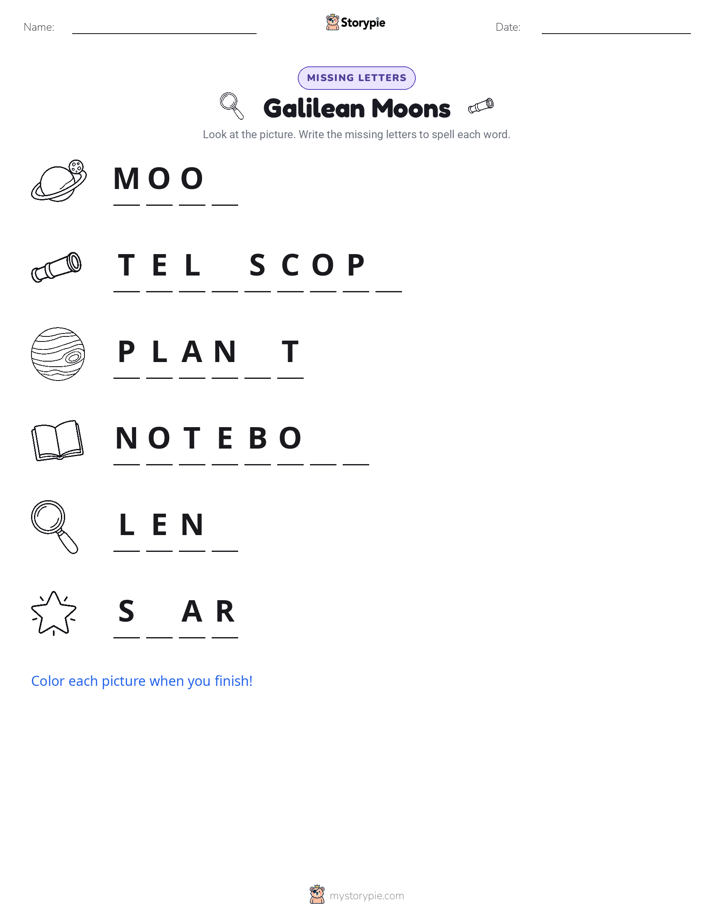
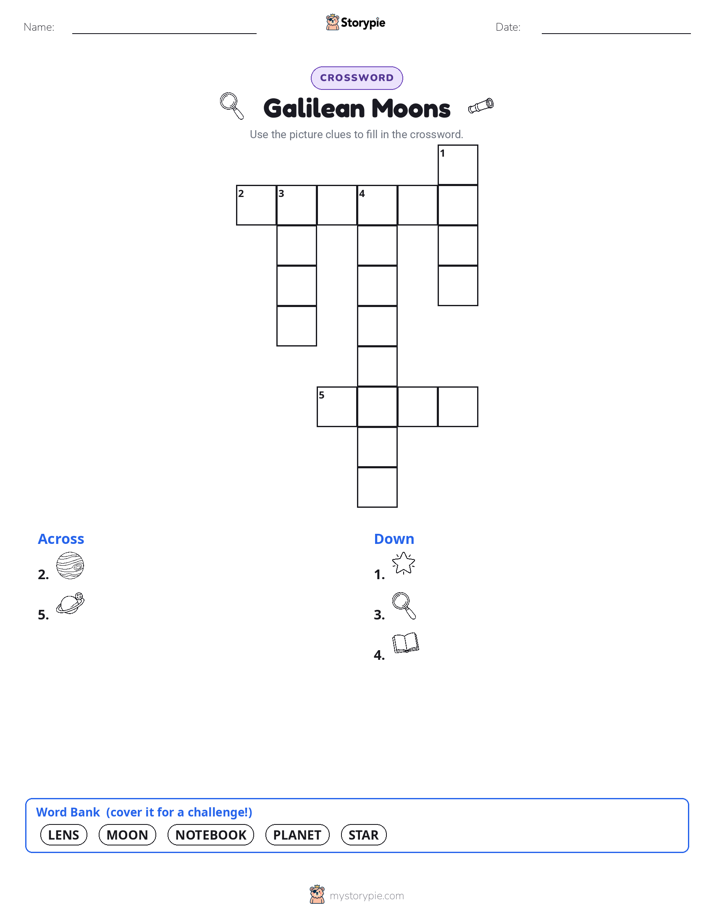
28 worksheets · answer keys · full story · quiz · Ages 8-10 · CEFR B1
Plus adds 164,000+ more stories in 27 languages, audio for every one, and printables for all of them.
Just want Galilean Moons?
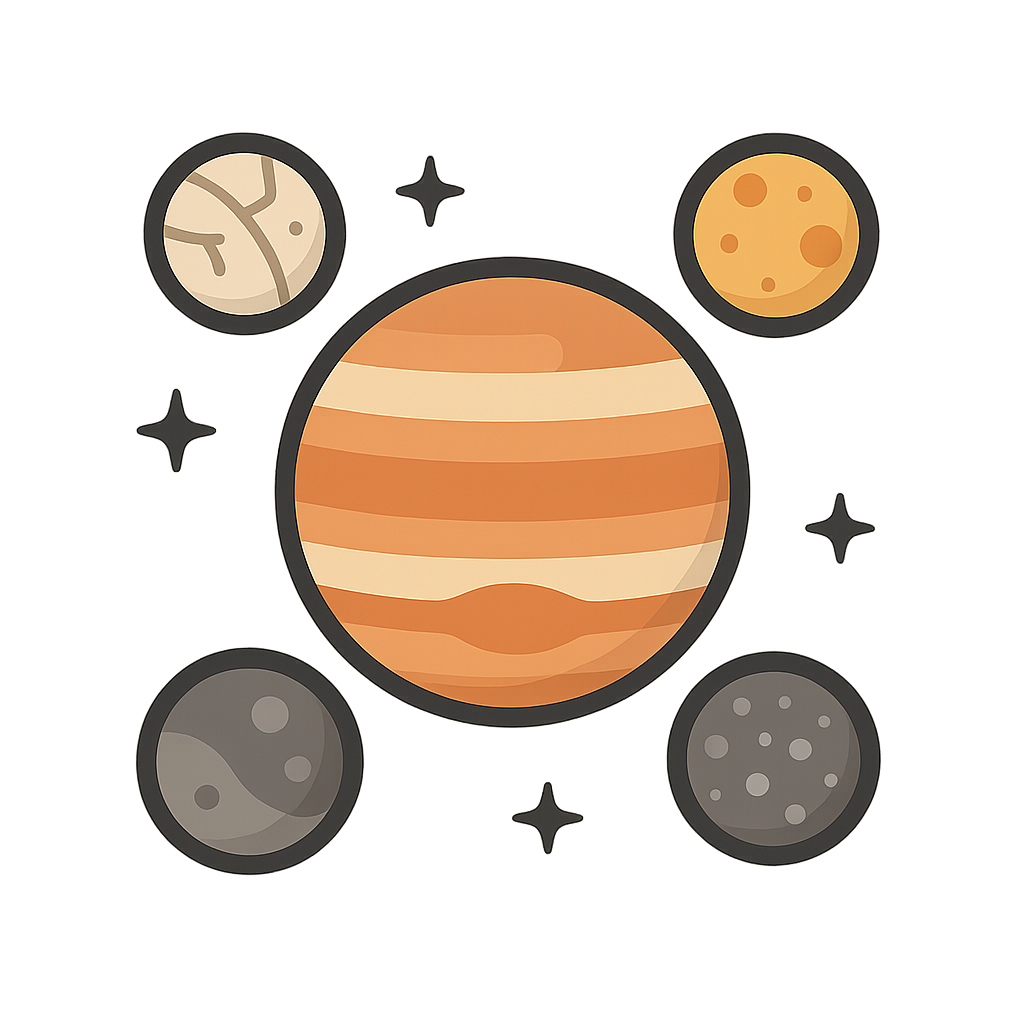
Hello. We're so glad you're listening. For billions of years, we danced in the dark, and no one on your beautiful blue-and-green planet knew we were here. We are four sisters, spinning and twirling around our giant, stormy partner. He is the king of all planets, a swirling giant of gas with a famous Great Red Spot. We swoop around him, playing a cosmic game of hide-and-seek. Sometimes we pass in front of him, and sometimes we hide behind his enormous shadow. For most of human history, when you looked up at our part of the sky, you only saw our partner shining like a very bright star. You had no idea he had a family of moons keeping him company. Can you imagine having secret friends that no one else could see? That’s what we were for a very long time. We are the Galilean Moons, and this is the story of how you finally met us.
For thousands of years, people charted the stars, but we remained a secret. Then, one cold winter night, everything changed. It was January 7th, 1610, and an Italian astronomer named Galileo Galilei decided to point his new invention, a telescope, toward our bright planet, Jupiter. He was amazed. Next to Jupiter, he saw three tiny, faint specks of light he thought were stars. But he was a careful scientist, so he kept watching. The next night, he saw that the 'stars' had moved. Stars don't move that fast. Over the next week, he watched us dance. He saw us disappear behind Jupiter and reappear on the other side. He even spotted the fourth one of us. He realized we weren't stars at all; we were moons, just like your Moon, but we were orbiting Jupiter. This was a gigantic discovery. At the time, most people in Europe believed that everything in the universe circled the Earth. But we proved them wrong. We showed that a planet could have its own moons, which meant Earth wasn't the center of everything. Galileo was so excited that he named us the 'Medicean Stars' after a powerful family, but today you know us by our individual names: Io, the fiery one covered in volcanoes; Europa, the smooth, icy one with a secret ocean underneath; Ganymede, the biggest moon in the whole solar system; and Callisto, the old, cratered one. Our discovery helped change the way humans saw the entire universe.
A Dance Around a Giant
Hello. We're so glad you're listening. For billions of years, we danced in the dark, and no one on your beautiful blue-and-green planet knew we were here. We are four sisters, spinning and twirling around our giant, stormy partner. He is the king of all planets, a swirling giant of gas with a famous Great Red Spot. We swoop around him, playing a cosmic game of hide-and-seek. Sometimes we pass in front of him, and sometimes we hide behind his enormous shadow. For most of human history, when you looked up at our part of the sky, you only saw our partner shining like a very bright star. You had no idea he had a family of moons keeping him company. Can you imagine having secret friends that no one else could see? That’s what we were for a very long time. We are the Galilean Moons, and this is the story of how you finally met us.
For thousands of years, people charted the stars, but we remained a secret. Then, one cold winter night, everything changed. It was January 7th, 1610, and an Italian astronomer named Galileo Galilei decided to point his new invention, a telescope, toward our bright planet, Jupiter. He was amazed. Next to Jupiter, he saw three tiny, faint specks of light he thought were stars. But he was a careful scientist, so he kept watching. The next night, he saw that the 'stars' had moved. Stars don't move that fast. Over the next week, he watched us dance. He saw us disappear behind Jupiter and reappear on the other side. He even spotted the fourth one of us. He realized we weren't stars at all; we were moons, just like your Moon, but we were orbiting Jupiter. This was a gigantic discovery. At the time, most people in Europe believed that everything in the universe circled the Earth. But we proved them wrong. We showed that a planet could have its own moons, which meant Earth wasn't the center of everything. Galileo was so excited that he named us the 'Medicean Stars' after a powerful family, but today you know us by our individual names: Io, the fiery one covered in volcanoes; Europa, the smooth, icy one with a secret ocean underneath; Ganymede, the biggest moon in the whole solar system; and Callisto, the old, cratered one. Our discovery helped change the way humans saw the entire universe.
Galileo’s discovery was just the beginning of our friendship. For centuries, you could only see us as tiny dots of light. But then, you started sending visitors. In the 1970s, spacecraft like Pioneer and Voyager flew by and took the first close-up pictures of us. We finally got to show you our true colors—Io’s yellows and reds, Europa’s icy white streaks, and Ganymede’s and Callisto’s ancient surfaces. A spacecraft even named Galileo came to visit in the 1990s and spent years studying us and our giant partner, Jupiter. Scientists are especially excited about Europa because they think its hidden ocean might have the right conditions for life. Imagine that. We went from being invisible secrets to one of the most exciting places to search for alien life. We are a reminder that the universe is full of surprises. So the next time you look up at the night sky, remember us. We are out there, dancing our ancient dance, waiting for the next hello from our friends on Earth and inspiring you to keep exploring, keep questioning, and keep dreaming.
Wow facts
About
The four largest moons of Jupiter—Io, Europa, Ganymede, and Callisto—discovered by Galileo Galilei in 1610. Their discovery was pivotal in changing humanity's understanding of the cosmos.
Take a Quiz
Question 1 of 5
In the story, the moons say they played a 'cosmic game of hide-and-seek.' What does the word 'cosmic' mean here?
Explore next


Want to do even more?
Go beyond exploring. Unlock tools that turn every story into real learning.

Storypie Plus for families
Full stories, quizzes, and printables. Nights and car rides, sorted.
- Unlimited audio stories
- Create Mode: your child stars in the story
- Offline downloads
- Printable worksheets & coloring pages

Why Storypie for Schools
Students engaged. Prep in seconds. Evenings back to you.
- Worksheets & Quizzes
- Classroom Management
- Formative Assessment
- Custom Curriculum & Lesson Plans
- 27 Languages

Why Storypie for Homeschool
Curriculum done. They'll ask for more. Hours back in your day.
- Worksheet Generator
- First-Person Audio Stories
- Built-in Comprehension Quizzes
- Custom Curriculum & Lesson Plans
- Print & Go Activities