English


Herbivore
A herbivore is an animal anatomically and physiologically adapted to eating plant material, such as foliage…
Reads at Grades 3–5 Listens at Grades 1–5
Print & create
Answer keys·No prep·Free with an account
28 worksheets · answer keys · full story · quiz · Ages 8-10 · CEFR B1
Plus adds 291,000+ more stories in 27 languages, audio for every one, and printables for all of them.
Just want Herbivore?

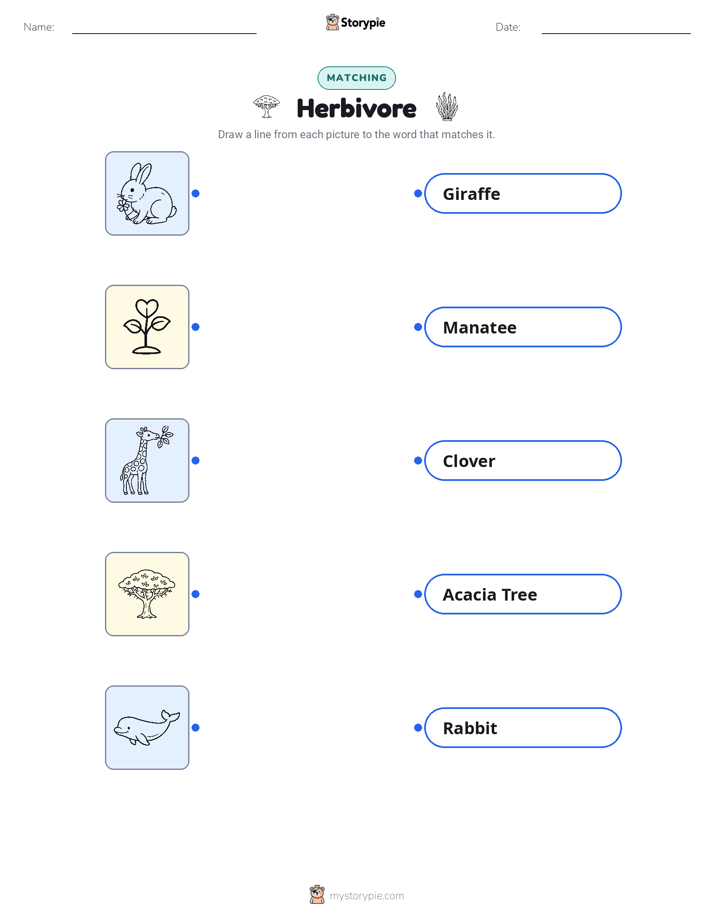
I want you to imagine the satisfying crunch of a fresh leaf, the sweet burst of a berry, or the tough, chewy bark of a tree. That’s me! I am the power that helps a cow chew its grassy breakfast and a giraffe reach for the highest leaves. I don't give animals sharp claws or pointy teeth for hunting. Instead, for many of my followers like horses and cattle, I provide wide, flat teeth perfect for grinding up plants, and special digestive systems with tiny microbe helpers to break down tough fibers. For millions of years, animals have relied on me to get their energy directly from plants, algae, and other amazing organisms that make their own food from sunlight. You can see me in the rabbit nibbling clover in your yard, the elephant tearing branches from a tree, and the caterpillar munching on a milkweed leaf. I am the way of life for all animals who eat mainly plants. Hello, I am Herbivore.
For as long as people have watched animals, they’ve known about me. Even ancient thinkers like the Greek philosopher Aristotle, who lived in the 4th century BCE, spent time observing animals and grouping them by what they ate. But I didn't get my official name until much later. My name comes from two Latin words: 'herba,' which means 'plant,' and 'vorare,' which means 'to devour.' In 1830, a famous geologist named Charles Lyell used the Latin version of my name, 'herbivora,' in his book 'Principles of Geology.' Then, in 1854, a scientist named Richard Owen used the English word you know today—'herbivore'—while writing about fossilized teeth and skeletons. Scientists studying fossils learned that the shape of an animal's teeth could show if it was a plant-eater! Fossils are how we know my story goes back so, so far. Scientists have found evidence that my earliest followers, the arthropods, started consuming plants less than 20 million years after the first land plants evolved. There is also evidence from the early Devonian period—that's over 400 million years ago!—of insects feeding on the spores of plants. My first big, four-limbed followers, called tetrapods, showed up in the Late Carboniferous period, about 300 million years ago. And of course, you know some of my most famous followers: the dinosaurs! The entire group of dinosaurs called Ornithischia were all herbivores, from the mighty Triceratops to the armored Stegosaurus. It took a long time for animals to develop the right tools to live my lifestyle, but it was worth it.
A World of Green Goodness: The Story of a Herbivore
I want you to imagine the satisfying crunch of a fresh leaf, the sweet burst of a berry, or the tough, chewy bark of a tree. That’s me! I am the power that helps a cow chew its grassy breakfast and a giraffe reach for the highest leaves. I don't give animals sharp claws or pointy teeth for hunting. Instead, for many of my followers like horses and cattle, I provide wide, flat teeth perfect for grinding up plants, and special digestive systems with tiny microbe helpers to break down tough fibers. For millions of years, animals have relied on me to get their energy directly from plants, algae, and other amazing organisms that make their own food from sunlight. You can see me in the rabbit nibbling clover in your yard, the elephant tearing branches from a tree, and the caterpillar munching on a milkweed leaf. I am the way of life for all animals who eat mainly plants. Hello, I am Herbivore.
For as long as people have watched animals, they’ve known about me. Even ancient thinkers like the Greek philosopher Aristotle, who lived in the 4th century BCE, spent time observing animals and grouping them by what they ate. But I didn't get my official name until much later. My name comes from two Latin words: 'herba,' which means 'plant,' and 'vorare,' which means 'to devour.' In 1830, a famous geologist named Charles Lyell used the Latin version of my name, 'herbivora,' in his book 'Principles of Geology.' Then, in 1854, a scientist named Richard Owen used the English word you know today—'herbivore'—while writing about fossilized teeth and skeletons. Scientists studying fossils learned that the shape of an animal's teeth could show if it was a plant-eater! Fossils are how we know my story goes back so, so far. Scientists have found evidence that my earliest followers, the arthropods, started consuming plants less than 20 million years after the first land plants evolved. There is also evidence from the early Devonian period—that's over 400 million years ago!—of insects feeding on the spores of plants. My first big, four-limbed followers, called tetrapods, showed up in the Late Carboniferous period, about 300 million years ago. And of course, you know some of my most famous followers: the dinosaurs! The entire group of dinosaurs called Ornithischia were all herbivores, from the mighty Triceratops to the armored Stegosaurus. It took a long time for animals to develop the right tools to live my lifestyle, but it was worth it.
Being a herbivore isn’t just about eating yummy plants; it’s one of the most important jobs in the world! I am a crucial link in what scientists call the food chain. Plants get their energy from the sun, and I help animals get that energy by eating the plants. We are the 'primary consumers.' Then, other animals might eat us to get that same energy. This flow of energy connects everyone. My relationship with plants is like a fascinating dance. Plants develop defenses like thorns or yucky-tasting leaves to protect themselves. In response, my herbivores find clever ways to get past those defenses. This back-and-forth has helped create the amazing variety of plants and animals you see today. I help shape entire landscapes, from bison herds creating meadows for wildflowers to grow, to beavers building dams that create new ponds. So next time you see a bee on a flower or a squirrel burying a nut, remember me. I am a reminder that every living thing is connected, all part of a big, beautiful, and delicious web of life.
Wow facts
About
A herbivore is an animal anatomically and physiologically adapted to eating plant material, such as foliage, fruits, or seeds, as the main component of its diet.
Take a Quiz
Question 1 of 5
In the story, the word 'devour' comes from the Latin word 'vorare.' What does 'devour' mean?
Explore next





Want to do even more?
Go beyond exploring. Unlock tools that turn every story into real learning.

Storypie Plus for families
Full stories, quizzes, and printables. Nights and car rides, sorted.
- Unlimited audio stories
- Create Mode: your child stars in the story
- Offline downloads
- Printable worksheets & coloring pages

Why Storypie for Schools
Students engaged. Prep in seconds. Evenings back to you.
- Worksheets & Quizzes
- Classroom Management
- Formative Assessment
- Custom Curriculum & Lesson Plans
- 27 Languages

Why Storypie for Homeschool
Curriculum done. They'll ask for more. Hours back in your day.
- Worksheet Generator
- First-Person Audio Stories
- Built-in Comprehension Quizzes
- Custom Curriculum & Lesson Plans
- Print & Go Activities