English

Hexagon
A hexagon is a six-sided polygon, a fundamental shape in geometry celebrated for its efficiency and strength.
Reads at Grades 6–8 Listens at Grades 4–8
Print & create
Answer keys·No prep·Free with an account
28 worksheets · answer keys · full story · quiz · Ages 10-12 · CEFR B2
Plus adds 244,000+ more stories in 27 languages, audio for every one, and printables for all of them.
Just want Hexagon?

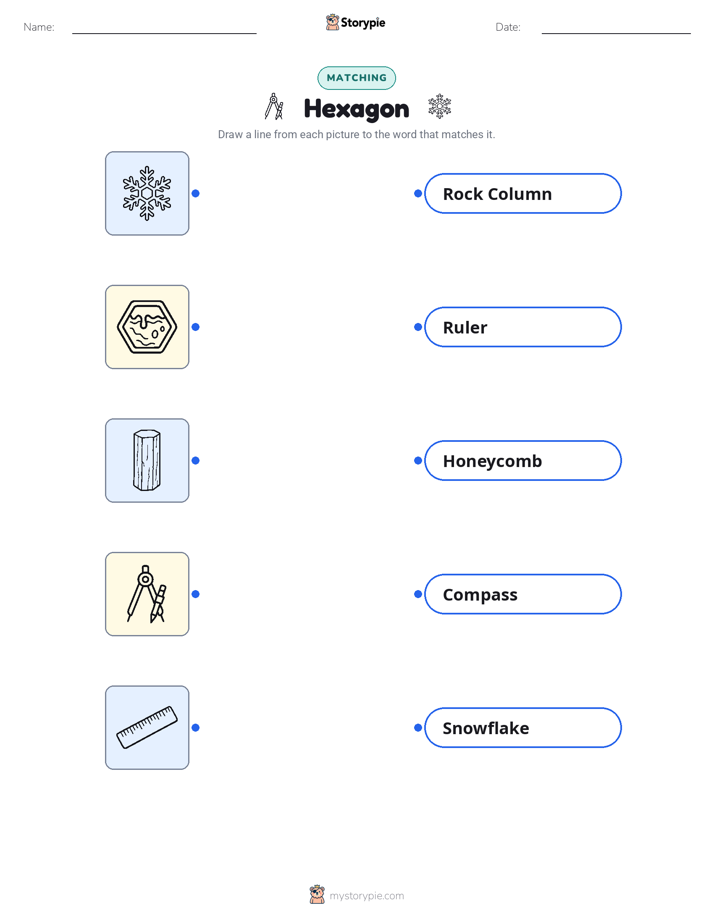
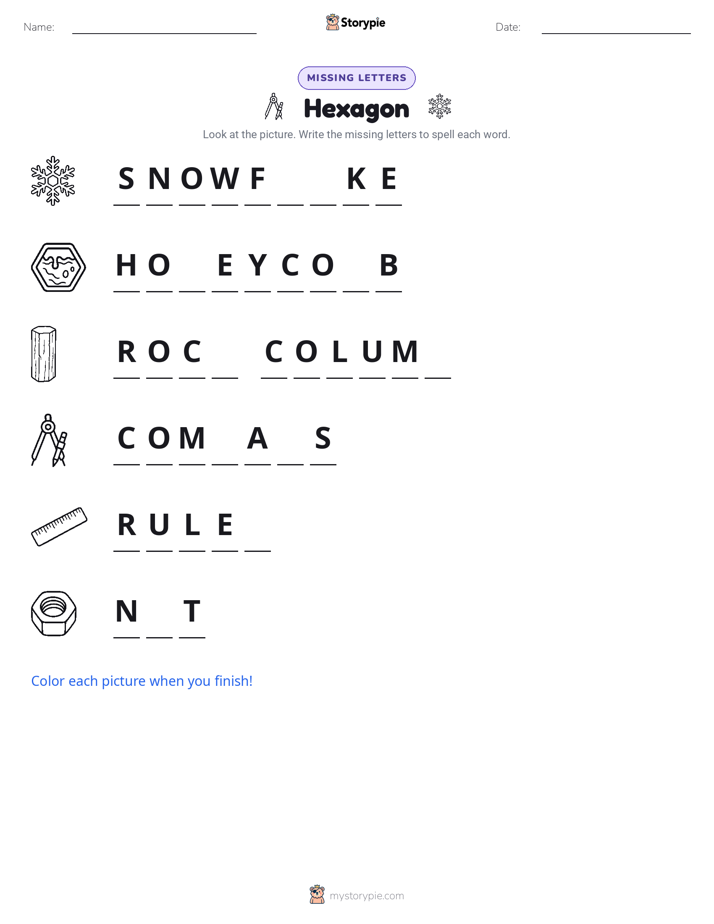
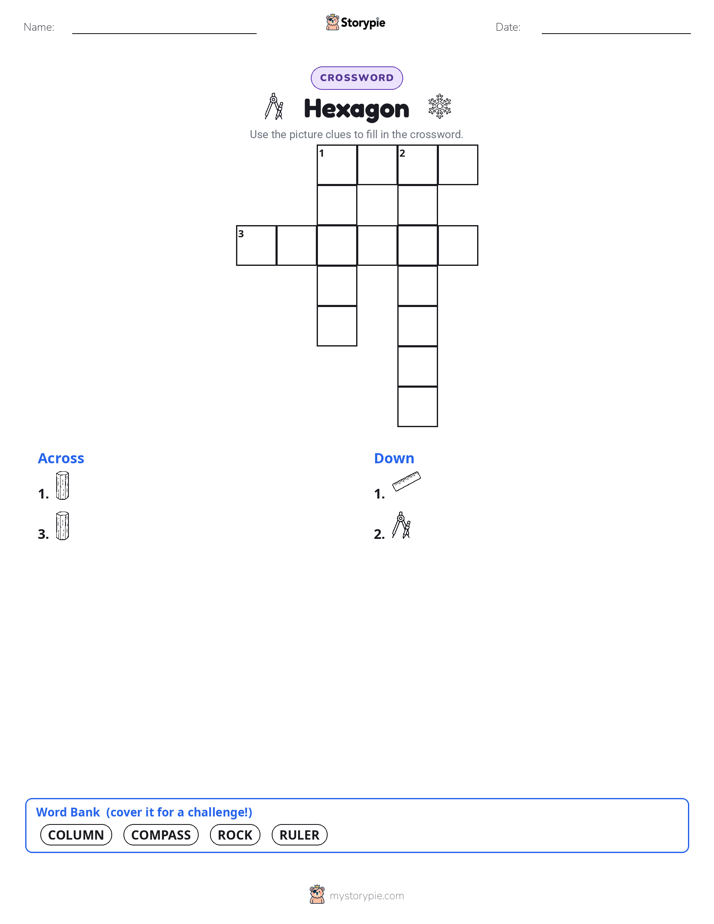
You have seen me your entire life, even if you never stopped to think about my name. I am there in the deep of winter, a delicate, six-pointed crystal of ice that lands silently on your mitten—a single, perfect snowflake. I am the sturdy, repeating chamber in a beehive, a waxy pantry built with perfect precision to hold golden honey. I am ancient and powerful. You can find me in the towering, six-sided columns of rock at the Giant's Causeway in Northern Ireland, a strange and beautiful landscape formed by cooling lava millions of years ago. I am a pattern of nature, a secret code for strength and efficiency. Before mathematicians drew me with a compass and ruler, bees and volcanoes and ice crystals already understood my power. They knew that my six straight sides and six identical angles created a form that was both strong and perfectly balanced. I am a shape that fits, a design that works, and a pattern that connects the smallest crystal to the largest structures. I am the Hexagon.
For thousands of years, people saw me in the world and marveled. They watched bees build their intricate homes and wondered how they knew to use my shape. Why not squares or circles? This question lingered in the minds of the curious, a puzzle waiting to be solved. It took a long time to unravel the mathematics behind my magic. Then, around the 4th century CE, a brilliant Greek mathematician named Pappus of Alexandria turned his attention to the bees' work. He was fascinated by their skill and wanted to understand it with numbers and logic. He wrote about what is now called the 'Honeycomb Conjecture,' a deep investigation into my properties. Pappus was the first to mathematically prove what the bees knew instinctively: if you want to divide a surface into sections of the exact same size, I am the shape that uses the least amount of material to create the walls. I enclose the most space with the shortest perimeter. This discovery was revolutionary. It showed that I wasn't just a pretty pattern; I was the most efficient way to tile a plane. This idea of tessellation—fitting together with no gaps—inspired humans to use me in their own designs, from intricate floor tiles in Roman villas to the strategic layouts of strong forts where every wall supported another.
The Hexagon's Secret
You have seen me your entire life, even if you never stopped to think about my name. I am there in the deep of winter, a delicate, six-pointed crystal of ice that lands silently on your mitten—a single, perfect snowflake. I am the sturdy, repeating chamber in a beehive, a waxy pantry built with perfect precision to hold golden honey. I am ancient and powerful. You can find me in the towering, six-sided columns of rock at the Giant's Causeway in Northern Ireland, a strange and beautiful landscape formed by cooling lava millions of years ago. I am a pattern of nature, a secret code for strength and efficiency. Before mathematicians drew me with a compass and ruler, bees and volcanoes and ice crystals already understood my power. They knew that my six straight sides and six identical angles created a form that was both strong and perfectly balanced. I am a shape that fits, a design that works, and a pattern that connects the smallest crystal to the largest structures. I am the Hexagon.
For thousands of years, people saw me in the world and marveled. They watched bees build their intricate homes and wondered how they knew to use my shape. Why not squares or circles? This question lingered in the minds of the curious, a puzzle waiting to be solved. It took a long time to unravel the mathematics behind my magic. Then, around the 4th century CE, a brilliant Greek mathematician named Pappus of Alexandria turned his attention to the bees' work. He was fascinated by their skill and wanted to understand it with numbers and logic. He wrote about what is now called the 'Honeycomb Conjecture,' a deep investigation into my properties. Pappus was the first to mathematically prove what the bees knew instinctively: if you want to divide a surface into sections of the exact same size, I am the shape that uses the least amount of material to create the walls. I enclose the most space with the shortest perimeter. This discovery was revolutionary. It showed that I wasn't just a pretty pattern; I was the most efficient way to tile a plane. This idea of tessellation—fitting together with no gaps—inspired humans to use me in their own designs, from intricate floor tiles in Roman villas to the strategic layouts of strong forts where every wall supported another.
That ancient wisdom is now at the heart of humanity's most advanced creations. My usefulness is everywhere, from the simple to the extraordinary. Look closely at a nut and bolt; my six sides make it easy for a wrench to get a firm, reliable grip from multiple angles. But my biggest jobs are helping you build the future and explore the cosmos. On December 25th, 2021, the James Webb Space Telescope was launched into the darkness of space. Its giant, golden primary mirror, designed to see the universe's first light, is not one solid piece. It is made of 18 of my individual hexagonal segments, all working together as one enormous eye. I was chosen for this critical mission because my shape allows a huge mirror to be folded compactly for launch and then unfolded flawlessly in space, fitting together without any gaps to create a perfect surface. Back on Earth, another revolution was happening. In 2004, scientists isolated a material called graphene for the first time. It is a single sheet of carbon atoms arranged in my honeycomb pattern, and it is two hundred times stronger than steel. From a bee's pantry to a telescope's eye to the strongest materials known to science, I am a shape of teamwork, strength, and intelligent design. I am a reminder that when things fit together perfectly, they can achieve what was once thought impossible.
Wow facts
About
A hexagon is a six-sided polygon, a fundamental shape in geometry celebrated for its efficiency and strength. It appears in nature from honeycombs to snowflakes and is used by humans in technology and design.
Take a Quiz
Question 1 of 5
What is the main idea of the story?
Explore next


Want to do even more?
Go beyond exploring. Unlock tools that turn every story into real learning.

Storypie Plus for families
Full stories, quizzes, and printables. Nights and car rides, sorted.
- Unlimited audio stories
- Create Mode: your child stars in the story
- Offline downloads
- Printable worksheets & coloring pages

Why Storypie for Schools
Students engaged. Prep in seconds. Evenings back to you.
- Worksheets & Quizzes
- Classroom Management
- Formative Assessment
- Custom Curriculum & Lesson Plans
- 27 Languages

Why Storypie for Homeschool
Curriculum done. They'll ask for more. Hours back in your day.
- Worksheet Generator
- First-Person Audio Stories
- Built-in Comprehension Quizzes
- Custom Curriculum & Lesson Plans
- Print & Go Activities