English

Hexagon
A hexagon is a six-sided polygon, a fundamental shape in geometry celebrated for its efficiency and strength.
Reads at Grades 3–5 Listens at Grades 1–5
Print & create
Answer keys·No prep·Free with an account
28 worksheets · answer keys · full story · quiz · Ages 8-10 · CEFR B1
Plus adds 244,000+ more stories in 27 languages, audio for every one, and printables for all of them.
Just want Hexagon?

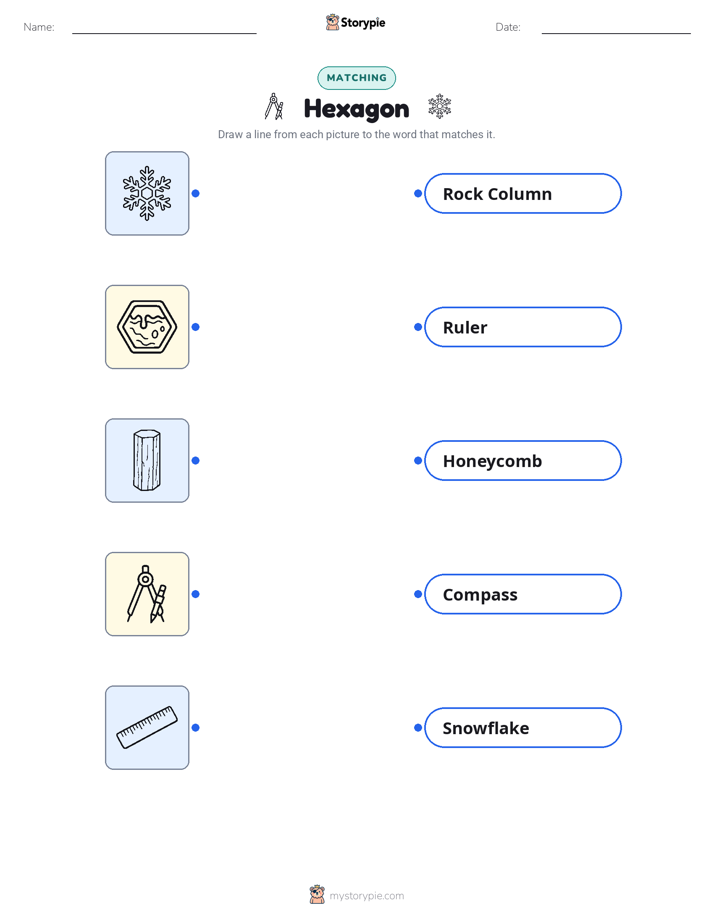
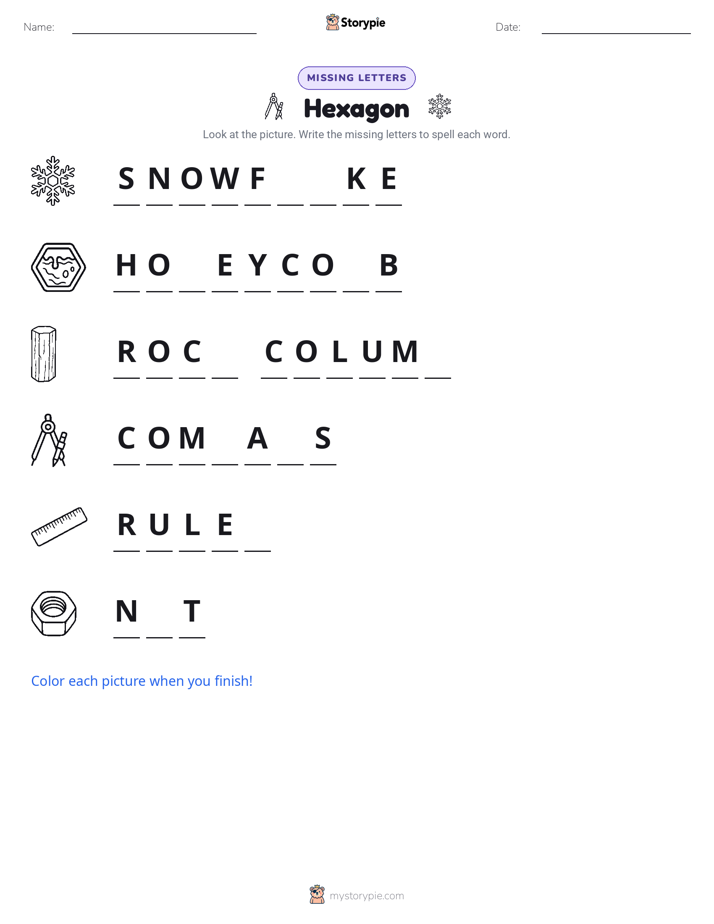
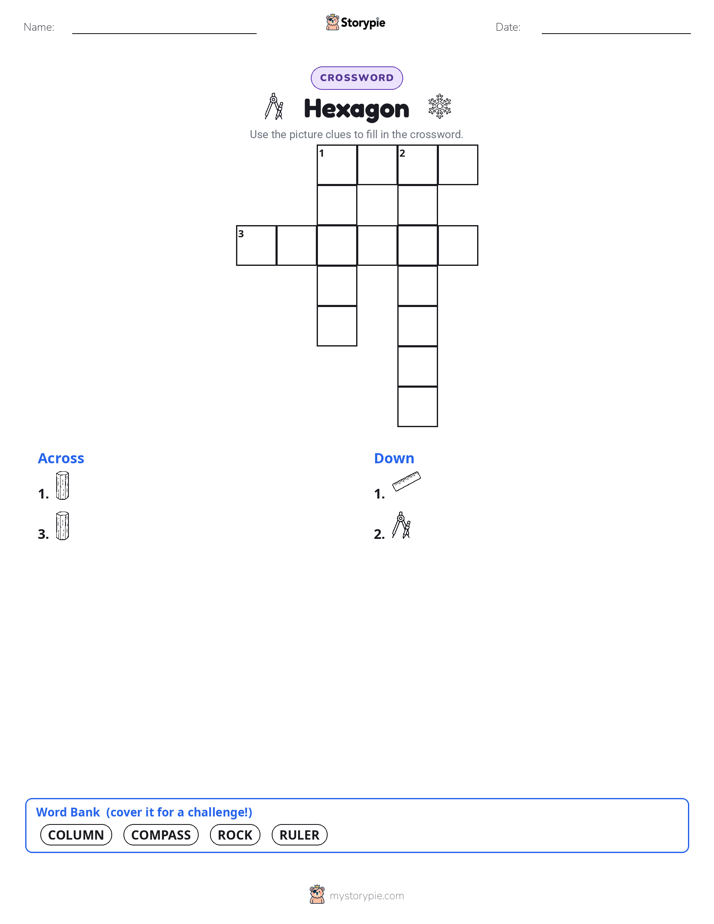
I am a shape with a secret. I have six straight sides and six pointy corners, all perfectly equal. My favorite thing to do is fit together with my brothers and sisters, side-by-side, creating a beautiful pattern with no gaps at all. Can you imagine a world without wasted space. That’s my specialty. You can find me in nature, where busy bees are my biggest fans. They build their cozy homes, called honeycombs, entirely out of me. My shape allows them to store every last drop of their golden, sticky honey without using too much precious wax. I help them be smart and save their energy. I also love to appear in the winter. When tiny water droplets freeze in the sky, they often form into beautiful, six-sided snowflakes. Each one is a unique work of art, but they all share my basic form. Sometimes, I show up in a much bigger, stronger way. When ancient volcanoes cooled down very slowly, they sometimes formed giant stone columns in my shape, creating incredible landscapes that look like they were carved by a giant. I am strong, I am efficient, and I love to connect everything together. Have you guessed who I am. I am the Hexagon.
For thousands of years, people saw me everywhere but didn't always stop to think about why I was so special. They knew I was useful. Early humans in places like ancient Mesopotamia and Egypt used me to create beautiful, strong tile patterns for their floors and walls because I fit together so perfectly, making their homes both sturdy and lovely to look at. But it was the great thinkers in ancient Rome and Greece who really started to study me and ask big questions. A Roman scholar named Marcus Terentius Varro, who was writing around the year 36 BCE, was completely fascinated by my role in honeycombs. He looked at the bees' work and wondered, why me. Why not a square or a triangle. He knew it was important, but he couldn't quite prove why. It was a puzzle that lasted for hundreds of years. Finally, around the year 320 CE, a brilliant Greek mathematician named Pappus of Alexandria cracked the code. He sat down with his tools and his amazing brain and proved with math that out of all the shapes that can fit together without gaps, I use the least amount of material to hold the most stuff. The bees had been master engineers all along, and I was their secret to success.
The Story of the Hexagon
I am a shape with a secret. I have six straight sides and six pointy corners, all perfectly equal. My favorite thing to do is fit together with my brothers and sisters, side-by-side, creating a beautiful pattern with no gaps at all. Can you imagine a world without wasted space. That’s my specialty. You can find me in nature, where busy bees are my biggest fans. They build their cozy homes, called honeycombs, entirely out of me. My shape allows them to store every last drop of their golden, sticky honey without using too much precious wax. I help them be smart and save their energy. I also love to appear in the winter. When tiny water droplets freeze in the sky, they often form into beautiful, six-sided snowflakes. Each one is a unique work of art, but they all share my basic form. Sometimes, I show up in a much bigger, stronger way. When ancient volcanoes cooled down very slowly, they sometimes formed giant stone columns in my shape, creating incredible landscapes that look like they were carved by a giant. I am strong, I am efficient, and I love to connect everything together. Have you guessed who I am. I am the Hexagon.
For thousands of years, people saw me everywhere but didn't always stop to think about why I was so special. They knew I was useful. Early humans in places like ancient Mesopotamia and Egypt used me to create beautiful, strong tile patterns for their floors and walls because I fit together so perfectly, making their homes both sturdy and lovely to look at. But it was the great thinkers in ancient Rome and Greece who really started to study me and ask big questions. A Roman scholar named Marcus Terentius Varro, who was writing around the year 36 BCE, was completely fascinated by my role in honeycombs. He looked at the bees' work and wondered, why me. Why not a square or a triangle. He knew it was important, but he couldn't quite prove why. It was a puzzle that lasted for hundreds of years. Finally, around the year 320 CE, a brilliant Greek mathematician named Pappus of Alexandria cracked the code. He sat down with his tools and his amazing brain and proved with math that out of all the shapes that can fit together without gaps, I use the least amount of material to hold the most stuff. The bees had been master engineers all along, and I was their secret to success.
Today, people have learned from the bees and use my super-smart design for all sorts of amazing things. If you look closely at a nut and bolt, you’ll often see me. My six sides make it easy for a wrench to get a good grip and turn without slipping. Some pencils are even shaped like me so they don't roll off your desk and get lost. But my biggest and most exciting job yet is helping scientists look back to the very beginning of time. The giant, golden mirror of the James Webb Space Telescope, which launched into space on December 25th, 2021, is made of 18 of my hexagonal shapes all fitted together perfectly. This allows the telescope to be big and powerful, yet light enough to fly. I am also the tiny building block for one of the strongest and thinnest materials ever discovered, called graphene. From a bee's cozy home to a powerful telescope exploring deep space, I show the world that working together and connecting perfectly makes everything stronger and better. Whenever you see me, remember the amazing power of connection and smart design.
Wow facts
About
A hexagon is a six-sided polygon, a fundamental shape in geometry celebrated for its efficiency and strength. It appears in nature from honeycombs to snowflakes and is used by humans in technology and design.
Take a Quiz
Question 1 of 5
According to the story, why did the mathematician Pappus of Alexandria think the hexagon was so special?
Explore next




Want to do even more?
Go beyond exploring. Unlock tools that turn every story into real learning.

Storypie Plus for families
Full stories, quizzes, and printables. Nights and car rides, sorted.
- Unlimited audio stories
- Create Mode: your child stars in the story
- Offline downloads
- Printable worksheets & coloring pages

Why Storypie for Schools
Students engaged. Prep in seconds. Evenings back to you.
- Worksheets & Quizzes
- Classroom Management
- Formative Assessment
- Custom Curriculum & Lesson Plans
- 27 Languages

Why Storypie for Homeschool
Curriculum done. They'll ask for more. Hours back in your day.
- Worksheet Generator
- First-Person Audio Stories
- Built-in Comprehension Quizzes
- Custom Curriculum & Lesson Plans
- Print & Go Activities