English


Igneous Rock
Igneous rocks are one of the three main rock types…
Reads at Grades 6–8 Listens at Grades 4–8
Print & create
Answer keys·No prep·Free with an account
28 worksheets · answer keys · full story · quiz · Ages 10-12 · CEFR B2
Plus adds 244,000+ more stories in 27 languages, audio for every one, and printables for all of them.
Just want Igneous Rock?

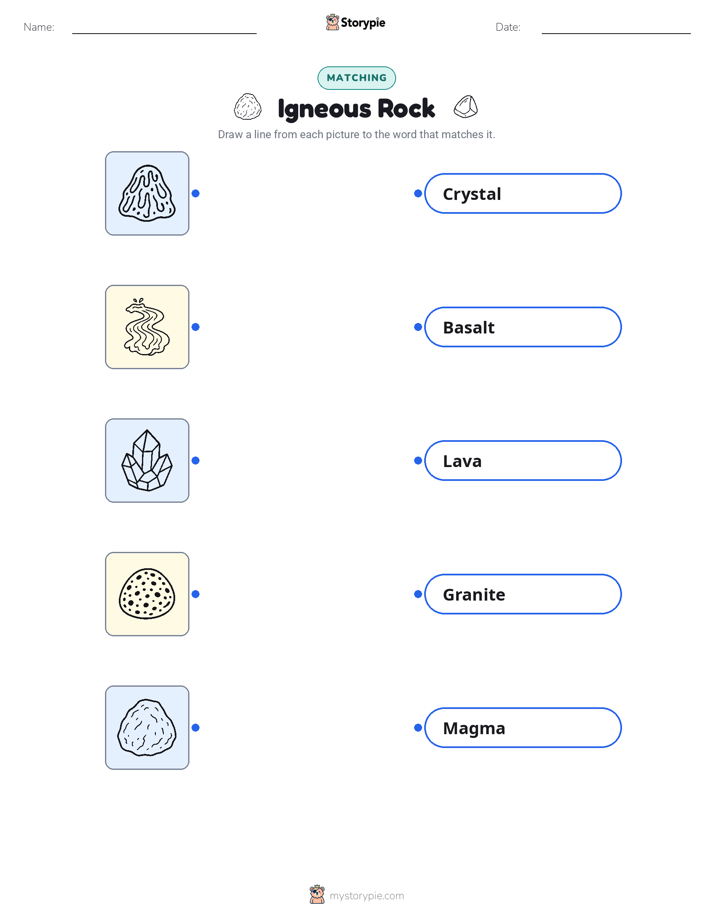
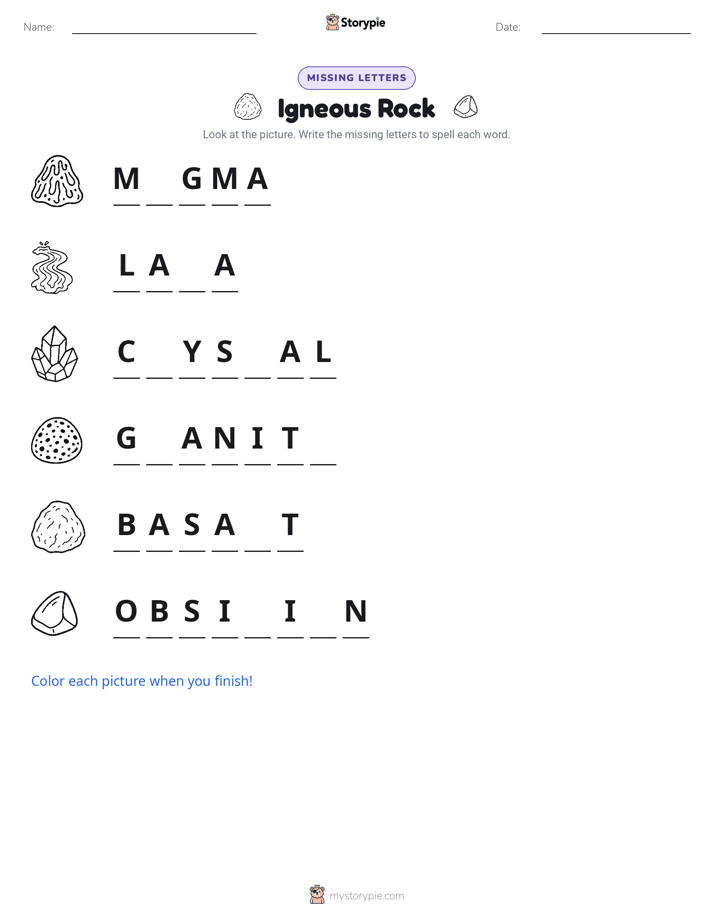
For millions of years, I knew only heat and pressure. I was liquid rock, a thick, glowing river churning deep beneath the surface of the Earth. Imagine being squeezed by the weight of entire continents, cooked by a heat so intense it could melt mountains. That was my world, a slow, patient existence in the planet’s fiery heart. From that deep place, I knew two destinies awaited me. One was a slow, deliberate journey upward, pushing into the cracks of the Earth's crust but never breaking through to the surface. Over thousands, even millions, of years, I would cool, so slowly that beautiful, large crystals of minerals like quartz and feldspar had time to grow within me, like glittering jewels locked in stone. The other path was one of sudden violence. I would be hurled from the throat of a volcano, a fiery fountain soaring into the sky. My journey would be a terrifying, thrilling flight, and my cooling would take mere moments as I tumbled through the air or spread across the land as a glowing river of lava. My crystals would be tiny, almost invisible, or I might cool so fast I formed a black, shiny glass. I am not just one thing, but a whole family of stone born from the planet's fiery heart. My name comes from the Latin word for fire, *ignis*. I am Igneous Rock.
My first encounters with humankind were practical ones. People didn't know my story, but they knew I was strong. They picked up my tough, dark form, basalt, and my speckled, durable form, granite, and saw their potential. Around 2580 BCE, the ancient Egyptians began quarrying my body to build their magnificent pyramids at Giza, monuments that would stand for millennia. Later, the Romans paved their famous, long-lasting roads with my sturdy stones, connecting their vast empire. For centuries, people used me, built with me, and walked upon me, but my origin remained a profound mystery. How could a stone so solid and heavy have come into being? In the late 18th century, this question sparked a great debate among scientists. One group, known as the Neptunists, was led by a respected German geologist named Abraham Gottlob Werner. He proposed that all rocks, including me, had precipitated from a vast, primeval ocean that once covered the entire globe. He imagined minerals settling out of the water in layers, creating every stone the world knew. But a Scottish doctor and farmer named James Hutton saw a different story. He was a keen observer of the land. In the cliffs and hills of his native Scotland, he saw veins of my dark basalt cutting through layers of other rocks. It looked to him as if I had been a hot liquid that forced my way in and then cooled. In 1788, he published his 'Theory of the Earth,' where he argued that I was not born of water, but of immense heat from within the planet. His idea, called the Plutonist theory after Pluto, the Roman god of the underworld, was revolutionary. It suggested the Earth was not a static, quiet place, but a dynamic, powerful one with a molten heart. This clash of ideas was the beginning of the modern science of geology, and I was the puzzle at its center.
The Rock Born of Fire
For millions of years, I knew only heat and pressure. I was liquid rock, a thick, glowing river churning deep beneath the surface of the Earth. Imagine being squeezed by the weight of entire continents, cooked by a heat so intense it could melt mountains. That was my world, a slow, patient existence in the planet’s fiery heart. From that deep place, I knew two destinies awaited me. One was a slow, deliberate journey upward, pushing into the cracks of the Earth's crust but never breaking through to the surface. Over thousands, even millions, of years, I would cool, so slowly that beautiful, large crystals of minerals like quartz and feldspar had time to grow within me, like glittering jewels locked in stone. The other path was one of sudden violence. I would be hurled from the throat of a volcano, a fiery fountain soaring into the sky. My journey would be a terrifying, thrilling flight, and my cooling would take mere moments as I tumbled through the air or spread across the land as a glowing river of lava. My crystals would be tiny, almost invisible, or I might cool so fast I formed a black, shiny glass. I am not just one thing, but a whole family of stone born from the planet's fiery heart. My name comes from the Latin word for fire, ignis. I am Igneous Rock.
My first encounters with humankind were practical ones. People didn't know my story, but they knew I was strong. They picked up my tough, dark form, basalt, and my speckled, durable form, granite, and saw their potential. Around 2580 BCE, the ancient Egyptians began quarrying my body to build their magnificent pyramids at Giza, monuments that would stand for millennia. Later, the Romans paved their famous, long-lasting roads with my sturdy stones, connecting their vast empire. For centuries, people used me, built with me, and walked upon me, but my origin remained a profound mystery. How could a stone so solid and heavy have come into being? In the late 18th century, this question sparked a great debate among scientists. One group, known as the Neptunists, was led by a respected German geologist named Abraham Gottlob Werner. He proposed that all rocks, including me, had precipitated from a vast, primeval ocean that once covered the entire globe. He imagined minerals settling out of the water in layers, creating every stone the world knew. But a Scottish doctor and farmer named James Hutton saw a different story. He was a keen observer of the land. In the cliffs and hills of his native Scotland, he saw veins of my dark basalt cutting through layers of other rocks. It looked to him as if I had been a hot liquid that forced my way in and then cooled. In 1788, he published his 'Theory of the Earth,' where he argued that I was not born of water, but of immense heat from within the planet. His idea, called the Plutonist theory after Pluto, the Roman god of the underworld, was revolutionary. It suggested the Earth was not a static, quiet place, but a dynamic, powerful one with a molten heart. This clash of ideas was the beginning of the modern science of geology, and I was the puzzle at its center.
James Hutton had correctly guessed my fiery origins, but the precise details of my birth were still unknown. The next chapter of my story was uncovered in the 1920s by a Canadian-American scientist named Norman L. Bowen. He did something extraordinary: he essentially built tiny volcanoes in his laboratory. He melted different kinds of rock powders in a furnace and then let them cool with painstaking slowness, observing them under a microscope. He discovered the exact 'recipe' for my creation, documenting the specific order and temperatures at which different minerals crystallize from magma. The result was a guide that geologists call Bowen's Reaction Series, and they still use it today to understand my family tree. This understanding revealed how I become so many different things. I am the beautiful, speckled granite of kitchen countertops, formed from magma that cooled slowly underground. I am the dark, dense basalt that paves the entire ocean floor, born from lava that flowed and cooled quickly. I am the sharp, glassy obsidian that ancient peoples chipped into razor-sharp tools, and the light, hole-filled pumice that can float on water, created from a frothy, gas-filled eruption. I am a direct link to the incredible power churning inside our planet. When you see me, you are seeing the Earth's inner fire brought to the surface and frozen in time. My story is one of transformation, proof that from intense heat and crushing pressure, something strong, useful, and beautiful can be created. I am a history of the Earth written in stone, reminding you of the dynamic, ever-changing planet you call home.
Wow facts
About
Igneous rocks are one of the three main rock types, formed through the cooling and solidification of magma or lava. Their name derives from the Latin word 'ignis,' meaning fire.
Take a Quiz
Question 1 of 5
What was the main reason James Hutton disagreed with the Neptunist theory?
Explore next





Want to do even more?
Go beyond exploring. Unlock tools that turn every story into real learning.

Storypie Plus for families
Full stories, quizzes, and printables. Nights and car rides, sorted.
- Unlimited audio stories
- Create Mode: your child stars in the story
- Offline downloads
- Printable worksheets & coloring pages

Why Storypie for Schools
Students engaged. Prep in seconds. Evenings back to you.
- Worksheets & Quizzes
- Classroom Management
- Formative Assessment
- Custom Curriculum & Lesson Plans
- 27 Languages

Why Storypie for Homeschool
Curriculum done. They'll ask for more. Hours back in your day.
- Worksheet Generator
- First-Person Audio Stories
- Built-in Comprehension Quizzes
- Custom Curriculum & Lesson Plans
- Print & Go Activities